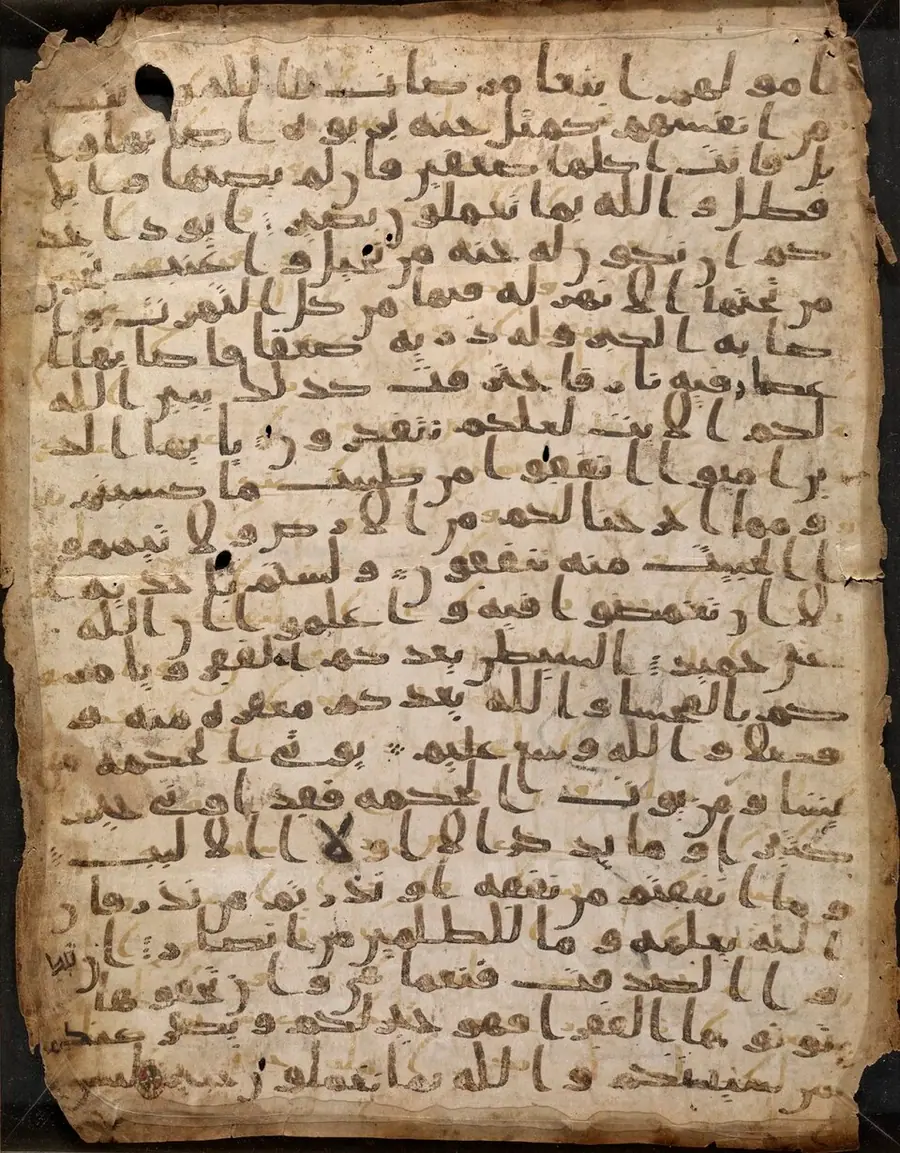
The short version: the oldest leaves of the Qur’an are seventh-century, from within a few decades of Muhammad’s death in 632, but none is a complete book and none carries a written date. They are dated by testing their parchment, and the results cluster in the first half-century of Islam.[1][2][3] Consensus on the measurements. How the Qur’an came to be written down in the first place, from recitation to standard book, is told in the chapter on the Qur’an; this page is about the physical copies and what their dates can and cannot tell.
The candidates
Birmingham. In 2015 the University of Birmingham announced that two parchment leaves in its Mingana Collection, Mingana 1572a, written in the early ḥijāzī script and containing parts of suras 18 to 20, had been dated by the Oxford Radiocarbon Accelerator Unit to between 568 and 645 at 95.4% probability. The researcher Alba Fedeli recognised that they belong to the same codex as sixteen leaves in Paris, BnF Arabe 328c.[1] Consensus on the measurement. The result was widely reported as “the oldest Qur’an in the world”.
Ṣanʿāʾ. In 1972 workers repairing the roof of the Great Mosque of Ṣanʿāʾ in Yemen found thousands of fragments of discarded Qur’an manuscripts. One codex, known as Ṣanʿāʾ 1, is a palimpsest: its parchment was scraped and rewritten. A leaf of it that had been sold at auction was radiocarbon-dated to 578–669 at 95% probability, with a 75% probability of a date before 646.[4][2] Consensus
Berlin and Tübingen. The German–French project Coranica dated further fragments to the seventh century, including Berlin’s ms. or. fol. 4313 to 606–652, and checked the method against Arabic papyri and Syriac manuscripts of known date, which it dated correctly.[5] In 2014 the University of Tübingen announced that its fragment Ma VI 165 had been dated by the ETH Zürich to 649–675.[3] Majority
Paris and St Petersburg. The largest early copy, the Codex Parisino-petropolitanus, has not been radiocarbon-dated. Its 118 surviving leaves preserve about 45% of the text and were written by five scribes; François Déroche dated it, from its script and spelling, to the third quarter of the seventh century.[6][7] Majority
How early copies are recognised
Before radiocarbon, early Qur’an fragments were dated by the style of their script, a method with wide margins of error. The earliest copies share three features: they are written in a slanting script called ḥijāzī or in early kufic; they mark few or none of the dots that distinguish Arabic letters of the same shape, and no short vowels; and they divide verses with clusters of strokes rather than numbers.[8][7] Consensus Many of these fragments were scattered among libraries in Europe, Russia and the Middle East, which is why a single early codex can now be split between Paris, St Petersburg, the Vatican and London. The project Corpus Coranicum of the Berlin-Brandenburg Academy of Sciences has been photographing and transcribing the early manuscripts since 2007 (How We Know).[8]
What radiocarbon dates measure
Radiocarbon tests the death of the animal whose skin became the parchment. It does not date the ink. Parchment could be stored for some years before use, and the statistical ranges are wide: a result of 568–645 means the animal most likely died somewhere in those 77 years, not that the leaf was written in 568. The Birmingham range even begins before Muhammad’s prophecy, which says nothing about which decade within it the leaf was written (How We Know).[1] Consensus
Specialists also disagree about how much precision the method can give. Déroche has cautioned that radiocarbon results for some Umayyad manuscripts come out earlier than their script and decoration allow.[8] Stephen Shoemaker argues that radiocarbon results for early manuscripts have varied too widely between tests and laboratories to settle a question of a few decades.[9] The Coranica team found the method reliable against documents of known date.[5] Contested on precision. The careful conclusion is the cumulative one: several independent leaves, from different manuscripts and tested in different laboratories, fall in the first half-century of Islam. Consensus
Is the oldest Qur’an the same as today’s?
Almost entirely, in its consonants. The earliest copies record the consonantal skeleton (rasm), with few of the dots that tell similar letters apart and no short vowels; the reader supplied them from memory and teaching (the Qur’an).[7] Consensus Within those limits, the Birmingham leaves and the other early copies agree with the standard text, apart from spellings that later copyists modernised.[1][5] Majority
They also share arbitrary spelling quirks. Marijn van Putten showed in 2019 that the phrase “the grace of God”, niʿmat Allāh, is spelled in two different ways in different places, and that the early manuscripts agree on which spelling goes where. Copies made independently, or written down from memory, would not reproduce such choices; copies of a single written exemplar would.[10] Majority That is the main reason most scholars date the standard text to the caliph ʿUthmān (r. 644–656), as the Muslim tradition does.[11] Majority
The one known exception is the lower text of the Ṣanʿāʾ palimpsest. It agrees with the standard text in most of its words but differs in many small ways, and orders some suras differently. Behnam Sadeghi and Mohsen Goudarzi read it as a companion’s codex independent of ʿUthmān’s; Éléonore Cellard as a professionally produced codex of a non-ʿUthmānic text; Asma Hilali as a teaching exercise.[12][13][14] Contested on what it was. What is not disputed is that someone in the seventh century copied a version that differed from ʿUthmān’s, and someone later erased it and wrote the standard text over it. Consensus
What about ʿUthmān’s own copies?
Two famous manuscripts are shown as copies made for ʿUthmān: the Samarkand Qur’an in Tashkent, said to be stained with his blood, and a codex in the Topkapı Palace in Istanbul. Palaeography, and radiocarbon for the Samarkand copy, date both to the eighth or ninth century. They are early and important, but they are not his.[15] Majority None of the copies the tradition says he sent to the provinces is known to survive. Majority
Common misconceptions
- “The Birmingham Qur’an is older than Muhammad.” The range begins before his prophecy because it dates the animal’s death, with a statistical margin; it does not mean the text was written before him.[1] Consensus
- “The oldest Qur’an proves the text was never changed.” The early copies show a stable consonantal text, but vowels and dots were added over the following centuries, and the Ṣanʿāʾ lower text shows that a different version also circulated.[10][12] Majority
- “The oldest copies prove the Qur’an was written centuries after Muhammad.” The opposite: the radiocarbon dates have made the theory that the text was fixed only around 800 untenable (How We Know).[16][17] Majority
- “There is a complete Qur’an from Muhammad’s time.” No manuscript can be shown to come from his lifetime, and no seventh-century copy is complete. Consensus
Why it matters
For Muslims, early copies agree with the belief that the text was preserved from the start; for others, they show only that the text is early. Both readings are compatible with the evidence. What historians can say is that the Qur’an was a written text within a few decades of Muhammad, whatever its origin, and that whether it is revealed is outside what radiocarbon, or any historical method, can test (How We Know). Majority
References
- ^ a b c d e Birmingham Qur'an manuscript (Cadbury Research Library, Mingana Islamic Arabic 1572a) — Two parchment leaves of the Qur'an, suras 18–20. parchment radiocarbon 568–645 CE. Arabic. Two ḥijāzī-script leaves radiocarbon dated by the Oxford Radiocarbon Accelerator Unit to 568–645 CE (95.4%); part of the same codex as Paris BnF Arabe 328(c). about
- ^ a b Behnam Sadeghi and Uwe Bergmann The Codex of a Companion of the Prophet and the Qurʾān of the Prophet. Arabica 57, 2010. Radiocarbon date and analysis of a leaf of the Ṣanʿāʾ palimpsest.
- ^ a b Tübingen University Library, Ma VI 165 — Kufic Qur'an fragment. parchment radiocarbon 649–675 CE. Arabic. Fragment acquired from the Wetzstein collection in 1864, radiocarbon dated in Zürich to 649–675 CE (above 95%), announced 2014. about
- ^ Ṣanʿāʾ 1 palimpsest (Dār al-Makhṭūṭāt, DAM 01-27.1) — Qur'an palimpsest from the Great Mosque of Ṣanʿāʾ. 7th c. CE (lower text). Arabic. Found in 1972; the erased lower text is a non-ʿUthmānic Qur'an with variant wording and sura order, overwritten with the standard text. about
- ^ a b c Michael Josef Marx and Tobias J. Jocham Radiocarbon (14C) Dating of Qurʾān Manuscripts. in A. Kaplony and M. Marx, eds., Qurʾān Quotations Preserved on Papyrus Documents, 7th–10th Centuries (Brill), 2019. Coranica dates for Tübingen, Berlin and Leiden fragments, tested against documents of known date.
- ^ Paris, BnF Arabe 328a–b; St Petersburg, NLR Marcel 18; Vatican, Vat. Ar. 1605/1; Khalili KFQ 60 — Codex Parisino-petropolitanus. c. 650–700 CE (palaeography). Arabic (ḥijāzī script). 118 surviving leaves, about 45% of the text, copied by five scribes; dated by Déroche to the third quarter of the seventh century. about
- ^ a b c François Déroche La transmission écrite du Coran dans les débuts de l'islam: le codex Parisino-petropolitanus. Brill, 2009. The largest early Qur'an codex, studied leaf by leaf.
- ^ a b c François Déroche Qur'ans of the Umayyads: A First Overview. Brill, 2014. The early manuscripts and how they are dated.
- ^ Stephen J. Shoemaker Creating the Qur'an: A Historical-Critical Study. University of California Press, 2022. Argues the canonical text was produced around 700, under ʿAbd al-Malik, and questions radiocarbon precision.
- ^ a b Marijn van Putten 'The Grace of God' as Evidence for a Written Uthmanic Archetype: The Importance of Shared Orthographic Idiosyncrasies. Bulletin of the School of Oriental and African Studies 82, 2019. Shared spelling quirks show the early manuscripts descend from one written copy.
- ^ Nicolai Sinai When Did the Consonantal Skeleton of the Quran Reach Closure? Parts I and II. Bulletin of the School of Oriental and African Studies 77, 2014. Weighs the evidence for later editing, including al-Ḥajjāj; concludes the standard rasm dates to 650 or earlier as the default view.
- ^ a b Behnam Sadeghi and Mohsen Goudarzi Ṣanʿāʾ 1 and the Origins of the Qurʾān. Der Islam 87, 2012. Transcription of the lower text and the case that it is a non-ʿUthmānic companion codex.
- ^ Éléonore Cellard The Ṣanʿāʾ Palimpsest: Materializing the Codices. Journal of Near Eastern Studies 80, 2021. Reconstructs the lower text's leaves as a complete codex by professional scribes.
- ^ Asma Hilali The Sanaa Palimpsest: The Transmission of the Qur'an in the First Centuries AH. Oxford University Press, 2017. Edition of both layers, reading the lower text as a teaching copy.
- ^ Tashkent, Muslim Board of Uzbekistan: the Samarkand Kufic Qur'an — Samarkand Kufic Qur'an. 8th–9th c. CE. Arabic (Kufic script). Venerated as ʿUthmān's own copy; palaeography and radiocarbon place it in the eighth or ninth century. about
- ^ John Wansbrough Quranic Studies: Sources and Methods of Scriptural Interpretation. Oxford University Press, 1977. The form-critical case for a late, composite canon.
- ^ Nicolai Sinai The Qur'an: A Historical-Critical Introduction. Edinburgh University Press, 2017. The Qur'an as a historical text, from the current mainstream.