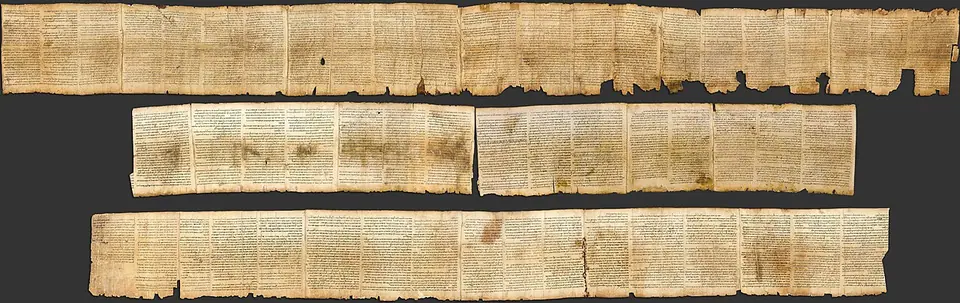
The Hebrew Bible tells the history of Israel from the creation of the world to the return from Babylon, and for most of the last two thousand years it was read as the record of that history. Since the eighteenth century it has also been read as evidence: a set of documents written by particular people at particular times, which can be dated, compared with one another, and tested against inscriptions and excavations from the same lands. Every later page of this series depends on that second kind of reading. This one explains how it works and where it stops.
The short answer: the Bible’s own text shows seams that let scholars separate its layers; inscriptions on stone, pottery and silver give fixed dates and show what Israelites actually wrote; archaeology shows how they lived; and manuscripts from the Dead Sea Scrolls to the Cairo Geniza show how the text itself was copied and changed. No single method is decisive. Where they agree, this series says so; where they do not, it says that too.
The problem: a library, not a book
The Hebrew Bible is a collection of writings composed, revised and gathered over roughly six centuries, from about the eighth century BCE to the second. It names few of its authors, and the ones it does name are traditional attributions added later.[1]
Jewish tradition calls it the Tanakh, an acronym of its three parts: Torah (Teaching, the five books from Genesis to Deuteronomy), Nevi’im (Prophets, which includes the histories from Joshua to Kings) and Ketuvim (Writings, from Psalms to Chronicles). The Jewish count is twenty-four books; Christian Old Testaments contain the same Hebrew books in a different order and count them as thirty-nine, and Catholic and Orthodox Bibles add books preserved in Greek.[1] Consensus
Three things make the collection hard to date:
- Almost nothing is signed. The Torah does not claim Moses as its author; it speaks of him in the third person and even narrates his death and burial “unto this day” (Deut 34:5–6).[2] The attribution of the whole Torah to Moses comes from later tradition, most explicitly in the Babylonian Talmud’s list of who wrote each book;[3] the headings that assign psalms to David and proverbs to Solomon were added by the books’ editors.
- The texts were revised for centuries. Ancient scribes did not treat a text as fixed. They updated, combined and expanded it, and copied the result as the same book. David Carr and Karel van der Toorn have shown how scribal schools in Israel, like those of Mesopotamia and Egypt, learned texts by heart and reworked them as they copied.[4][5] Majority
- The earliest copies are late. The oldest manuscripts of most biblical books are among the Dead Sea Scrolls, centuries after the books were composed. Everything earlier has to be reconstructed.[6]
Writing itself is not the obstacle. Alphabetic Hebrew inscriptions are well attested from the ninth century BCE onward, and become common in Judah in the eighth and seventh centuries, the period when most scholars think the first substantial biblical books were written down.[7][8] Majority The question is not whether ancient Israelites could write books, but which books they wrote when.
Reading the text against itself: source criticism
The oldest tool is close reading. The Torah contains doublets, contradictions and changes of vocabulary that are hard to explain as the work of one author and easy to explain as the joining of several. Separating those strands is called source criticism.
Some of the classic observations:
- Two creation stories. Genesis 1:1–2:4a creates plants, animals and finally man and woman together, in six days, by a god called Elohim. Genesis 2:4b–25 creates a man first, then plants, animals and finally a woman from his side, by a god called YHWH Elohim, with a different vocabulary and style.[9][10]
- Doubled stories. Abraham passes off his wife as his sister twice (Gen 12 and 20), and Isaac does it once more (Gen 26). Two accounts of the flood are interwoven in Genesis 6–9: in one, Noah takes seven pairs of the clean animals and the rain lasts 40 days; in the other, a pair of every animal, and the waters prevail for 150 days.[10][11]
- The revelation of the name. In Exodus 6:2–3 God tells Moses: “I appeared to Abraham, Isaac and Jacob as El Shaddai, but by my name YHWH I did not make myself known to them.” Yet in Genesis the patriarchs use the name YHWH freely (Gen 15:7, 28:13).[12] One strand of the Torah held that the name was revealed only to Moses; another did not.
These observations are old. The twelfth-century commentator Abraham ibn Ezra hinted in a cryptic note that some verses of the Torah had been added after Moses.[13] Baruch Spinoza argued openly in 1670 that Moses could not have written the Pentateuch.[14] Jean Astruc, a French physician, noticed in 1753 that Genesis alternated between the names Elohim and YHWH and proposed that Moses had combined older documents.[15] In 1805 W. M. L. de Wette argued that the “book of the law” found in the Temple in the reign of King Josiah, in 622 BCE (2 Kings 22:8), was an early form of Deuteronomy, written not long before it was found.[16][17] That gave the field its first fixed point. Consensus on the history; Majority on de Wette’s dating, which still anchors the field (§3).
The Documentary Hypothesis
Julius Wellhausen’s Geschichte Israels (1878), retitled Prolegomena to the History of Israel in 1883, gave the theory its classic shape. The Torah, he argued, was woven from four documents. Wellhausen himself dated J and E only broadly, to the “golden age” of the kings and prophets before the Assyrian conquests; the separate centuries in the table are the refinement of later handbooks.[18][10]
| Siglum | Name | Classic date | Marks |
|---|---|---|---|
| J | Yahwist | 9th c. BCE, Judah | Uses YHWH from the start; vivid, human-like God |
| E | Elohist | 8th c. BCE, northern Israel | Uses Elohim until Exod 3; dreams and angels |
| D | Deuteronomist | 7th c. BCE, Josiah’s reform | One sanctuary; covenant, love of God, obedience |
| P | Priestly source | 6th–5th c. BCE, exile and after | Genealogies, dates, sacrifice, purity, Sabbath |
The decisive move was the order. Earlier scholars had assumed the Priestly laws were the oldest part of the Torah, because they were the most elaborate. Wellhausen argued they were the latest: the prophets of the eighth century never mention them, the histories of the kings describe sacrifice at many local shrines without any sense that it was forbidden, and the single-sanctuary rule appears only with Deuteronomy. On his reading the religion of the law came after the prophets, not before them.[18] Majority on the order; Wellhausen’s own picture of post-exilic Judaism as a decline into legalism is now recognised as a product of nineteenth-century Protestant prejudice and is no longer defended.[19]
Where the theory stands now
The four-document model is no longer the consensus. What is still agreed is narrower and sturdier:
- The Torah is composite. It has several authors and was edited over a long period.[1] Consensus
- Deuteronomy is a distinct layer whose core is connected with the seventh century BCE, and which shaped the histories from Joshua to Kings.[20] Majority
- The Priestly material is a distinct layer, exilic or later in its final form, though some of its laws may be older.[11] Majority
- The Torah reached its final form in the Persian period, roughly the fifth and fourth centuries BCE (§5).[21][11] Majority
Beyond that, the field has divided. Since the 1970s many scholars in Germany and Switzerland, after Rolf Rendtorff and Erhard Blum, have abandoned the continuous J and E documents in favour of models in which separate blocks of tradition (the ancestors, the exodus, the wilderness, the law) grew independently and were joined late, partly by Priestly and Deuteronomistic editors.[22][21] Konrad Schmid argues that the patriarchs and the exodus were originally two rival accounts of Israel’s origins, first combined by the Priestly writer.[23] A smaller group, the Neo-Documentarians around Baruch Schwartz, Joel Baden and Jeffrey Stackert in Jerusalem and the United States, defends a revised four-source model based strictly on narrative contradictions.[24] Contested
This series uses the agreed core and flags where a claim depends on one model rather than another. Richard Elliott Friedman’s Who Wrote the Bible? (1987) remains the most readable introduction to the classic version.[10]
The limit. Source criticism can show that a text is composite and can often put its layers in order. It is much weaker at putting them in absolute dates. Those have to come from outside the text.
Inscriptions: the first hard dates
Inscriptions are the only written evidence from ancient Israel and its neighbours that has not passed through later copyists. They are few and short, but each is dated by its archaeological context or its script, and together they give the fixed points against which the biblical text is measured.
| Date | Inscription | What it attests |
|---|---|---|
| c. 1208 BCE | Merneptah Stele, Egypt | “Israel” as a people in Canaan[25] |
| c. 1400–1250 BCE | Egyptian topographic lists, Soleb and Amarah West | “Yhw in the land of the Shasu,” a place or group south of Canaan (§2)[26] |
| c. 840 BCE | Mesha Stele, Moab | Omri king of Israel; the earliest certain mention of YHWH[27] |
| c. 840–800 BCE | Tel Dan Stele | “House of David” as the name of the kingdom of Judah[28] |
| c. 800 BCE | Kuntillet ʿAjrud, Sinai | “Yahweh of Samaria and his Asherah”[29] |
| c. 600 BCE | Ketef Hinnom amulets, Jerusalem | The priestly blessing of Num 6:24–26[30] |
| c. 588 BCE | Lachish letters | Judah’s last fortresses before Babylon[31] |
| 419 BCE | Elephantine papyri, Egypt | A Judean temple to YHW and a letter on the festival of Unleavened Bread[32] |
Five of these are worth reading closely, because each tests a different kind of claim.
1. Merneptah: the first “Israel”
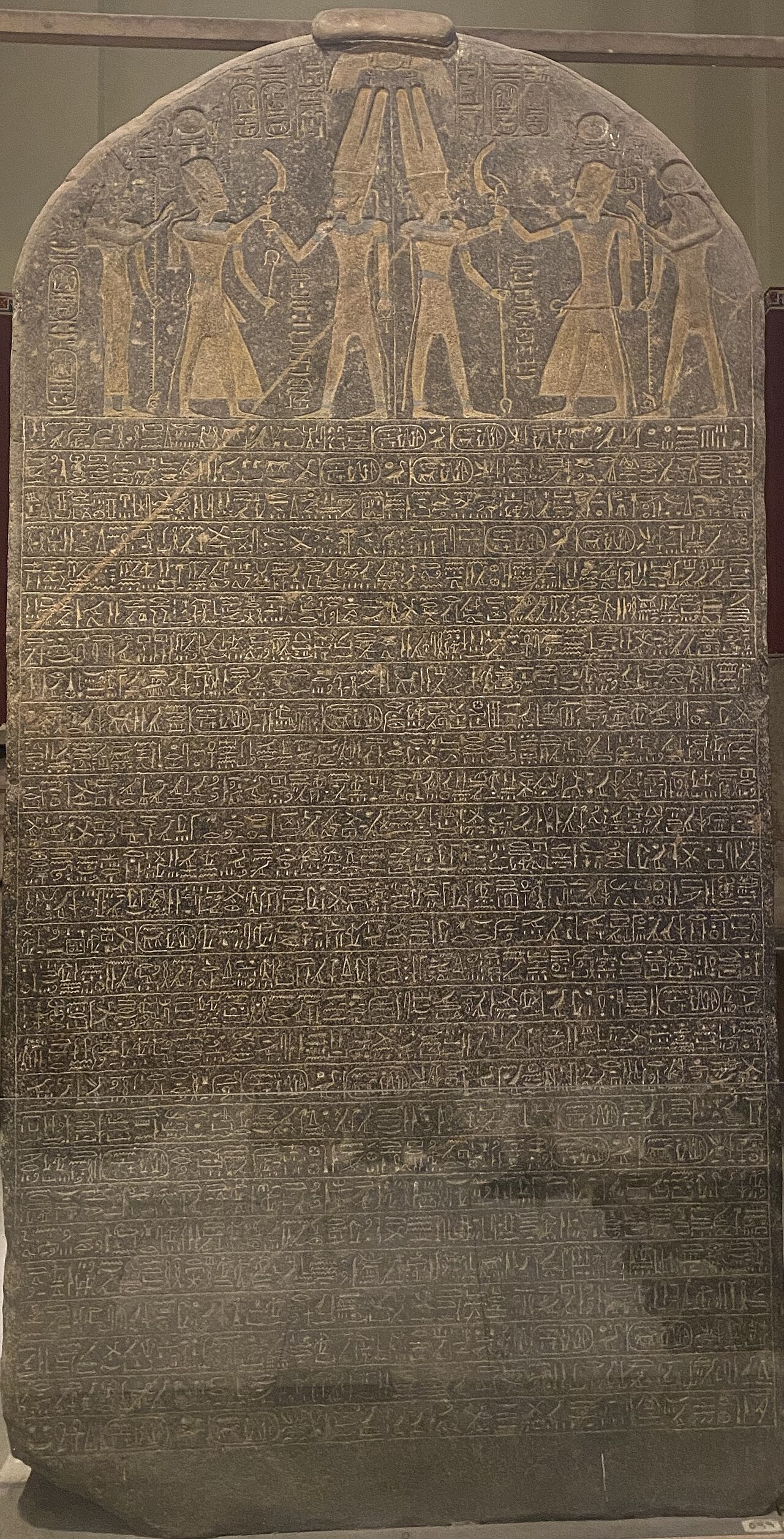
In his fifth year, around 1208 BCE, Pharaoh Merneptah set up a granite stele celebrating victories, mostly over the Libyans. Its last lines list conquests in Canaan:
Ysrỉꜣr fk.t bn pr.t=f
“Ashkelon is carried off, Gezer is seized, Yanoam is made as if it never existed; Israel is laid waste, his seed is not.”[25]
What it proves. That a group called Israel existed in Canaan by the late thirteenth century BCE, important enough for Egypt to claim a victory over it. The hieroglyphs mark Ashkelon, Gezer and Yanoam with the sign for a foreign city-state or land, but Israel with the sign for a people. Most scholars read this as a population in the highlands that was not yet a kingdom with a capital (§1).[33] Consensus What it does not prove is anything about where that people came from, or what god it worshipped.
2. Mesha: Israel’s god seen by an enemy
The Mesha Stele, a black basalt inscription found at Dhiban in Jordan in 1868 and now in the Louvre, is King Mesha of Moab’s account, around 840 BCE, of how he threw off Israelite rule. It names “Omri, king of Israel,” who “oppressed Moab many days,“[27] and describes the capture of the Israelite town of Nebo:
wʾqḥ mšm ʾ[t k]ly YHWH wʾsḥb hm lpny Kmš
“And I took from there the [ves]sels of YHWH, and I dragged them before Chemosh.”[27]
What it proves. That Yahweh was the god of the kingdom of Israel in the ninth century BCE, with a sanctuary at Nebo, and that the Moabites understood their war in the same terms as the Bible: Mesha says Chemosh was angry with his land and let Omri oppress it, then saved it. The theology of a national god who punishes and rescues his people was not unique to Israel. Consensus The Bible tells Mesha’s rebellion from the other side (2 Kings 3), and the two accounts disagree on who won.[34]
3. Kuntillet ʿAjrud: “Yahweh and his Asherah”
Kuntillet ʿAjrud is a small way-station in the northeastern Sinai, excavated by Ze’ev Meshel in 1975–76 and dated by radiocarbon to around 800 BCE.[35] On two large storage jars, travellers wrote blessings:
brkt ʾtkm lYHWH šmrn wlʾšrth
“I bless you by Yahweh of Samaria and by his Asherah.”[29][35]
A second jar has “Yahweh of Teman and his Asherah.”[36] A tomb inscription from Khirbet el-Qom near Hebron, from the eighth century, has a similar formula.[37]
What it proves. That some Israelites around 800 BCE invoked Yahweh together with his Asherah, and that Yahweh was worshipped under local titles (“of Samaria,” “of Teman”) much as Baal and other gods were. Consensus on the reading. What “his Asherah” means is debated: the goddess Asherah as Yahweh’s consort, or a wooden cult object named after her and standing beside his altar, the asherah that Deuteronomy forbids beside Yahweh’s altar.[38][39][40] Contested Either way, it is the clearest case of what inscriptions add: evidence of practice the biblical editors condemned and mostly left out (§2).
4. Ketef Hinnom: the oldest biblical text
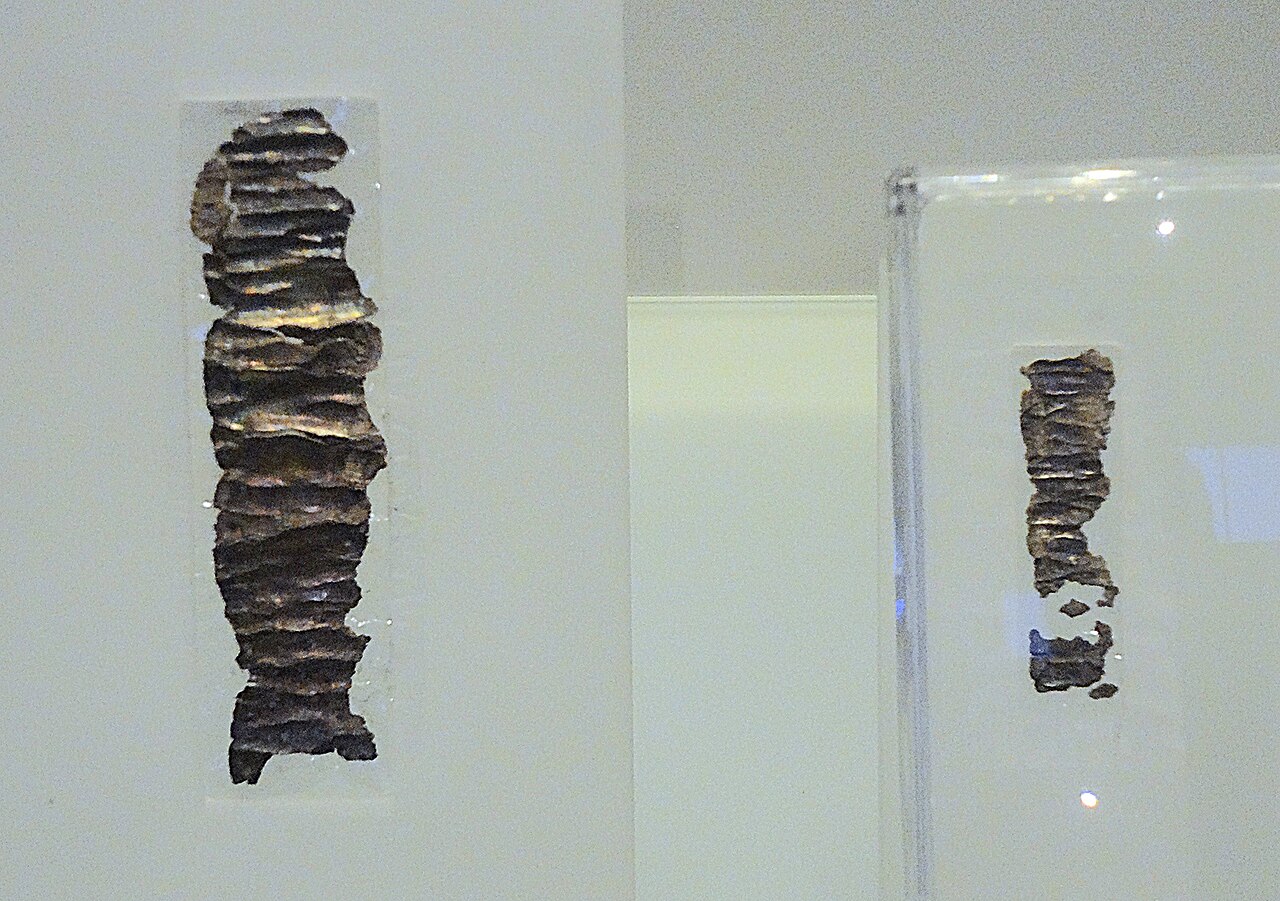
In 1979 Gabriel Barkay’s excavation of burial caves at Ketef Hinnom, just southwest of Jerusalem’s Old City, found two tiny rolled-up silver amulets.[41] Unrolled and read with modern imaging, both contain a version of the priestly blessing:
ybrk YHWH wyšmrk yʾr YHWH pnyw [ʾlyk w]yśm lk š[lm]
“May YHWH bless you and keep you; may YHWH make his face shine [upon you and] grant you pe[ace].”[30][41]
What it proves. That a text closely matching Numbers 6:24–26 was in use in Jerusalem around 600 BCE, before the Babylonian destruction. They are some 350 years older than the oldest Dead Sea Scrolls. Majority on the date, which rests on the script; a few scholars, notably Johannes Renz, have argued that the script is too damaged to date securely and could be Hellenistic, but the 2004 re-edition from new images supported the late seventh or early sixth century.[41] What the amulets do not prove is that the Book of Numbers existed in its present form: a blessing could circulate in worship long before or apart from the book that now contains it. Majority
5. Lachish: the end of the kingdom of Judah
In 1935 the excavators of Lachish, a fortress city southwest of Jerusalem, found ink-written potsherds (ostraca) in the burnt ruins of its gate. They are letters from an officer at an outpost to his commander, written as the Babylonian army closed in around 588 BCE. Letter 4 ends:
“We are watching for the fire-signals of Lachish, according to all the signs my lord has given, for we cannot see Azekah.”[31]
The Book of Jeremiah describes the same moment: the Babylonian army was fighting against Jerusalem “and against all the cities of Judah that were left, Lachish and Azekah; for these alone remained of the fortified cities of Judah” (Jer 34:7).[42]
What it proves. That parts of the biblical account of Judah’s last years match independent contemporary evidence closely. Consensus The Lachish letters, the Arad ostraca, Babylonian ration tablets naming the exiled king Jehoiachin, and the Babylonian Chronicle’s entry for the capture of Jerusalem in 597 BCE make the late monarchy the best-documented period of biblical history.[43][44][45]
The pattern. The further back the biblical story goes, the fewer independent witnesses it has. The kings of the ninth to sixth centuries appear in Assyrian, Babylonian and Moabite records.[46][47] David is named with certainty only once, as the founder of a dynasty, on the Tel Dan Stele; a reading of “House of David” on the Mesha Stele has been proposed and disputed.[28][48][49] Before that, for the patriarchs, the exodus, the conquest and the judges, there is no external written evidence at all. That is not proof that nothing happened. It is the reason why the confidence tags in §1 are lower than those in §3. Consensus
Comparative evidence: Israel among its neighbours
The other great source is the literature of Israel’s neighbours. Israel shared a language family, an alphabet, a set of gods and a stock of poetic images with the peoples around it, and texts from those peoples show which parts of Israel’s religion were inherited and which were new.
The single most important find is Ugarit (Ras Shamra), a city on the Syrian coast destroyed around 1185 BCE. From 1929 French excavators recovered hundreds of clay tablets in a cuneiform alphabet, including myths of the gods El, Baal, Asherah (Athirat) and Anat.[50] Before Ugarit, the “Canaanite religion” the Bible condemns was known almost only from the Bible. Afterwards it could be read in its own words.[51] Consensus
One passage shows how close the connection is. In the Baal cycle, Baal is told:
k tmḫṣ ltn bṯn brḥ / tkly bṯn ʿqltn
“When you smote Litan, the fleeing serpent, finished off the twisting serpent…”[52]
Several centuries later, the Book of Isaiah promises that on the last day Yahweh
yipqōd … ʿal liwyātān nāḥāš bāriaḥ wəʿal liwyātān nāḥāš ʿăqallātôn
“will punish Leviathan the fleeing serpent, Leviathan the twisting serpent” (Isa 27:1).[53]
What it proves. That Hebrew poetry inherited not just a theme but an exact formula, word for word, from the Canaanite mythology of the Late Bronze Age, and transferred Baal’s victory over the sea monster to Yahweh. Consensus Many other parallels run the same way: the high god El, “father of years,” presiding over a council of gods; Baal as “rider of the clouds”; the divine mountain in the north.[54][55] §2 uses them to trace how Yahweh absorbed the roles of El and Baal.
Mesopotamian sources matter in the same way for other texts: the flood story in the Epic of Gilgamesh for Genesis 6–9, Hammurabi’s laws for the laws of Exodus 21–23, Assyrian vassal treaties of the seventh century for the covenant language of Deuteronomy.[56][57][58] A borrowed form says nothing, on its own, about whether the borrower changed its meaning. Usually it did.
Archaeology: what the texts leave out
Archaeology does two jobs: it tests specific biblical claims, and it shows how ordinary Israelites lived and worshipped, which the biblical writers were rarely interested in.
For most of the twentieth century “biblical archaeology” meant digging with the Bible in one hand. William F. Albright and his students looked for, and often believed they had found, the patriarchs’ world, the destruction layers of Joshua’s conquest and the buildings of Solomon.[59] Much of that synthesis collapsed between the 1970s and the 1990s. Excavations at Jericho and Ai showed no walled city to conquer at the relevant dates;[60][61] surveys of the central hill country showed the Israelite settlement emerging from local Canaanite populations rather than arriving from outside (§1).[62] Majority
Three debates since then frame everything in §1 and §2:
- Minimalists and maximalists (1990s). Scholars of the “Copenhagen” and “Sheffield” schools, among them Thomas L. Thompson, Niels Peter Lemche and Philip Davies, argued that the Hebrew Bible was largely composed in the Persian or Hellenistic period and that its “ancient Israel” was a literary construct with little basis in Iron Age reality.[63][64][65] The discovery of the Tel Dan Stele in 1993, naming the “House of David,” undercut the strongest form of that claim. Few scholars now hold the extreme position on either side. Majority
- The low chronology. Israel Finkelstein argued in 1996 that the monumental gates and palaces at Megiddo, Hazor and Gezer, attributed to Solomon since Yigael Yadin, should be dated about a century later, to the Omride kings of the ninth century. On that reading, tenth-century Judah under David and Solomon was a small highland chiefdom, not the empire of the Book of Kings.[66][67] Amihai Mazar and others defend a “modified conventional chronology,” and Yosef Garfinkel’s fortified town at Khirbet Qeiyafa, radiocarbon-dated to around 1000 BCE, is cited on that side.[68][69] The two positions were set out in a single volume by Finkelstein and Mazar in 2007.[70] Contested
- Popular religion. Excavations have found household shrines, small altars, standing stones (maṣṣebot), a shrine inside the Judean fortress of Arad whose raised inner niche, often called its holy of holies, held a standing stone with two incense altars at its entrance,[71][72][73] and hundreds of clay figurines of a woman supporting her breasts, the “Judean pillar figurines” of the eighth and seventh centuries.[74][75] They show that the religion practised in Israel and Judah was more varied than the one the Bible’s editors prescribed. Consensus on the finds; Majority on the interpretation.
The limit. Archaeology is good at showing how big a town was, when it was destroyed and what its people ate and worshipped. It is poor at confirming or ruling out individuals and single events. An absence of evidence for the exodus or for a given king carries weight when we know where to look and have looked; it carries much less when we do not.
Manuscripts: how the text reached us
The Hebrew Bible survives in three ancient forms that sometimes disagree: the Masoretic text, the standard Hebrew Bible of Judaism; the Septuagint, the Greek translation made in Egypt; and the Samaritan Pentateuch. The Dead Sea Scrolls showed that all three descend from versions circulating side by side before the first century CE.
The Masoretic text
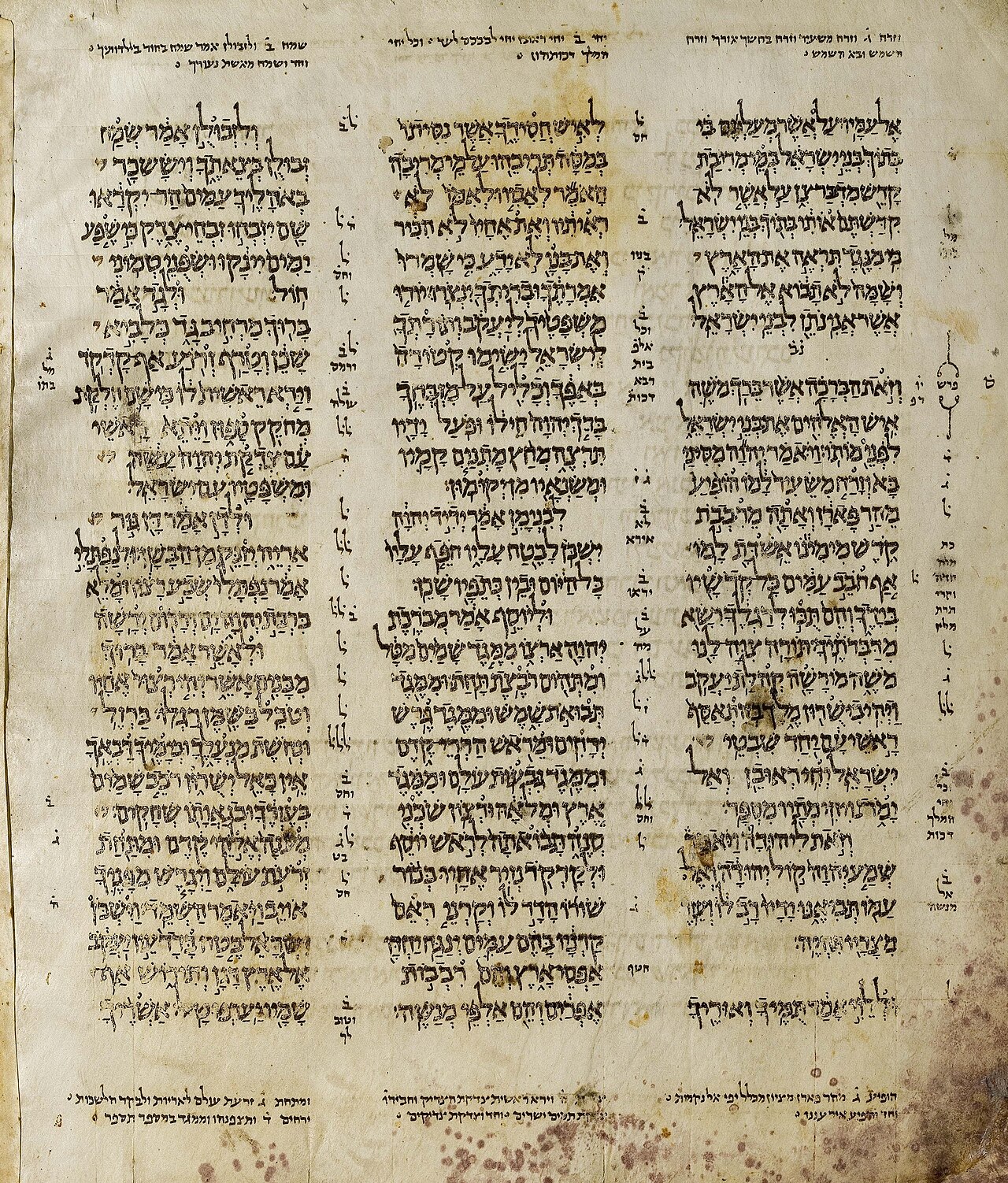
The Hebrew Bible printed today is the work of the Masoretes, scribal families in Tiberias in Galilee who between about the seventh and tenth centuries CE added vowel points, accents and marginal notes to a consonantal text that had been fixed several centuries earlier.[6] Their best manuscripts are:
- The Aleppo Codex, written around 930 CE and pointed by Aaron ben Asher, the most respected of the Masoretes. Maimonides used it as his model text. About 40 percent of it, including most of the Torah, went missing between the riots in Aleppo in 1947 and its arrival in Israel in 1958: 294 of some 487 leaves survive.[76][77]
- The Leningrad Codex, copied in 1008 CE from Ben Asher manuscripts: the oldest complete Hebrew Bible, and the basis of modern scholarly editions.[78][6] Consensus
Before the Dead Sea Scrolls, the Nash Papyrus, a single sheet with the Ten Commandments and the Shema from about 150–100 BCE, was the only Hebrew biblical text older than the ninth century CE.[79]
The Septuagint
The Torah was translated into Greek in Alexandria in the third century BCE, for a Jewish community that no longer read Hebrew; the other books followed over the next two centuries. The Letter of Aristeas tells a legend of seventy-two elders brought from Jerusalem by King Ptolemy II, which gave the translation its name, Septuaginta, “seventy.”[80][81] Consensus on the date and place; the legend is not history.
The Septuagint matters because in places it translates a Hebrew text different from the Masoretic one. Its Book of Jeremiah is about one-seventh shorter than the Hebrew and arranges the chapters differently. Before 1947 that could be put down to a careless translator. The Dead Sea Scrolls changed the picture.[6]
The Dead Sea Scrolls
Between 1947 and 1956, Bedouin shepherds and archaeologists recovered the remains of some 900 manuscripts from eleven caves near Khirbet Qumran on the northwest shore of the Dead Sea. They date from about 250 BCE to 68 CE, when the Romans destroyed the settlement. About a quarter, some 230 manuscripts, are copies of biblical books; every book of the Hebrew Bible except Esther is represented. The rest are commentaries, hymns, rules and other works, many of them belonging to a sectarian community whose identity is debated (§6).[82] Consensus
The most famous is the Great Isaiah Scroll from Cave 1, copied around 150–100 BCE: all sixty-six chapters of Isaiah, more than a thousand years older than the Aleppo Codex.[83] It differs from the Masoretic text in more than 2,600 places, almost all of them spelling, small grammatical forms and single words.[83] That is the first lesson of the Scrolls: the text of the main biblical books was transmitted with remarkable care for a thousand years. Consensus
The second lesson is the opposite one. Other scrolls preserve different editions of the same books. Fragments of Jeremiah from Cave 4 (4QJerb and 4QJerd) agree with the short Greek Jeremiah, proving that the Septuagint translated a real Hebrew edition rather than abridging. Some Torah scrolls agree with the Samaritan text. A scroll of Deuteronomy (4QDeutj) reads “sons of God” in Deut 32:8 where the Masoretic text has “sons of Israel,” a difference that turns out to matter for the history of monotheism (§2).[84] Emanuel Tov, editor-in-chief of the Scrolls’ official publication, concludes that before the first century CE the biblical text existed in several forms, and that the Masoretic text became standard only after the destruction of the Temple in 70 CE.[6] Majority
What it proves. That the Bible’s text had a history of its own. Copying was conservative but not frozen; for some books two editions circulated at once; and the choice of one text as authoritative was a later decision by the rabbis, not something given from the beginning.
The Samaritan Pentateuch
The Samaritans, who worshipped at Mount Gerizim and accepted only the Torah as scripture, preserve their own Hebrew text of the five books, in an old script. It differs from the Masoretic text in about six thousand places, mostly minor, about a third of them shared with the Septuagint,[6] but it also includes deliberate changes favouring Gerizim as the chosen place of worship (§5).[85][86] Consensus
The Cairo Geniza
Jewish practice forbids destroying a document that might contain the name of God. Worn-out texts were stored in a genizah, a storeroom, until they could be buried. The Ben Ezra synagogue in Fustat (Old Cairo) never emptied its storeroom. Solomon Schechter of Cambridge removed most of its contents in 1896–97; about 193,000 fragments are now in Cambridge’s Taylor-Schechter Collection, and with the pieces scattered to other libraries the genizah totals several hundred thousand, spanning about a thousand years: Bible and Talmud manuscripts, the lost Hebrew original of the Book of Ben Sira, letters, contracts, marriage documents, shopping lists and children’s exercises.[87][88][89] It is the single richest source for Jewish life under Islam, and the basis of much of §8.[90] Consensus
How the canon closed
A book being old does not make it scripture. When the collection of authoritative books was fixed is a separate question, and the answer is later and vaguer than most people assume.
Two dated witnesses frame it. Soon after 132 BCE, a grandson who translated his grandfather’s book of wisdom from Hebrew into Greek in Egypt wrote a preface. He speaks three times of a three-part collection:
toû nómou kaì tôn prophētôn kaì tôn állōn tôn kat’ autoùs ēkolouthēkótōn
“the Law and the Prophets and the others that followed them.”[91]
What it proves. That by the late second century BCE the Law and the Prophets were recognised collections, but the third part had no fixed name, and probably no fixed contents. Majority
Around 95 CE, the Jewish historian Josephus, writing in Rome, gives a count (here in William Whiston’s 1737 translation):
“We have not an innumerable multitude of books among us, disagreeing from and contradicting one another, but only twenty-two books, which contain the records of all the past times.”[92]
He lists the five books of Moses, thirteen books of the prophets and four of hymns and moral instruction, and says that books written after the time of Artaxerxes are not of equal authority “because there hath not been an exact succession of prophets since that time.” His twenty-two probably correspond to the twenty-four of the later Jewish count, combined differently. Majority
Between those two dates, the Dead Sea Scrolls community treated some books outside the later canon, such as Jubilees and parts of Enoch, as authoritative, and argued over others.[82] The rabbis of the Mishnah, around 200 CE, were still debating whether Ecclesiastes and the Song of Songs “defile the hands,” their term for sacred status.[93] The “Council of Jamnia” that is often said to have closed the canon around 90 CE is a nineteenth-century scholarly construction, first proposed by Heinrich Graetz in 1871, not a known event (§7).[94] Majority
Faith and history: what historians can and cannot say
Historians can say when a text was written, by what kind of people, out of what earlier material and for what purpose. They cannot say whether God spoke at Sinai. That question is outside the reach of historical method, in either direction.
This series reports the traditional account and the critical account side by side, because both are part of the history:
- The traditional view. Rabbinic tradition holds that the whole Torah was given by God to Moses, and that an Oral Torah, later written in the Mishnah and Talmud, was given with it. Maimonides made “the Torah from heaven” the eighth of his Thirteen Principles of faith in the twelfth century. [95] Orthodox Judaism maintains it today, and traditional scholars have long had their own answers to the questions source criticism raises.[96]
- Critical scholarship within Judaism. Jewish scholars have been central to modern biblical criticism, from the nineteenth-century Wissenschaft des Judentums movement (§11) to Tov, Schwartz, Baden and Benjamin Sommer.[97] The Conservative movement’s Torah commentary, Etz Hayim (2001), presents the documentary analysis to synagogue readers.[98] Sommer argues that a modern Jewish theology can accept that the Torah is the work of many hands and still hold it as revelation, understood as Israel’s response to an encounter with God.[99]
- Ancient scepticism is not modern. The questions themselves are old. The Talmud records the opinion that Joshua wrote the last eight verses of the Torah, which describe Moses’ death.[3] Ibn Ezra noticed problems in the twelfth century. What changed in the modern period was not the noticing but the conclusions drawn.
James Kugel’s How to Read the Bible (2007) walks through the gap between the two readings, chapter by chapter, from the point of view of an observant Jewish scholar who accepts the critical results.[100] This series does not tell readers which reading to hold. It describes the evidence and attributes faith claims to the traditions that hold them.
The divine name: why this series writes “Yahweh”
The God of Israel has a personal name, written in Hebrew with four consonants, YHWH (יהוה), the Tetragrammaton. For more than two thousand years Jews have not pronounced it, and its original vowels were never written down. “Yahweh” is the reconstruction most scholars use.[101]
How the name stopped being said. By the late Second Temple period the name was spoken only in the Temple, by priests, and on the Day of Atonement by the high priest.[102] In reading scripture, Jews said Adonai, “my Lord,” instead; most manuscripts of the Septuagint render it Kyrios, “Lord,” though a few early Jewish copies keep the Hebrew letters, and English Bibles follow with LORD in capitals.[101][103] Some Dead Sea Scrolls write the Tetragrammaton in the old Hebrew script while the rest of the text is in the square script, setting it apart.[103] The Mishnah, compiled around 200 CE, lists among those who have no share in the world to come “one who pronounces the name according to its letters.”[104] Today many Jews say HaShem, “the Name,” and some write “G-d” in English. Consensus
Where “Yahweh” comes from. It is reconstructed from shortened forms of the name in personal names and inscriptions (Yahu, Yah, as in Elijah, ʾēlîyāhû, “my god is Yahu,” and halelu-yah); from the spelling YHW at Elephantine;[105] and from Greek transcriptions by early Christian writers, such as Clement of Alexandria’s Iaoue and Theodoret’s report that the Samaritans said Iabe.[106][101] Majority on the pronunciation, which is a scholarly best guess.
Why not “Jehovah.” When the Masoretes added vowels, they wrote the vowels of Adonai under YHWH, as a reminder to say Adonai. Christian readers in the late Middle Ages read the two together and produced “Jehovah,” a word no one in antiquity ever said.[101] Consensus
This series’ convention. For the Iron Age, when Yahweh was one god among others in Israel’s world, the historical chapters (§1–§6) use “Yahweh,” as scholarship does, because the point under discussion is often precisely that he had a name, like Baal or Chemosh. From the rabbinic period onward (§7–§13), the chapters say “God,” as Jewish sources do. Quoted inscriptions keep YHWH. No disrespect is intended, and readers who prefer not to read the name will find it confined to the early chapters.
What “Judaism” means in this series
The English word “Judaism” comes from the Greek Ioudaismos, first attested in 2 Maccabees, in the late second or first century BCE, for the way of life of the Ioudaioi as opposed to Greek ways.[107] Ioudaios itself originally meant a Judean, someone from the land or people of Judah, and scholars argue over when it started to mean “Jew” in the religious sense (§5, §6).[108][109] Contested
That gives this series its shape. The religion of Iron Age Israel and Judah is not yet Judaism: it had a temple, sacrifices, kings, prophets and many local shrines, and its god had a name and, sometimes, a consort. Judaism grows out of it in stages: exclusive worship of Yahweh (§3), explicit monotheism (§4), the Torah as a written authority (§5), and above all the rabbinic rebuilding after the Temple fell (§7). The series calls the early stage “Israelite religion” or “the religion of Israel and Judah,” and keeps “Judaism” for the later ones. The continuity is real, as it is between any religion and its ancestors. But the evidence shows a religion that changed, not one that stood still.
Reading conventions used throughout
- Dates are BCE/CE, given as ranges where they are uncertain, with a confidence tag. Biblical kings are dated by the conventional chronology, which is accurate to within a few years from the ninth century on.
- Hebrew, Aramaic and Greek appear in italic transliteration, then translation, then what the passage is being used to prove. Inscriptions are given in consonants only, as they were written.
- The Bible is cited by book, chapter and verse in the standard English numbering; where the Hebrew numbering differs (as in many Psalms), the note says so. Translations are this site’s own, close to the Jewish Publication Society and New Revised Standard versions.
- Rabbinic sources: m. = Mishnah, b. = Babylonian Talmud (cited by tractate and folio, as b. Bava Batra 14b), y. = Jerusalem Talmud.
- Confidence tags: Consensus Majority Contested Speculative Political
Further reading
- John J. Collins, Introduction to the Hebrew Bible (Fortress, 3rd ed. 2018) — the standard critical introduction.
- Richard Elliott Friedman, Who Wrote the Bible? (1987) — the classic Documentary Hypothesis, readably told.
- Joel S. Baden, The Composition of the Pentateuch (Yale, 2012) and Konrad Schmid, Genesis and the Moses Story (Eisenbrauns, 2010) — the two main current alternatives; read as a pair.
- Emanuel Tov, Textual Criticism of the Hebrew Bible (Fortress, 3rd ed. 2012).
- James C. VanderKam, The Dead Sea Scrolls Today (Eerdmans, 2nd ed. 2010).
- Israel Finkelstein and Amihai Mazar, The Quest for the Historical Israel (SBL, 2007) — the archaeological debate, both sides in one book.
- Mark S. Smith, The Early History of God (Eerdmans, 2nd ed. 2002).
- Adina Hoffman and Peter Cole, Sacred Trash: The Lost and Found World of the Cairo Geniza (Schocken, 2011).
- James L. Kugel, How to Read the Bible (Free Press, 2007), and Benjamin D. Sommer, Revelation and Authority (Yale, 2015) — two Jewish scholars on faith and criticism.
References
- ^ a b c John J. Collins Introduction to the Hebrew Bible. Fortress Press, 3rd ed., 2018. The standard critical introduction.
- ^ Deut 34:5–6 — Deuteronomy (Hebrew Bible). c. 7th–5th c. BCE. Hebrew. The Torah narrates the death and burial of Moses and says no one knows his grave 'unto this day', a classic sign that Moses is not its author. read the text
- ^ a b b. Bava Batra 14b–15a — Babylonian Talmud. c. 500–600 CE. Hebrew/Aramaic. The rabbinic list of who wrote each biblical book: Moses wrote his book, Balaam's portion and Job; one opinion holds that Joshua wrote the last eight verses of the Torah. read the text
- ^ David M. Carr Writing on the Tablet of the Heart: Origins of Scripture and Literature. Oxford University Press, 2005. How ancient scribes learned texts by heart and reworked them as they copied.
- ^ Karel van der Toorn Scribal Culture and the Making of the Hebrew Bible. Harvard University Press, 2007. The Bible as the product of temple scribes who edited, expanded and combined.
- ^ a b c d e f Emanuel Tov Textual Criticism of the Hebrew Bible. Fortress Press, 3rd ed., 2012. The standard work on the Masoretic text, Septuagint, Samaritan Pentateuch and Scrolls.
- ^ Christopher A. Rollston Writing and Literacy in the World of Ancient Israel: Epigraphic Evidence from the Iron Age. Society of Biblical Literature, 2010. What the inscriptions show about who could write, and when.
- ^ William M. Schniedewind How the Bible Became a Book: The Textualization of Ancient Israel. Cambridge University Press, 2004. Argues for the late eighth and seventh centuries as the first great period of biblical writing.
- ^ Gen 1:1–2:3 — Genesis (Hebrew Bible, Priestly source). c. 6th–5th c. BCE. Hebrew. Creation by word in six days, with the sun and moon as 'lights' and the deep (tĕhôm) as inert matter, ending with God's rest on the seventh day. read the text
- ^ a b c d Richard Elliott Friedman Who Wrote the Bible?. Summit Books, 1987. The most readable account of the four-source theory.
- ^ a b c Jean-Louis Ska Introduction to Reading the Pentateuch. Eisenbrauns, 2006. Accessible survey of how the Torah was composed, critical of imperial authorisation.
- ^ Exod 6:2–3 — Exodus (Hebrew Bible). c. 6th–5th c. BCE (Priestly source). Hebrew. God tells Moses he appeared to the patriarchs as El Shaddai but did not make his name YHWH known to them, contradicting Genesis passages where they use the name: a key piece of evidence for separate sources. read the text
- ^ Ibn Ezra on Deuteronomy 1:2 — Abraham ibn Ezra, Commentary on the Torah. c. 1150s CE. Hebrew. The cryptic note 'if you understand the secret of the twelve', together with Gen 12:6 and Deut 31:22, hinting that some verses of the Torah were written after Moses. read the text
- ^ Spinoza, Tractatus Theologico-Politicus, ch. 8 — Tractatus Theologico-Politicus (Amsterdam, 1670). 1670 CE. Latin. Spinoza decodes Ibn Ezra's hints and argues openly that the Pentateuch was written not by Moses but by someone who lived many centuries after him. about
- ^ Jean Astruc Conjectures sur les mémoires originaux dont il paroit que Moyse s'est servi pour composer le livre de la Genèse. Fricx, Brussels [i.e. Cavelier, Paris], 1753. open library The physician's anonymous treatise that sorted Genesis by its use of Elohim and YHWH into older memoirs Moses had combined.
- ^ 2 Kgs 22:8 — 2 Kings (Hebrew Bible). c. 6th c. BCE. Hebrew. The high priest Hilkiah 'finds the book of the law' in the Temple in Josiah's reign (622 BCE); since de Wette (1805) identified with an early form of Deuteronomy. read the text
- ^ Wilhelm Martin Leberecht de Wette Dissertatio critica qua Deuteronomium a prioribus Pentateuchi libris diversum, alius cuiusdam recentioris auctoris opus esse monstratur. Jena, 1805. The doctoral dissertation that identified Josiah's book of the law with Deuteronomy, a later work than the rest of the Torah.
- ^ a b Julius Wellhausen Geschichte Israels I (from 1883: Prolegomena zur Geschichte Israels). Reimer, Berlin, 1878. full text The classic Documentary Hypothesis, and the argument that the Priestly law came after the prophets. Its view of post-exilic Judaism as decline is long discarded.
- ^ Jon D. Levenson The Hebrew Bible, the Old Testament, and Historical Criticism: Jews and Christians in Biblical Studies. Westminster/John Knox Press, 1993. A Jewish biblical scholar's essays on the Protestant assumptions, including Wellhausen's, built into historical criticism.
- ^ Martin Noth Überlieferungsgeschichtliche Studien. Niemeyer, Halle, 1943. The theory of a single 'Deuteronomistic History' from Deuteronomy to Kings; English translation The Deuteronomistic History (1981).
- ^ a b Erhard Blum Studien zur Komposition des Pentateuch. de Gruyter (BZAW 189), 1990. The Pentateuch as a Persian-period combination of Priestly and Deuteronomic compositions.
- ^ Rolf Rendtorff Das überlieferungsgeschichtliche Problem des Pentateuch. de Gruyter (BZAW 147); English: The Problem of the Process of Transmission in the Pentateuch (JSOT Press, 1990), 1977. open library The book that abandoned continuous J and E sources for larger blocks of tradition joined late, opening the European alternative to the Documentary Hypothesis.
- ^ Konrad Schmid Genesis and the Moses Story: Israel's Dual Origins in the Hebrew Bible. Eisenbrauns, 2010. The main European alternative: patriarchs and exodus as rival origin stories joined late.
- ^ Joel S. Baden The Composition of the Pentateuch: Renewing the Documentary Hypothesis. Yale University Press, 2012. The Neo-Documentarian case for four sources, argued from narrative contradictions.
- ^ a b Merneptah Stele — Egyptian Museum, Cairo. c. 1208 BCE. Egyptian (hieroglyphic). A victory hymn of Pharaoh Merneptah naming "Israel" as a people: the earliest mention of Israel outside the Bible. about
- ^ Soleb temple list, "Land of the Shasu, Yhw" — Temple of Amenhotep III at Soleb, Nubia. c. 1390–1350 BCE. Egyptian (hieroglyphic). Names a land or group of Shasu nomads as Yhw, possibly the earliest trace of the name Yahweh; repeated in a list of Ramesses II at Amara West. Whether it refers to the god is debated. about
- ^ a b c Mesha Stele — Louvre AO 5066. c. 840 BCE. Moabite. King Mesha of Moab names Omri king of Israel and boasts of taking the vessels of YHWH from Nebo and dragging them before Chemosh: the earliest certain mention of Yahweh outside the Bible. about
- ^ a b Tel Dan Stele — Israel Museum, Jerusalem. c. 840–800 BCE. Old Aramaic. An Aramean king, probably Hazael, claims to have killed a king of Israel and a king of the 'House of David' (bytdwd): the only certain mention of David outside the Bible from the Iron Age. about
- ^ a b Kuntillet ʿAjrud, Pithos A — Kuntillet ʿAjrud inscriptions (Meshel 2012). c. 800 BCE. Hebrew. Blessing written on a storage jar at a Sinai way-station: 'I bless you by Yahweh of Samaria and by his Asherah.' A second jar names 'Yahweh of Teman and his Asherah'. about
- ^ a b Ketef Hinnom amulets (KH1, KH2) — Israel Museum, Jerusalem. c. 650–587 BCE. Hebrew. Two rolled silver amulets from a Jerusalem burial cave containing a form of the priestly blessing of Num 6:24–26: the oldest surviving text paralleling a biblical verse. about
- ^ a b Lachish Letter 4 — Lachish ostraca. c. 588 BCE. Hebrew. An officer reports that he is watching for the fire-signals of Lachish 'for we cannot see Azekah', matching Jer 34:7 on the last fortified cities of Judah before Babylon. about
- ^ Elephantine 'Passover Letter' (TAD A4.1) — Elephantine papyri. 419 BCE. Aramaic. Hananiah writes to the Judean garrison at Elephantine with instructions for the festival of Unleavened Bread, in the fifth year of Darius II. about
- ^ William G. Dever Who Were the Early Israelites and Where Did They Come From?. Eerdmans, 2003. The 'proto-Israelites' as Canaanite farmers resettling the hills.
- ^ 2 Kings 3:4–27 — Kings (Hebrew Bible). c. 6th c. BCE. Hebrew. Mesha king of Moab rebels after Ahab's death; Israel, Judah and Edom invade, but withdraw after Mesha sacrifices his eldest son on the wall: the Israelite side of the revolt the Mesha Stele celebrates. read the text
- ^ a b Ze'ev Meshel Kuntillet ʿAjrud (Ḥorvat Teman): An Iron Age II Religious Site on the Judah–Sinai Border. Israel Exploration Society, 2012. The final excavation report, with the inscriptions and drawings.
- ^ Kuntillet ʿAjrud, Pithos B — Ink inscription on a storage jar, Kuntillet ʿAjrud (Ḥorvat Teman), Sinai. c. 800 BCE. Hebrew. "I bless you by Yahweh of Teman and by his asherah": a southern local form of Yahweh, matching Habakkuk 3:3, paired with asherah. about
- ^ Khirbet el-Qom, Tomb Inscription 3 — Tomb inscription, Khirbet el-Qom, near Hebron. 2nd half of the 8th c. BCE. Hebrew. "Blessed is Uriyahu by Yahweh; from his enemies, by his asherah, he has saved him": the Yahweh–asherah pairing in a Judahite burial. about
- ^ Deuteronomy 16:21–22 — Deuteronomy (Hebrew Bible). c. 7th c. BCE. Hebrew. Forbids planting an asherah beside the altar of Yahweh or setting up a standing stone: a law that implies both were practised. read the text
- ^ J. A. Emerton New Light on Israelite Religion: The Implications of the Inscriptions from Kuntillet ʿAjrud. Zeitschrift für die alttestamentliche Wissenschaft 94, 1982. The grammatical argument that "his asherah" is a cult object, not a goddess's name.
- ^ Judith M. Hadley The Cult of Asherah in Ancient Israel and Judah: Evidence for a Hebrew Goddess. Cambridge University Press, 2000. The inscriptions and biblical texts on asherah, and how a goddess became a cult symbol.
- ^ a b c Gabriel Barkay, Andrew G. Vaughn, Marilyn J. Lundberg and Bruce Zuckerman The Amulets from Ketef Hinnom: A New Edition and Evaluation. Bulletin of the American Schools of Oriental Research 334, 2004. The re-edition from new images that confirmed the pre-exilic date.
- ^ Jeremiah 34:7 — Jeremiah (Hebrew Bible). c. 6th c. BCE. Hebrew. Babylon's army fights against Jerusalem and against Lachish and Azekah, 'for these alone remained of the fortified cities of Judah'. read the text
- ^ Arad Ostracon 18 — Letter from the Arad fortress archive. c. 600 BCE. Hebrew. A letter mentioning "the house of Yahweh", possibly the Temple in Jerusalem. about
- ^ Jehoiachin ration tablets — Ration lists from the Southern Palace, Babylon (VAT 16378 and others). c. 592/591 BCE. Akkadian. Oil rations issued from Nebuchadnezzar's stores to 'Ya'u-kinu, king of the land of Yahudu' and his five sons: King Jehoiachin held at the Babylonian court. about
- ^ Babylonian Chronicle ABC 5 (BM 21946) — Chronicle of the early years of Nebuchadnezzar II. 6th c. BCE. Akkadian. Nebuchadnezzar besieges "the city of Judah" and captures it on the second day of Adar in his seventh year (March 597 BCE), seizes its king and appoints a king of his own choice. about
- ^ Kurkh Monolith — Annals of Shalmaneser III (British Museum). c. 852 BCE. Akkadian. Records "Ahab the Israelite" bringing 2,000 chariots and 10,000 soldiers to the battle of Qarqar in 853 BCE. about
- ^ Sennacherib's annals (Taylor, Chicago and Jerusalem prisms) — Annals of Sennacherib. 700 BCE (first edition); prisms c. 691–689 BCE. Akkadian. Sennacherib conquers 46 fortified cities of Judah, brings out 200,150 people and confines Hezekiah inside Jerusalem "like a bird in a cage"; after the king's departure Hezekiah sends 30 talents of gold and 800 of silver to Nineveh. No claim that Jerusalem fell. read the text
- ^ André Lemaire "House of David" Restored in Moabite Inscription. Biblical Archaeology Review 20:3, 1994. The proposal to read "House of David" in line 31 of the Mesha Stele.
- ^ Israel Finkelstein, Nadav Naʾaman and Thomas Römer Restoring Line 31 in the Mesha Stele: The "House of David" or Biblical Balak?. Tel Aviv 46, 2019. Argues the disputed name in line 31 is Balak, not David.
- ^ Simon B. Parker, ed. Ugaritic Narrative Poetry. Scholars Press (SBL Writings from the Ancient World 9), 1997. Translations of the Baal Cycle and other Ugaritic myths.
- ^ Mark S. Smith The Early History of God: Yahweh and the Other Deities in Ancient Israel. Eerdmans, 2nd ed., 2002. open library How Israelite religion emerged from its Canaanite setting and became monotheistic.
- ^ KTU 1.5 I 1–3 — Baal Cycle (Ugarit). c. 1300–1185 BCE. Ugaritic. 'When you smote Litan, the fleeing serpent, finished off the twisting serpent': the Canaanite formula that Isa 27:1 applies to Yahweh and Leviathan. about
- ^ Isa 27:1 — Isaiah (Hebrew Bible). c. 6th–4th c. BCE. Hebrew. Yahweh will punish 'Leviathan the fleeing serpent, Leviathan the twisting serpent', word for word the Ugaritic description of Baal's enemy Litan. read the text
- ^ Frank Moore Cross Canaanite Myth and Hebrew Epic: Essays in the History of the Religion of Israel. Harvard University Press, 1973. The classic study of El, Baal and Yahweh; argues Yahweh began as a title of El.
- ^ Mark S. Smith The Origins of Biblical Monotheism: Israel's Polytheistic Background and the Ugaritic Texts. Oxford University Press, 2001. How the divine council of Ugarit shrank into the one God of the Bible.
- ^ A. R. George The Babylonian Gilgamesh Epic: Introduction, Critical Edition and Cuneiform Texts. Oxford University Press, 2 vols., 2003. The critical edition of the Gilgamesh epic, including the flood story of Tablet XI and its relation to Atrahasis and Genesis.
- ^ David P. Wright Inventing God's Law: How the Covenant Code of the Bible Used and Revised the Laws of Hammurabi. Oxford University Press, 2009. The strongest case that Exodus 20:23–23:19 was modelled directly on Hammurabi's laws; its direct-dependence thesis is debated.
- ^ Hans Ulrich Steymans Deuteronomium 28 und die adê zur Thronfolgeregelung Asarhaddons: Segen und Fluch im Alten Orient und in Israel. Universitätsverlag Freiburg / Vandenhoeck & Ruprecht (OBO 145), 1995. The detailed case that Deuteronomy 28 adapts Esarhaddon's treaty curses.
- ^ William F. Albright The Israelite Conquest of Canaan in the Light of Archaeology. Bulletin of the American Schools of Oriental Research 74, 1939. The classic statement of the conquest model.
- ^ Kathleen M. Kenyon Digging Up Jericho. Ernest Benn, 1957. The excavation that removed Joshua's walls from the 13th century.
- ^ et-Tell (Ai) — Excavations of Marquet-Krause (1933–35) and Callaway (1964–72). Early Bronze city; abandoned c. 2400–2200 BCE until c. 1200 BCE. The site identified with biblical Ai was empty ruins for about a millennium before a small Iron I village was built there: no city existed for Joshua to conquer. about
- ^ Israel Finkelstein The Archaeology of the Israelite Settlement. Israel Exploration Society, 1988. The survey data behind the local-origin view: about 250 Iron I hill-country sites where there had been some 25.
- ^ Philip R. Davies In Search of 'Ancient Israel'. JSOT Press, Sheffield, 1992. The minimalist manifesto: the Bible's Israel as a late literary construct.
- ^ Thomas L. Thompson The Mythic Past: Biblical Archaeology and the Myth of Israel. Basic Books, 1999. The Copenhagen minimalist case that the united monarchy and biblical 'Israel' are literary creations of a much later age.
- ^ Niels Peter Lemche The Israelites in History and Tradition. Westminster John Knox Press, 1998. Argues that the biblical picture of Israel is a Persian- and Hellenistic-period construction with little value for the early Iron Age.
- ^ Israel Finkelstein The Archaeology of the United Monarchy: An Alternative View. Levant 28, 1996. The article that launched the Low Chronology.
- ^ Israel Finkelstein and Neil Asher Silberman The Bible Unearthed. Free Press, 2001. The low chronology and a sceptical reading of early Israel, for general readers.
- ^ Amihai Mazar The Debate over the Chronology of the Iron Age in the Southern Levant. In T. E. Levy and T. Higham, eds., The Bible and Radiocarbon Dating (Equinox), 2005. The "modified conventional chronology" as a middle way.
- ^ Yosef Garfinkel, Igor Kreimerman and Peter Zilberg Debating Khirbet Qeiyafa: A Fortified City in Judah from the Time of King David. Israel Exploration Society, 2016. The excavators' case for Qeiyafa as a Judahite town of David's kingdom.
- ^ Israel Finkelstein and Amihai Mazar The Quest for the Historical Israel: Debating Archaeology and the History of Early Israel. Society of Biblical Literature, 2007. The two leading positions on the archaeology of David and Solomon, side by side.
- ^ Arad sanctuary — Shrine in the Judahite fortress at Tel Arad. c. 760–715 BCE. A sanctuary of Yahweh inside a royal fortress, with a courtyard altar, standing stones and two incense altars (frankincense and cannabis residues); later dismantled and buried. about
- ^ Ze'ev Herzog The Fortress Mound at Tel Arad: An Interim Report. Tel Aviv 29, 2002. Re-dates the Arad strata and the shrine.
- ^ Eran Arie, Baruch Rosen and Dvory Namdar Cannabis and Frankincense at the Judahite Shrine of Arad. Tel Aviv 47, 2020. Residue analysis of the two altars; dates the shrine to c. 760–715 BCE.
- ^ William G. Dever What Did the Biblical Writers Know and When Did They Know It?. Eerdmans, 2001. An archaeologist's answer to the minimalists, with much on household religion.
- ^ Raz Kletter The Judean Pillar-Figurines and the Archaeology of Asherah. BAR International Series 636, 1996. The catalogue of the figurines and the case for identifying them with Asherah.
- ^ Aleppo Codex — Israel Museum (Shrine of the Book). c. 930 CE. Hebrew. The most authoritative Masoretic manuscript, pointed by Aaron ben Asher in Tiberias and used by Maimonides; about 40% lost after 1947. about
- ^ Matti Friedman The Aleppo Codex: A True Story of Obsession, Faith, and the Pursuit of an Ancient Bible. Algonquin Books of Chapel Hill, 2012. open library Journalistic investigation of how about 40 percent of the codex went missing between the 1947 Aleppo riots and its arrival in Israel in 1958.
- ^ Leningrad Codex (Firkovich B 19 A) — National Library of Russia, St Petersburg. 1008 or 1009 CE. Hebrew. Copied in Cairo by Samuel ben Jacob from Ben Asher manuscripts: the oldest complete Hebrew Bible, and the base text of modern scholarly editions. about
- ^ Nash Papyrus (Cambridge University Library, MS Or. 233) — Papyrus fragment from Egypt. c. 150–100 BCE. Hebrew. Twenty-four lines with the Ten Commandments and the opening of the Shema; acquired in Egypt in 1902, it was the oldest known Hebrew biblical text before the Dead Sea Scrolls. about
- ^ Letter of Aristeas 301–307 — Letter of Aristeas. 2nd c. BCE. Greek. Legend of seventy-two Jewish elders translating the Torah into Greek for Ptolemy II in seventy-two days on the island of Pharos; shows the Greek Torah's authority among Alexandrian Jews. about
- ^ Jennifer M. Dines The Septuagint. T&T Clark, 2004. Short, reliable introduction to how and when the Greek Bible was made.
- ^ a b James C. VanderKam The Dead Sea Scrolls Today. Eerdmans, 2nd ed., 2010. The clearest introduction to the Scrolls and the debates around them.
- ^ a b 1QIsaᵃ (Great Isaiah Scroll) — Dead Sea Scrolls, Qumran Cave 1. c. 150–100 BCE. Hebrew. All 66 chapters of Isaiah, over a thousand years older than the Aleppo Codex; some 2,600 variants from the Masoretic text, almost all minor. read the text
- ^ Deuteronomy 32:8–9 (MT, 4QDeutj, LXX) — Song of Moses (Hebrew Bible). c. 8th–6th c. BCE (debated). Hebrew. The Most High divides the nations "according to the number of the sons of God" (Qumran, Septuagint) or "the sons of Israel" (Masoretic text); Yahweh's portion is Israel. Trace of the divine council. read the text
- ^ Samaritan Pentateuch, Exodus 20 and Deuteronomy 12 — Samaritan Pentateuch. text-type 2nd c. BCE. Hebrew (Samaritan script). The Samaritan Torah adds a commandment to build an altar on Mount Gerizim and reads "the place Yahweh has chosen" where the Jewish text has "will choose". about
- ^ Reinhard Pummer The Samaritans: A Profile. Eerdmans, 2016. Introduction to Samaritan history, scripture and practice.
- ^ Cairo Geniza (Taylor-Schechter Collection) — Cambridge University Library, Genizah Research Unit. c. 9th–19th c. CE. Hebrew, Judeo-Arabic, Aramaic. Several hundred thousand fragments from the storeroom of the Ben Ezra synagogue in Fustat, about 193,000 of them at Cambridge: letters, contracts, court records, lost texts and Maimonides autographs. about
- ^ Stefan C. Reif A Jewish Archive from Old Cairo: The History of Cambridge University's Genizah Collection. RoutledgeCurzon, 2000. open library The history of the Ben Ezra genizah and of Schechter's removal of its contents to Cambridge, by the former head of the Genizah Research Unit.
- ^ Adina Hoffman and Peter Cole Sacred Trash: The Lost and Found World of the Cairo Geniza. Schocken, 2011. The story of the Geniza and what it revealed.
- ^ S. D. Goitein A Mediterranean Society: The Jewish Communities of the Arab World as Portrayed in the Documents of the Cairo Geniza. University of California Press, 6 vols. (1967–1993), 1967. Four decades of work on the Geniza's documentary fragments; the foundation of medieval Jewish social history.
- ^ Sirach, Prologue — Wisdom of Ben Sira (Greek translation). soon after 132 BCE. Greek. Ben Sira's grandson speaks of 'the Law and the Prophets and the others that followed them': a three-part collection whose third part has no fixed name yet. about
- ^ Josephus, Against Apion 1.38–41 — Against Apion. c. 95 CE. Greek. Josephus counts twenty-two authoritative books (five of Moses, thirteen of prophets, four of hymns and precepts) and says later books lack equal authority because the succession of prophets failed. read the text
- ^ m. Yadayim 3:5 — Mishnah. c. 200 CE. Hebrew. The debate over whether the Song of Songs and Ecclesiastes 'defile the hands', with Akiva's verdict that the Song is 'the holy of holies': the only rabbinic basis for the 'Council of Jamnia'. read the text
- ^ Jack P. Lewis What Do We Mean by Jabneh?. Journal of Bible and Religion 32, 125–132, 1964. The article that dismantled the 'Council of Jamnia'.
- ^ Maimonides, Commentary on Mishnah Sanhedrin 10 (Introduction to Perek Ḥeleq) — Commentary on the Mishnah. c. 1168 CE. Judeo-Arabic. The Thirteen Principles of faith; the eighth holds that the whole Torah now in our hands was given to Moses from heaven. about
- ^ Marc B. Shapiro The Limits of Orthodox Theology: Maimonides' Thirteen Principles Reappraised. Littman Library of Jewish Civilization, 2004. Shows that respected rabbinic authorities held views contrary to several of the principles.
- ^ Ismar Schorsch From Text to Context: The Turn to History in Modern Judaism. Brandeis University Press, 1994. Wissenschaft des Judentums, Zunz, Frankel and the positive-historical school.
- ^ David L. Lieber (senior ed.) Etz Hayim: Torah and Commentary. Rabbinical Assembly and United Synagogue of Conservative Judaism / Jewish Publication Society, 2001. The Conservative movement's synagogue Torah commentary, whose essays present critical scholarship to congregants.
- ^ Benjamin D. Sommer Revelation and Authority: Sinai in Jewish Scripture and Tradition. Yale University Press, 2015. A Jewish theology that accepts critical scholarship and keeps revelation.
- ^ James L. Kugel How to Read the Bible: A Guide to Scripture, Then and Now. Free Press, 2007. Ancient and modern readings set side by side by an observant Jewish scholar.
- ^ a b c d Karel van der Toorn Yahweh. in K. van der Toorn, B. Becking and P. W. van der Horst (eds.), Dictionary of Deities and Demons in the Bible, 2nd ed. (Brill/Eerdmans), pp. 910–919, 1999. Reference survey of the name, its etymologies and pronunciation, and a modified Kenite–Midianite case for Yahweh's origin in Edom and Midian.
- ^ m. Yoma 6:2 — Mishnah. c. 200 CE. Hebrew. On the Day of Atonement the people in the Temple court prostrate themselves when they hear the explicit Name from the mouth of the high priest. read the text
- ^ a b Emanuel Tov Scribal Practices and Approaches Reflected in the Texts Found in the Judean Desert. Brill (STDJ 54), 2004. The handbook of how the Qumran scribes wrote, including the writing of the divine name in palaeo-Hebrew script.
- ^ m. Sanhedrin 10:1 — Mishnah. c. 200 CE. Hebrew. Abba Saul adds to those with no share in the world to come 'one who pronounces the name according to its letters'. read the text
- ^ Petition to Bagavahya (TAD A4.7; Cowley 30) — Elephantine papyri. 407 BCE. Aramaic. The Elephantine priests ask the governor of Judah to help rebuild the temple of YHW destroyed in 410 BCE; it predates Cambyses (525 BCE), and they name the high priest Jehohanan and the sons of Sanballat of Samaria. about
- ^ Clement of Alexandria, Stromata 5.6 — Stromata. c. 200 CE. Greek. Gives a Greek transcription of the divine name (Iaoue in the standard edition; some manuscripts read Iaou), one of the witnesses behind the reconstruction 'Yahweh'. about
- ^ 2 Maccabees 2:21 — 2 Maccabees. late 2nd–1st c. BCE. Greek. Praises those who fought bravely 'for Judaism' (Ioudaismos): the earliest attestation of the word. read the text
- ^ Shaye J. D. Cohen The Beginnings of Jewishness: Boundaries, Varieties, Uncertainties. University of California Press, 1999. When Ioudaios came to mean a religious identity, and how conversion and matrilineal descent arose.
- ^ Steve Mason Jews, Judaeans, Judaizing, Judaism: Problems of Categorization in Ancient History. Journal for the Study of Judaism 38, 2007. Argues that Ioudaios should be translated 'Judean' throughout antiquity.