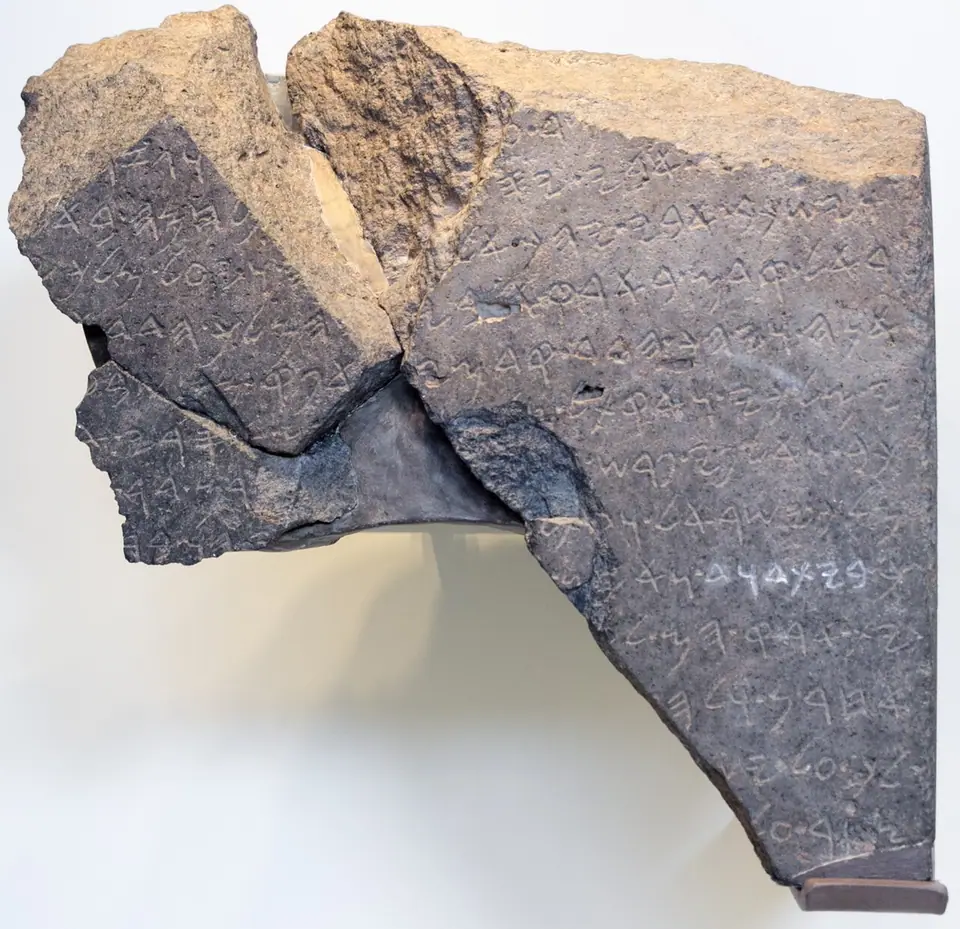
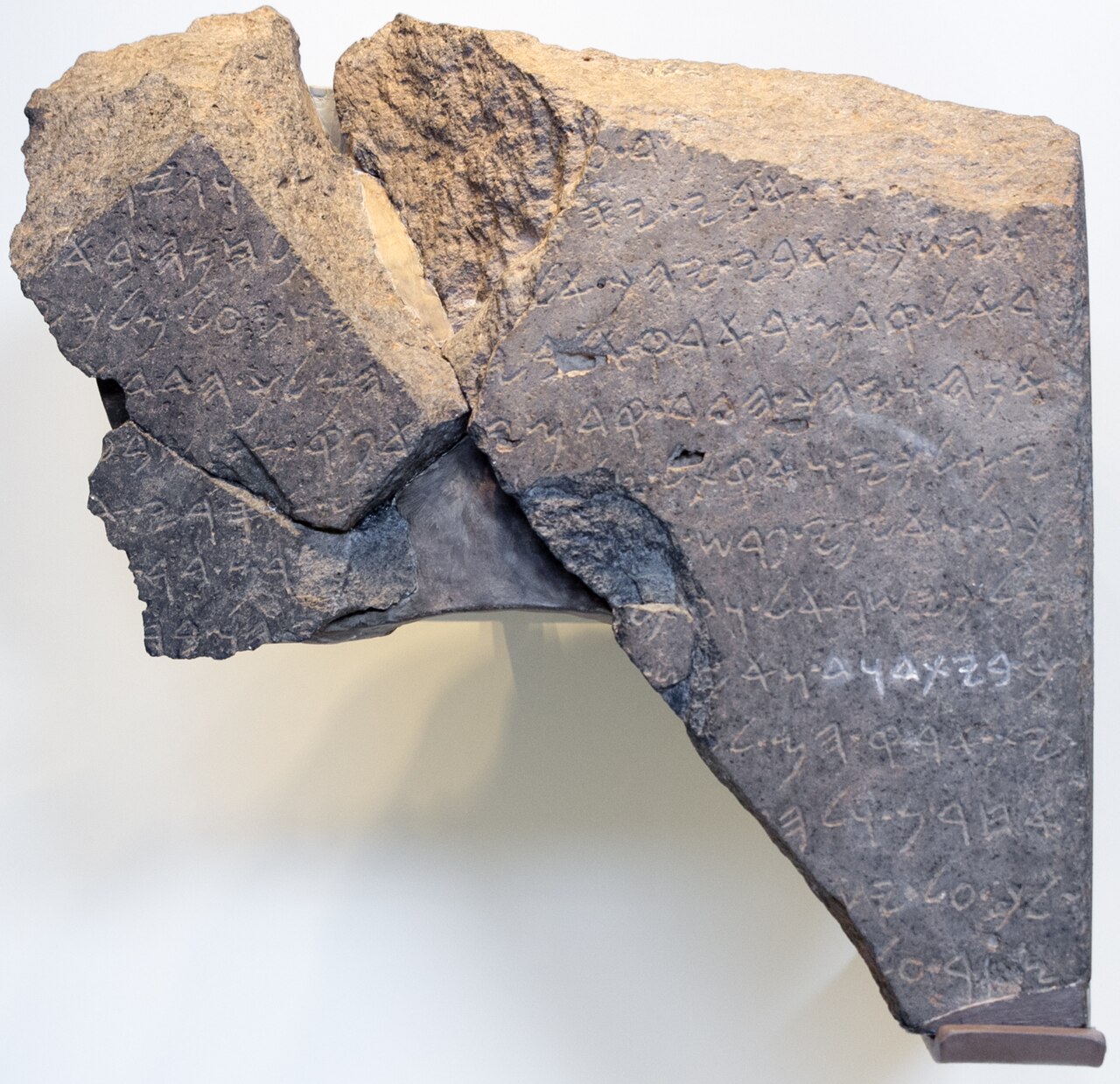
The short version: David is probably historical, Solomon possibly, and the golden age is the part in doubt. A king of Damascus boasted around 840 BCE of killing a king of the “House of David”, which means Judah’s royal line already traced itself back to a man called David.[1][2] Nothing written in the tenth century BCE names either king, and no inscription anywhere names Solomon. Between those facts, archaeologists have built very different pictures of the kingdom the Bible describes, and the argument between them is one of the longest-running in the field (§2).
What the Bible claims
The books of Samuel and Kings tell of David, a shepherd from Bethlehem, who became king of Judah, then of all Israel, took Jerusalem from the Jebusites and conquered an empire from the Euphrates to the border of Egypt. His son Solomon built the Temple and a palace in Jerusalem, fortified Hazor, Megiddo and Gezer (1 Kings 9:15), and grew rich on international trade.[3] Counting back from later kings, the biblical chronology puts them in the tenth century BCE, roughly 1000–930. On that account, the kingdom then split in two: Israel in the north, Judah in the south.
The books were written down centuries later. Most scholars date the main edition of Samuel and Kings to the late seventh and sixth centuries BCE, using older sources the text itself names, such as “the book of the acts of Solomon” (1 Kings 11:41) (§3).[4][5][6] The question is how much of the tenth century those sources preserved.
The evidence
The House of David
Three basalt fragments found at Tel Dan in northern Israel in 1993 and 1994 belong to a victory inscription in Aramaic, probably set up by Hazael of Damascus. The king claims to have killed a king of Israel and a king of bytdwd, “the House of David”.[1] In the inscriptions of the period “House of X” names a kingdom after the founder of its dynasty: Assyrian texts call the northern kingdom the “House of Omri”.[7] So by the mid-ninth century BCE, the kings of Jerusalem claimed descent from a David. Majority
The discovery had an immediate effect on the debate. In the early 1990s scholars of the “Copenhagen” and “Sheffield” schools, among them Thomas Thompson, Niels Peter Lemche and Philip Davies, argued that David was a literary figure invented centuries later.[8][9][10] Some answered the inscription by reading bytdwd as a place name. That reading has few defenders now, and the strongest form of the minimalist position did not survive the stele (§0).[2] Majority
A proposal by André Lemaire to read “House of David” in the broken line 31 of the Mesha Stele, another ninth-century inscription, is still disputed. Israel Finkelstein, Nadav Naʾaman and Thomas Römer argued in 2019 that the name there is Balak; Lemaire and Michael Langlois have defended the David reading from new images.[11][12][13] Contested
The gates of Solomon, and the Low Chronology
From the 1950s Yigael Yadin attributed identical six-chambered gates at Hazor, Megiddo and Gezer to Solomon, because 1 Kings 9:15 names those three cities as his building projects. The pottery found with the gates then became the yardstick for the tenth century. In 1996 Finkelstein argued that the yardstick was off by about 75–100 years: the pottery, and the gates and palaces with it, belonged to the ninth century and to the Omride kings of the north, whose power is confirmed by Assyrian and Moabite inscriptions.[14][15] At Qarqar in 853 BCE, Shalmaneser III records Ahab of Israel fielding 2,000 chariots, more than any other member of the coalition.[16] On the Low Chronology, the monuments are real but belong to Israel’s Omrides, and tenth-century Jerusalem was a modest highland village. Contested
Amihai Mazar answered with a “modified conventional chronology” in which the archaeological period in question runs across both centuries, so that some monumental buildings are Solomonic and others Omride.[17] Radiocarbon dating since the 2000s has narrowed the disagreement to a few decades.[18] Because the dispute is about a few decades at the turn of a century, it cannot be settled by any single find. Contested
Khirbet Qeiyafa
Between 2007 and 2013 Yosef Garfinkel and Saar Ganor excavated a small fortified town above the Elah Valley, the setting of the David and Goliath story. Radiocarbon dates on olive pits place it c. 1020–980 BCE. It had a casemate wall, two gates and no pig bones.[19] Garfinkel argues it is a Judahite town built by a centralised kingdom, and so direct evidence for David’s state.[20] Finkelstein and Alexander Fantalkin accept the date but argue that the town could belong to Saul’s highland polity, or to a group around Gibeon, rather than to Judah.[21] Contested
Jerusalem itself
Jerusalem should hold the answer and does not give it. The city has been occupied continuously for three thousand years, its tenth-century levels are deep beneath later building or eroded down the slopes, and the Temple Mount has never been excavated. Eilat Mazar identified a large stone structure in the City of David as David’s palace; others date it later or doubt that it is a single building (§2).[22] Those who expect a capital find little; those who expect a highland stronghold find about what they expected. Contested
The architecture problem
Erez Ben-Yosef’s excavations at the copper mines of Timna in the Arabah found a complex, organised industry in the tenth century run by people who left almost no permanent buildings. He argues that archaeologists have underrated states built by nomadic or semi-nomadic peoples, and that a kingdom can exist without monuments.[23] The argument cuts against using the absence of grand buildings in tenth-century Judah as proof that David’s kingdom was trivial. Contested
Each side at its strongest
The traditional and maximalist case. The biblical account of David is unusually unflattering for royal propaganda: adultery, murder, a rebellious son, a disputed succession. Its sources are named. Jerusalem cannot be dug properly, so absence of evidence there is weak. Qeiyafa shows that a fortified, administered settlement existed in Judah exactly when the Bible places David, and the Tel Dan Stele confirms the dynasty within a century and a half. Kenneth Kitchen argued that a short-lived “mini-empire” of this kind fits the political vacuum of the Levant around 1000 BCE, when Egypt and Assyria were both weak.[24][20] Contested
The minimalist case. Thompson, Lemche and Davies argued that the united monarchy is a literary construction of the Persian or Hellenistic age, and that a dynastic name on a ninth-century stele says nothing about a tenth-century kingdom or its founder.[9][10][8] Contested
The Low Chronology case. Survey archaeology shows tenth-century Judah thinly settled, with most of its people in villages. The monuments attributed to Solomon fit the ninth century better, and the ninth-century north under Omri and Ahab is the first Israelite state that outside sources describe as powerful. The story of a glorious united kingdom, Finkelstein argues, was written in seventh-century Judah, when Jerusalem had grown large and its kings claimed the north’s heritage (§3).[15] Contested
Where most scholars stand. David and probably Solomon were real rulers in the highlands around 1000 BCE. Their kingdom was smaller and poorer than the Bible’s description, and how much smaller is the open question. Very few scholars now hold either extreme: a fictional David, or a tenth-century empire as large as the text says.[18] Majority
Common misconceptions
- “Archaeology has proved David never existed.” No find can prove a negative, and the one inscription that bears on the question points the other way.[1]
- “Archaeology has confirmed the Bible’s David.” It has confirmed a dynasty named after him, not the giant, the empire or the palace intrigue.
- “Solomon’s Temple has been found.” The Temple Mount has never been excavated, and no remains of the First Temple have been identified. What is known of Judahite temples comes from shrines such as the one at Arad (§2).[25]
- “The minimalists won” or “the maximalists won.” The debate moved to the middle: radiocarbon dates now separate the camps by a few decades, not a century.[17][18]
Why it matters
A strong tenth-century kingdom would mean an early royal cult of Yahweh centred on Jerusalem, and early scribes who could have written down the first histories. A small chiefdom would mean that Jerusalem’s religious dominance, and most of the writing about David, came later, under the kings who also pushed for the worship of Yahweh alone (§3). How one dates David shapes how one dates the Bible.
For the full archaeology of early Israel, see Chapter 2: Yahweh Among the Gods. For how the debate developed, see Chapter 0: How We Know.
References
- ^ a b c Tel Dan Stele — Israel Museum, Jerusalem. c. 840–800 BCE. Old Aramaic. An Aramean king, probably Hazael, claims to have killed a king of Israel and a king of the 'House of David' (bytdwd): the only certain mention of David outside the Bible from the Iron Age. about
- ^ a b Avraham Biran and Joseph Naveh The Tel Dan Inscription: A New Fragment. Israel Exploration Journal 45, 1995. Publication of fragments B1 and B2 and the joined text.
- ^ 1 Kings 9:15 — Kings (Hebrew Bible). composed 7th–6th c. BCE. Hebrew. Solomon's forced labour builds the Temple, his palace, the Millo, the wall of Jerusalem, and Hazor, Megiddo and Gezer. read the text
- ^ 1 Kings 11:41 — Kings (Hebrew Bible). composed 7th–6th c. BCE. Hebrew. 'The rest of the acts of Solomon … are they not written in the book of the acts of Solomon?': the text names an older source. read the text
- ^ Martin Noth Überlieferungsgeschichtliche Studien. Niemeyer, Halle, 1943. The theory of a single 'Deuteronomistic History' from Deuteronomy to Kings; English translation The Deuteronomistic History (1981).
- ^ Frank Moore Cross Canaanite Myth and Hebrew Epic: Essays in the History of the Religion of Israel. Harvard University Press, 1973. The classic study of El, Baal and Yahweh; argues Yahweh began as a title of El.
- ^ Sargon II, annals and Nimrud Prism (Samaria) — Inscriptions of Sargon II. c. 720–706 BCE. Akkadian. Sargon claims the conquest of Samaria, the deportation of 27,280 of its people and the resettlement of the region with captives from elsewhere. about
- ^ a b Philip R. Davies In Search of 'Ancient Israel'. JSOT Press, Sheffield, 1992. The minimalist manifesto: the Bible's Israel as a late literary construct.
- ^ a b Thomas L. Thompson The Mythic Past: Biblical Archaeology and the Myth of Israel. Basic Books, 1999. The Copenhagen minimalist case that the united monarchy and biblical 'Israel' are literary creations of a much later age.
- ^ a b Niels Peter Lemche The Israelites in History and Tradition. Westminster John Knox Press, 1998. Argues that the biblical picture of Israel is a Persian- and Hellenistic-period construction with little value for the early Iron Age.
- ^ André Lemaire "House of David" Restored in Moabite Inscription. Biblical Archaeology Review 20:3, 1994. The proposal to read "House of David" in line 31 of the Mesha Stele.
- ^ Israel Finkelstein, Nadav Naʾaman and Thomas Römer Restoring Line 31 in the Mesha Stele: The "House of David" or Biblical Balak?. Tel Aviv 46, 2019. Argues the disputed name in line 31 is Balak, not David.
- ^ Michael Langlois Les rois, la cité et la maison de David sur la stèle de Mésha à la lumière de nouvelles techniques d'imagerie (The Kings, the City and the House of David on the Mesha Stele in Light of New Imaging Techniques). Semitica 61, pp. 23–47, 2019. New RTI images of the stele and its squeeze; concludes that "house of David" in line 31 remains hypothetical but is the most probable reading.
- ^ Israel Finkelstein The Archaeology of the United Monarchy: An Alternative View. Levant 28, 1996. The article that launched the Low Chronology.
- ^ a b Israel Finkelstein and Neil Asher Silberman The Bible Unearthed. Free Press, 2001. The low chronology and a sceptical reading of early Israel, for general readers.
- ^ Kurkh Monolith — Annals of Shalmaneser III (British Museum). c. 852 BCE. Akkadian. Records "Ahab the Israelite" bringing 2,000 chariots and 10,000 soldiers to the battle of Qarqar in 853 BCE. about
- ^ a b Amihai Mazar The Debate over the Chronology of the Iron Age in the Southern Levant. In T. E. Levy and T. Higham, eds., The Bible and Radiocarbon Dating (Equinox), 2005. The "modified conventional chronology" as a middle way.
- ^ a b c Israel Finkelstein and Amihai Mazar The Quest for the Historical Israel: Debating Archaeology and the History of Early Israel. Society of Biblical Literature, 2007. The two leading positions on the archaeology of David and Solomon, side by side.
- ^ Khirbet Qeiyafa — Fortified Iron Age town above the Elah Valley. c. 1020–980 BCE. A casemate-walled town with two gates, radiocarbon-dated to c. 1020–980 BCE; claimed as Judahite and Davidic by its excavators, attributed to a northern or Saulide polity by critics. about
- ^ a b Yosef Garfinkel, Igor Kreimerman and Peter Zilberg Debating Khirbet Qeiyafa: A Fortified City in Judah from the Time of King David. Israel Exploration Society, 2016. The excavators' case for Qeiyafa as a Judahite town of David's kingdom.
- ^ Israel Finkelstein and Alexander Fantalkin Khirbet Qeiyafa: An Unsensational Archaeological and Historical Interpretation. Tel Aviv 39, 2012. Accepts the early date but attributes Qeiyafa to a northern or Saulide polity.
- ^ Israel Finkelstein, Ze'ev Herzog, Lily Singer-Avitz and David Ussishkin Has King David's Palace in Jerusalem Been Found?. Tel Aviv 34:2, pp. 142–164, 2007. Argues that the Large Stone Structure combines walls of different periods and is not a tenth-century palace.
- ^ Erez Ben-Yosef The Architectural Bias in Current Biblical Archaeology. Vetus Testamentum 69, 2019. Timna's copper industry and the argument that nomadic kingdoms leave little architecture.
- ^ K. A. Kitchen On the Reliability of the Old Testament. Eerdmans, 2003. A maximalist Egyptologist's defence of the biblical narratives.
- ^ Arad sanctuary — Shrine in the Judahite fortress at Tel Arad. c. 760–715 BCE. A sanctuary of Yahweh inside a royal fortress, with a courtyard altar, standing stones and two incense altars (frankincense and cannabis residues); later dismantled and buried. about