The short version: if you compare the oldest datable evidence for each tradition, the Vedic layer of Hinduism comes out a few centuries ahead. If you ask which religion, as practised today, has changed least, neither wins clearly, because both have been transformed. And if you count each tradition’s own account of its origins, the question is not one a historian can settle. This page puts the two side by side on the same tests. It does not rank them. The companion page in the Hinduism series, Is Hinduism the oldest religion in the world?, applies the same tests to Hinduism against Egypt, Mesopotamia and Zoroastrianism.
Test 1: the oldest external mention
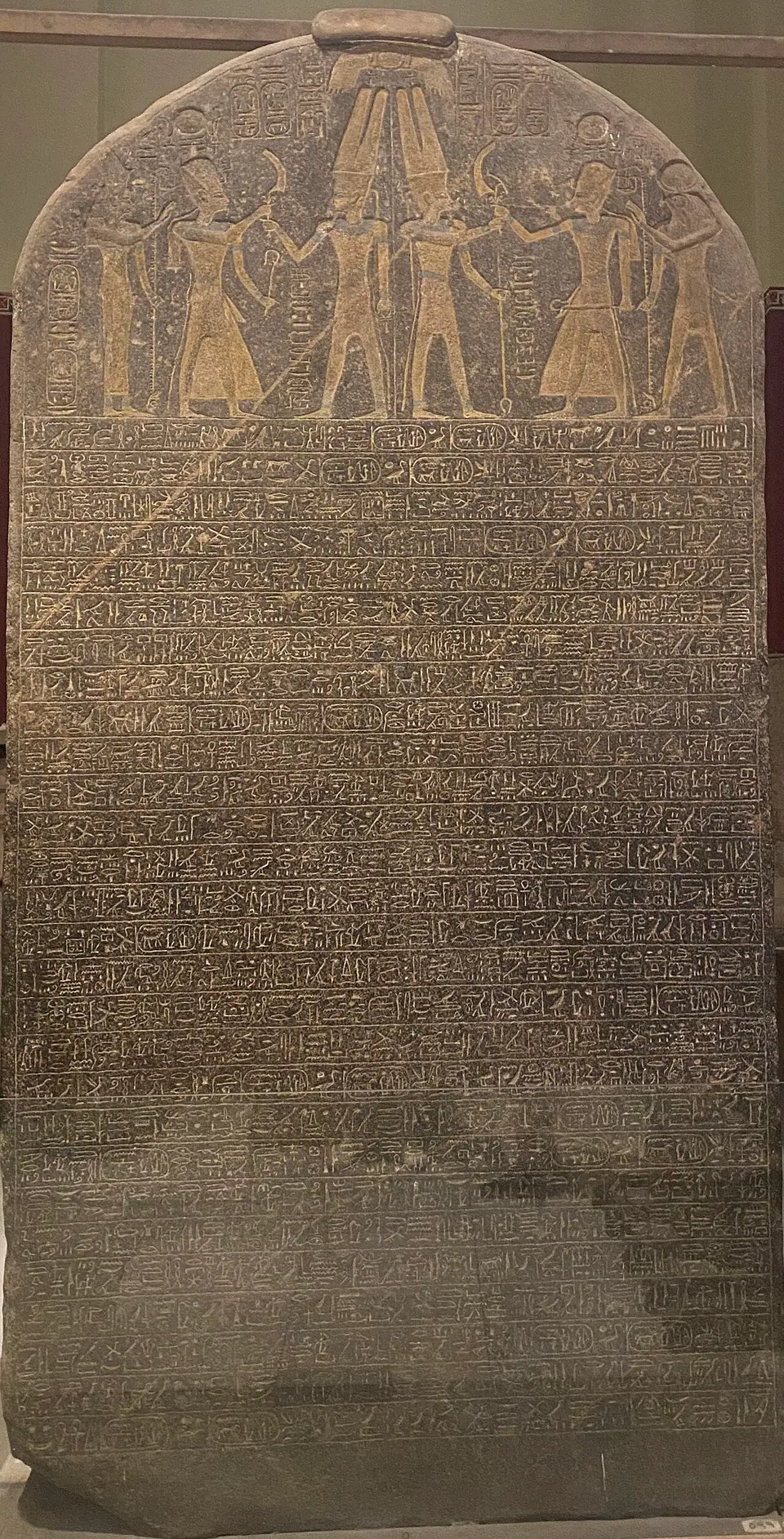
The earliest mention of Israel anywhere is on a granite victory stele of the pharaoh Merneptah, from about 1208 BCE: “Israel is laid waste, his seed is not”. The word is written with the sign for a people, not a land.[1] An earlier Egyptian list, from the temple of Amenhotep III at Soleb in Nubia, c. 1390–1350 BCE, names a “land of the Shasu, Yhw”, a place or group of nomads south of Canaan whose name may be connected with Yahweh’s; whether it is, is debated (§1, §2).[2] Contested on the meaning.
On the Hindu side, a treaty of c. 1350–1320 BCE between the Hittite king and the king of Mitanni in northern Syria invokes as witnesses Mitra, Varuṇa, Indra and the Nāsatyas, the gods of the Rigveda.[3] Consensus
What it shows. On this test the two are close: the Mitanni gods and the Soleb Yhw are roughly contemporary, and the Merneptah Stele is about 140 years later. But the Mitanni treaty names gods of a recognisable religious tradition, while the Soleb list names a place or people whose link to the later god of Israel is uncertain. The first securely dated mention of Yahweh as a god is the Moabite Mesha Stele of about 840 BCE.[4] Majority
Test 2: the oldest scripture
The Rigveda’s oldest layer, the six “Family Books”, was composed orally in the Punjab, most likely c. 1500–1200 BCE on the mainstream dating.[5][6] Majority Some date it much earlier; most specialists do not (see the Hinduism series).
The oldest parts of the Hebrew Bible are probably a few poems, such as the Song of Deborah in Judges 5, which many scholars date between the twelfth and tenth centuries BCE, though the dating is disputed.[7] Most of the Torah took its present shape much later: a core of Deuteronomy in the seventh century, the Priestly writing around the exile, and the final form of the five books in the Persian period (§0, §5).[8] Majority
What it shows. The oldest Vedic hymns are older than the oldest biblical texts by a few centuries on the mainstream datings. The Bible’s main books are later still.
Test 3: the oldest surviving text
Here the comparison turns the other way. The oldest surviving text with a biblical parallel is the priestly blessing of Numbers 6:24–26, scratched on two small silver amulets found at Ketef Hinnom in Jerusalem and dated to about 600 BCE.[9] The Dead Sea Scrolls preserve copies of almost every biblical book from about 250 BCE on (§0). The Rigveda, by contrast, was preserved by a memorisation system so exact that it needed no writing. When it was first written down is not recorded, but it cannot have been before writing appears in India, in Ashoka’s edicts of c. 250 BCE, so at least a thousand years after its composition and perhaps much longer; its surviving manuscripts are far later.[10][11][6] Consensus
What it shows. That “oldest” depends on the medium. Judaism’s scriptures were written early and copied by scribes; the Veda was kept in memory, with astonishing accuracy, for centuries before it was written.
Test 4: the same religion?
Both traditions fail this test in instructive ways, and they fail it in similar ways.
The earliest Israelites worshipped Yahweh among other gods. In some inscriptions of about 800 BCE he has a consort, Asherah; the oldest reading of Deuteronomy 32 has the Most High divide the nations among the “sons of God”; and explicit monotheism, “I am Yahweh and there is no other”, is first stated in the prophecies of the exile in the sixth century BCE (§2, §4).[8] The Temple and its sacrifices, the centre of biblical religion, ended in 70 CE, and Judaism as practised today, with synagogue, prayer, Talmud and rabbis, is the rabbis’ rebuilding after that (§7). Majority
The Rigveda’s leading gods, Indra and Agni, are barely worshipped now, while Viṣṇu and Rudra-Śiva have only a handful of its hymns; it has no temples, no images, no karma, no rebirth and no devotion in the later sense.[6] Majority
What it shows. Each tradition has a real continuity of people, language and practice: Hebrew Torah is still read aloud in synagogues, and Vedic hymns are still recited. And each has changed its core beliefs and rituals since its oldest texts. Neither is the religion of its oldest scripture.
Test 5: each tradition’s own account
Judaism dates the world, not itself. The Jewish calendar counts from Creation, which rabbinic chronology places in 3761 BCE, so the year 5787 began in September 2026, and the Seder Olam places the giving of the Torah at Sinai in the year 2448 from Creation, conventionally 1313 BCE (§1).[12] Hindu tradition calls itself sanātana dharma, the eternal order, and treats the Veda as eternal and authorless.[13] These are theological claims. A historian can describe them but not test them, and they should not be compared as if they were archaeological dates. Consensus
A short timeline
| Date | Judaism | Hinduism |
|---|---|---|
| c. 1500–1200 BCE | — | Oldest Rigvedic hymns composed[6] |
| c. 1390–1350 BCE | “Land of the Shasu, Yhw” at Soleb[2] | — |
| c. 1350–1320 BCE | — | Vedic gods named in the Mitanni treaty[3] |
| c. 1208 BCE | “Israel” on the Merneptah Stele[1] | — |
| c. 840 BCE | Yahweh named on the Mesha Stele[4] | — |
| c. 700–500 BCE | Deuteronomy; the exile; explicit monotheism[8] | Karma and rebirth first stated in the Upaniṣads[14] |
| c. 600 BCE | Ketef Hinnom amulets[9] | — |
| 70 CE onward | The rabbinic rebuilding after the Temple | Temples, images and the great gods take shape (c. 300–650 CE)[15] |
Common misconceptions
- “Judaism is the oldest monotheistic religion, so it is the oldest religion.” Monotheism in Judaism emerged gradually and was stated explicitly only around the sixth century BCE; the tradition’s roots are older than its monotheism.[8]
- “Hinduism is 10,000 years old, so it is obviously older.” Claims of very great age rest on possible links to the Indus civilisation and earlier, which are plausible but not demonstrable (see the Hinduism series). The datable evidence starts in the second millennium BCE.
- “Judaism goes back to Abraham, so it began around 2000 BCE.” The patriarchal dates come from biblical chronology, written down many centuries later; there is no external evidence for Abraham (§1). For believers that does not settle the question; for historians it means the date cannot be checked.
Why it matters
Questions of age are often questions of standing, and on this one both traditions have a strong case: each is among the oldest living religious traditions in the world, each has scripture more than two and a half thousand years old that is still read or recited, and each has survived by changing. The honest answer is that the oldest datable layer of Hinduism is a few centuries older than the oldest datable evidence for Israel and its god, and that neither tradition today is the religion of its oldest texts. For how the evidence for ancient Israel is dated see Chapter 0: How We Know; for Israel’s origins and Yahweh see §1 and §2; for the Hindu side see the Hinduism series.
References
- ^ a b Merneptah Stele — Egyptian Museum, Cairo. c. 1208 BCE. Egyptian (hieroglyphic). A victory hymn of Pharaoh Merneptah naming "Israel" as a people: the earliest mention of Israel outside the Bible. about
- ^ a b Soleb temple list, "Land of the Shasu, Yhw" — Temple of Amenhotep III at Soleb, Nubia. c. 1390–1350 BCE. Egyptian (hieroglyphic). Names a land or group of Shasu nomads as Yhw, possibly the earliest trace of the name Yahweh; repeated in a list of Ramesses II at Amara West. Whether it refers to the god is debated. about
- ^ a b Mitanni–Hittite treaty — Boğazköy archive. c. 1350–1320 BCE. Akkadian, with Indo-Aryan divine names. Invokes Mitra, Varuṇa, Indra and the Nāsatyas as witnesses — Indo-Aryan gods attested in writing in the Near East more than a thousand years before the earliest deciphered writing from India. about
- ^ a b Mesha Stele — Louvre AO 5066. c. 840 BCE. Moabite. King Mesha of Moab names Omri king of Israel and boasts of taking the vessels of YHWH from Nebo and dragging them before Chemosh: the earliest certain mention of Yahweh outside the Bible. about
- ^ Michael Witzel "Early Sanskritization: Origins and Development of the Kuru State". Electronic Journal of Vedic Studies 1(4); repr. in B. Kölver, ed., Recht, Staat und Verwaltung im klassischen Indien (Oldenbourg, 1997): 27–52, 1995. doi The Kuru state thesis — canonization as a political project.
- ^ a b c d Stephanie W. Jamison & Joel P. Brereton, trans. The Rigveda: The Earliest Religious Poetry of India. Oxford University Press, 3 vols., 2014. The standard complete English translation. Supersedes Griffith entirely.
- ^ Judges 5:4–5 — Song of Deborah (Hebrew Bible). c. 1100–900 BCE (debated). Hebrew. Yahweh marches out from Seir and the field of Edom as a storm god; the mountains quake before "the One of Sinai". Among the oldest poems locating Yahweh in the south. read the text
- ^ a b c d Mark S. Smith The Early History of God: Yahweh and the Other Deities in Ancient Israel. Eerdmans, 2nd ed., 2002. open library How Israelite religion emerged from its Canaanite setting and became monotheistic.
- ^ a b Ketef Hinnom amulets (KH1, KH2) — Israel Museum, Jerusalem. c. 650–587 BCE. Hebrew. Two rolled silver amulets from a Jerusalem burial cave containing a form of the priestly blessing of Num 6:24–26: the oldest surviving text paralleling a biblical verse. about
- ^ Richard Salomon Indian Epigraphy. Oxford University Press, 1998. open library The standard handbook for inscriptions and their dating.
- ^ Rock Edict 13 — Ashokan edicts. c. 256 BCE. Prakrit in Brāhmī. Names five Hellenistic kings whose reigns are independently dated — the peg the entire Indian chronology hangs from. read the text
- ^ Seder Olam Rabbah — Seder Olam Rabbah (Hebrew). c. 2nd c. CE (attributed to Yose ben Halafta). Hebrew. The rabbinic chronology from creation to Alexander, on which the traditional Jewish dating of the Exodus to the year 2448 from creation rests. read the text
- ^ Gavin Flood An Introduction to Hinduism. Cambridge University Press, 1996. open library The standard university textbook, and the most balanced single overview.
- ^ Patrick Olivelle, trans. The Early Upaniṣads: Annotated Text and Translation. Oxford University Press, 1998. full text The scholarly standard. Its introduction is the best short account of the period.
- ^ Michael Willis The Archaeology of Hindu Ritual: Temples and the Establishment of the Gods. Cambridge University Press, 2009. Includes the re-edition that undoes the "first Tantric temple" reading of Gaṅgdhār.