The Babylonian exile in one paragraph
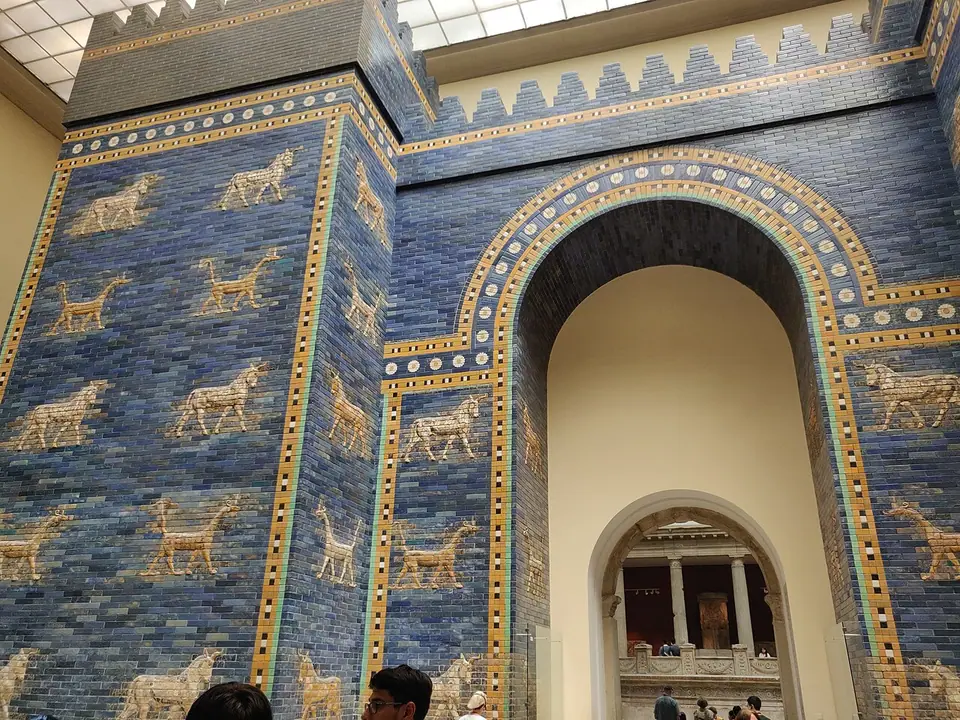
Between 597 and 582 BCE the Babylonian king Nebuchadnezzar II captured Jerusalem twice, deported its king and much of its elite to Babylonia, burned the Temple of Yahweh, and ended the kingdom of Judah. For the people who had worshipped Yahweh as the god of a land, a dynasty and a temple, all three were gone. Some concluded that Yahweh had been defeated, or that other gods had been offended. The writers whose work survives in the Bible drew the opposite conclusion: Yahweh had punished his own people, using Babylon as his instrument, and therefore he was not merely Judah’s god but the ruler of all nations. In the 540s an anonymous prophet in Babylonia went further than anyone before him and declared that no other god exists. When Cyrus of Persia took Babylon in 539, some exiles returned, many stayed, and the religion they carried was no longer tied to one place. Majority
The exile is the hinge of this series. The religion of the earlier chapters (§2, §3) is Israelite religion: a national cult with a king and temples. What comes out of the sixth century is recognisably the ancestor of Judaism: a people defined by a book, by practices that work anywhere, and by belief in one God. The change was not completed in these sixty years, and much of the Bible’s account of it was written afterwards, but this is where most historians place its decisive turn. Majority
Timeline of the exile and its evidence
Biblical and Babylonian dates are converted to the Julian calendar. Where the year of an event is disputed by one, the alternatives are given.
| Date | Event or evidence | Confidence |
|---|---|---|
| 605 BCE | Nebuchadnezzar defeats Egypt at Carchemish; Judah becomes a Babylonian vassal[1] | Consensus |
| 16 March 597 BCE | Babylon captures “the city of Judah” and its king; Jehoiachin and the elite are deported[2] | Consensus |
| 593 BCE | Ezekiel, a deported priest, sees his first vision by the Chebar canal in Babylonia[3] | Majority |
| 592/591 BCE | Ration lists in Babylon record oil for “Ya’u-kinu, king of the land of Yahudu” and his five sons[4] | Consensus |
| 587/586 BCE | Jerusalem falls after a siege; the Temple is burned and more of the population deported[5] | Consensus (event); Contested (year) |
| c. 586–582 BCE | Gedaliah, the Babylonian-appointed governor at Mizpah, is murdered; a group flees to Egypt taking Jeremiah[6] | Majority |
| 582/581 BCE | A third deportation of 745 people[5] | Majority |
| 572 BCE | The earliest dated tablet from Āl-Yāhūdu, “Judah-town”, in Babylonia[7] | Consensus |
| 562 BCE | Amel-Marduk (biblical Evil-merodach) releases Jehoiachin from prison: the last event in the books of Kings[8] | Majority |
| c. 550–539 BCE | The prophet known as Second Isaiah announces Cyrus and declares that no god but Yahweh exists[9] | Majority |
| October 539 BCE | Cyrus of Persia takes Babylon without a siege[10] | Consensus |
| 539/538 BCE | The Cyrus Cylinder proclaims the return of gods and peoples to their cities; Ezra 1 dates a decree for Judah to his first year[11][12] | Consensus (Cylinder); Contested (decree) |
| 520–515 BCE | The Temple in Jerusalem is rebuilt (§5) | Majority |
| 477 BCE | The latest dated Āl-Yāhūdu tablet; Judeans are still living there two generations after Cyrus[7] | Consensus |
The catastrophe: 597, 586 and 582 BCE
Judah’s last decades were spent between two empires. After Nebuchadnezzar defeated Egypt at Carchemish in 605 BCE, Judah paid tribute to Babylon, then rebelled, encouraged by Egypt. The Babylonian response came in two waves.[1][13] Consensus
597 BCE. A Babylonian chronicle tablet in the British Museum records the first capture of Jerusalem in the dry style of a royal annal: in Nebuchadnezzar’s seventh year he “encamped against the city of Judah, and on the second day of the month Adar he seized the city and captured the king.”[2][1] The date corresponds to 16 March 597 BCE, one of the most precisely dated events in the history of ancient Israel. The young king Jehoiachin was taken to Babylon with his family, his officials, the army’s leading men and the city’s craftsmen; Nebuchadnezzar installed his uncle Zedekiah in his place. Consensus
587/586 BCE. Zedekiah also rebelled. After a siege of about eighteen months, the Babylonian army breached the walls, and a month later Nebuzaradan, commander of the guard, burned “the house of Yahweh, the king’s house and all the houses of Jerusalem” (2 Kings 25:9). Zedekiah’s sons were killed in front of him, he was blinded and taken to Babylon.[14] The year is either 587 or 586 BCE, depending on how the regnal years in Kings and Jeremiah are synchronised with the Babylonian calendar; scholars are split.[15] Consensus on the event; Contested on the year.
The excavated remains bear it out. Destruction layers with burned buildings and arrowheads are found across Jerusalem’s City of David and at the fortresses of Lachish and Arad, and the last Lachish letters, written as the Babylonian army advanced, report that the signal fires of Azekah could no longer be seen.[16][17] Consensus
582/581 BCE. Babylon appointed a Judahite official, Gedaliah, as governor at Mizpah, north of Jerusalem. He was murdered by a member of the royal family (Jeremiah 41:1 gives the month but not the year; some date it to 586, others to 582), and a group of Judahites, fearing reprisals, fled to Egypt and took the prophet Jeremiah with them (Jeremiah 40–44). Jeremiah records a third deportation in Nebuchadnezzar’s twenty-third year, which may have been the reprisal.[5] Majority
How many were deported?
The Bible gives two sets of numbers. 2 Kings 24:14–16 says that ten thousand were taken in 597, including seven thousand fighting men and a thousand craftsmen.[13] Jeremiah 52:28–30 lists three deportations: 3,023 “Judeans” in 597, 832 “from Jerusalem” in 587/586 and 745 in 582, “four thousand six hundred persons in all”.[5] Jeremiah’s precise figures look like they come from an administrative list and probably count adult men. On any reckoning the deportees were a minority of Judah’s population, but they included the people who had run the state and the Temple. Majority
Was the land empty?
The Bible’s later account presents the land as emptied: “to fulfil the word of Yahweh by the mouth of Jeremiah, until the land had enjoyed its sabbaths; all the days that it lay desolate it kept sabbath, to fulfil seventy years” (2 Chronicles 36:21).[18] That picture serves a purpose: it makes the returning exiles the true Israel, and those who stayed behind irrelevant.
Archaeology does not support an empty land. Jerusalem and the area around it were devastated and largely abandoned. But the region of Benjamin to the north, including Mizpah, shows continuity of settlement through the sixth century, and much of the Judahite countryside was not destroyed. Robert Carroll and Hans Barstad called the biblical picture “the myth of the empty land”.[19][20] Oded Lipschits, accepting continuity in Benjamin, still estimates that Judah’s population fell from roughly 110,000 before the destruction to around 40,000 afterwards, a loss of some 60 per cent, with the heaviest losses in and around Jerusalem.[15] At the other end of the debate, Ephraim Stern argued for a “Babylonian gap”: a collapse of settlement so severe that, outside Benjamin, the land was close to empty, much as Chronicles says.[17] The question is now less whether people stayed than how many.[21] Majority that a large population remained; Contested on the scale of the collapse.
The distinction matters for the history of religion. The texts that shaped later Judaism were written largely by and for the deportees and their descendants. The religion of those who stayed in Judah, and of those who went to Egypt, survives only where those writers chose to mention it. Majority
The exiles: a king on rations and a village called Judah
Until the twentieth century the exile was known only from the Bible. Two groups of cuneiform tablets now show it from the Babylonian side.
Jehoiachin’s rations
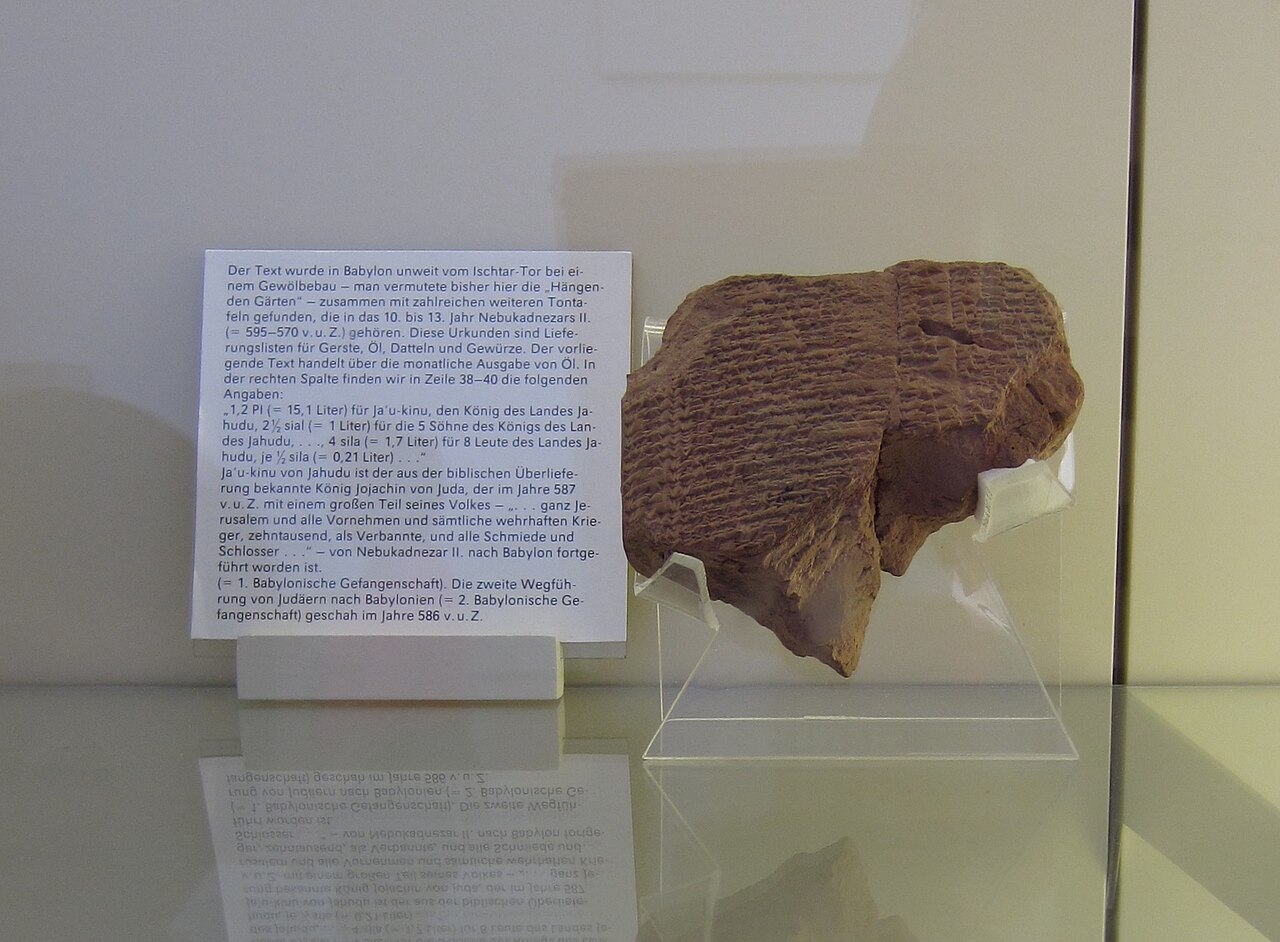
Between 1899 and 1917 a German expedition led by Robert Koldewey excavated Babylon. In vaulted rooms of Nebuchadnezzar’s Southern Palace, near the Ishtar Gate, they found about three hundred administrative tablets recording rations of oil and grain issued from the royal stores to foreign dependants: Egyptians, Philistines from Ashkelon, Phoenicians from Tyre, Byblos and Arvad, Lydians and Greeks. Ernst Weidner published the tablets that mention Judah in 1939.[22][23] Among the recipients is “Ya’u-kinu, king of the land of Yahudu”, that is, Jehoiachin, king of Judah, with his five sons. One of the tablets is dated to Nebuchadnezzar’s thirteenth year, 592/591 BCE.[4] Consensus
This is a rare case of a biblical figure documented in a foreign administrative archive. It confirms that Jehoiachin was held in Babylon as a royal hostage, kept his title and was fed at the palace’s expense; 2 Kings 25:27–30 says that he was later released from prison and “ate bread in the king’s presence” for the rest of his life.[8] Consensus
Judah-town: the Āl-Yāhūdu tablets
The more important find came from the antiquities market. Since the 1990s about two hundred cuneiform tablets have surfaced that were written in a cluster of villages in central Babylonia, the best documented of them called Āl-Yāhūdu, “town of Judah” (early tablets say “town of the Judeans”). The earliest is dated 572 BCE, fifteen years after the destruction of Jerusalem; the latest 477 BCE. Laurie Pearce and Cornelia Wunsch published a first group of 103 in 2014, and further volumes have followed.[7][24] Consensus
The tablets are ordinary documents: leases, promissory notes, receipts for taxes paid in dates and barley, a few marriage agreements. They show what life in exile was for most deportees. Judeans were settled as dependent farmers on royal land along the canals, in villages often named after their places of origin, owing taxes and labour service to the crown. They were not slaves, and they were not in ghettos; they did business with Babylonian neighbours and used Babylonian scribes and law.[24][23] Majority
The names are the religious evidence. Many people in the tablets have names built on Yahweh, written in cuneiform as -ia-a-ma or -ia-ḫu-ú, and these names continue into the third and fourth generation, alongside children given Babylonian names. A few people are called Šabbatāya, “born on (or belonging to) the Sabbath”.[7][24] A community that kept naming its children after Yahweh for a century in a land of other gods had not given up its god. Majority
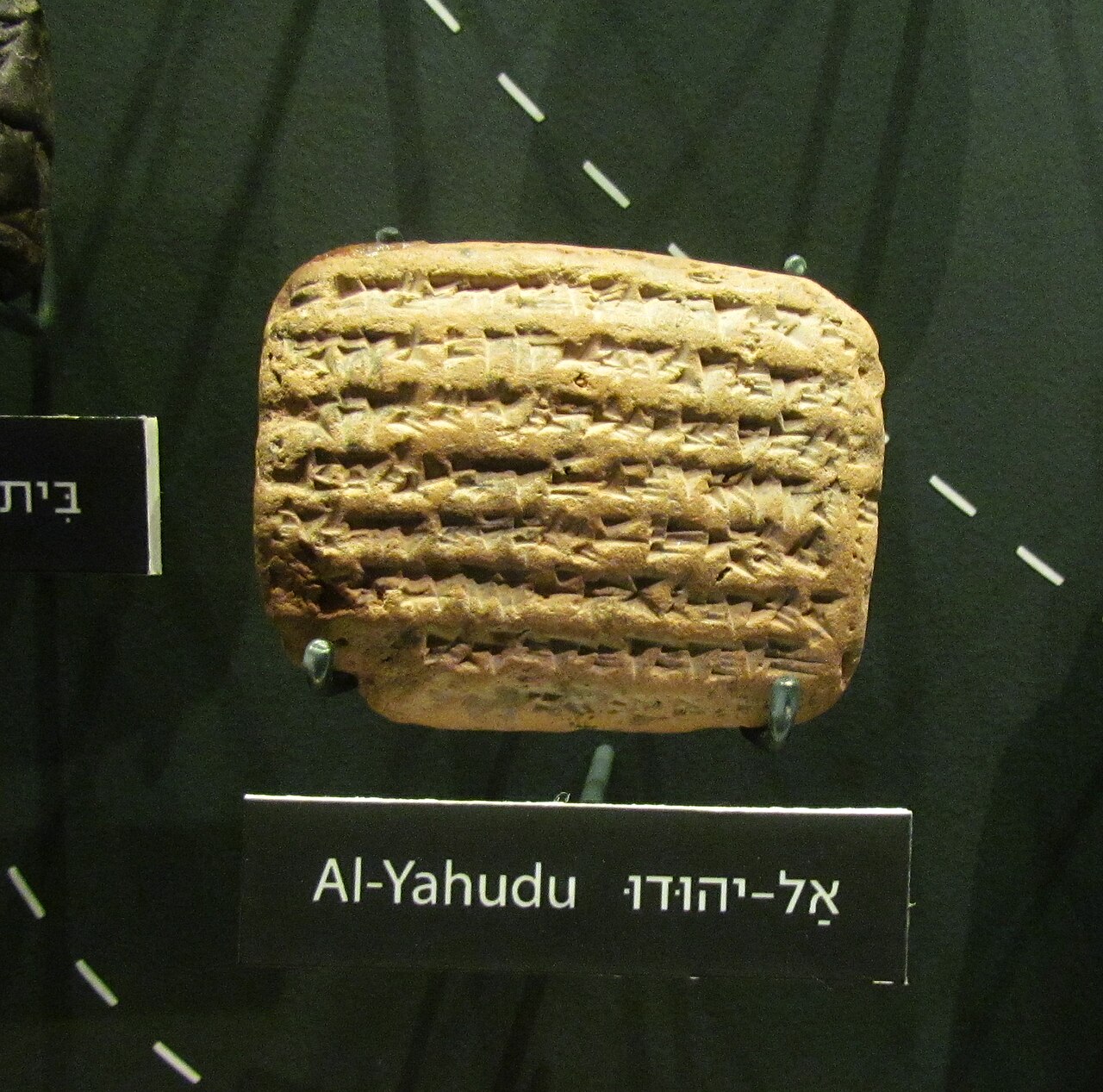
There is a cost to this evidence. The tablets have no recorded findspot and probably came from illicit digging in Iraq. Their authenticity is not seriously doubted, since they match known Babylonian archives in every detail, but where exactly Āl-Yāhūdu lay is unknown, and the context that an excavation would have provided is lost. Consensus
Explaining the disaster
A temple destroyed by enemies was a theological event. In the ancient Near East, the fall of a city was commonly read as the anger or departure of its god, and sometimes as a victory of the conquerors’ gods. Judah’s survivors had several explanations available, and the Bible preserves more than one of them. Consensus
“Yahweh has forsaken the land.” Ezekiel quotes people in Jerusalem saying, before the fall, “Yahweh does not see us; Yahweh has forsaken the land” (Ezekiel 8:12). The same chapter shows what he considered the reason: in the Temple courts, women weeping for the Mesopotamian god Tammuz and men bowing to the sun.[25]
The queen of heaven. The most striking alternative is recorded by Jeremiah among the refugees in Egypt. When he tells them that the disaster was punishment for worshipping other gods, they reply that the opposite is true: as long as they made offerings to “the queen of heaven”, Judah prospered, and since they stopped (presumably under Josiah’s reform) they have “lacked everything”.[6] For these Judahites, the catastrophe proved that the reform was the mistake. Consensus on the text.
The Deuteronomistic answer. The answer that won is the one built into the books from Deuteronomy to Kings. In 1943 Martin Noth argued that these books form a single history, edited in the exile to explain the fall: Israel and Judah were destroyed because they worshipped other gods and at other sanctuaries, against the law of Deuteronomy.[26] Kings blames the sins of King Manasseh, “for the innocent blood that he had shed, for he filled Jerusalem with innocent blood, and Yahweh would not pardon” (2 Kings 24:3–4).[27] Its final paragraph, Jehoiachin’s release in 562, is the last datable event it reports, and dates its completion to the exile or soon after. Majority
The consequence of this answer was enormous. If Babylon was Yahweh’s instrument, Yahweh had not lost; he controlled Babylon. A national god whose nation had been destroyed survived by becoming the god of history itself. Majority
Religion without a temple
The deportees in Babylonia could not offer sacrifice: Deuteronomy allowed it only in the place Yahweh chose, and that place was in ruins. What they could do was keep practices that needed no temple, and these became the identity markers of Judaism.[28] Majority
- The Sabbath. A day of rest at the end of the week is older than the exile: Amos and Hosea mention it in the eighth century, and a field worker’s complaint from Yavneh-Yam c. 630 BCE may refer to work finished “before the Sabbath”.[29] But in exilic and later texts it becomes a sign of the covenant itself. The Priestly writer roots it in creation (God rests on the seventh day, Genesis 2:2–3) and calls it “a sign between me and you throughout your generations” (Exodus 31:13).[30] Majority
- Circumcision. Widely practised in the Levant and Egypt, it was not distinctive at home. In Babylonia, where it was not practised, it marked Judeans off from their neighbours; the Priestly writer makes it the “sign of the covenant” with Abraham (Genesis 17:11).[31] Majority
- Food rules and purity, likewise portable, became markers of separateness, though their full development is later (§5, §6). Majority
- Prayer and assembly. Ezekiel’s elders gather at his house to ask the word of Yahweh (Ezekiel 8:1; 14:1; 20:1). Rabbinic tradition later read Ezekiel 11:16, “I have been to them a little sanctuary in the countries where they have gone”, as a reference to the synagogues of Babylonia.[32][33] There is no evidence for synagogue buildings in this period; the earliest are from the third century BCE in Egypt (§6). Speculative that the synagogue began in the exile.
Babylon in Judaism. The exiles also brought Babylon home. The Jewish month names still in use, Nisan, Iyyar, Tishri, Kislev, Adar and the rest, are Babylonian. The Jerusalem Talmud says so itself: “the names of the months came up with them from Babylon”.[34] Earlier biblical texts number the months or use Canaanite names. The square Hebrew script used ever since replaced the older Hebrew alphabet under Aramaic influence in the following centuries. Consensus
The Priestly creation account of Genesis 1, which most scholars date to this period or soon after, can be read in the same setting. Its God creates by word, without a battle; the sun and moon are “lights”, not gods; and the watery deep, tĕhôm, is a cognate of the name of Tiamat, the sea monster whom Marduk splits in the Babylonian epic Enuma Elish. Many scholars read Genesis 1 as a quiet polemic against Babylonian cosmology; others think the shared terms are common Semitic stock.[35][36] Contested
Second Isaiah: “there is no other”
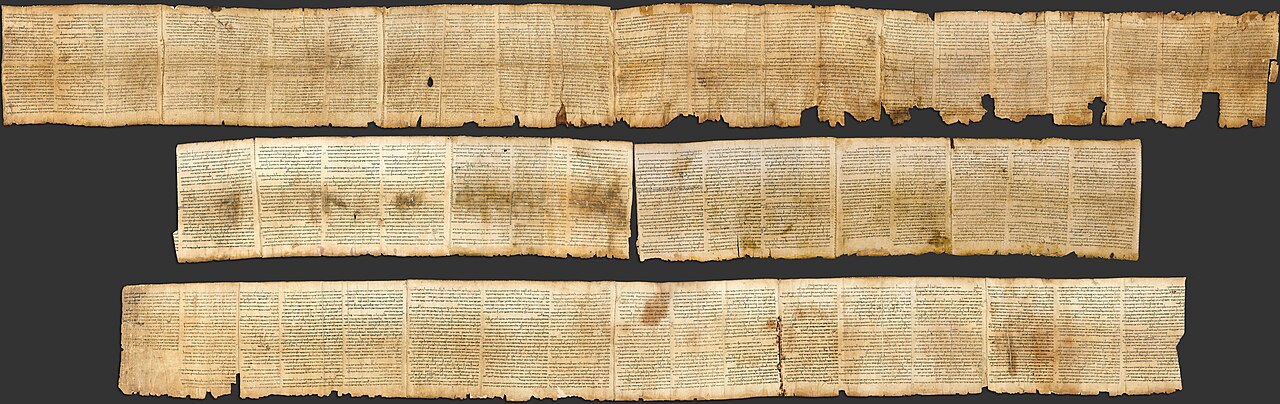
The book of Isaiah has sixty-six chapters. Chapters 1–39 contain the oracles of Isaiah son of Amoz, active in Jerusalem c. 740–700 BCE, with later additions (§3). Chapters 40–55 address a different world. Jerusalem lies in ruins and is to be rebuilt; the audience is in Babylon; the Persian king Cyrus is named twice, as Yahweh’s “shepherd” and his “anointed” (44:28; 45:1). Since the late eighteenth century, critical scholars have attributed these chapters to an anonymous prophet of the exile, known as Second Isaiah or Deutero-Isaiah, active around 550–539 BCE, as Cyrus’s rise made the fall of Babylon look likely.[37] Majority
Second Isaiah is where the Bible first says, unmistakably and repeatedly, that no other god exists:
- “I am the first and I am the last; besides me there is no god” (44:6).[38]
- “Before me no god was formed, nor shall there be any after me” (43:10).[39]
- “I am Yahweh, and there is no other; besides me there is no god” (45:5).[9]
- “Turn to me and be saved, all the ends of the earth! For I am God, and there is no other” (45:22).[40]
Earlier texts demand that Israel worship no other god than Yahweh, or claim that Yahweh is greater than the gods.[41] These verses deny that the other gods are gods at all. Majority
The argument has three strands, and each answers the crisis of the exile.
- Yahweh controls history. He predicted events and brought them about; the gods of Babylon cannot say what will happen. Cyrus’s victories are Yahweh’s doing, though Cyrus “does not know” him (45:4). The empire that destroyed Jerusalem is about to fall to an instrument of Judah’s god.
- Yahweh made everything. He stretched out the heavens and created light and darkness, peace and evil (45:7). There is no second power responsible for disaster, and so no rival who could have defeated him.
- Idols are nothing. Second Isaiah mocks the making of divine images at length: a carpenter cuts a tree, cooks his dinner over half of it, and bows down to the other half (44:9–20). The great gods of Babylon, Bel and Nabu, are loaded onto pack animals when their city is in danger: “Bel bows down, Nebo stoops” (46:1).[38][42] Majority
Deuteronomy 4, which most scholars regard as an exilic addition framing the older law code, says the same in prose: “Yahweh is God; there is no other besides him” (4:35, 39).[43] The same chapter, however, says that Yahweh allotted the sun, moon and stars to the other nations to worship (4:19), which shows how recently the idea had been formulated. Majority
From one god to the only God
The development the last three chapters have traced can now be put in sequence. Historians of religion distinguish three positions, and the Bible contains all three. Consensus on the distinction.
| Position | Meaning | Biblical example | Period in which it dominates |
|---|---|---|---|
| Polytheism with a chief god | Yahweh heads or belongs to a council of gods; other deities, such as Asherah, are worshipped alongside him | Deuteronomy 32:8–9 (older reading); the Kuntillet ʿAjrud blessings (§2) | Before c. 750 BCE |
| Monolatry (“Yahweh alone”) | Israel must worship only Yahweh; other gods exist but are not Israel’s | “You shall have no other gods before me” (Exodus 20:3); Hosea; Josiah’s reform (§3) | c. 750–586 BCE |
| Monotheism | No other god exists | Isaiah 43–46; Deuteronomy 4:35, 39 | From the exile |
Some scholars think “monotheism”, a word coined in the seventeenth century, misdescribes even Second Isaiah. Nathan MacDonald argues that Deuteronomy’s claims are about Yahweh’s uniqueness and Israel’s loyalty, not a philosophical denial that other divine beings exist; others note that angels, the “host of heaven” and later Satan continue to populate the biblical heavens.[44] The majority position is that Second Isaiah’s denials are explicit enough that the label fits, as long as it is not taken to mean a heaven without other spiritual beings. Contested
Who drove the change? Morton Smith and Bernhard Lang described a “Yahweh-alone movement”: a minority party of prophets, priests and officials who campaigned from the ninth century onward for exclusive worship of Yahweh, won royal backing under Hezekiah and Josiah, and after 586 found its explanation of the disaster confirmed and its writings preserved.[45][46] Most historians accept some version of this picture, while noting that “party” may overstate how organised it was. Majority
Cyrus: Yahweh’s anointed and Marduk’s chosen
In October 539 BCE Cyrus of Persia, who had already conquered Media and Lydia, took Babylon, by most accounts without a siege. Its king Nabonidus had alienated the priests of Babylon’s god Marduk by neglecting his New Year festival and spending ten years at the Arabian oasis of Tayma. Cyrus presented himself as Marduk’s restorer.[10][11] Consensus
Second Isaiah presented him as Yahweh’s: “Thus says Yahweh to his anointed, to Cyrus, whose right hand I have grasped, to subdue nations before him … I call you by your name, I name you, though you do not know me” (45:1, 4).[9] Anointed, māšîaḥ, is the title of Israel’s kings; a foreign king who did not worship Yahweh is given it. Consensus
The Cyrus Cylinder. A barrel-shaped clay cylinder found at Babylon by Hormuzd Rassam in 1879, now in the British Museum, records Cyrus’s own account, written in Babylonian for a Babylonian audience. It describes Marduk searching for a righteous king, “grasping the hand” of Cyrus and calling him by name, and Cyrus restoring the neglected cults of Babylonia and returning gods and peoples to their homes.[11][47] Consensus
The parallel with Isaiah 45 is close enough that some scholars, notably Morton Smith in 1963, think Second Isaiah knew and adapted Persian propaganda circulating in Babylon before the conquest, recasting Marduk’s choice as Yahweh’s.[48] Contested
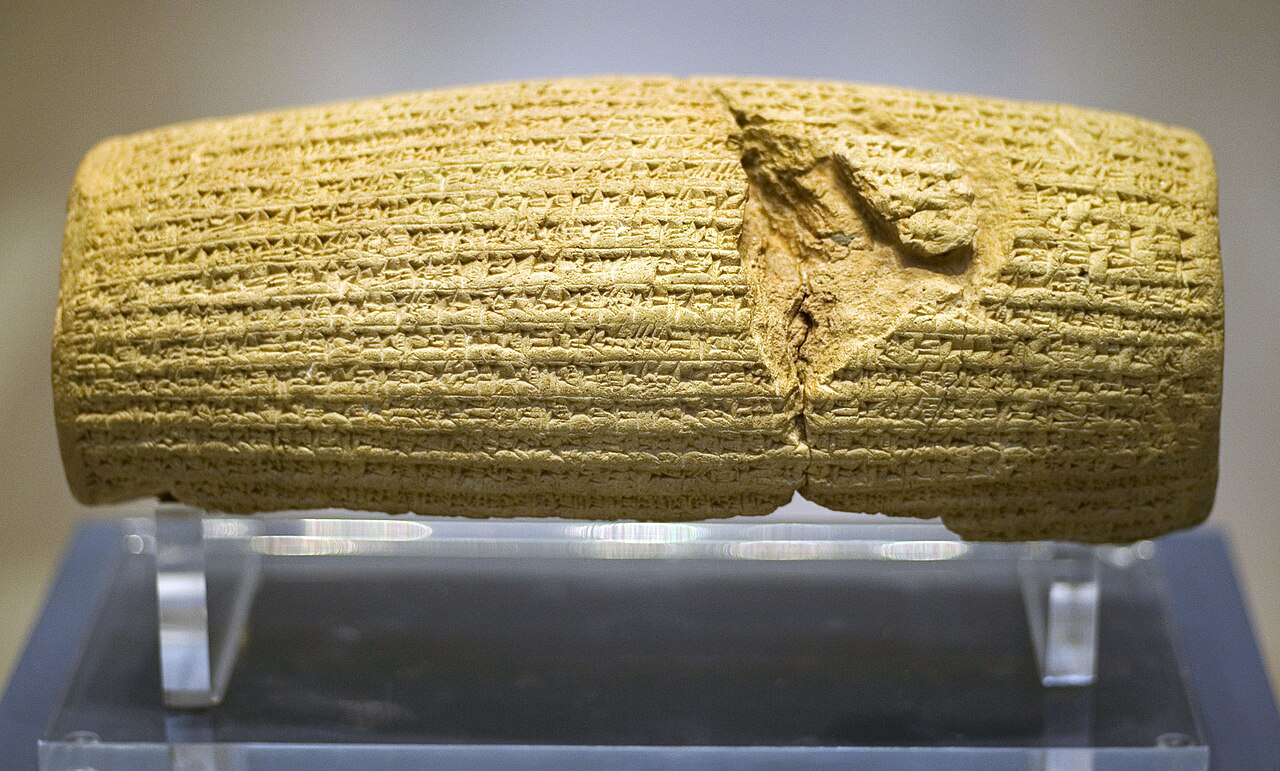
What the Cylinder does not say. It never mentions Judah, Jerusalem or Yahweh. The places it names are cities of Mesopotamia and western Iran, and the gods it returns are those of long-ruined shrines beyond the Tigris and images that Nabonidus had brought into Babylon. Amélie Kuhrt showed in 1983 that its language follows Assyrian and Babylonian royal inscriptions: a conqueror restoring order after a “bad” predecessor is a stock theme, not evidence of a new policy of tolerance.[49] The popular description of the Cylinder as “the first charter of human rights” is a twentieth-century reading that historians reject. Majority
The edict in Ezra. The book of Ezra quotes a decree of Cyrus twice: in Hebrew as a public proclamation (Ezra 1:2–4), allowing all Judeans to go up and rebuild “the house of Yahweh, the God of Israel”, and in Aramaic as a filed memorandum giving the Temple’s dimensions and promising royal funding (Ezra 6:3–5).[12] Elias Bickerman argued in 1946 that both are authentic in substance, the Aramaic version especially, which reads like an administrative record.[50] Others think the Hebrew proclamation, with its Judean theology in a Persian king’s mouth, was composed later. That Cyrus allowed some Judeans to return and rebuild is probable; that he issued a decree specially for them is debated (§5). Contested
What is certain is that the return was partial. The Āl-Yāhūdu tablets run to 477 BCE; Judean names appear in the Murashu business archive of Nippur in the late fifth century, and the Babylonian Jewish community never disappeared.[23] A thousand years later it produced the Babylonian Talmud (§7, §8). Consensus
The evidence ledger for the exile
| Question | What the evidence supports | Key evidence | Confidence |
|---|---|---|---|
| The deportations | Three Babylonian deportations, 597, 587/586 and 582; the first precisely dated | Babylonian Chronicle; 2 Kings 24–25; Jeremiah 52[2][5] | Consensus |
| Scale | A minority, weighted toward the elite; most people stayed | Jeremiah’s 4,600; survey archaeology[5][15][20] | Majority |
| The king in exile | Jehoiachin held at the Babylonian court with his sons | Ration tablets, 592/591 BCE[4] | Consensus |
| Life in exile | Settled farming communities on royal land, using Babylonian law, keeping Yahweh names for generations | Āl-Yāhūdu tablets, 572–477 BCE[7][24] | Consensus |
| Explanation of the fall | Competing views: Yahweh punished Judah’s other gods; or abandoning the queen of heaven caused it | Kings; Jeremiah 44[27][6] | Consensus (texts) |
| First explicit monotheism | In Isaiah 40–55 and Deuteronomy 4, c. 550–520 BCE | Isaiah 43–46; Deuteronomy 4:35, 39[9][43] | Majority |
| Portable identity | Sabbath and circumcision raised to signs of the covenant | Priestly texts in Genesis and Exodus[30][31] | Majority |
| Babylonian imprint | Month names, script, possibly creation imagery | Jerusalem Talmud; Genesis 1[34][35] | Consensus (months); Contested (Genesis 1) |
| Cyrus and the return | Cyrus restored cults and peoples as a conqueror’s favour; a specific decree for Judah is uncertain | Cyrus Cylinder; Ezra 1 and 6[11][12][49] | Contested |
Primary sources
1. The first fall of Jerusalem: the Babylonian Chronicle
A tablet in the British Museum (BM 21946), one of a series of Babylonian chronicles that record each year’s main events, covers the early reign of Nebuchadnezzar.[2][1]
Akkadian (reverse, lines 11–13, abridged): … ina Addari ūm 2 āla iṣṣabat šarra iktašad šarra ša libbišu ina libbi ipteqid …
“Year 7: In the month Kislev the king of Akkad mustered his army, marched to the land of Hatti and encamped against the city of Judah (āl Yaḫūdu). On the second day of the month Adar he seized the city and captured the king. He appointed there a king of his own choice, received its heavy tribute and brought it to Babylon.”
What it proves. An independent Babylonian record of the capture of Jerusalem, dated to the day: 2 Adar in Nebuchadnezzar’s seventh year, 16 March 597 BCE. It agrees with 2 Kings 24:10–17 on the capture, the deportation of the king and the installation of a replacement. The chronicle for the years including 587/586 has not survived, which is one reason that date remains disputed. Consensus
2. “King of the land of Yahudu”: the ration tablets
Administrative tablets from Nebuchadnezzar’s Southern Palace, now in Berlin, list monthly oil allocations to dependants of the court.[4][22]
Akkadian (one entry): “10 sila (of oil) to Ya’u-kinu, king of the land of Yahudu; 2½ sila to the five sons of the king of the land of Yahudu.”
What it proves. That Jehoiachin was alive in Babylon around 592 BCE, still recognised as king of Judah, and supported by the crown with his family. The scribes write Judah as Yahudu, the same name that, through Hebrew Yehudi, Greek Ioudaios and Latin Iudaeus, gives English “Jew”. Consensus
3. “By the rivers of Babylon”: Psalm 137
Hebrew (v. 1, 4–5): ʿal nahărôt bābel šām yāšabnû gam-bākînû bĕzokrēnû ʾet-ṣiyyôn … ʾêk nāšîr ʾet-šîr-YHWH ʿal ʾadmat nēkār. ʾim-ʾeškāḥēk yĕrûšālāim tiškaḥ yĕmînî.
“By the rivers of Babylon, there we sat down, and wept, when we remembered Zion … How shall we sing Yahweh’s song in a foreign land? If I forget you, O Jerusalem, let my right hand forget its skill.”[51]
What it proves. The emotional memory of exile, composed by or for deportees: the canals of Babylonia, captors who demand songs, and a loyalty to Jerusalem expressed as an oath. The psalm ends with a curse on Babylon’s infants, which shows how raw that memory was. It also raises the exile’s central religious question: can Yahweh be worshipped away from his land? Majority
4. “Seek the welfare of the city”: Jeremiah’s letter
Jeremiah, still in Jerusalem, writes to the deportees of 597 against prophets who promised a quick return.
Hebrew (Jeremiah 29:7): wĕdiršû ʾet-šĕlôm hāʿîr ʾăšer higlêtî ʾetkem šāmmâ, wĕhitpallĕlû baʿădāh ʾel-YHWH, kî bišlômāh yihyeh lākem šālôm.
“Seek the welfare of the city where I have sent you into exile, and pray to Yahweh on its behalf, for in its welfare you will find your welfare.”[52]
What it proves. Two things that later Jewish life in the diaspora took as its charter: that the exiles should build houses, plant gardens and raise families in Babylonia (29:5–6), and that prayer to Yahweh is possible, and required, outside the land. The Āl-Yāhūdu tablets show exiles doing exactly that. Majority
5. The queen of heaven: Jeremiah 44
Among the refugees in Egypt, women and men answer Jeremiah’s call to repent.
Hebrew (vv. 17–18, abridged): … lĕqaṭṭēr limleket haššāmayim … wanniśbaʿ-leḥem wanniheyeh ṭôbîm wĕrāʿâ lōʾ rāʾînû. ûmin-ʾāz ḥāḏalnû … ḥāsarnû kōl.
“We will burn incense to the queen of heaven and pour out drink offerings to her, as we did, we and our fathers, our kings and our officials, in the cities of Judah and in the streets of Jerusalem. For then we had plenty of food and prospered and saw no evil. But since we stopped burning incense to the queen of heaven and pouring out drink offerings to her, we have lacked everything and have been consumed by the sword and by famine.”[6]
What it proves. That the theology which became the Bible’s was not the only reading of events. For these Judahites, a goddess worshipped by kings and commoners alike had protected them, and the reformers’ ban had brought the catastrophe. Jeremiah’s book preserves their argument in order to refute it, but it records that the worship was traditional and royal. Who the queen of heaven was, Asherah, Astarte or the Mesopotamian Ishtar, is debated. Consensus on the text; Contested on the goddess.
6. A small sanctuary: Ezekiel 11:16 and the Talmud
Ezekiel, a priest deported in 597, sees the glory of Yahweh leave the Temple and the city before the destruction (Ezekiel 10–11). He then hears:
Hebrew (Ezekiel 11:16): wāʾĕhî lāhem lĕmiqdāš mĕʿaṭ bāʾărāṣôt ʾăšer-bāʾû šām.
“Yet I have been to them a little sanctuary (or: a sanctuary for a little while) in the countries where they have gone.”[32]
The Babylonian Talmud, a thousand years later and in Babylonia, reads it this way: “‘A little sanctuary’: Rabbi Yitzḥak said, these are the synagogues and study houses in Babylonia.”[33]
What it proves. In Ezekiel’s vision Yahweh’s presence is mobile: it travels on a throne-chariot and can be with the exiles in Babylonia. The verse does not mention synagogues; the Talmud’s reading shows how the Babylonian Jewish community later understood its own origins. Majority on Ezekiel; Consensus that the synagogue reading is rabbinic.
7. Judah-town: an Āl-Yāhūdu contract
The Āl-Yāhūdu documents are written in Babylonian cuneiform and follow standard Babylonian legal formulas; the first in Pearce and Wunsch’s edition is dated by the regnal year of Nebuchadnezzar to 572 BCE.[7][24]
Typical formula (translated): “[So much] barley belonging to [a Babylonian creditor] is owed by [a man with a Yahweh name], son of [a man with a Yahweh name]. In the month [X] he will repay. Written at Āl-Yāhūdu, [day, month], year [N] of [the king].”
What it proves. The ordinariness of exile: Judeans as tenant farmers and borrowers inside the Babylonian economy, dating their contracts by Babylonian kings, while preserving Yahweh in their children’s names. Consensus
8. “There is no other”: Isaiah 45:5–7
Hebrew: ʾănî YHWH wĕʾên ʿôd, zûlātî ʾên ʾĕlōhîm … yôṣēr ʾôr ûbôrēʾ ḥōšek, ʿōśeh šālôm ûbôrēʾ rāʿ, ʾănî YHWH ʿōśeh kol-ʾēlleh.
“I am Yahweh, and there is no other; besides me there is no god. I arm you, though you do not know me … I form light and create darkness, I make peace and create evil; I am Yahweh, who does all these things.”[9]
What it proves. The first unambiguous denial in the Bible that any other god exists, joined to the claim that Yahweh is responsible for everything, including darkness and disaster. The verse leaves no room for an evil power independent of God. Jewish liturgy later softened “create evil” to “create all things” in the daily morning blessing, and the Talmud explains the change as a euphemism, which shows how strong the original statement was.[53] Majority
9. Bel bows down: Isaiah 44 and 46
Hebrew (Isaiah 46:1): kāraʿ bēl qōrēs nĕbô, hāyû ʿăṣabbêhem laḥayyâ wĕlabbĕhēmâ.
“Bel bows down, Nebo stoops; their idols are loaded on beasts and cattle.”[42]
Isaiah 44:15–17 (abridged): “Half of it he burns in the fire; over half he roasts meat and is satisfied … and the rest of it he makes into a god, his idol, and falls down to it and worships it, and prays to it and says, ‘Deliver me, for you are my god!’”[38]
What it proves. Second Isaiah knows Babylonian religion at first hand: Bel (Marduk) and Nabu (Nebo), whose statues were carried in procession at the New Year festival, are mocked as burdens for the animals that carry them. The polemic depends on equating the gods with their statues, which Babylonian theology did not do; it is satire, not a description of what Babylonians believed. Majority
10. Marduk calls Cyrus: the Cyrus Cylinder, 539/538 BCE
Akkadian (line 12, normalised): išteʾʾēma malki išaru bibil libbiša ittamaḫ qātuššu, Kuraš šar āl Anšan ittabi nibīssu.
“He [Marduk] searched for an upright king, his heart’s desire; he grasped his hand. He called the name of Cyrus, king of Anshan.”
Lines 30–32 (abridged): ”… the gods who dwell in them I returned to their places and let them dwell in eternal abodes. I gathered all their people and returned them to their settlements.”[11][47]
What it proves. Cyrus’s propaganda presented him as chosen by Babylon’s own god and as a restorer of displaced gods and peoples. The language of a god grasping the king’s hand and calling his name reappears in Isaiah 45:1–4. The return it describes concerns Mesopotamian and Iranian cities; it is compatible with a return of Judeans but does not mention one. Consensus on the text; Contested on its relevance to Judah.
11. Isaiah the comforter: Ben Sira 48:24–25
Around 180 BCE the Jerusalem sage Ben Sira praised Isaiah son of Amoz:
“By his dauntless spirit he saw the future, and comforted the mourners in Zion. He revealed what was to occur to the end of time, and the hidden things before they happened.”[54]
What it proves. “Comfort” is the first word of Isaiah 40 (naḥămû naḥămû ʿammî, “Comfort, comfort my people”). By the early second century BCE, chapters 40–55 were read as part of the eighth-century prophet’s book and as prophecy of the future. This is the root of the traditional attribution. Consensus
What is absent from the record of the exile
- An empty land. The deportations removed a minority; Benjamin and much of rural Judah continued. Majority
- A Judean temple in Babylonia. No source mentions one. Whether the “place” Kasiphia, where Ezra later finds Levites (Ezra 8:17), was a sanctuary is speculation. In Egypt, by contrast, Judeans had a temple of Yahweh at Elephantine (§5). Majority
- Synagogues. The institution is later; the earliest evidence is third-century BCE Egypt (§6). Consensus
- A complete Torah. Priestly and Deuteronomistic writing was under way; the five books as one authoritative work belong to the Persian period (§5). Majority
- Resurrection of the dead. Ezekiel’s vision of the valley of dry bones (Ezekiel 37) is about the revival of the nation: “these bones are the whole house of Israel”. Individual resurrection appears first in Daniel, c. 165 BCE (§6).[55][56] Consensus
- Satan and a dualist cosmos. Isaiah 45:7 assigns darkness and evil to Yahweh himself. The adversary figure develops in the Persian and Hellenistic periods (§5, §6). Majority
- “Jews” as a religion. Yehudim still means people from Judah. The idea of Judaism as a religion one could join is later (§5, §6). Majority
Debates about the exile
When did Israel become monotheistic?
| View | Main argument | Main proponents |
|---|---|---|
| In the exile (majority) | Explicit denials of other gods first appear in Isaiah 40–55 and Deuteronomy 4; earlier texts assume other gods exist | Smith, Römer, Albertz[36][57][58] |
| A long evolution, never complete in the Bible | “Monotheism” is a modern philosophical category; the Bible’s heaven stays full of divine beings | MacDonald[44] |
| Early, from the beginnings of Israel | Israelite religion was distinct from its neighbours from the start; personal names favour Yahweh overwhelmingly; idolatry was marginal | Kaufmann[59] |
| Traditional | Abraham recognised the one God and broke his father’s idols; the revelation at Sinai taught it to all Israel; the prophets called the people back to what they had always been commanded | Rabbinic and later Jewish tradition[60] |
The traditional view and the critical view agree on one thing: the Bible itself depicts a long struggle between Yahweh and other gods. They disagree on whether that struggle was a falling away from an original monotheism or the road to one. The evidence of §2 (El, Asherah, the council) and the dating of the explicit statements make the second reading the majority scholarly view, but the strongest form of the early view, Kaufmann’s, still has defenders on the ground that ordinary Israelites named their children almost exclusively after Yahweh. Majority
Who wrote Isaiah 40–55?
| View | Main argument |
|---|---|
| An anonymous exilic prophet (critical consensus) | The chapters address Babylonian exiles, treat Jerusalem’s destruction as past, and name Cyrus; their style and themes differ from chapters 1–39. First suggested by J. C. Döderlein (in a 1781 review, then in the 1789 edition of his Isaiah commentary) and J. G. Eichhorn (1783), and widely accepted in the nineteenth century; Bernhard Duhm (1892) further separated chapters 56–66 as “Third Isaiah”[61][37] |
| A school of Isaiah | The later chapters are the work of disciples who continued the eighth-century prophet’s tradition; this explains shared vocabulary, such as “the Holy One of Israel” |
| Isaiah son of Amoz (traditional) | The book presents itself as one, and no ancient manuscript divides it; Ben Sira and the New Testament attribute the later chapters to Isaiah, and the Talmud treats it as a single prophetic book; prediction of Cyrus by name is prophecy, which is the book’s own claim (44:24–28)[54] |
The medieval commentator Abraham ibn Ezra, in the twelfth century, reported that Rabbi Moses ha-Kohen (ibn Gikatilla) applied the opening prophecies of chapter 40 to the Second Temple period. He then mentioned Cyrus, observed that the book of Samuel runs past Samuel’s death, and ended his comment with the formula he used for opinions too delicate to state outright: “and the wise will understand”.[62] Most scholars accept the exilic dating; the school-of-Isaiah view is a common refinement. Majority
Did Persian religion shape Second Isaiah?
Mary Boyce and others have argued that Zoroastrianism, the religion of the Persian kings, influenced Judaism profoundly, and that Second Isaiah is the first point of contact.[63] The Gathas, the oldest Zoroastrian hymns, present Ahura Mazda as the wise creator, and in Yasna 44.5 Zarathustra asks him which craftsman made light and darkness, sleep and waking.[64] Isaiah 45:7, “I form light and create darkness”, could echo it, or answer it: where Zoroastrian thought assigns darkness and evil to a hostile spirit, Isaiah assigns them to Yahweh. Morton Smith listed parallels between Second Isaiah and Persian sources in 1963.[48]
Against this: there is no evidence that Judeans in Babylonia knew Zoroastrian texts before 539; the Achaemenid kings’ own religion is debated; and Second Isaiah’s monotheism grows naturally out of the Yahweh-alone tradition. The influence is more often argued for later ideas, angels, Satan and resurrection (§6), than for monotheism itself. Contested
Was the exile a crisis or an opportunity?
Daniel Smith-Christopher argues that the exile was a trauma of forced migration and that scholars have underplayed its violence, reading the exiles’ texts as the literature of a defeated, colonised people.[65] The Āl-Yāhūdu tablets show communities that settled, farmed and prospered enough to remain after Cyrus. Both are true of different people and different decades: the first generation lived through siege, massacre and deportation, and their grandchildren were Babylonian tenant farmers who chose to stay. Majority
Further reading
- Rainer Albertz, Israel in Exile: The History and Literature of the Sixth Century B.C.E. (Society of Biblical Literature, 2003) — the standard full history.
- Oded Lipschits, The Fall and Rise of Jerusalem: Judah under Babylonian Rule (Eisenbrauns, 2005) — the archaeology of those who stayed.
- Jill Middlemas, The Templeless Age (Westminster John Knox, 2007) — a short introduction to the period and its literature.
- Laurie E. Pearce and Cornelia Wunsch, Documents of Judean Exiles and West Semites in Babylonia in the Collection of David Sofer (CDL Press, 2014) — the Āl-Yāhūdu tablets.
- Joseph Blenkinsopp, Isaiah 40–55 (Anchor Bible, Doubleday, 2002).
- Irving Finkel, ed., The Cyrus Cylinder (I.B. Tauris, 2013) — the text with translation.
- Mark S. Smith, The Origins of Biblical Monotheism (Oxford, 2001), and Thomas Römer, The Invention of God (Harvard, 2015) — how monotheism emerged.
- Nathan MacDonald, Deuteronomy and the Meaning of “Monotheism” (Mohr Siebeck, 2003) — the case against the label.
References
- ^ a b c d A. K. Grayson Assyrian and Babylonian Chronicles. J. J. Augustin, 1975. Standard edition of the chronicles, including ABC 5 on the capture of Jerusalem in 597.
- ^ a b c d ABC 5 — Babylonian Chronicle of Nebuchadnezzar's early years (BM 21946). after 594 BCE. Akkadian. Records that in his seventh year Nebuchadnezzar besieged 'the city of Judah', seized it on 2 Adar (16 March 597 BCE), captured its king and appointed a king of his choice: the first fall of Jerusalem, dated to the day. about
- ^ Ezek 1:1–3 — Ezekiel (Hebrew Bible). c. 6th c. BCE. Hebrew. Ezekiel, a priest among the deportees, sees the heavens open by the Chebar canal in the land of the Chaldeans in the fifth year of Jehoiachin's exile (593 BCE). read the text
- ^ a b c d Jehoiachin ration tablets — Ration lists from the Southern Palace, Babylon (VAT 16378 and others). c. 592/591 BCE. Akkadian. Oil rations issued from Nebuchadnezzar's stores to 'Ya'u-kinu, king of the land of Yahudu' and his five sons: King Jehoiachin held at the Babylonian court. about
- ^ a b c d e f Jer 52:28–30 — Jeremiah (Hebrew Bible). c. 6th c. BCE. Hebrew. Lists three Babylonian deportations, 3,023 in 597, 832 in 587/586 and 745 in 582, 'four thousand six hundred persons in all'. read the text
- ^ a b c d Jer 44:15–18 — Jeremiah (Hebrew Bible). c. 6th c. BCE. Hebrew. Judahite refugees in Egypt tell Jeremiah that they prospered while they made offerings to 'the queen of heaven' and have lacked everything since they stopped: a rival explanation of the catastrophe. read the text
- ^ a b c d e f Āl-Yāhūdu tablets — Cuneiform archive of Judean exiles in Babylonia (Pearce and Wunsch 2014). 572–477 BCE. Akkadian. About two hundred contracts, receipts and leases written in 'Judah-town' and neighbouring villages, recording Judean exiles and their descendants as tenant farmers who kept Yahweh names for generations. about
- ^ a b 2 Kgs 25:27–30 — 2 Kings (Hebrew Bible). c. 560–540 BCE. Hebrew. Amel-Marduk (Evil-merodach) releases Jehoiachin from prison in 562 BCE and gives him a seat at the king's table: the last event in the books of Kings. read the text
- ^ a b c d e Isa 45:1–7 — Isaiah (Hebrew Bible). c. 550–539 BCE. Hebrew. Yahweh calls Cyrus his 'anointed' and declares 'I am Yahweh and there is no other; besides me there is no god ... I form light and create darkness, I make peace and create evil': the Bible's first explicit monotheism. read the text
- ^ a b ABC 7 — Nabonidus Chronicle (BM 35382). after 539 BCE. Akkadian. Records that Nabonidus stayed in Tayma and the New Year festival was not held, and that in October 539 BCE Sippar fell 'without a battle' and the army of Cyrus entered Babylon 'without battle', Cyrus himself entering on 3 Arahsamna. read the text
- ^ a b c d e Cyrus Cylinder — British Museum 90920. 539/538 BCE. Akkadian. Cyrus's Babylonian proclamation: Marduk grasped his hand and called his name; he restored neglected cults and returned gods and peoples to their cities in Mesopotamia and western Iran. Judah is not mentioned. about
- ^ a b c Ezra 1:1–4 — Ezra (Hebrew Bible). c. 4th c. BCE (debated). Hebrew. Quotes a proclamation of Cyrus in his first year allowing the Judeans to return and rebuild the house of Yahweh in Jerusalem; an Aramaic memorandum version appears in Ezra 6:3–5. read the text
- ^ a b 2 Kgs 24:14–16 — 2 Kings (Hebrew Bible). c. 6th c. BCE. Hebrew. Says Nebuchadnezzar deported ten thousand from Jerusalem in 597 with King Jehoiachin, including seven thousand men of valour and a thousand craftsmen and smiths, leaving only 'the poorest people of the land'. read the text
- ^ 2 Kgs 25:1–12 — 2 Kings (Hebrew Bible). c. 6th c. BCE. Hebrew. Narrates the siege of Jerusalem from Zedekiah's ninth to eleventh year, the killing of his sons before his eyes and his blinding, and Nebuzaradan's burning of the Temple, the palace and the houses of Jerusalem. read the text
- ^ a b c Oded Lipschits The Fall and Rise of Jerusalem: Judah under Babylonian Rule. Eisenbrauns, 2005. Archaeology and demography of Judah after 586: continuity in Benjamin, collapse around Jerusalem.
- ^ Lachish Letter 4 — Lachish ostraca. c. 588 BCE. Hebrew. An officer reports that he is watching for the fire-signals of Lachish 'for we cannot see Azekah', matching Jer 34:7 on the last fortified cities of Judah before Babylon. about
- ^ a b Ephraim Stern Archaeology of the Land of the Bible, Volume II: The Assyrian, Babylonian, and Persian Periods (732–332 BCE). Doubleday (Anchor Bible Reference Library), 2001. open library Survey of the archaeology of the period; pp. 303–350 make the case for a near-total 'Babylonian gap' in settlement outside Benjamin after 586.
- ^ 2 Chr 36:20–21 — Chronicles (Hebrew Bible). c. 4th c. BCE. Hebrew. Presents the land as lying desolate and 'keeping sabbath' for seventy years while its people were in Babylon: the 'empty land' picture. read the text
- ^ Robert P. Carroll The Myth of the Empty Land. Semeia 59, 1992. Article that named and criticised the biblical picture of a Judah emptied by the exile.
- ^ a b Hans M. Barstad The Myth of the Empty Land: A Study in the History and Archaeology of Judah during the 'Exilic' Period. Scandinavian University Press, 1996. Argues that most of Judah's population stayed and life went on after 586.
- ^ Jill Middlemas The Templeless Age: An Introduction to the History, Literature, and Theology of the "Exile". Westminster John Knox, 2007. Short introduction to the period, including those who stayed in Judah.
- ^ a b Ernst F. Weidner Jojachin, König von Juda, in babylonischen Keilschrifttexten. Mélanges syriens offerts à M. René Dussaud, vol. 2 (Geuthner), 1939. First publication of the ration tablets naming Jehoiachin.
- ^ a b c Tero Alstola Judeans in Babylonia: A Study of Deportees in the Sixth and Fifth Centuries BCE. Brill (Culture and History of the Ancient Near East), 2020. doi Open-access social history of the deportees from cuneiform sources: the Babylon ration lists, the Āl-Yāhūdu texts and the Murašû archive.
- ^ a b c d e Laurie E. Pearce and Cornelia Wunsch Documents of Judean Exiles and West Semites in Babylonia in the Collection of David Sofer. CDL Press (CUSAS 28), 2014. Edition of 103 tablets from Āl-Yāhūdu and neighbouring villages, 572–477 BCE.
- ^ Ezek 8:12–16 — Ezekiel (Hebrew Bible). c. 593–570 BCE. Hebrew. Ezekiel's vision of the Temple: elders saying 'Yahweh does not see us; Yahweh has forsaken the land', women weeping for Tammuz, and men bowing to the sun in the inner court. read the text
- ^ Martin Noth Überlieferungsgeschichtliche Studien. Niemeyer, Halle, 1943. The theory of a single 'Deuteronomistic History' from Deuteronomy to Kings; English translation The Deuteronomistic History (1981).
- ^ a b 2 Kgs 24:3–4 — 2 Kings (Hebrew Bible). c. 6th c. BCE. Hebrew. Explains the fall of Judah as Yahweh's punishment for the sins of Manasseh and the innocent blood he shed, which Yahweh 'would not pardon'. read the text
- ^ Deuteronomy 12:13–14 — Deuteronomy (Hebrew Bible). core 7th c. BCE. Hebrew. Burnt offerings may be offered only "at the place that Yahweh will choose": the centralisation law that Josiah enforced and no other book of the Torah contains. read the text
- ^ Yavneh-Yam ostracon — Letter from Meṣad Ḥashavyahu. c. 630 BCE. Hebrew. A field worker petitions the governor to return his confiscated cloak, saying he finished his work 'before the Sabbath' (or 'before stopping'); possibly the earliest mention of the Sabbath outside the Bible. about
- ^ a b Exod 31:12–17 — Exodus (Hebrew Bible, Priestly source). c. 6th–5th c. BCE. Hebrew. The Sabbath as 'a sign between me and you throughout your generations' and a perpetual covenant, rooted in God's rest at creation. read the text
- ^ a b Gen 17:9–14 — Genesis (Hebrew Bible, Priestly source). c. 6th–5th c. BCE. Hebrew. Circumcision as 'the sign of the covenant' between God and Abraham's descendants. read the text
- ^ a b Ezek 11:16 — Ezekiel (Hebrew Bible). c. 6th c. BCE. Hebrew. Yahweh says he has been to the exiles 'a little sanctuary' (or 'a sanctuary for a little while') in the lands where they have gone: divine presence outside the Temple. read the text
- ^ a b b. Megillah 29a — Babylonian Talmud. c. 500–600 CE. Hebrew/Aramaic. Rabbi Yitzḥak reads Ezekiel's 'little sanctuary' as the synagogues and study houses of Babylonia: the rabbinic view of the synagogue's exilic roots. read the text
- ^ a b y. Rosh Hashanah 1:2 — Jerusalem Talmud. c. 400 CE. Hebrew/Aramaic. Rabbi Ḥanina: 'the names of the months came up with them from Babylon': the Jewish month names are Babylonian. read the text
- ^ a b Gen 1:1–2:3 — Genesis (Hebrew Bible, Priestly source). c. 6th–5th c. BCE. Hebrew. Creation by word in six days, with the sun and moon as 'lights' and the deep (tĕhôm) as inert matter, ending with God's rest on the seventh day. read the text
- ^ a b Mark S. Smith The Origins of Biblical Monotheism: Israel's Polytheistic Background and the Ugaritic Texts. Oxford University Press, 2001. How the divine council of Ugarit shrank into the one God of the Bible.
- ^ a b Joseph Blenkinsopp Isaiah 40–55. Doubleday (Anchor Bible 19A), 2002. Commentary on Second Isaiah, with the case for its exilic date.
- ^ a b c Isa 44:6–20 — Isaiah (Hebrew Bible). c. 550–539 BCE. Hebrew. 'I am the first and I am the last; besides me there is no god', followed by the satire of the carpenter who cooks over half a log and worships the other half. read the text
- ^ Isa 43:10 — Isaiah (Hebrew Bible). c. 550–539 BCE. Hebrew. 'Before me no god was formed, nor shall there be any after me': Second Isaiah denies that any god preceded or will follow Yahweh. read the text
- ^ Isa 45:22 — Isaiah (Hebrew Bible). c. 550–539 BCE. Hebrew. 'Turn to me and be saved, all the ends of the earth! For I am God, and there is no other': Yahweh's claim extended to all nations. read the text
- ^ Exod 20:3 — Exodus (Hebrew Bible). uncertain; pre-exilic to exilic. Hebrew. 'You shall have no other gods before me': a command of exclusive worship that does not itself deny other gods exist. read the text
- ^ a b Isa 46:1–2 — Isaiah (Hebrew Bible). c. 550–539 BCE. Hebrew. 'Bel bows down, Nebo stoops': the gods of Babylon carried off as burdens on pack animals. read the text
- ^ a b Deut 4:35, 39 — Deuteronomy (Hebrew Bible). c. 6th c. BCE. Hebrew. 'Yahweh is God; there is no other besides him': an exilic framing of Deuteronomy that also says the heavenly bodies were allotted to the other nations (4:19). read the text
- ^ a b Nathan MacDonald Deuteronomy and the Meaning of "Monotheism". Mohr Siebeck, 2003. Argues that 'monotheism' is a modern category that misreads Deuteronomy's claims.
- ^ Morton Smith Palestinian Parties and Politics That Shaped the Old Testament. Columbia University Press, 1971. The 'Yahweh-alone party' as the minority whose writings became the Bible.
- ^ Bernhard Lang Monotheism and the Prophetic Minority: An Essay in Biblical History and Sociology. Almond Press, Sheffield, 1983. How a minority of prophets turned the worship of Yahweh alone into Israel's religion.
- ^ a b Irving Finkel, ed. The Cyrus Cylinder: The King of Persia's Proclamation from Ancient Babylon. I.B. Tauris, 2013. Text, translation and history of the Cylinder.
- ^ a b Morton Smith II Isaiah and the Persians. Journal of the American Oriental Society 83, 1963. Parallels between Second Isaiah and Persian propaganda for Cyrus.
- ^ a b Amélie Kuhrt The Cyrus Cylinder and Achaemenid Imperial Policy. Journal for the Study of the Old Testament 25, 1983. Shows the Cylinder follows Mesopotamian royal conventions and is no evidence of a general policy of repatriation.
- ^ Elias J. Bickerman The Edict of Cyrus in Ezra 1. Journal of Biblical Literature 65, 1946. Defends the authenticity of both versions of Cyrus's decree in Ezra.
- ^ Ps 137 — Psalms (Hebrew Bible). c. 6th c. BCE. Hebrew. 'By the rivers of Babylon we sat down and wept, when we remembered Zion': the exiles' lament and oath never to forget Jerusalem. read the text
- ^ Jer 29:5–7 — Jeremiah (Hebrew Bible). c. 6th c. BCE. Hebrew. Jeremiah's letter tells the deportees of 597 to build houses, raise families and 'seek the welfare of the city' where they are exiled, praying to Yahweh on its behalf. read the text
- ^ b. Berakhot 11b — Babylonian Talmud. c. 500–600 CE. Hebrew/Aramaic. Explains that the morning blessing quotes Isaiah 45:7 but says 'creates all things' instead of 'creates evil', as a euphemism. read the text
- ^ a b Sir 48:24–25 — Wisdom of Ben Sira. c. 180 BCE. Hebrew/Greek. Praises Isaiah son of Amoz, who 'comforted the mourners in Zion': by the early second century BCE Isaiah 40–55 was read as part of the eighth-century prophet's book. read the text
- ^ Ezekiel 37:1–14 — Ezekiel (Hebrew Bible). 6th c. BCE. Hebrew. The valley of dry bones: bones that rise and live are explained as 'the whole house of Israel', the nation restored from exile, not individuals raised from death. read the text
- ^ Daniel 12:1–3 — Book of Daniel (Hebrew Bible). c. 165 BCE. Hebrew. Michael the great prince arises; 'many of those who sleep in the dust of the earth shall awake, some to everlasting life, and some to shame and everlasting contempt': the first clear biblical statement of resurrection and judgment. read the text
- ^ Thomas Römer The Invention of God. Harvard University Press (trans. Raymond Geuss), 2015. Readable account from Yahweh's southern origins to biblical monotheism.
- ^ Rainer Albertz Israel in Exile: The History and Literature of the Sixth Century B.C.E.. Society of Biblical Literature, 2003. The standard full history of the exilic period and its writings.
- ^ Yehezkel Kaufmann The Religion of Israel: From Its Beginnings to the Babylonian Exile. University of Chicago Press (trans. Moshe Greenberg), 1960. The classic argument that Israelite religion was monotheistic from the start.
- ^ Genesis Rabbah 38:13 — Genesis Rabbah. c. 400–500 CE. Hebrew. The midrash of Abraham breaking the idols in his father Terah's shop: the traditional view that monotheism began with Abraham. read the text
- ^ Martin Mulzer Döderlein und Deuterojesaja. Biblische Notizen 66, 1993. Shows, following Rudolf Smend, that Döderlein first proposed an exilic author for Isaiah 40ff. in a 1781 review and in the 1789 third edition of his commentary, not in 1775.
- ^ Ibn Ezra on Isaiah 40:1 — Abraham ibn Ezra, Commentary on Isaiah. c. 1145 CE. Hebrew. Reports that Rabbi Moses ha-Kohen (ibn Gikatilla) applied the opening comfort of Isaiah 40 to the Second Temple period and closes with 'the wise will understand': a medieval hint that the later chapters belong to the exile. read the text
- ^ Mary Boyce Zoroastrians: Their Religious Beliefs and Practices. Routledge & Kegan Paul, 1979. open library Argues for an early date for Zarathustra; most scholars now place him later, and the range is wide.
- ^ Yasna 44.5 — Gathas (Avesta). c. 1200–600 BCE (debated). Avestan. Zarathustra asks Ahura Mazda what craftsman made light and darkness, sleep and waking, dawn, noon and night: a Zoroastrian question often compared with Isaiah 45:7. about
- ^ Daniel L. Smith-Christopher A Biblical Theology of Exile. Fortress Press, 2002. Reads the exilic literature as the response of a traumatised, displaced people.