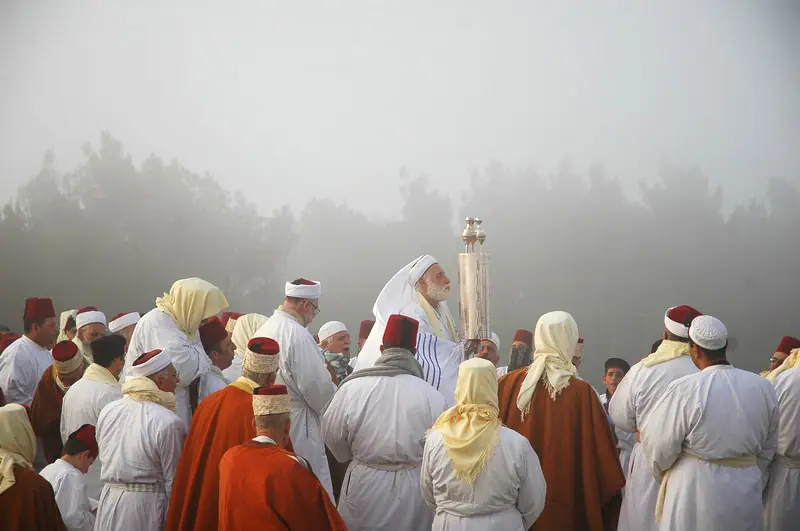
The short version: Samaritans are not Jews, but they are the closest relatives Judaism has. Both communities descend from the Yahweh-worshippers of ancient Israel, both keep the five books of Moses, and both observe the Sabbath, circumcise their sons and keep Passover. They differ over where God chose to be worshipped, over which books are scripture, and over the authority of the rabbis. Samaritans call themselves Israelites, not Jews, because Yehudi, “Jew”, originally meant a Judahite, a person of the southern kingdom and of Jerusalem (§5). A small community of under nine hundred people, about 880 in 2025, survives today, roughly half at Kiryat Luza on Mount Gerizim and half in Holon, near Tel Aviv, and still sacrifices the Passover lambs on the mountain.[1][2] Consensus
How the two communities came apart is the harder question, and the answer depends on whose account you read.
The Judean account: 2 Kings 17
The Bible tells the story from Jerusalem’s side. After Assyria conquered the northern kingdom of Israel around 720 BCE, it deported Israelites and brought in settlers from Babylon, Cuthah and other cities. When lions attacked them, the king of Assyria sent back an Israelite priest to teach them “the law of the god of the land”, and they worshipped Yahweh while still serving their own gods.[3] Josephus, writing in the first century CE, follows this account and calls the Samaritans “Cuthaeans”. On this view they were never Israelites at all.[4]
What it shows. A real deportation and resettlement: Sargon II boasted of deporting 27,280 people from Samaria and settling foreigners there.[5] But 27,280 people was a fraction of the northern population, most of whom stayed on the land, and the biblical account was written by the Samaritans’ rivals in Judah (§3). Majority
The Samaritan account: the keepers of the law
The Samaritans tell the story the other way round. They are the descendants of the northern tribes, chiefly Ephraim and Manasseh, with priests of the line of Levi, and they have kept the Torah and the sanctuary on Mount Gerizim without a break. They call themselves Shamerim, “keepers”, meaning keepers of the law. In their account it was the Judeans who broke away, when the priest Eli left Gerizim and set up a rival sanctuary at Shiloh, from which the line of Jerusalem descends.[1] Consensus on what the tradition says.
What it shows. That the Samaritans understand themselves as the original Israel, not as a sect of Judaism. Their Torah supports that self-understanding: after the Ten Commandments it adds a commandment to build an altar on Mount Gerizim, and where the Jewish text of Deuteronomy speaks of “the place that Yahweh will choose”, the Samaritan text reads “has chosen”.[6]
What archaeology adds
Excavations on the summit of Mount Gerizim by Yitzhak Magen between 1983 and 2006 found a sacred precinct with a temple built by the mid-fifth century BCE, rebuilt on a larger scale in the Hellenistic period. Around four hundred inscriptions, mostly dedications in Aramaic and some in Hebrew, date mostly to the third and second centuries BCE; several contain the divine name.[7][8][9] Two inscriptions from the Aegean island of Delos honour donors on behalf of a community that called itself “Israelites” and made offerings to “Argarizein”, Mount Gerizim.[10] Papyri left by refugees from Samaria in a cave at Wadi Daliyeh, from about 375–335 BCE, show that most of their personal names containing a divine name were built on Yahweh.[11] Majority
What it shows. A community worshipping Yahweh on Gerizim at the same time as the Second Temple stood in Jerusalem, calling itself Israel, and with close ties to Judah. Nehemiah complains that a grandson of the Jerusalem high priest married the daughter of Sanballat, the governor of Samaria.[12] Gary Knoppers and Reinhard Pummer conclude that Samarians and Judeans were two populations of Yahweh-worshippers with a shared past, whose rivalry centred on which mountain God had chosen.[13][1] Majority
When did they separate?
Not in one moment. The two communities built rival temples in the Persian period, shared essentially the same Torah, and went on intermarrying. The decisive break came when the Hasmonean ruler John Hyrcanus destroyed the temple on Gerizim around 112–110 BCE (§6).[7] After that the rivalry hardened. By the first century CE the hostility between the two is taken for granted in Josephus and in the New Testament’s parable of the Good Samaritan, whose point depends on it.[4][14] Majority
The shared Torah is itself evidence for a late separation. It is hard to believe that Samaritans would have adopted a book newly issued by their rivals in Jerusalem, so the five books were probably completed while both communities still shared a religious world (§5). Majority
How Judaism classified them
Rabbinic literature was divided. The Talmud records a dispute between Rabbi Ishmael and Rabbi Akiva: Ishmael held that the Samaritans were “lion converts”, who took up the worship of Yahweh only out of fear of the lions in 2 Kings 17 and so remained gentiles; Akiva held that they were true converts.[15] In practice the rabbis treated them sometimes as Israelites in the commandments they kept and sometimes as outsiders, and the hostility grew over the centuries; a later talmudic tradition says that Rabbi Ami and Rabbi Asi, sages of the late third century, finally ruled them “full-fledged gentiles”.[16] Consensus on the texts.
Jews and Samaritans compared
| Jews | Samaritans | |
|---|---|---|
| Self-name | Yehudim, Jews; also Israel | Bene Yisraʾel, Israelites; Shamerim, keepers |
| Holy place | Jerusalem, the Temple Mount | Mount Gerizim |
| Scripture | Torah, Prophets and Writings (the Tanakh), with the Oral Torah of the rabbis | The Torah only, in the Samaritan version |
| Priesthood | Ended as a ruling office with the Temple in 70 CE | A hereditary high priest of the line of Levi still serves |
| Passover | A home ritual, the Seder | The lambs are still sacrificed on Gerizim |
| Script | Square Aramaic-derived Hebrew script | A descendant of the old Hebrew script |
Common misconceptions
- “Samaritans are a Jewish sect.” They do not see themselves that way, and historians now treat them as a parallel branch of Israelite religion, not an offshoot of Judaism.[13]
- “Samaritans are descended from foreigners.” That is the Judean polemic of 2 Kings 17. The evidence points to descendants of northern Israelites, though some mixing with settlers is likely.[1]
- “The Samaritans died out in antiquity.” They were numerous in late antiquity, were reduced by revolts, persecution and conversion, and survive today as a small living community.[1]
Why it matters
The Samaritans are a living reminder that biblical religion had more than one heir. Judaism as it is practised today is one branch of the religion of ancient Israel, the one that ran through Jerusalem, Babylon and the rabbis; the Samaritans are another, which kept the priesthood, the sacrifices and a single book. For the Persian-period evidence see Chapter 5: Persian Yehud and the Making of the Torah; for the destruction of the Gerizim temple see Chapter 6: Hellenism, the Maccabees and the Second Temple Sects; for the fall of Samaria and the Assyrian resettlement see Chapter 3: The Prophets and the Yahweh-Alone Movement.
References
- ^ a b c d e Reinhard Pummer The Samaritans: A Profile. Eerdmans, 2016. Introduction to Samaritan history, scripture and practice.
- ^ AFP, 'Samaritans mark Passover in West Bank, hoping for "peace"' (12 April 2025) — Agence France-Presse news report. 2025. English. The Samaritans number about 880, some 440 on Mount Gerizim near Nablus and some 440 in Holon; the community still sacrifices the Passover lambs on Gerizim. about
- ^ 2 Kings 17:24–41 — Kings (Hebrew Bible). c. 6th–5th c. BCE. Hebrew. The Judean account of Samaria after 722 BCE: settlers from Cuthah and elsewhere worship Yahweh alongside their own gods. read the text
- ^ a b Josephus, Jewish Antiquities 11.302–347 — Jewish Antiquities. c. 93–94 CE. Greek. Josephus's story of Sanballat, whom he calls a Cuthaean, building the Gerizim temple under Alexander for his son-in-law Manasseh, a Jerusalem priest. about
- ^ Sargon II, annals and Nimrud Prism (Samaria) — Inscriptions of Sargon II. c. 720–706 BCE. Akkadian. Sargon claims the conquest of Samaria, the deportation of 27,280 of its people and the resettlement of the region with captives from elsewhere. about
- ^ Samaritan Pentateuch, Exodus 20 and Deuteronomy 12 — Samaritan Pentateuch. text-type 2nd c. BCE. Hebrew (Samaritan script). The Samaritan Torah adds a commandment to build an altar on Mount Gerizim and reads "the place Yahweh has chosen" where the Jewish text has "will choose". about
- ^ a b Mount Gerizim sacred precinct — Excavations of Yitzhak Magen, 1983–2006. mid-5th c. BCE – c. 110 BCE. A temple of Yahweh on Mount Gerizim built by the mid-fifth century BCE, enlarged in the Hellenistic period and destroyed by John Hyrcanus c. 112–110 BCE. about
- ^ Mount Gerizim inscriptions — Mount Gerizim sacred precinct. 3rd–2nd c. BCE. Aramaic and Hebrew. About four hundred dedicatory inscriptions, mostly Aramaic, several containing the divine name, from the Samaritan sanctuary. about
- ^ Yitzhak Magen, Haggai Misgav and Levana Tsfania Mount Gerizim Excavations, Vol. I: The Aramaic, Hebrew and Samaritan Inscriptions. Staff Officer of Archaeology, Civil Administration of Judea and Samaria; Israel Antiquities Authority (Judea and Samaria Publications 2), 2004. The excavator's publication of the Gerizim inscriptions.
- ^ Delos Samaritan inscriptions — Two Greek inscriptions from Delos. 3rd–1st c. BCE. Greek. Honours voted by a community calling itself "Israelites" who make offerings to "Argarizein" (Mount Gerizim) — Samaritans in the Aegean calling themselves Israelites. about
- ^ Samaria papyri from Wadi Daliyeh — Wadi Daliyeh cave finds (1962). c. 375–335 BCE. Aramaic. Legal documents left by refugees from Samaria who fled Alexander; they name members of the house of Sanballat as governors of Samaria. about
- ^ Nehemiah 13:23–28 — Nehemiah (Hebrew Bible). Memoir, c. 430 BCE. Hebrew. Nehemiah finds children who speak the language of Ashdod and cannot speak Judean, and expels a high priest's grandson married to Sanballat's daughter. read the text
- ^ a b Gary N. Knoppers Jews and Samaritans: The Origins and History of Their Early Relations. Oxford University Press, 2013. Samarians and Judeans as kin with a shared heritage and a long rivalry.
- ^ Luke 10:25–37 — Gospel of Luke (New Testament). c. 80–90 CE. Greek. The parable of the Good Samaritan: a priest and a Levite pass by a wounded man, and a Samaritan, the outsider, is the one who helps him. read the text
- ^ b. Kiddushin 75b — Babylonian Talmud. redacted c. 5th–7th c. CE. Hebrew and Aramaic. Rabbi Ishmael holds that the Samaritans (Cutheans) are 'lion converts' who never truly converted; Rabbi Akiva holds that they are true converts. read the text
- ^ b. Hullin 6a — Babylonian Talmud. redacted c. 5th–7th c. CE. Hebrew and Aramaic. After a report that the Samaritans were not 'keepers of the Torah', Rabbi Ami and Rabbi Asi, sages of the late third century, 'did not move from there until they rendered them full-fledged gentiles'. read the text