The short version: there are four different answers, depending on whether you mean a complete Hebrew Bible, a complete Christian Bible, the oldest biblical book, or the oldest scrap of biblical text. They range from about 600 BCE to 1008 CE. The surprise is the gap: for most books of the Hebrew Bible, the oldest complete copy is about a thousand years younger than the oldest fragments (§0).[1] Consensus
The oldest complete Hebrew Bible
The Hebrew Bible used in synagogues and printed in modern editions is the Masoretic text, the work of scribal families in Tiberias who between about the seventh and tenth centuries CE added vowels, accents and notes to a consonantal text fixed centuries earlier (§0).[1] Their two best manuscripts survive.
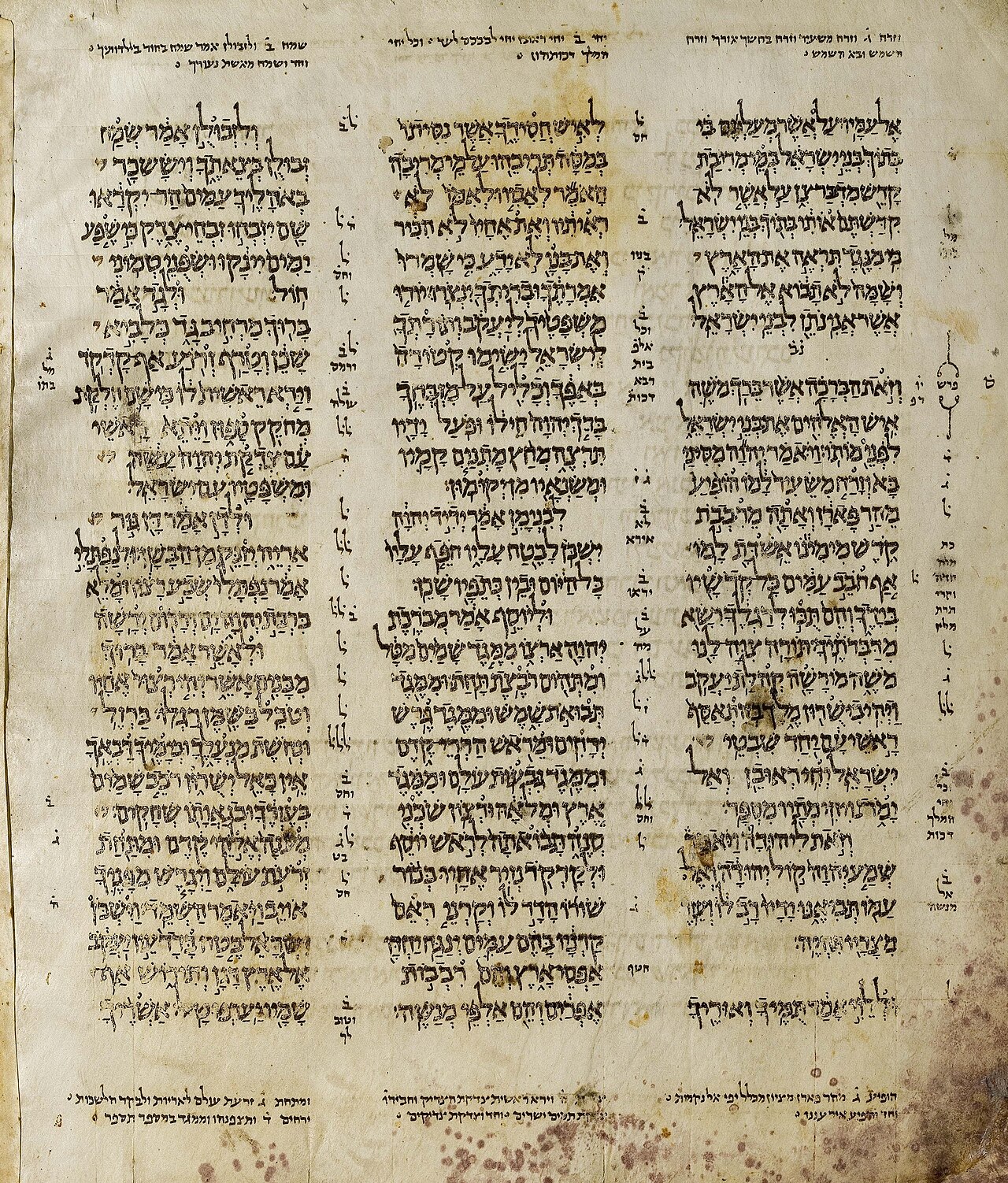
The Aleppo Codex, written around 930 CE and pointed by Aaron ben Asher, was the model text that Maimonides used. It was kept for centuries in the synagogue of Aleppo in Syria. During riots after the United Nations partition vote in 1947 the synagogue was burned, and about 40 percent of the codex, including most of the Torah, has been missing ever since.[2] Consensus
The Leningrad Codex was copied in Cairo in 1008 or 1009 CE by a scribe named Samuel ben Jacob, from manuscripts of the Ben Asher school. It is complete, which makes it the oldest complete Hebrew Bible, and it is the base text of the standard scholarly editions.[3][1] Consensus
The oldest complete Christian Bibles
Christians read the Old Testament first in Greek, in the Septuagint translation made in Egypt from the third century BCE (§6). The oldest surviving books containing both Testaments are Greek codices of the fourth century CE. Codex Vaticanus, in the Vatican Library, dates to about 300–350 and contains most of both Testaments.[4] Codex Sinaiticus, of about 325–360, now divided between the British Library and three other collections, contains about half of the Greek Old Testament and the oldest complete New Testament.[5] These are Bibles six or seven centuries older than the Leningrad Codex, but they are translations: the Hebrew original of the Old Testament survives in full only in the later Masoretic codices. Consensus
The oldest biblical books: the Dead Sea Scrolls
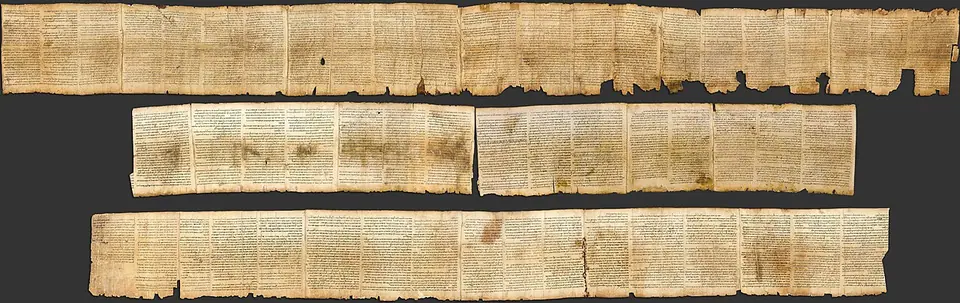
Between 1947 and 1956 the caves near Qumran gave up the remains of some 900 manuscripts, copied between about 250 BCE and 68 CE. About a quarter are copies of biblical books, and every book of the Hebrew Bible except Esther is represented, mostly in fragments.[6] The most famous is the Great Isaiah Scroll, copied around 150–100 BCE, which preserves all sixty-six chapters of Isaiah. It is the oldest complete copy of any biblical book, more than a thousand years older than the Aleppo Codex.[7] Consensus
Before 1947 the oldest Hebrew biblical text known was the Nash Papyrus, a single sheet bought in Egypt in 1902, its twenty-four lines carrying the Ten Commandments and the opening of the Shema. First dated to the first or second century CE, it was placed in the Maccabean period by W. F. Albright and is now usually dated c. 150–100 BCE.[8][9] The oldest known Greek Bible manuscript was Papyrus Rylands 458, eight small fragments of Deuteronomy from the mid-second century BCE.[10] Consensus
The oldest biblical text: the silver amulets
In 1979 Gabriel Barkay’s excavation of burial caves at Ketef Hinnom, just outside Jerusalem’s Old City, found two tiny rolled-up silver amulets. Unrolled and read with modern imaging, both contain a version of the priestly blessing:
ybrk YHWH wyšmrk yʾr YHWH pnyw [ʾlyk w]yśm lk š[lm]
“May YHWH bless you and keep you; may YHWH make his face shine [upon you and] grant you pe[ace].”[11][12]
What it proves. That words closely matching Numbers 6:24–26 were in use in Jerusalem around 600 BCE, before the Babylonian destruction, some 350 years before the oldest Dead Sea Scrolls. It does not prove that the Book of Numbers existed in its present form: a blessing can circulate in worship long before the book that later contains it. The date rests on the script; a few scholars have argued it is too damaged to date securely, and a re-edition from new images in 2004 defended the pre-exilic date (§0).[12] Majority
What the gap means
The Great Isaiah Scroll differs from the Masoretic text of Isaiah in more than 2,600 places, almost all of them spelling, small grammatical forms and single words. For a thousand years of copying, that is remarkable fidelity.[7] Consensus
Other scrolls tell a different story. Fragments of Jeremiah from Cave 4 agree with the shorter Greek edition, about one-seventh shorter than the Hebrew, and some Torah scrolls agree with the Samaritan Pentateuch. Before the first century CE several editions of some books circulated side by side, and the Masoretic text became standard among Jews only after the Temple fell in 70 CE.[1] Majority
Each side at its strongest
The case for a stable text. Where the Dead Sea Scrolls and the medieval codices overlap, they mostly agree word for word, and the Masoretes’ system of counting letters and noting variants shows how seriously copyists treated every character. Jewish tradition holds that the Torah was transmitted faithfully from Sinai, and the evidence of Isaiah supports careful transmission over a very long period. Consensus on the care of copying.
The case for a plural text. The same scrolls prove that more than one edition of some books existed, that the Greek translators worked from real Hebrew texts that differed from the Masoretic one, and that the choice of one text as authoritative was made by the rabbis after 70 CE.[1] Majority
Common misconceptions
- “The Dead Sea Scrolls contain the whole Bible.” They contain fragments of every book but Esther; only Isaiah survives complete.[6]
- “The oldest Bible is a Christian codex.” The oldest complete Bibles are, but the oldest biblical manuscripts are Jewish scrolls, centuries older.[4][6]
- “The silver amulets are a copy of the Bible.” They contain one blessing, which later also appears in Numbers.[11]
- “The text of the Bible was fixed from the start.” The scrolls show it was copied carefully but existed in more than one form until the first century CE.[1]
Why it matters
The oldest copies tell two stories at once. Copyists preserved their texts with great care, so the Bible read today is very close to the one read in the first century CE. But the Bible’s text also had a history: books grew, editions differed, and one form was chosen. Both facts come from the same caves.
For the full history of the text, see Chapter 0: How We Know. For the Dead Sea Scrolls and their community, see Chapter 6: Hellenism, the Maccabees and the Second Temple Sects.
References
- ^ a b c d e f Emanuel Tov Textual Criticism of the Hebrew Bible. Fortress Press, 3rd ed., 2012. The standard work on the Masoretic text, Septuagint, Samaritan Pentateuch and Scrolls.
- ^ Aleppo Codex — Israel Museum (Shrine of the Book). c. 930 CE. Hebrew. The most authoritative Masoretic manuscript, pointed by Aaron ben Asher in Tiberias and used by Maimonides; about 40% lost after 1947. about
- ^ Leningrad Codex (Firkovich B 19 A) — National Library of Russia, St Petersburg. 1008 or 1009 CE. Hebrew. Copied in Cairo by Samuel ben Jacob from Ben Asher manuscripts: the oldest complete Hebrew Bible, and the base text of modern scholarly editions. about
- ^ a b Codex Vaticanus (Vat. gr. 1209) — Vatican Library, Rome. c. 300–350 CE. Greek. One of the two oldest near-complete Bibles: most of the Greek Old Testament and most of the New Testament in one book. about
- ^ Codex Sinaiticus — British Library (most leaves); Leipzig, St Catherine's Monastery and St Petersburg. c. 325–360 CE. Greek. About half of the Greek Old Testament survives, with the oldest complete copy of the New Testament. read the text
- ^ a b c James C. VanderKam The Dead Sea Scrolls Today. Eerdmans, 2nd ed., 2010. The clearest introduction to the Scrolls and the debates around them.
- ^ a b 1QIsaᵃ (Great Isaiah Scroll) — Dead Sea Scrolls, Qumran Cave 1. c. 150–100 BCE. Hebrew. All 66 chapters of Isaiah, over a thousand years older than the Aleppo Codex; some 2,600 variants from the Masoretic text, almost all minor. read the text
- ^ Nash Papyrus (Cambridge University Library, MS Or. 233) — Papyrus fragment from Egypt. c. 150–100 BCE. Hebrew. Twenty-four lines with the Ten Commandments and the opening of the Shema; acquired in Egypt in 1902, it was the oldest known Hebrew biblical text before the Dead Sea Scrolls. about
- ^ W. F. Albright A Biblical Fragment from the Maccabaean Age: The Nash Papyrus. Journal of Biblical Literature 56, pp. 145–176, 1937. doi The palaeographic study that moved the Nash Papyrus from the first or second century CE to the Maccabean period.
- ^ Papyrus Rylands 458 — John Rylands Library, Manchester. mid-2nd c. BCE. Greek. Eight small fragments of Deuteronomy 23–28 in Greek: before the Dead Sea Scrolls, the oldest known manuscript of the Greek Bible. about
- ^ a b Ketef Hinnom amulets (KH1, KH2) — Israel Museum, Jerusalem. c. 650–587 BCE. Hebrew. Two rolled silver amulets from a Jerusalem burial cave containing a form of the priestly blessing of Num 6:24–26: the oldest surviving text paralleling a biblical verse. about
- ^ a b Gabriel Barkay, Andrew G. Vaughn, Marilyn J. Lundberg and Bruce Zuckerman The Amulets from Ketef Hinnom: A New Edition and Evaluation. Bulletin of the American Schools of Oriental Research 334, 2004. The re-edition from new images that confirmed the pre-exilic date.