The short version: Yahweh seems to have come from the south. In the oldest layers of the evidence he is a god who arrives in Israel’s land from the deserts of Seir and Edom, not a god who was always there. Once in Israel he absorbed the Canaanite high god El, whose name the people Israel already bore, and became the god of the kingdom. How and when he first came north, and with whom, is still argued over.[1][2]
The question is often asked as “was Yahweh a Canaanite god?” The answer has two parts. He is not securely attested among the gods of Ugarit, the Canaanite city whose texts name El, Asherah, Baal and dozens of others.[3] But Israel’s religion grew out of Canaanite religion, and Yahweh became Israel’s version of its leading gods: El’s wisdom and council, Baal’s storm.[1]
The evidence for Yahweh’s origins
The southern poems
Several of the oldest poems in the Bible describe Yahweh setting out from somewhere, as a warrior on the march, and that somewhere is always to the south and southeast of Judah:
- “Yahweh, when you went out from Seir, when you marched from the field of Edom, the earth trembled” (Judges 5:4).[4]
- “Yahweh came from Sinai, and dawned from Seir upon them; he shone forth from Mount Paran” (Deuteronomy 33:2).[5]
- “God comes from Teman, the Holy One from Mount Paran” (Habakkuk 3:3).[6]
Seir and Edom are the highlands east of the Arabah valley, in today’s southern Jordan; Teman is a region of Edom; Paran is the wilderness of northern Sinai and the Negev.
What it proves. Three independent poems share one geography, and the Song of Deborah is usually counted among the oldest passages in the Bible. A tradition that the national god of Israel came from outside its land is not the kind of thing later writers would invent, since it cuts against the idea of Yahweh as the god of the land itself.[2][7] Majority
“Yahweh of Teman”
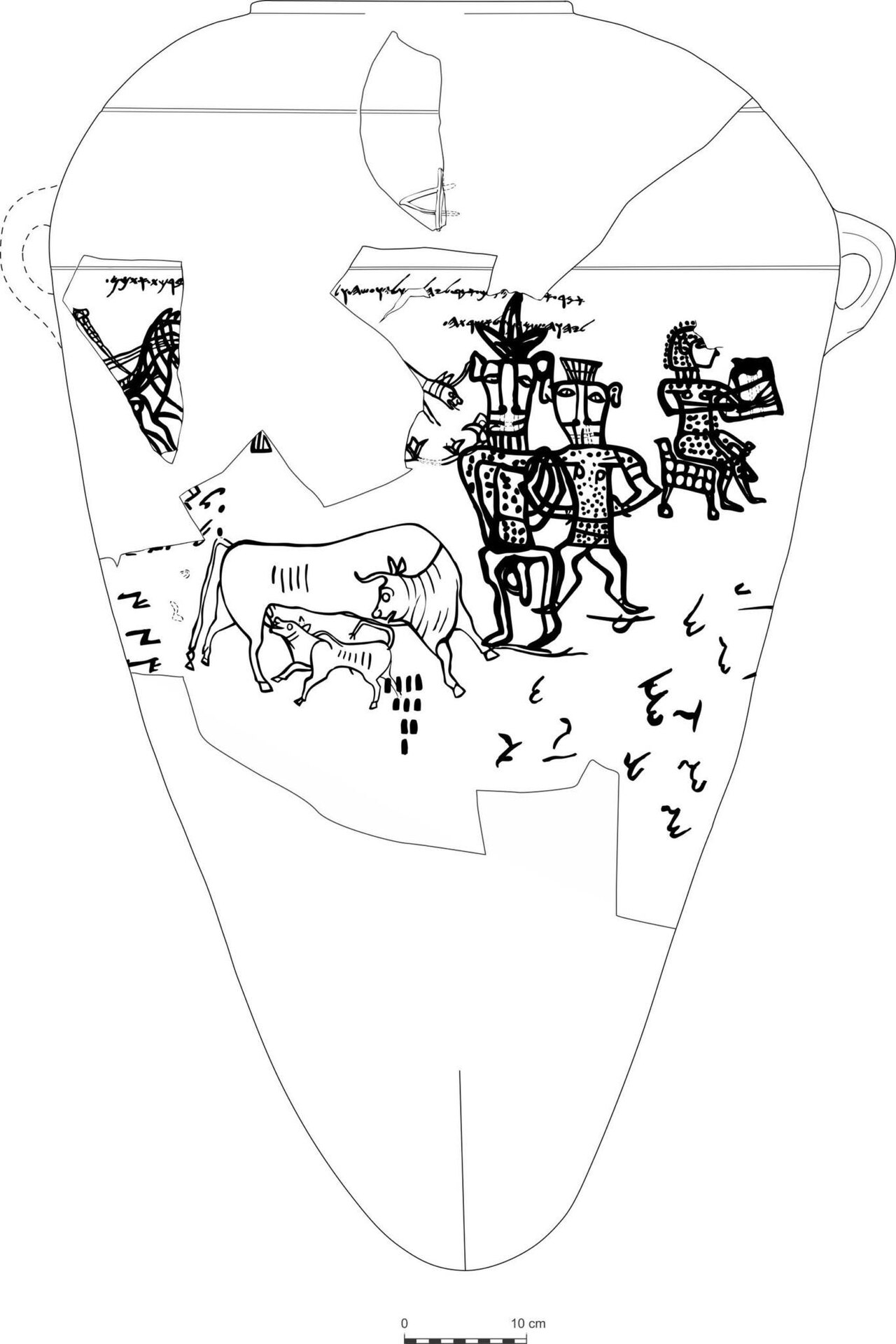
Around 800 BCE, at Kuntillet ʿAjrud, a desert way-station in northeastern Sinai, travellers wrote blessings on storage jars “by Yahweh of Samaria” and “by Yahweh of Teman”.[8][9] “Teman” is the same southern name used in Habakkuk.
What it proves. The southern title was not a poetic memory only: it was a living local form of the god, invoked by people on the desert road, alongside the Yahweh of the northern capital. Consensus on the reading.
The Shasu of Yhw
The oldest possible trace of the name is Egyptian. A list of conquered peoples in the temple of Amenhotep III at Soleb, in Nubia, c. 1390–1350 BCE, includes “the land of the Shasu, Yhw”. The Shasu were the nomadic herders of the Levant, and the same list includes Seir.[10][11]
What it proves. That a nomad group or region with a name very like Yahweh’s existed in the south by the fourteenth century BCE. It does not show that anyone worshipped a god of that name. If the people and the god are linked, this is the earliest trace of Yahweh by more than five centuries. Contested
Moses and Midian
The Bible itself links Moses with the south. He marries the daughter of a “priest of Midian”; in Exodus 18 that priest, Jethro, blesses Yahweh, offers sacrifices and teaches Moses how to organise the people. The Kenites, a clan associated with Midian, appear in Judges as allies of Israel.[12][13] On this combination of clues rests the Midianite–Kenite hypothesis, first proposed in the nineteenth century: Yahweh was the god of southern pastoral groups and reached Israel through them.[7][14]
The first certain mention
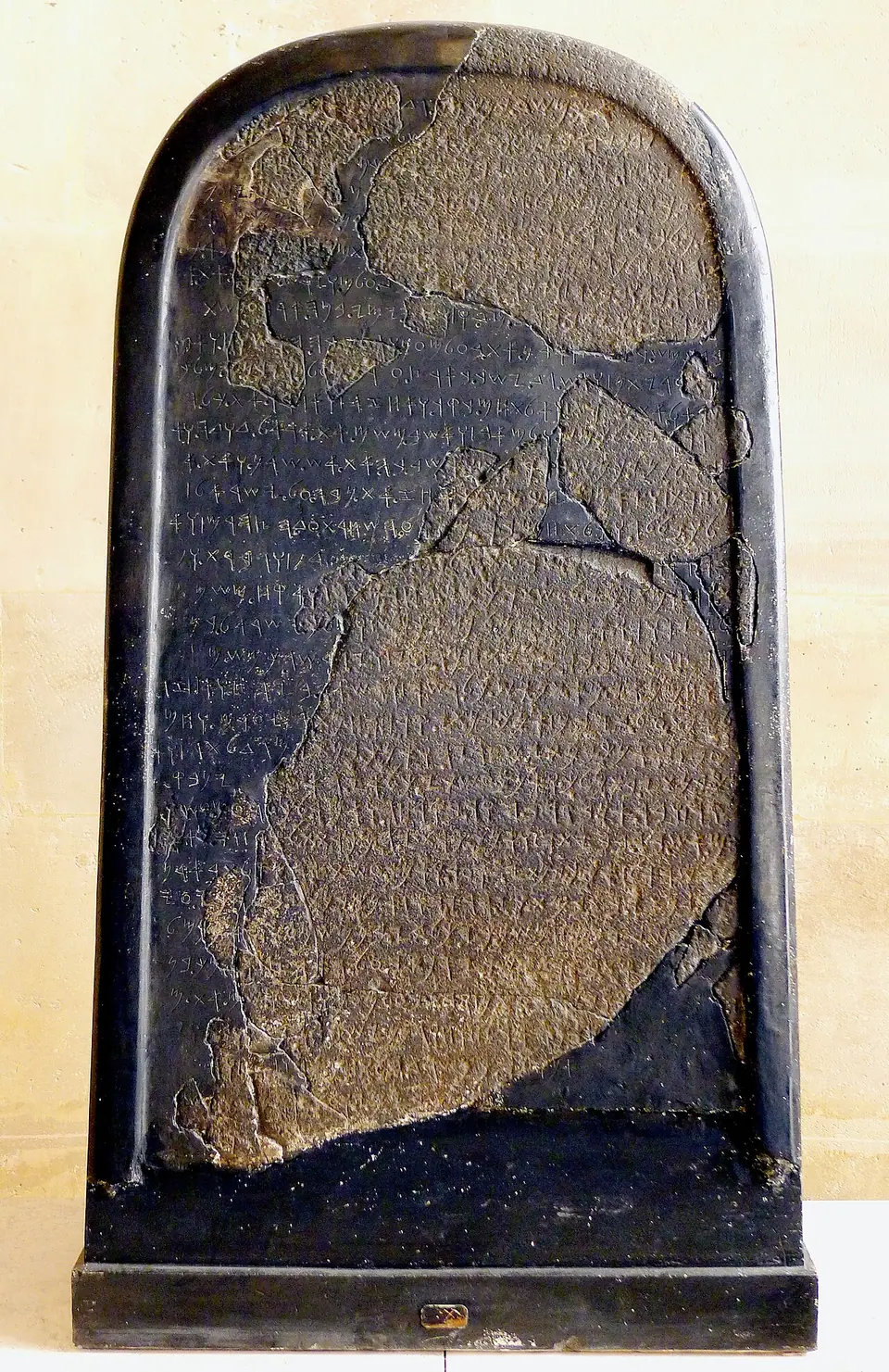
The earliest securely dated mention of Yahweh as a god is Moabite. On the Mesha Stele, c. 840 BCE, the king of Moab says he took “the [vessel]s of Yahweh” from the Israelite town of Nebo and dragged them before his own god Chemosh.[15] By then Yahweh was Israel’s national god, as Chemosh was Moab’s. Consensus
How Yahweh became the god of Israel
The name Israel contains El, not Yahweh, and the stories of the patriarchs use El’s names: El Shaddai, El Elyon, El Bethel.[16][17] The Priestly writer says it outright: “I appeared to Abraham, Isaac and Jacob as El Shaddai, but by my name Yahweh I did not make myself known to them” (Exodus 6:3).[18]
Mark S. Smith calls what followed convergence. Yahweh, the warrior god of a particular people, and El, the high god of the wider Canaanite world, merged during the early first millennium BCE. Yahweh took El’s titles and his place at the head of the council of gods, and the word ʾēl became a common noun for “god”.[1] The older reading of Deuteronomy 32:8–9, preserved at Qumran, still shows the Most High dividing the nations among “the sons of God”, with Yahweh receiving Israel as his share.[19] Majority
Yahweh also took on the language of Baal, the storm god. He rides on the clouds, thunders over the waters and defeats the sea; Psalm 29 is so close to Canaanite storm-god poetry that many scholars think it was adapted from a hymn to Baal.[20][21] Majority
So the answer to “was Yahweh a Canaanite god?” depends on the stage. At his origin, apparently not. Within Israel’s history, he became the heir to Canaan’s chief gods.
The competing explanations
Southern origin through Midianites or Kenites. The oldest poems, the Midian traditions and “Yahweh of Teman” all point the same way. This is the most widely held view, refined in different ways by Joseph Blenkinsopp, Thomas Römer and Karel van der Toorn.[7][14][22] Majority
The god of a people who became part of Israel. Daniel Fleming argues that Yhw was a pastoral people of the inland Levant whose name became their god’s name, and that their descendants were among the groups that formed Israel. On this view Israel did not borrow a foreign god; part of Israel brought its own.[23] Contested
A northern storm god. Henrik Pfeiffer argues that the southern poems are late literary compositions and that Yahweh began as a Levantine weather god like Baal-Hadad, worshipped in the north.[24] Contested
A title of El. Frank Moore Cross proposed that the name began as part of a title of El, “he who creates (the hosts)”, and only later became the name of a separate god.[21] Contested
The traditional account. In Jewish and Christian tradition, the one God was already known to the patriarchs and revealed his name and its meaning to Moses at Horeb, “the mountain of God”, in the wilderness (Exodus 3 and 6). The southern poems, on this reading, remember that revelation at Sinai, not the adoption of a foreign god.[25] The traditional and the southern hypotheses share more than might be expected: both place Yahweh’s first revelation in the southern wilderness, outside Canaan, and connect it with Moses and Midian.
What scholars disagree about
Whether the poems are old. The southern theory leans on the early date of Judges 5 and its companions. If Pfeiffer is right that they are late, the strongest evidence becomes a literary convention.[24] Contested
Whether the Shasu of Yhw are connected at all. The spelling and the company of Seir make many scholars think so; others think the resemblance is coincidental.[2] Contested
What the name means. The Bible’s own explanation, “I will be what I will be” (Exodus 3:14), is a play on the verb “to be”; Cross’s “he who creates” and proposals linking it to roots meaning “to blow” or “to fall” all have defenders, and none has won.[25][21][2] Contested
Common misconceptions
- “Mount Sinai is the mountain in southern Sinai.” The identification with Jebel Musa, near Saint Catherine’s Monastery, is a Christian tradition of late antiquity. The old poems pair Sinai with Seir and Paran, and its location is unknown.[26][5]
- “Yahweh was one of El’s seventy sons at Ugarit.” Yahweh’s name does not appear securely in the Ugaritic texts. The idea comes from reading Deuteronomy 32:8–9 as a Canaanite scene, which is one interpretation among several.[3][19]
- “The name Jehovah is the original pronunciation.” “Jehovah” combines the consonants YHWH with the vowels of Adonai, “my Lord”, which readers said instead of the name. “Yahweh” is a scholarly reconstruction from Greek transcriptions and short forms in personal names (§0).[27]
Why it matters
The question of where Israel’s god came from sits at the start of the long road traced in this series: from a god among gods to the worship of Yahweh alone, and finally to the claim that no other god exists (§3, §4). The southern evidence suggests that Israel’s god was, from the start, remembered as one who came to his people rather than one who grew out of their land, an idea that would matter greatly when the people lost the land in the Babylonian exile.
For the full evidence on Yahweh, El, Baal and Asherah, see Chapter 2: Yahweh Among the Gods. For the origins of Israel itself, see Chapter 1: Out of Canaan.
References
- ^ a b c Mark S. Smith The Early History of God: Yahweh and the Other Deities in Ancient Israel. Eerdmans, 2nd ed., 2002. open library How Israelite religion emerged from its Canaanite setting and became monotheistic.
- ^ a b c d Theodore J. Lewis The Origin and Character of God: Ancient Israelite Religion through the Lens of Divinity. Oxford University Press, 2020. The fullest recent survey of the texts, inscriptions and images of Israel's god.
- ^ a b KTU 1.4 (Baal Cycle) — Ugaritic texts, Ras Shamra. c. 1350–1185 BCE. Ugaritic. Part of the Baal Cycle: El as father of the gods, Athirat (Asherah) his consort with her "seventy sons", and Baal's kingship and palace. The Canaanite background of Israel's god. about
- ^ Judges 5:4–5 — Song of Deborah (Hebrew Bible). c. 1100–900 BCE (debated). Hebrew. Yahweh marches out from Seir and the field of Edom as a storm god; the mountains quake before "the One of Sinai". Among the oldest poems locating Yahweh in the south. read the text
- ^ a b Deuteronomy 33:2 — Blessing of Moses (Hebrew Bible). c. 1000–700 BCE (debated). Hebrew. "Yahweh came from Sinai, and dawned from Seir upon them; he shone forth from Mount Paran": a second poem placing Yahweh's home in the south. read the text
- ^ Habakkuk 3:3 — Prayer of Habakkuk (Hebrew Bible). late 7th c. BCE, possibly older material. Hebrew. "God comes from Teman, the Holy One from Mount Paran": the same southern geography as the Kuntillet Ajrud blessings by "Yahweh of Teman". read the text
- ^ a b c Joseph Blenkinsopp The Midianite–Kenite Hypothesis Revisited and the Origins of Judah. Journal for the Study of the Old Testament 33, 2008. A modern restatement of the theory that Yahweh came to Israel from the south.
- ^ Kuntillet ʿAjrud, Pithos A — Kuntillet ʿAjrud inscriptions (Meshel 2012). c. 800 BCE. Hebrew. Blessing written on a storage jar at a Sinai way-station: 'I bless you by Yahweh of Samaria and by his Asherah.' A second jar names 'Yahweh of Teman and his Asherah'. about
- ^ Kuntillet ʿAjrud, Pithos B — Ink inscription on a storage jar, Kuntillet ʿAjrud (Ḥorvat Teman), Sinai. c. 800 BCE. Hebrew. "I bless you by Yahweh of Teman and by his asherah": a southern local form of Yahweh, matching Habakkuk 3:3, paired with asherah. about
- ^ Soleb temple list, "Land of the Shasu, Yhw" — Temple of Amenhotep III at Soleb, Nubia. c. 1390–1350 BCE. Egyptian (hieroglyphic). Names a land or group of Shasu nomads as Yhw, possibly the earliest trace of the name Yahweh; repeated in a list of Ramesses II at Amara West. Whether it refers to the god is debated. about
- ^ Raphael Giveon Les bédouins Shosou des documents égyptiens. Brill, 1971. The Egyptian sources on the Shasu, including the Soleb list.
- ^ Exodus 18 — Exodus (Hebrew Bible). c. 7th–5th c. BCE. Hebrew. Jethro, priest of Midian and Moses' father-in-law, blesses Yahweh, offers sacrifice and advises Moses: a basis of the Midianite–Kenite hypothesis. read the text
- ^ Judges 1:16; 4:11 — Judges (Hebrew Bible). c. 7th–6th c. BCE (composition). Hebrew. The Kenites, descendants of Moses' father-in-law, go up with Judah into the Negev; Heber the Kenite camps apart from them: the Bible's own link between Moses' in-laws and southern clans allied with Israel. read the text
- ^ a b Thomas Römer The Invention of God. Harvard University Press (trans. Raymond Geuss), 2015. Readable account from Yahweh's southern origins to biblical monotheism.
- ^ Mesha Stele — Louvre AO 5066. c. 840 BCE. Moabite. King Mesha of Moab names Omri king of Israel and boasts of taking the vessels of YHWH from Nebo and dragging them before Chemosh: the earliest certain mention of Yahweh outside the Bible. about
- ^ Genesis 14:19 — Genesis (Hebrew Bible). c. 7th–5th c. BCE. Hebrew. Melchizedek blesses Abram by "El Elyon, creator of heaven and earth", a title of El also found in Phoenician inscriptions. read the text
- ^ Genesis 33:20 — Genesis (Hebrew Bible). c. 8th–5th c. BCE. Hebrew. Jacob builds an altar and calls it "El, the god of Israel". read the text
- ^ Exod 6:2–3 — Exodus (Hebrew Bible). c. 6th–5th c. BCE (Priestly source). Hebrew. God tells Moses he appeared to the patriarchs as El Shaddai but did not make his name YHWH known to them, contradicting Genesis passages where they use the name: a key piece of evidence for separate sources. read the text
- ^ a b Deuteronomy 32:8–9 (MT, 4QDeutj, LXX) — Song of Moses (Hebrew Bible). c. 8th–6th c. BCE (debated). Hebrew. The Most High divides the nations "according to the number of the sons of God" (Qumran, Septuagint) or "the sons of Israel" (Masoretic text); Yahweh's portion is Israel. Trace of the divine council. read the text
- ^ Psalm 29 — Psalms (Hebrew Bible). c. 10th–8th c. BCE (debated). Hebrew. "The voice of Yahweh" thunders over the waters and breaks the cedars; so close to Canaanite storm-god poetry that many scholars think it adapts a hymn to Baal. read the text
- ^ a b c Frank Moore Cross Canaanite Myth and Hebrew Epic: Essays in the History of the Religion of Israel. Harvard University Press, 1973. The classic study of El, Baal and Yahweh; argues Yahweh began as a title of El.
- ^ Karel van der Toorn Family Religion in Babylonia, Syria and Israel: Continuity and Change in the Forms of Religious Life. Brill (SHCANE 7), 1996. Family and state religion compared; argues that Yahweh, a god from the Edomite south, became Israel's state god under Saul.
- ^ Daniel E. Fleming Yahweh before Israel: Glimpses of History in a Divine Name. Cambridge University Press, 2021. Yahweh as the god of a Shasu herding people who became part of Israel, not a god borrowed from outsiders.
- ^ a b Henrik Pfeiffer Jahwes Kommen von Süden: Jdc 5; Hab 3; Dtn 33 und Ps 68 in ihrem literatur- und theologiegeschichtlichen Umfeld. Vandenhoeck & Ruprecht (FRLANT 211), 2005. Argues the "Yahweh from the south" poems are late literary texts, not early memories.
- ^ a b Exodus 3:13–15 — Exodus (Hebrew Bible). c. 7th–5th c. BCE. Hebrew. At the burning bush God answers Moses "I will be what I will be" (ʾehyeh ʾăšer ʾehyeh) and gives the name YHWH: the Bible's own explanation of the name. read the text
- ^ Egeria, Itinerarium 1–5 — Itinerarium Egeriae (Latin). c. 381–384 CE. Latin. A pilgrim's account of climbing 'the holy mountain of God' in southern Sinai with the monks living there: the earliest detailed witness to the Christian identification of Sinai with the Jebel Musa massif. about
- ^ Emanuel Tov Textual Criticism of the Hebrew Bible. Fortress Press, 3rd ed., 2012. The standard work on the Masoretic text, Septuagint, Samaritan Pentateuch and Scrolls.