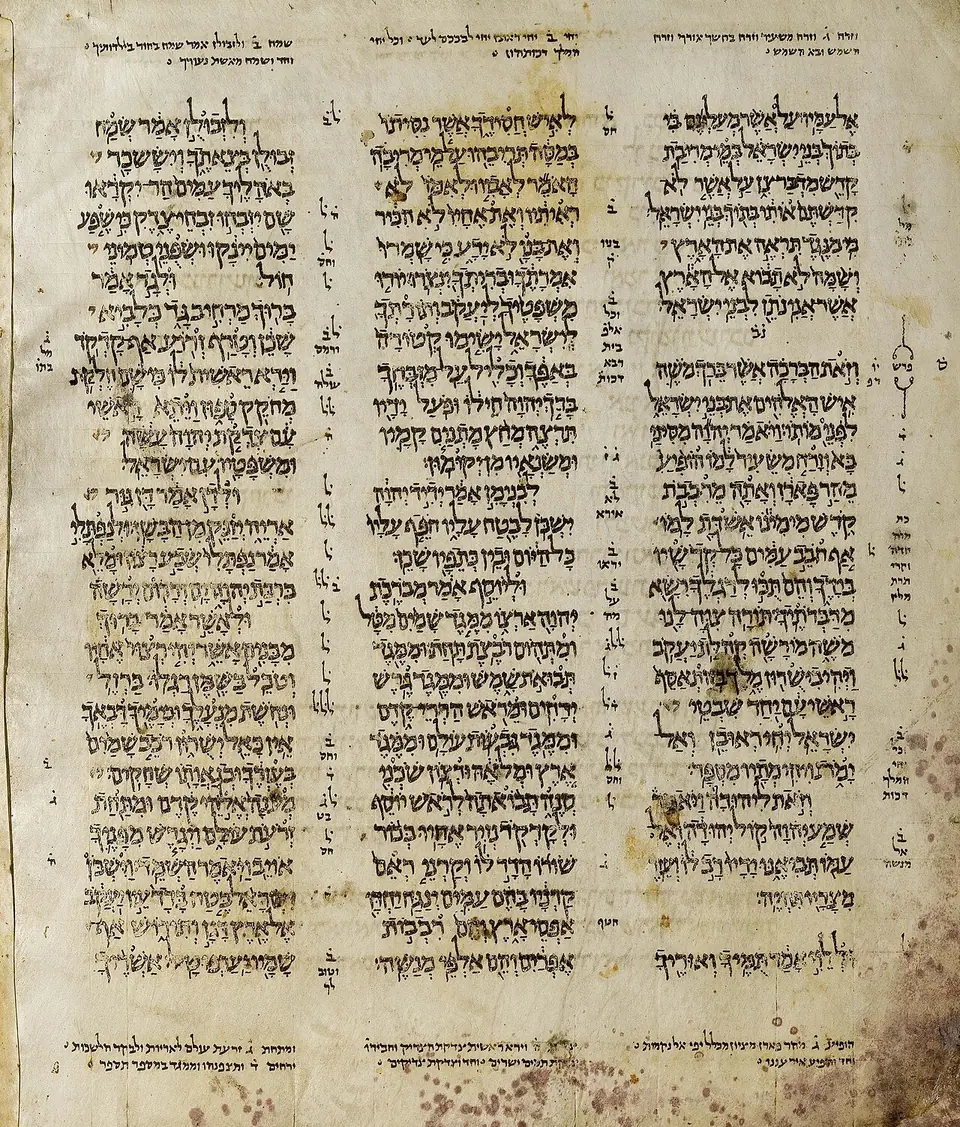
The short version: the Torah does not name its author, and the attribution to Moses comes from later tradition. Read closely, the five books contain doublets, contradictions and changes of style that most scholars explain as the joining of several sources, written over several centuries and edited into their present form in the Persian period. Traditional Judaism holds that the whole Torah was given by God to Moses. Both positions have a long history, and the questions they answer are older than modern scholarship.[1][2]
What the tradition says
Later books of the Bible call the Torah “the book of the law of Moses”,[3] but the five books themselves never say that Moses wrote them all, and Deuteronomy ends with an account of his death and burial: “no one knows his burial place to this day.”[4] Rabbinic tradition, in the Babylonian Talmud’s list of who wrote each book, assigns the Torah to Moses and records the opinion that Joshua wrote its last eight verses.[5] In the twelfth century Maimonides made “the Torah from heaven” the eighth of his Thirteen Principles of Jewish faith.[6] Orthodox Judaism maintains this today. Consensus that this is the traditional view.
What the text itself shows
The case for several authors rests on features of the text that readers have noticed for centuries:
- Two creation stories. Genesis 1:1–2:4a creates plants, animals and finally man and woman together, in six days, by a god called Elohim. Genesis 2:4b–25 creates a man first, then plants, animals and finally a woman, by YHWH Elohim, in a different style.[7][1]
- Interwoven flood stories. In one strand Noah takes seven pairs of the clean animals and the rain lasts 40 days; in the other, a pair of every animal, and the waters prevail for 150 days.[1]
- The divine name. In Exodus 6:2–3 God tells Moses that he appeared to the patriarchs as El Shaddai, “but by my name YHWH I did not make myself known to them”. Yet in Genesis the patriarchs use the name freely.[8]
- Repeated laws. The Ten Commandments appear twice (Exodus 20 and Deuteronomy 5), with different reasons for the Sabbath, and the festival calendars of Exodus, Leviticus and Deuteronomy differ.[9]
What it proves. That the Torah combines material from more than one hand and more than one tradition. Nearly all critical scholars, Jewish and Christian, accept this much. Consensus
How scholars reached the classic answer
The observations are old. Abraham ibn Ezra hinted in the twelfth century that some verses were added after Moses. Baruch Spinoza argued openly in 1670 that Moses could not have written the Pentateuch. In 1753 Jean Astruc noticed Genesis alternating between Elohim and YHWH. In 1805 W. M. L. de Wette argued that the “book of the law” found in the Temple under King Josiah in 622 BCE (2 Kings 22) was an early form of Deuteronomy, written not long before.[1][10][11]
Julius Wellhausen’s Prolegomena (1878; retitled 1883) gave this the shape known as the Documentary Hypothesis: four sources, J (the Yahwist), E (the Elohist), D (Deuteronomy) and P (the Priestly source), combined after the exile. His decisive argument was the order: the eighth-century prophets never mention the Priestly laws, and the histories of the kings treat sacrifice at local shrines as normal, so the law code demanding one sanctuary must be later than the prophets, and the Priestly system later still.[12] Majority on the order.
The strongest outside evidence for Deuteronomy’s date came later. Its curses closely follow an Assyrian loyalty treaty imposed by King Esarhaddon in 672 BCE, copies of which were found in 1955 and 2009.[13][14][15] Majority
Where the question stands now
The four-document model is no longer the consensus. What is agreed is narrower:
- The Torah is composite, with several authors and a long period of editing. Consensus
- Deuteronomy is a distinct layer whose core belongs to the seventh century BCE. Majority
- The Priestly material is a distinct layer, exilic or later in its final form. Majority
- The Torah reached its final form in the Persian period, roughly the fifth and fourth centuries BCE: the Samaritans share the same five books, and the oldest Torah manuscripts from Qumran date to the third and second centuries BCE.[16] Majority
Beyond that the field has split. Many European scholars, after Rolf Rendtorff and Erhard Blum, have abandoned continuous J and E documents for models in which blocks of tradition grew separately and were joined late;[17] Konrad Schmid argues that the patriarchs and the Exodus were originally rival accounts of Israel’s origins, first combined by the Priestly writer.[18] The Neo-Documentarians, including Baruch Schwartz, Joel Baden and Jeffrey Stackert, defend a revised four-source model based strictly on contradictions in the narrative.[19] Contested
Why it was finished in the Persian period
Peter Frei proposed in 1984 that the Persian empire “authorised” local law codes, and that the Torah was completed because Persia required an agreed law for Judah; the letter of Artaxerxes in Ezra 7, binding “the law of your God and the law of the king”, would reflect the process.[20][21] Critics replied that Persian authorisation is attested for small regulations, not a national literature.[22] Others see the Torah as a compromise between Priestly and Deuteronomic circles in a small temple community, or as the curated anthology of a professional scribal class.[23][24][25] Contested
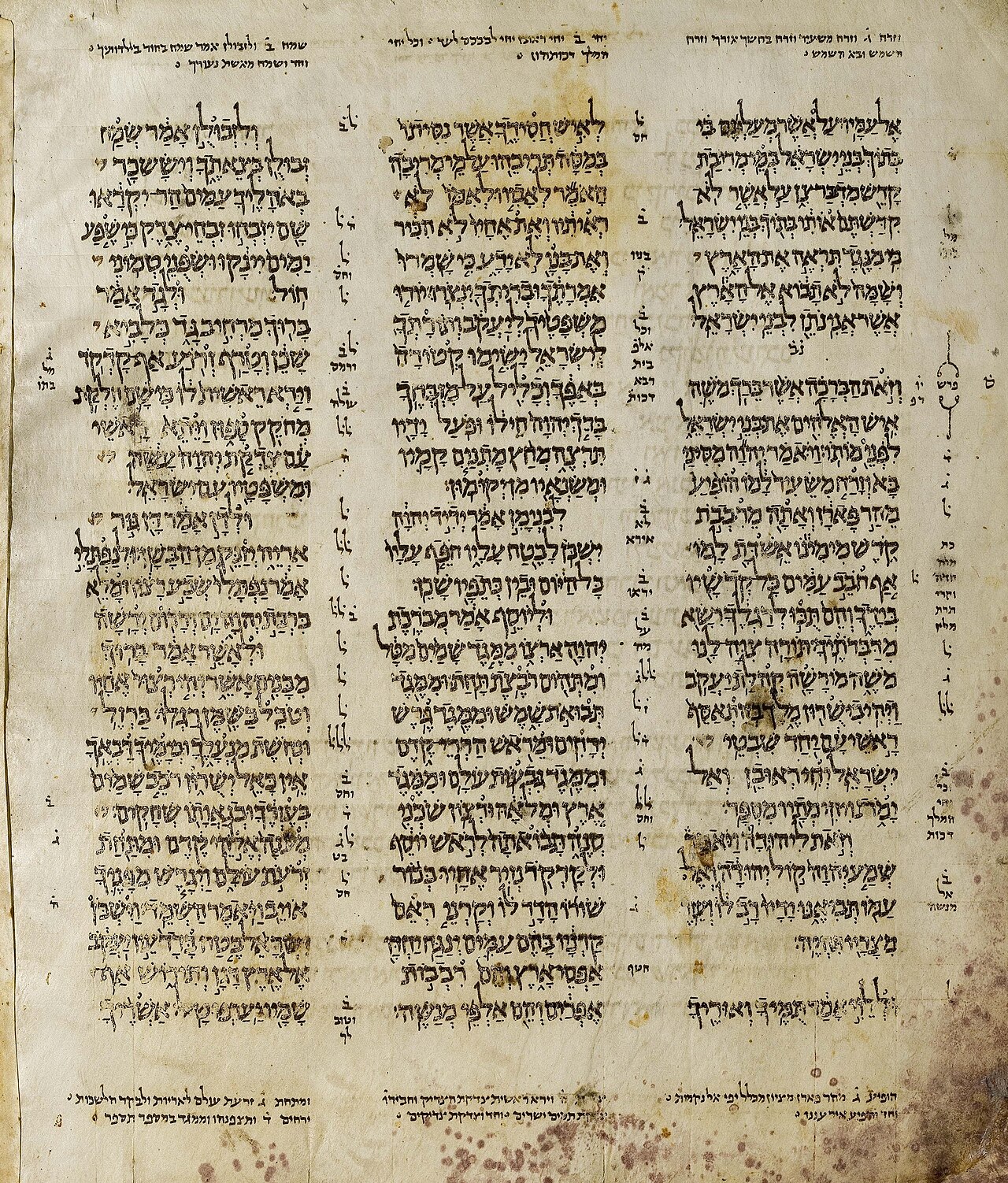
The case on each side
The traditional view. The whole Torah was revealed to Moses; Ezra after the exile restored and taught it rather than composing it.[26] Defenders point out that the Torah’s Hebrew, unlike that of Ezra, Nehemiah, Esther and Chronicles, contains no Persian loanwords and few features of Late Biblical Hebrew;[27] that the Samaritans, rivals of Jerusalem, would hardly have adopted a book newly issued there; and that apparent contradictions can be read as complementary perspectives, as traditional commentators have done for centuries. Consensus that this is the traditional view.
The critical view. The doublets, the changes of divine name and style, the absence of the Priestly laws from the prophets and the histories, and the Assyrian treaty parallels together point to a composite work assembled between the seventh and fourth centuries BCE. Majority
Positions in between. Many Jewish scholars have accepted the critical findings while holding the Torah as revelation. Benjamin Sommer argues that the Torah is Israel’s response to an encounter with God, recorded by many hands; James Kugel, an observant scholar, has written at length about living with the gap between the two readings.[28][2] The Conservative movement’s Torah commentary, Etz Hayim (2001), presents the documentary analysis to synagogue readers.[29]
Common misconceptions
- “The Torah says Moses wrote it.” Parts of it describe Moses writing specific laws and songs, but the five books as a whole are anonymous, and Deuteronomy narrates his death.[30][4]
- “JEDP is the scholarly consensus.” It was, for much of the twentieth century. Today the composite character of the Torah is the consensus; the four-document model is one of several.
- “If many people wrote it, it is a forgery.” Ancient Near Eastern scribes routinely compiled and edited traditional texts in the name of a founding figure. Anonymous, layered composition was the normal way sacred literature was made.[24]
Why it matters
The Torah is the foundation of Judaism: the text read aloud in synagogues in an annual cycle, the source of Jewish law and the charter of the covenant. Knowing how it took shape explains why it contains two creation stories, two versions of the Ten Commandments and laws that seem to conflict, and why the rabbis later needed an Oral Torah to interpret it (§7).
For the methods behind these conclusions, see Chapter 0: How We Know. For Deuteronomy and Josiah, see Chapter 3: The Prophets and the Yahweh-Alone Movement. For the Persian period, see Chapter 5: Persian Yehud and the Making of the Torah.
References
- ^ a b c d Richard Elliott Friedman Who Wrote the Bible?. Summit Books, 1987. The most readable account of the four-source theory.
- ^ a b James L. Kugel How to Read the Bible: A Guide to Scripture, Then and Now. Free Press, 2007. Ancient and modern readings set side by side by an observant Jewish scholar.
- ^ Nehemiah 8:1–8 — Nehemiah (Hebrew Bible). c. 4th c. BCE (composition). Hebrew. Ezra reads the book of the Torah of Moses to the assembled people from morning to midday, and Levites read it "distinctly" and give the sense. read the text
- ^ a b Deut 34:5–6 — Deuteronomy (Hebrew Bible). c. 7th–5th c. BCE. Hebrew. The Torah narrates the death and burial of Moses and says no one knows his grave 'unto this day', a classic sign that Moses is not its author. read the text
- ^ b. Bava Batra 14b–15a — Babylonian Talmud. c. 500–600 CE. Hebrew/Aramaic. The rabbinic list of who wrote each biblical book: Moses wrote his book, Balaam's portion and Job; one opinion holds that Joshua wrote the last eight verses of the Torah. read the text
- ^ Maimonides, Commentary on Mishnah Sanhedrin 10 (Introduction to Perek Ḥeleq) — Commentary on the Mishnah. c. 1168 CE. Judeo-Arabic. The Thirteen Principles of faith; the eighth holds that the whole Torah now in our hands was given to Moses from heaven. about
- ^ Gen 1:1–2:3 — Genesis (Hebrew Bible, Priestly source). c. 6th–5th c. BCE. Hebrew. Creation by word in six days, with the sun and moon as 'lights' and the deep (tĕhôm) as inert matter, ending with God's rest on the seventh day. read the text
- ^ Exod 6:2–3 — Exodus (Hebrew Bible). c. 6th–5th c. BCE (Priestly source). Hebrew. God tells Moses he appeared to the patriarchs as El Shaddai but did not make his name YHWH known to them, contradicting Genesis passages where they use the name: a key piece of evidence for separate sources. read the text
- ^ Deuteronomy 5:12–15 (cf. Exodus 20:8–11) — Deuteronomy (Hebrew Bible). core 7th c. BCE. Hebrew. The Sabbath commandment grounded in the memory of slavery in Egypt, where the Exodus version grounds it in God's rest after the six days of creation. read the text
- ^ 2 Kgs 22:8 — 2 Kings (Hebrew Bible). c. 6th c. BCE. Hebrew. The high priest Hilkiah 'finds the book of the law' in the Temple in Josiah's reign (622 BCE); since de Wette (1805) identified with an early form of Deuteronomy. read the text
- ^ Wilhelm Martin Leberecht de Wette Dissertatio critica qua Deuteronomium a prioribus Pentateuchi libris diversum, alius cuiusdam recentioris auctoris opus esse monstratur. Jena, 1805. The doctoral dissertation that identified Josiah's book of the law with Deuteronomy, a later work than the rest of the Torah.
- ^ Julius Wellhausen Geschichte Israels I (from 1883: Prolegomena zur Geschichte Israels). Reimer, Berlin, 1878. full text The classic Documentary Hypothesis, and the argument that the Priestly law came after the prophets. Its view of post-exilic Judaism as decline is long discarded.
- ^ Esarhaddon's succession treaty (SAA 2 6; Tell Tayinat copy) — Succession oath of Esarhaddon for Ashurbanipal. 672 BCE. Akkadian. Vassals swear total loyalty to Ashurbanipal, must report anyone urging disloyalty, and are threatened with curses (ground of iron, sky of bronze) closely paralleled in Deuteronomy 13 and 28. read the text
- ^ Hans Ulrich Steymans Deuteronomium 28 und die adê zur Thronfolgeregelung Asarhaddons: Segen und Fluch im Alten Orient und in Israel. Universitätsverlag Freiburg / Vandenhoeck & Ruprecht (OBO 145), 1995. The detailed case that Deuteronomy 28 adapts Esarhaddon's treaty curses.
- ^ Jacob Lauinger Esarhaddon's Succession Treaty at Tell Tayinat: Text and Commentary. Journal of Cuneiform Studies 64, 2012. The copy found in a temple at Tayinat in 2009.
- ^ Emanuel Tov Textual Criticism of the Hebrew Bible. Fortress Press, 3rd ed., 2012. The standard work on the Masoretic text, Septuagint, Samaritan Pentateuch and Scrolls.
- ^ Erhard Blum Studien zur Komposition des Pentateuch. de Gruyter (BZAW 189), 1990. The Pentateuch as a Persian-period combination of Priestly and Deuteronomic compositions.
- ^ Konrad Schmid Genesis and the Moses Story: Israel's Dual Origins in the Hebrew Bible. Eisenbrauns, 2010. The main European alternative: patriarchs and exodus as rival origin stories joined late.
- ^ Joel S. Baden The Composition of the Pentateuch: Renewing the Documentary Hypothesis. Yale University Press, 2012. The Neo-Documentarian case for four sources, argued from narrative contradictions.
- ^ Peter Frei Zentralgewalt und Lokalautonomie im Achämenidenreich. in P. Frei and K. Koch, Reichsidee und Reichsorganisation im Perserreich (OBO 55), Universitätsverlag Freiburg / Vandenhoeck & Ruprecht, 1984. The original statement of the imperial-authorisation theory.
- ^ Ezra 7:25–26 — Ezra (Hebrew Bible). c. 4th c. BCE (composition); set in 458 or 398 BCE. Aramaic. Artaxerxes' letter empowers Ezra to appoint judges and punish whoever will not obey "the law of your God and the law of the king" — the key text for the imperial-authorisation theory. read the text
- ^ James W. Watts, ed. Persia and Torah: The Theory of Imperial Authorization of the Pentateuch. Society of Biblical Literature, 2001. The theory tested by its supporters and critics.
- ^ Jean-Louis Ska Introduction to Reading the Pentateuch. Eisenbrauns, 2006. Accessible survey of how the Torah was composed, critical of imperial authorisation.
- ^ a b Karel van der Toorn Scribal Culture and the Making of the Hebrew Bible. Harvard University Press, 2007. The Bible as the product of temple scribes who edited, expanded and combined.
- ^ David M. Carr Writing on the Tablet of the Heart: Origins of Scripture and Literature. Oxford University Press, 2005. How ancient scribes learned texts by heart and reworked them as they copied.
- ^ b. Sanhedrin 21b–22a — Babylonian Talmud. c. 500–600 CE. Hebrew and Aramaic. The Torah was first given in Hebrew script and given again in Ezra's day in the Assyrian script; Rabbi Yose: Ezra was worthy to receive the Torah had Moses not preceded him. read the text
- ^ Avi Hurvitz A Linguistic Study of the Relationship between the Priestly Source and the Book of Ezekiel: A New Approach to an Old Problem. Gabalda (Cahiers de la Revue Biblique 20), 1982. The linguistic case that the Priestly source's Hebrew predates Late Biblical Hebrew, the main argument against a post-exilic P.
- ^ Benjamin D. Sommer Revelation and Authority: Sinai in Jewish Scripture and Tradition. Yale University Press, 2015. A Jewish theology that accepts critical scholarship and keeps revelation.
- ^ David L. Lieber (senior ed.) Etz Hayim: Torah and Commentary. Rabbinical Assembly and United Synagogue of Conservative Judaism / Jewish Publication Society, 2001. The Conservative movement's synagogue Torah commentary, whose essays present critical scholarship to congregants.
- ^ Deuteronomy 31:9, 22 (cf. Exodus 24:4) — Deuteronomy (Hebrew Bible). 7th–6th c. BCE. Hebrew. Moses writes 'this law' and gives it to the priests, and writes down a song: the Torah describes Moses writing particular texts, not the five books as a whole. read the text