The origins of Israel in one paragraph
Israel appears in history around 1208 BCE as a people in Canaan named by an Egyptian pharaoh. At about the same time, as the international world of the Late Bronze Age collapsed, the hill country west of the Jordan filled with small, unwalled farming villages. Their houses, pottery, language and script were Canaanite, and most archaeologists now think their inhabitants were mostly of local origin: herders settling down, villagers leaving the lowland city-states, and smaller groups from outside, perhaps including one that remembered Egypt. Out of these villagers, over the next two centuries, came the people who called themselves Israel. The biblical stories of an exodus of the whole nation from Egypt and a conquest of Canaan under Joshua were written down centuries later, and the archaeology does not support them as accounts of a mass migration and a war of conquest. Majority
That conclusion is not a judgement on the stories’ meaning. The Exodus became the founding memory of Judaism, retold at every Passover, and its importance does not depend on archaeology. It also does not mean that nothing in the stories is old. Many scholars think the Exodus preserves the memory of a smaller group, and the stories contain Egyptian details that fit the Late Bronze Age. This chapter sets out what is known, what is argued, and where the argument now stands. Consensus
Timeline of Israel’s origins and its evidence
| Date | Event or evidence | Confidence |
|---|---|---|
| c. 1650–1550 BCE | The Hyksos, rulers of Levantine origin, govern northern Egypt from Avaris in the eastern Delta; they are expelled by Ahmose c. 1550 BCE[1] | Consensus |
| c. 1550–1150 BCE | Egypt rules Canaan through local city-state kings and garrisons[2] | Consensus |
| c. 1390–1350 BCE | Soleb: a “land of the Shasu, Yhw” among the nomads of the Levant (§2)[3] | Consensus (text); Contested (meaning) |
| c. 1350–1335 BCE | The Amarna letters: Abdi-Heba of Jerusalem warns the pharaoh that the ʿApiru are plundering “all the lands of the king”[4][5] | Consensus |
| c. 1270s BCE | Ramesses II builds his Delta capital, Pi-Ramesses, the “Raamses” of Exodus 1:11[6] | Majority |
| c. 1250–1200 BCE | Canaanite Hazor is burned and abandoned; who destroyed it is disputed[7][8] | Consensus (event); Contested (agent) |
| c. 1208 BCE | The Merneptah Stele: “Israel is laid waste, his seed is not”[9][10] | Consensus |
| late 13th c. BCE | Papyrus Anastasi VI: Egyptian officials let Shasu tribes from Edom water their herds at the pools of Per-Atum (Pithom)[11][10] | Consensus |
| c. 1200–1150 BCE | Collapse of the Late Bronze Age system: Ugarit and Hattusa destroyed, trade networks broken[12] | Consensus |
| c. 1200–1000 BCE | The highland village boom: from about 25 inhabited sites to about 250, perhaps 45,000 people[13][14] | Majority |
| c. 1177 BCE | Ramesses III fights the Sea Peoples, including the Peleset (Philistines), who then settle on the southern coast of Canaan[15] | Consensus |
| c. 1150–1130 BCE | Egyptian rule over Canaan ends, not long after Ramesses VI, the last pharaoh attested there; the Egyptian garrison at Beth-Shean is destroyed[2] | Majority |
| 12th c. BCE | The ʿIzbet Ṣarṭah ostracon, an alphabet practised by a scribe in a village on the western edge of the hills[16] | Majority (date) |
| 12th c. BCE | The Bull Site and the Mount Ebal structure: open-air sanctuaries in the northern hills (§2)[17][18] | Majority (date); Contested (Ebal’s function) |
| c. 1000 BCE | Highland villages grow into towns; the first kingdoms form (§2) | Majority |
| 7th–5th c. BCE | The Exodus and conquest narratives take written form in the Torah and the books of Joshua and Judges (§0, §3, §5)[19][20] | Majority |
The world that collapsed
Canaan in the Late Bronze Age (c. 1550–1200 BCE) was a land of small city-states, each ruled by a local king from a walled town in the lowlands or the valleys, and all of them subject to Egypt. The pharaohs kept garrisons at places like Gaza and Beth-Shean, collected tribute, and corresponded with the local kings in Akkadian cuneiform, the diplomatic language of the age.[2][5] The hill country, rough and forested, had few settlements.[13] Consensus
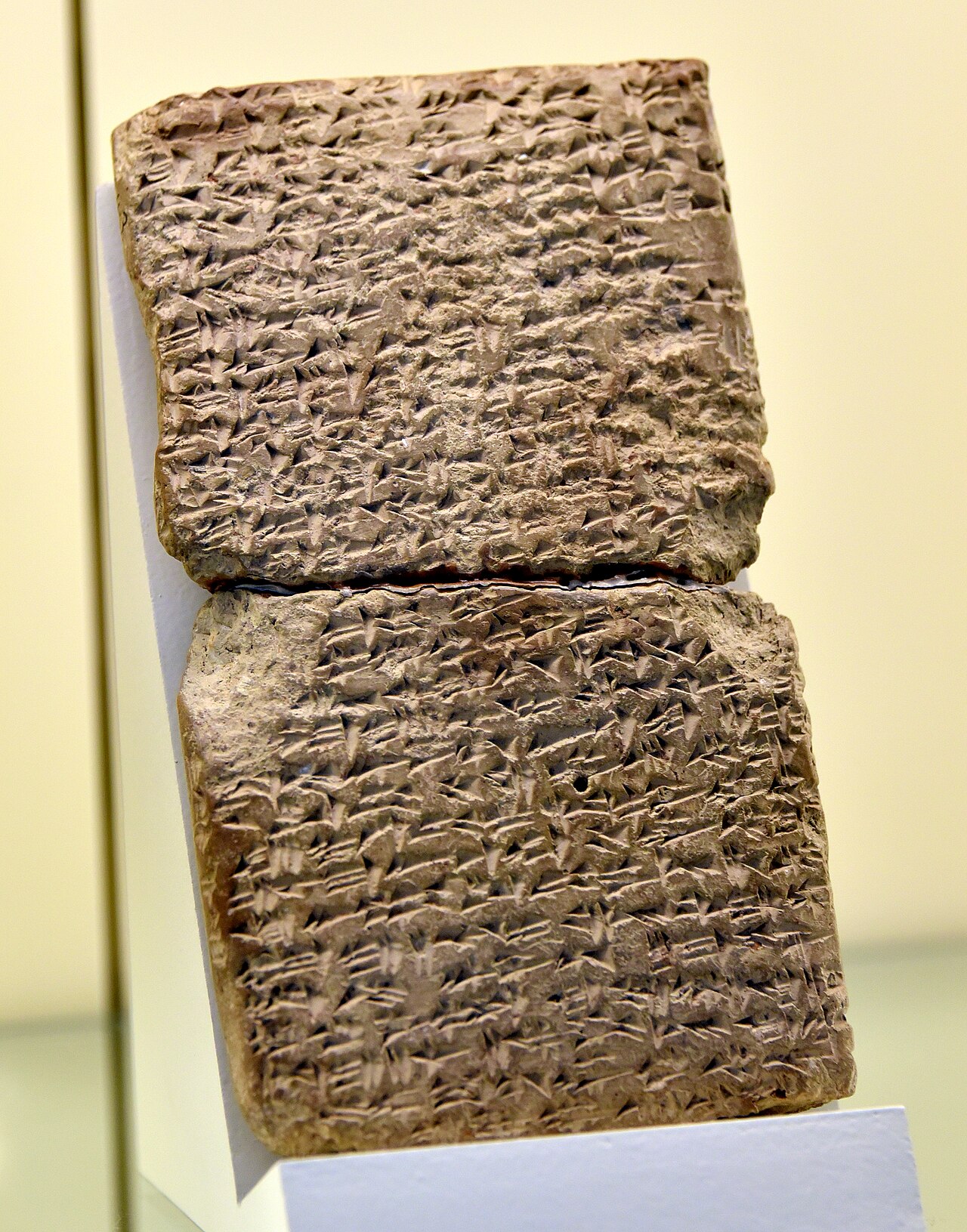
The best window into this world is the archive found at Amarna in Egypt in 1887: some 380 clay tablets, most of them letters from the kings of the Levant to the pharaohs Amenhotep III and Akhenaten in the mid-fourteenth century BCE.[5] They show a quarrelsome network of petty kings, each accusing the others of disloyalty, and they mention a troublesome class of people called the ʿApiru (Akkadian ḫabiru): uprooted men living outside the city-states, who hired themselves out as soldiers or raided the countryside. Jerusalem was one of these city-states, ruled by a king named Abdi-Heba. Consensus
Shortly after 1200 BCE, this world came apart. Over a few decades, cities across the eastern Mediterranean were destroyed or abandoned: Ugarit on the Syrian coast, the Hittite capital Hattusa, the Mycenaean palaces of Greece. Trade in copper and tin broke down. Drought, earthquakes, internal revolts and invasions all played a part, and historians still argue about the balance between them.[12] In the southern Levant, Egypt’s grip weakened and then, by around 1140–1130 BCE, ended.[2] The “Sea Peoples” attacked Egypt by land and sea; one of them, the Peleset, settled on the southern coast of Canaan and became the Philistines.[15] Consensus
It was in this vacuum, in the hills that the city-states had left mostly empty, that Israel took shape. Majority
The first Israel: Merneptah’s stele
The earliest mention of Israel anywhere is on a granite stele set up in Thebes in the fifth year of Pharaoh Merneptah, around 1208 BCE, found by Flinders Petrie in 1896 (§0).[9][10] Most of its 28 lines celebrate a victory over the Libyans. Near the end, it lists conquests in Canaan:
“Plundered is the Canaan with every evil; carried off is Ashkelon; seized upon is Gezer; Yanoam is made as that which does not exist; Israel is laid waste, his seed is not.” (John A. Wilson’s translation.) The list ends with Hurru, an Egyptian name for the Levant: “Hurru is become a widow for Egypt!”[10]
Egyptian: ysrỉꜣr fk.t bn pr.t=f, “Israel is laid waste, his seed is not.”
Three things about this line matter. First, Israel already existed as a recognised group in Canaan by c. 1208 BCE, important enough for the pharaoh to claim its defeat. Second, the hieroglyphic sign that classifies the name is the sign for a foreign people, not the sign for a city or land used for Ashkelon, Gezer and Yanoam. Israel was a population, probably in the hill country, not a city-state or a kingdom. Third, “his seed is not” is a stock boast of destruction, so the stele tells us nothing about where Israel came from.[21] Majority
How this Israel relates to the later kingdoms of Israel and Judah is not certain. It may have been a group in the northern highlands that later gave its name to a larger union. Reliefs at Karnak showing battles in Canaan, long credited to Ramesses II, were assigned to Merneptah by Frank Yurco, who argued that one scene, of a battle in open country, depicts the Israelites, dressed like Canaanites;[22] Anson Rainey argued instead that Israel is the group shown in another scene, the Shasu nomads, which would fit a pastoral origin.[23] Contested
An earlier Israel? In 2001 Manfred Görg proposed that a damaged name ring on a statue pedestal in the Egyptian Museum in Berlin (ÄM 21687), whose spelling suggests the Eighteenth Dynasty (others date it as late as Ramesses II), should be read as Israel; in 2010 Peter van der Veen, Christoffer Theis and Görg argued the case in detail.[24] If correct, it could put Israel in Canaan as much as two centuries before Merneptah. The spelling is different and the sign is damaged, and Egyptologists including James Hoffmeier and Robert Ritner have rejected the reading. Contested
The highland villages
The decisive evidence for Israel’s origins is not a text but a pattern on the map. In the 1980s, surface surveys of the hill country between Jerusalem and the Jezreel Valley, in which teams walked the land recording every ancient site, revealed a striking change at the end of the Late Bronze Age. Consensus
The numbers. In the thirteenth century BCE the central hills had perhaps 25 inhabited sites. By the eleventh century they had about 250, almost all of them new: small villages of a few dozen houses, without walls, temples or palaces. Israel Finkelstein, who synthesised the surveys in 1988, estimated the population at around 45,000.[13] Many of the villages stood in the places later named in the Bible as Israelite heartland: Shiloh, Bethel, the hills of Ephraim and Manasseh. Majority
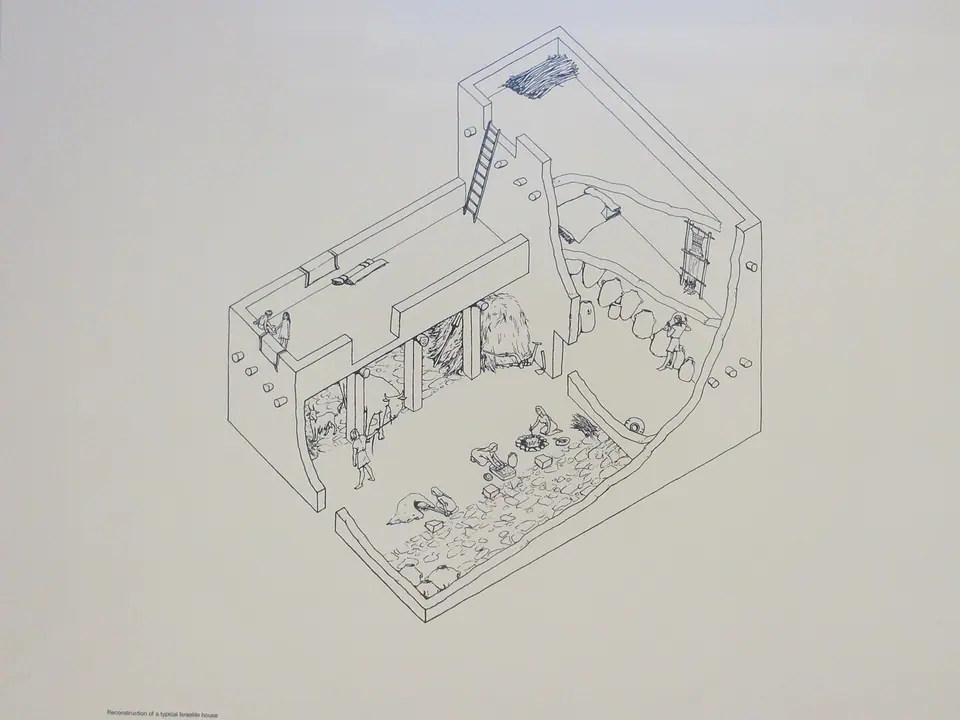
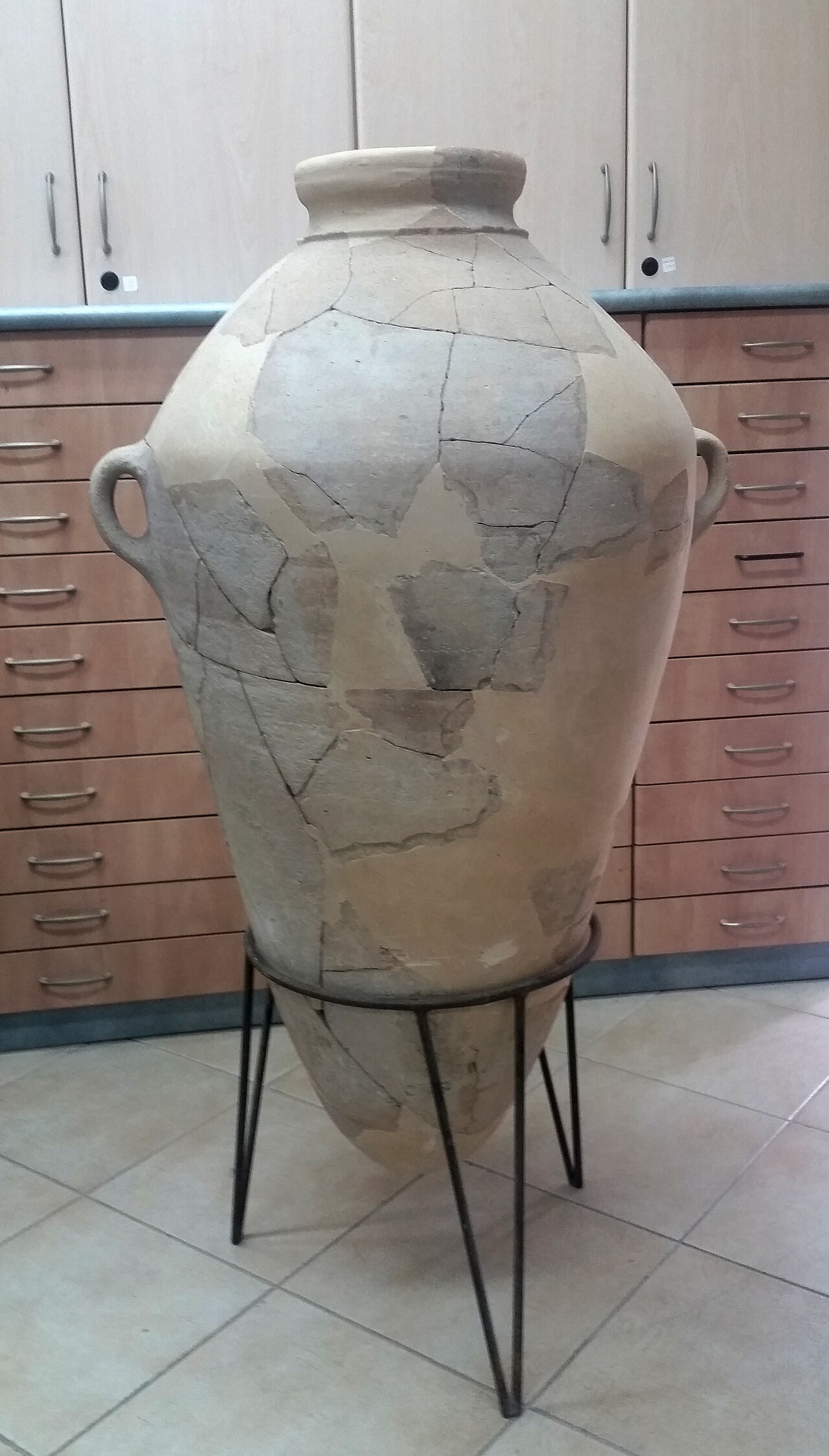
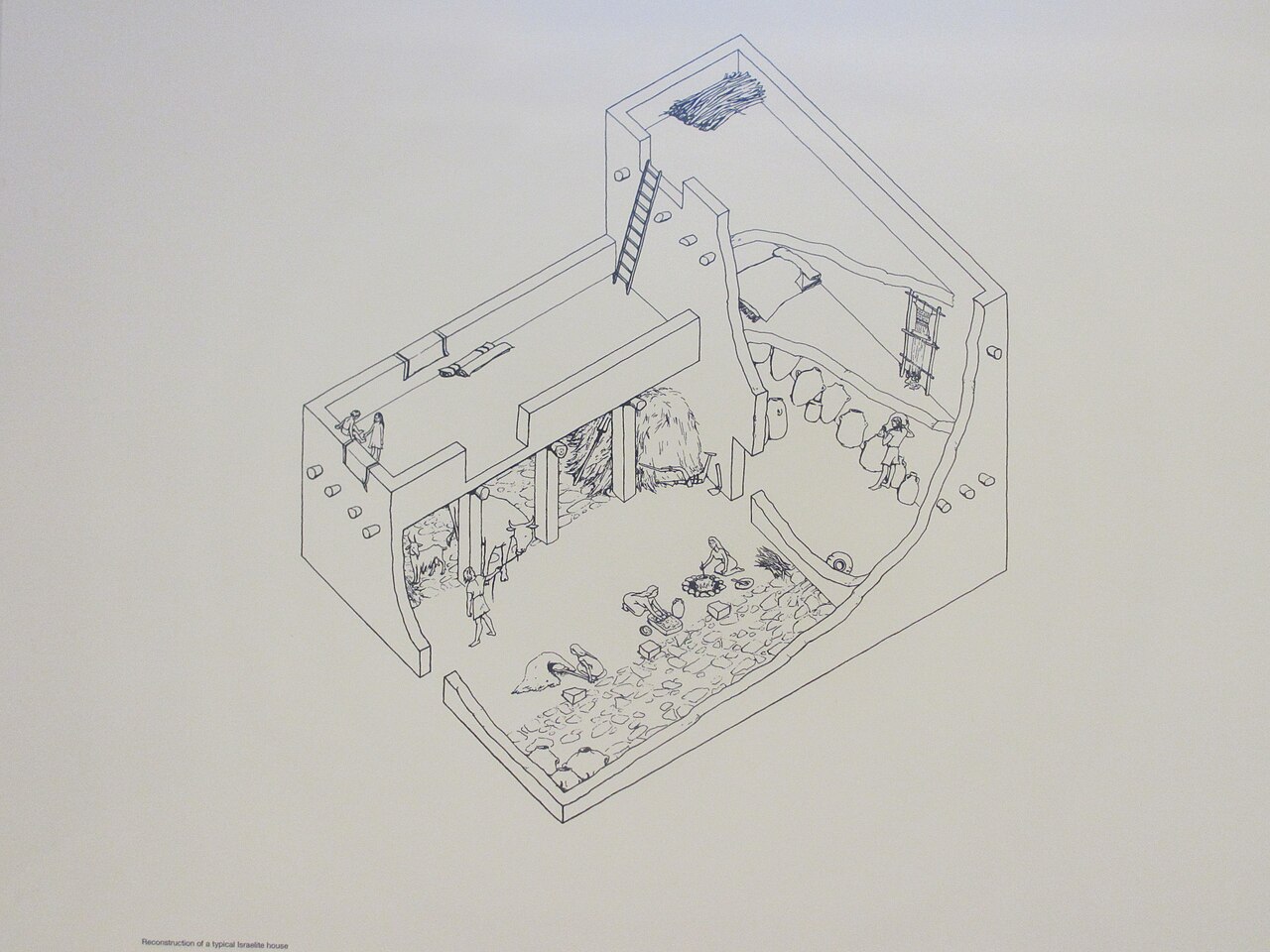
How they lived. The settlers grew grain, planted olives and vines, terraced the slopes, dug plastered cisterns and kept sheep and goats. Their houses usually had a plan archaeologists call the “four-room house”: a broad back room and three long rooms in front, divided by rows of pillars, with a courtyard and probably an upper floor. They stored water and grain in large “collared-rim jars”, named after the ridge around the neck. Their pottery was plain, with almost none of the painted or imported wares found in the lowland cities.[25][26] Consensus
What they brought with them. Almost everything in these villages has roots in the Canaanite culture of the Late Bronze Age. The pottery develops from Canaanite forms. The four-room house and the collared-rim jar were once taken as uniquely Israelite, but both occur outside the highlands and both grow out of earlier local types.[27][13] The people spoke a Canaanite language: Hebrew is a dialect of the same family as Phoenician and Moabite. The alphabet they used, as on the ostracon from ʿIzbet Ṣarṭah, is the Canaanite alphabet.[16] Consensus
What was new. A few features do seem to set the highlanders apart, though none is a perfect marker:
- Pork. Pig bones are rare or absent in the highland villages, while they are common in the Philistine towns of the coast and present in some lowland Canaanite sites. Finkelstein argued that avoiding pork was among the first signs of a separate identity.[28] Brian Hesse and Paula Wapnish cautioned that pigs suit neither dry hills nor herding life, so the pattern may be ecological as much as cultural.[29] Contested
- Plainness and equality. Avraham Faust argues that the lack of decorated pottery, imported luxuries, palaces and elaborate tombs reflects a deliberate egalitarian ethos, defined in opposition first to the Canaanite city-states and later to the Philistines.[25] Contested
- No temples. The villages have no temples. Cult places are rare, small and open-air, such as the Bull Site and the structure on Mount Ebal (§2).[17][18] Majority
What these villages lack is as telling as what they contain. There is no sign of a population arriving from Egypt with Egyptian habits: no Egyptian-style pottery, burials or names in quantity. And there is no sign of a population arriving from the desert with a foreign material culture. The settlers look like people of the land. Majority
Who were the settlers? Four models
Since the 1920s, scholars have proposed four main explanations of how Israel came to be in Canaan. Each grew out of the evidence available at the time. Consensus
1. Conquest (William F. Albright, 1930s). Israel entered Canaan from outside and conquered it much as the book of Joshua describes. Albright pointed to destruction layers in Late Bronze Age cities such as Hazor, Lachish and Bethel.[30] The model failed on two counts: many of the cities that Joshua says were taken were not inhabited or not destroyed at the right time, and the destructions that did occur were spread over more than a century and had many possible causes. Majority view: not supported
2. Peaceful infiltration (Albrecht Alt, 1925). Pastoral clans from the steppe east of the Jordan drifted gradually into the thinly settled hills, settled down, and only later came into conflict with the cities.[31] Alt’s picture of slow settlement fits the survey data better than conquest, but the idea that the settlers came from outside does not fit the local character of their culture. Contested
3. Peasant revolt (George Mendenhall, 1962; Norman Gottwald, 1979). Israel was born when Canaanite peasants, perhaps led by an outside group with a new religion of Yahweh, rejected the oppressive city-states and withdrew to the hills to form an egalitarian society.[32][33] The model explained the Canaanite culture of the villages and the ʿApiru of the Amarna letters, but there is no direct evidence for a revolt, and the cities were already in decline. Contested: now a minority view
4. Local emergence (Israel Finkelstein, 1988; William Dever, 2003). The settlers were mostly local people responding to the collapse. Finkelstein emphasised pastoral groups who had lived in and around the hills through the Late Bronze Age, moving between herding and farming as conditions changed, and who now settled down. Dever emphasised farmers leaving the lowland city-states, calling the settlers “proto-Israelites”.[13][26] Majority
Most archaeologists now combine the last two in some form: Israel was a coalition that formed out of several populations, mostly of local origin, including settling pastoralists, displaced villagers and marginal groups such as the ʿApiru, with some newcomers from the south or east. A shared name, shared stories, a shared god and shared customs turned them into a people over several generations; scholars call this ethnogenesis.[25][27] Majority
The Exodus: what the evidence shows
The Bible’s own story of origins is very different. Jacob’s family goes down to Egypt in a famine, its descendants multiply and are enslaved, and Moses leads them out, “about six hundred thousand men on foot, besides children” (Exodus 12:37), on a forty-year journey through the wilderness to the edge of the promised land.[34] It is the central story of the Hebrew Bible and the foundation of Jewish memory. Consensus on the text.
What is missing
- Egyptian records. Egypt left extensive administrative and royal records, and none mentions Israelites in Egypt, Moses, the plagues or the loss of an army. Royal inscriptions rarely record defeats, so this silence alone proves little. Consensus
- The numbers. 600,000 men implies a total of two million or more people. That is many times the population of all the highland villages put together, and probably more than Egypt could have lost without a trace.[14] Some traditional interpreters read the Hebrew ʾelep, “thousand”, as a military unit or clan, which would reduce the numbers greatly.[35] Majority
- The wilderness. Forty years of a large population in Sinai would leave camps, pottery and burials. Surveys of Sinai and the Negev have found nomadic remains of other periods but nothing of this kind from the Late Bronze Age. At Kadesh Barnea, where Numbers places the Israelites for many years, Rudolph Cohen’s excavations of 1976–82 found Iron Age fortresses but nothing from the Late Bronze Age.[36][14] Majority
- The arrival. As shown above, the material culture of the first Israelites is local, not Egyptian or desert-born. Majority
What fits
Other parts of the story fit Egypt’s history well, and scholars who defend a historical core lean on them.[35][37]
- Semites in the Delta. People from the Levant lived in the eastern Nile Delta throughout the second millennium BCE as herders, workers, soldiers and slaves. The Hyksos ruled from Avaris there before their expulsion c. 1550 BCE.[1] A tomb painting at Beni Hasan, c. 1890 BCE, shows a party of ʿAamu (Asiatics) from Shu arriving with their donkeys and goods; its caption numbers them at 37.[38] Consensus
- Herders crossing the border. Papyrus Anastasi VI, a model letter from Merneptah’s reign, reports that officials let Shasu tribes from Edom pass a border fortress to water their herds at the pools of Per-Atum, the biblical Pithom.[11][10] Movement between Canaan and Egypt was routine and recorded. Consensus
- Raamses. Exodus 1:11 says the Hebrews built “Pithom and Raamses”. Pi-Ramesses, at modern Qantir, was the capital built by Ramesses II in the thirteenth century and abandoned in the eleventh, when the capital moved to Tanis.[1][39] A writer who knew that name and its importance is likely to be drawing on old tradition.[6][35] Contested
- Egyptian names. Moses, Phinehas, Hophni and Merari are Egyptian or plausibly Egyptian names, all attached to the priestly tribe of Levi.[35][40] Majority
What looks later
Other details fit a later Egypt better. Pithom has usually been identified with Tell el-Maskhuta in the Wadi Tumilat, and John Holladay’s excavations there from 1978 into the mid-1980s found that it was occupied in the Middle Bronze Age and then not again until Pharaoh Necho II built there around 610 BCE.[41][42] Hoffmeier identifies Pithom with Tell er-Retaba instead, about 14 km to the west, which was occupied in Ramesside times; he and Gary Rendsburg argue that Ramesside monuments naming Pi-Atum were later carried from Retaba to Maskhuta, so that Exodus 1:11 reflects New Kingdom geography and not a late anachronism.[35][39] Finkelstein, Thomas Römer and others argue that the geography of the Exodus story best matches the Egypt of the seventh and sixth centuries BCE, when Judah lived in Egypt’s shadow and the story was probably taking written form.[14][19] Contested
Where the memory might come from
Most scholars who doubt a mass Exodus do not think the story came from nowhere. The main proposals:
- A small group. A few hundred or a few thousand people escaped Egypt and joined the highland population, bringing their story and perhaps their god with them. Richard Elliott Friedman argues that this group was the Levites, which would explain the Egyptian names concentrated in that tribe.[40] Dever and many others accept a version of this view. Majority
- The memory of Egyptian rule. For three centuries Canaan was ruled by Egypt; Nadav Naʾaman and others suggest that memories of that oppression, and of its end, were transferred to a story set in Egypt itself.[43] Contested
- The Hyksos. Egyptian tradition remembered the expulsion of the Hyksos as an exodus of Asiatics. The Egyptian priest Manetho, quoted by Josephus, says the expelled “shepherds” went to Judea and founded Jerusalem. Donald Redford and Jan Assmann read the biblical story as a mirror image of this memory, told from the other side.[44][45][46] Contested
Each proposal explains some features and not others, and they are not mutually exclusive. What all share is the conclusion that the Exodus, in the form it now has, is a national story built up over centuries, not an eyewitness record. Majority

The conquest: Jericho, Ai and Hazor
The book of Joshua describes a rapid, total conquest: “So Joshua took the whole land, according to all that Yahweh had spoken to Moses” (Joshua 11:23).[47] Archaeology tested this account site by site through the twentieth century. Consensus
- Jericho. John Garstang dated the fall of Jericho’s walls to c. 1400 BCE in the 1930s. Kathleen Kenyon’s re-excavation of 1952–58 showed that the walls he identified were much older, and that the last walled city was destroyed c. 1550 BCE. In the thirteenth century there was at most a small unwalled settlement. Radiocarbon dates published in 1995 confirmed her date for the destruction.[48][49][50] Bryant Wood argued in 1990 for a destruction c. 1400 BCE, matching a traditional early Exodus date; few archaeologists accept it.[51] Majority
- Ai. The name means “the ruin”. The site usually identified with it, et-Tell, was a large city in the Early Bronze Age, destroyed around 2400 BCE and left empty until a small village was built there around 1200 BCE.[52][53] There was nothing for Joshua to conquer. Some traditional scholars propose a different site, Khirbet el-Maqatir. Majority
- Hazor. Hazor, the largest city in Canaan, which Joshua 11 says was burned, really was destroyed and burned in the thirteenth century BCE. Yigael Yadin and Amnon Ben-Tor attribute the destruction to the Israelites. Sharon Zuckerman argues that the city was already in decline and that its own people rose against its rulers, deliberately destroying the palace and temples; the site then lay empty for a century or more before a small village was built.[7][8] Contested
The Bible itself contains a second, different account. The first chapter of Judges lists city after city that the tribes did not capture: “Manasseh did not drive out the inhabitants of Beth-shean … or Megiddo”; the Jebusites stayed in Jerusalem “to this day”. Joshua 13:1 admits that “very much land remains to be possessed”.[47] This slower, partial picture is closer to what archaeology shows, and many scholars think it is the older tradition. Majority
The evidence ledger for Israel’s origins
| Question | What the evidence supports | Key evidence | Confidence |
|---|---|---|---|
| First appearance | A people named Israel in Canaan by c. 1208 BCE | Merneptah Stele[9] | Consensus |
| Where they lived | Small villages in the central hill country, c. 1200–1000 BCE | Survey archaeology[13] | Majority |
| Their culture | Canaanite in language, script, pottery and house types | Pottery sequences; ʿIzbet Ṣarṭah; four-room houses[27][16] | Consensus |
| Their origin | Mostly local: settling pastoralists, displaced villagers and marginal groups | Continuity of material culture; settlement patterns[13][26][25] | Majority |
| Distinctive markers | Possibly pork avoidance, plainness, no temples | Animal bones; pottery; site plans[28][25] | Contested |
| A mass exodus from Egypt | Not supported | No Egyptian record; no wilderness remains; local culture[14] | Majority |
| A smaller group from Egypt | Possible, not provable | Egyptian names among the Levites; Delta background[40][35] | Contested |
| A conquest as in Joshua | Not supported | Jericho, Ai; Judges 1[48][52][47] | Majority |
| Destructions of some cities | Real, spread over decades, attackers unknown | Hazor; Lachish; Megiddo[7] | Consensus (events); Contested (agents) |
| Yahweh’s arrival | Probably with southern groups (§2) | Southern hymns; Shasu of Yhw[3][54] | Contested |
Primary sources
1. “Israel is laid waste”: the Merneptah Stele, c. 1208 BCE
The full text and its discovery are discussed in §0. The key line:
Egyptian: ysrỉꜣr fk.t bn pr.t=f
“Israel is laid waste, his seed is not.”[9]
What it proves. That a group called Israel existed in Canaan before 1200 BCE and was classed by the Egyptians as a people rather than a city-state. It is the fixed point against which every theory of Israel’s origins must be measured, and it rules out any model in which Israel arrives in Canaan after the late thirteenth century. Consensus
2. “The ʿApiru have plundered”: a letter from Jerusalem, c. 1350 BCE
Amarna letter EA 286, from Abdi-Heba, king of Jerusalem, to the pharaoh, written in Akkadian cuneiform and now in Berlin (VAT 1642):
“Why do you love the ʿApiru, but the mayors you hate? … The ʿApiru have plundered all the lands of the king. If there are archers this year, the lands of the king, my lord, will remain. But if there are no archers, lost are the lands of the king, my lord.” (William Moran’s translation)[4][5]
What it proves. That Jerusalem was a Canaanite city-state under Egyptian rule a century and a half before Merneptah, and that the hill country was already home to people outside the city-state system. The resemblance between ʿApiru and ʿIbrî, “Hebrew”, has been noticed since the letters were found. The ʿApiru are a social category found from Mesopotamia to Egypt over many centuries, not an ethnic group, so they cannot simply be the Hebrews. Some early Israelites may have come from such people, and “Hebrew” may once have carried a similar social meaning. Majority on the social category; Contested on any link.
3. The Shasu of Edom at the pools of Pithom: Papyrus Anastasi VI
A model letter used in scribal training, dated to the eighth year, probably of Merneptah (c. 1213–1203 BCE), now in the British Museum (EA 10245). John A. Wilson’s translation renders the Egyptian Shasu as “Bedouin”; Per-Atum is the biblical Pithom:
“We have finished letting the Bedouin tribes of Edom pass the Fortress [of] Mer-ne-Ptah Hotep-hir-Maat—life, prosperity, health!—which is (in) Tjeku, to the pools of Per-Atum [of] Mer-[ne]-Ptah Hotep-hir-Maat, which are (in) Tjeku, to keep them alive and to keep their cattle alive, through the great ka of Pharaoh—life, prosperity, health!—the good sun of every land.”[11][10]
What it proves. That herders from the region of Edom, the same southern region the old poems connect with Yahweh (§2), moved in and out of the eastern Delta with Egyptian permission, through the same area the Exodus story describes. It does not prove the Exodus, but it shows that the story’s setting was a real and familiar border zone. Consensus
4. Pithom and Raamses: Exodus 1:11
Hebrew: wayyiben ʿārê miskĕnôt lĕparʿōh, ʾet-pitōm wĕʾet-raʿamsēs.
“And they built store-cities for Pharaoh, Pithom and Raamses.”[6]
What it proves. That the writer knew the names of real Delta cities. Raamses points to the thirteenth century, when Pi-Ramesses was Egypt’s capital; Pithom, if it is Tell el-Maskhuta, points to the seventh. The verse may preserve an early memory, a later writer’s knowledge, or both. It is the single most debated verse in the dating of the Exodus. Contested
5. Six hundred thousand: Exodus 12:37–38
Hebrew (v. 37): kĕšēš-mēʾôt ʾelep raglî haggĕbārîm, lĕbad miṭṭāp.
“About six hundred thousand men on foot, besides children. A mixed multitude also went up with them, and flocks and herds, very much livestock.”[34]
What it proves. The number, repeated in the census of Numbers (603,550 men of fighting age),[55] is far beyond what the land or the archaeology can support, and is generally read as the scale of a national epic. The “mixed multitude” (ʿēreb rab) is notable: even the Bible’s own account says the people who left Egypt were not of one descent. Majority
6. Two accounts of the conquest: Joshua 11:23 and Judges 1
Joshua 11:23: “So Joshua took the whole land, according to all that Yahweh had spoken to Moses, and Joshua gave it for an inheritance to Israel according to their tribes. And the land had rest from war.”
Judges 1:27, 1:21: “Manasseh did not drive out the inhabitants of Beth-shean and its villages, or Taanach … or Megiddo … for the Canaanites persisted in living in that land.” “But the Benjaminites did not drive out the Jebusites who lived in Jerusalem; so the Jebusites have lived with the Benjaminites in Jerusalem to this day.”[47]
What it proves. That the biblical tradition itself is not uniform. Joshua presents a complete conquest, the ideal of a later, centralised Israel; Judges 1 preserves a memory of a long coexistence with Canaanite cities that lasted into the monarchy. Majority
7. “Your father was an Amorite”: Ezekiel 16:3 and Deuteronomy 26:5
Ezekiel 16:3: mĕkōrōtayik ûmōlĕdōtayik mēʾereṣ hakkĕnaʿănî, ʾābîk hāʾĕmōrî wĕʾimmēk ḥittît.
“Your origin and your birth are of the land of the Canaanites; your father was an Amorite, and your mother a Hittite.”[56]
Deuteronomy 26:5: ʾărammî ʾōbēd ʾābî.
“A wandering Aramean was my father; he went down into Egypt and lived there as an alien, few in number, and there he became a great nation.”[57]
What it proves. Ezekiel, a priest of the sixth century, is insulting Jerusalem, a city that was indeed Canaanite before David, but the insult works only because the claim was believable. The confession in Deuteronomy, recited when offering first fruits, traces Israel’s ancestry to Aram in Syria. The Bible thus keeps several origin stories side by side, from Mesopotamia, Aram, Egypt and Canaan itself, and Konrad Schmid has argued that the ancestor stories and the Exodus were originally two separate accounts of where Israel came from.[20] Majority
8. Manetho’s shepherds go to Jerusalem: Josephus, Against Apion 1.90
The Egyptian priest Manetho, writing in Greek in the third century BCE, told how the Hyksos, the “shepherd kings”, were driven out of Egypt. Josephus quotes him, in William Whiston’s translation:
“They built a city in that country which is now called Judea, and that large enough to contain this great number of men, and called it Jerusalem.”[44]
What it proves. That by the Hellenistic period, Egyptian and Jewish writers both connected the expulsion of the Hyksos with the origins of the Jews. Josephus welcomed the passage as Egyptian confirmation of the Exodus; modern scholars read it as evidence that the two traditions had come into contact, not that either is accurate. Whether the biblical story itself goes back to a Canaanite memory of the Hyksos is debated. Contested
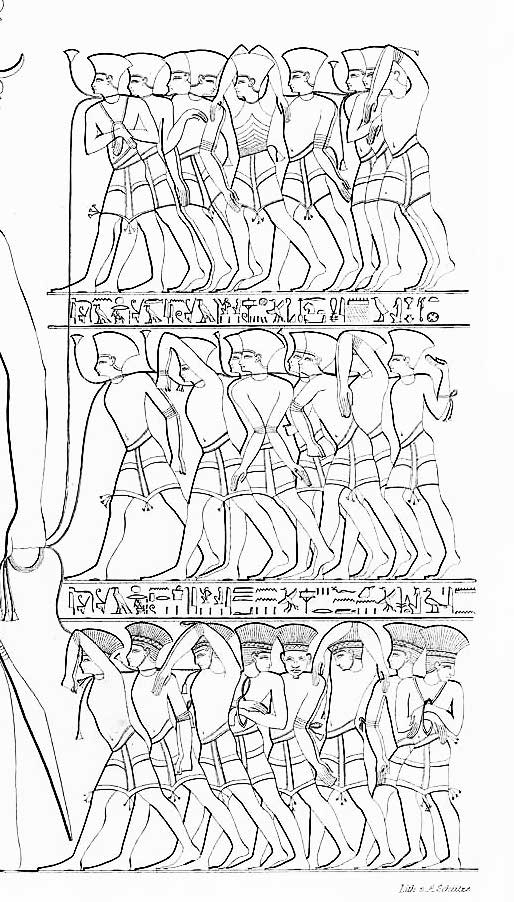
9. The Sea Peoples: Medinet Habu, c. 1177 BCE
Ramesses III’s account of his eighth year, carved on his mortuary temple at Medinet Habu in Thebes, after John A. Wilson’s translation, with Wilson’s “Philistines” and “Denye(n)” given in their Egyptian forms:
“The foreign countries made a conspiracy in their islands. All at once the lands were removed and scattered in the fray. No land could stand before their arms, from Hatti, Kode, Carchemish, Arzawa, and Alashiya on, being cut off at [one time]. … Their confederation was the Peleset, Tjeker, Shekelesh, Denyen, and Weshesh, lands united.”[15][10]
What it proves. The scale of the collapse that cleared the way for new peoples in Canaan, including the Philistines, Israel’s neighbours and rivals. Archaeology confirms that the Philistine towns of the coast had an Aegean-influenced culture, with pork in their diet, quite unlike the highland villages. Consensus
What is absent from the earliest record of Israel
- Abraham, Isaac, Jacob and the twelve tribes. None is named outside the Bible, and the genealogy that makes the tribes one family is probably the product of later political unity. Majority
- Moses. No source outside the Bible mentions him. Most historians think the question of his existence cannot be settled; some think a leader of an Egypt group lies behind the figure. Contested
- Kings, temples and a capital. The villages show no central authority before c. 1000 BCE. Shiloh, remembered as the site of the tabernacle, was a modest village. Majority
- Writing in quantity. A handful of short inscriptions survive from the twelfth and eleventh centuries; no texts of any length. Consensus
- A clear ethnic boundary. Nothing in the archaeology marks where “Canaanite” ends and “Israelite” begins in the twelfth century. The distinction is clearer in later Israelite writing than it was on the ground. Majority
- Yahweh. No inscription from the highland villages names any god. Yahweh first appears in a dated text c. 840 BCE (§2). Consensus
Debates about Israel’s origins
Did the Exodus happen?
| View | Main argument | Main proponents |
|---|---|---|
| Traditional, early date | The Exodus happened as described, c. 1446 BCE, counting 480 years back from Solomon’s fourth year (1 Kings 6:1; compare the 300 years of Judges 11:26)[58]; Wood’s c. 1400 BCE date for Jericho’s fall, a 15th-century destruction at Hazor, Khirbet el-Maqatir as Ai and the Berlin pedestal are read as fitting a 15th-century conquest | Wood, Stripling; many traditional and conservative Christian scholars[51] |
| Historical core, late date | A real departure from Egypt under Ramesses II in the 13th century; the Egyptian details are too accurate to be invented; a semi-nomadic group in the wet Delta and the desert would leave little trace; the large numbers are a misreading or epic exaggeration | Hoffmeier, Kitchen[35][37] |
| A small group | A few thousand people, perhaps the Levites, left Egypt and joined Israel, which adopted their story as everyone’s | Friedman, Dever[40][26] |
| Cultural memory | The story is a later composition shaped by memories of Egyptian rule over Canaan, the Hyksos, and Judah’s dealings with Egypt in the 7th–6th centuries | Redford, Assmann, Naʾaman, Finkelstein, Römer[45][46][43][14][19] |
| Jewish tradition | The Exodus is the founding event of the covenant, commemorated at Passover and dated in rabbinic chronology (Seder Olam) to the year 2448 from Creation, conventionally 1313 BCE; Jewish thinkers from the medieval to the modern period have held that its religious truth does not depend on archaeology, while many also maintain its historicity | Traditional and modern Jewish thought |
Contested — the “small group” and “cultural memory” positions together represent the majority of critical scholars; the traditional early date has little support among archaeologists.
Conquest, infiltration, revolt or emergence?
The four models are set out above. The debate has narrowed since the 1990s: few archaeologists now defend a unified conquest, and few deny some local origin. The remaining arguments are about proportions (how many settlers were local farmers, how many pastoralists, how many outsiders) and about when the settlers began to think of themselves as Israel. Faust argues that Israelite identity crystallised in the late Iron Age I, the eleventh century, sharpened by conflict with the Philistines.[25] Majority on local origin; Contested on the details.
Is Mount Ebal Joshua’s altar?
On Mount Ebal near Shechem, Adam Zertal excavated in 1982–89 a stone structure of the twelfth century BCE, with burned animal bones, mostly of young male sheep, goats and cattle. Zertal identified it as the altar Joshua built there (Joshua 8:30–35). Others see a watchtower, a farmhouse or a non-Israelite cult site.[18] In 2022 a team led by Scott Stripling announced a small folded lead tablet, recovered in 2019 from Zertal’s spoil heaps, which they read in a 2023 paper as a curse naming YHW and presented as the earliest Hebrew inscription.[59] Aren Maeir and Christopher Rollston replied that the published scans do not show the letters claimed, Amihai Mazar suggested the object is a fishing-net weight, and the reading is not accepted by most specialists; the team stands by it. Contested on the site; Majority view: not accepted on the tablet so far.
Why do Jews not eat pork? Did it begin here?
The absence of pig bones in the highland villages is one of the most cited facts about early Israel, and it is tempting to see it as the origin of the biblical ban. Finkelstein suggests that pork avoidance became an identity marker as Israel defined itself against the pork-eating Philistines.[28] Hesse and Wapnish caution that pig-raising depends on climate, economy and the type of settlement, and that the dry hills and a herding economy discourage it for practical reasons.[29] On either view, a practical habit may have come first and a religious rule, written in Leviticus 11:7 and Deuteronomy 14:8, later.[60] Contested
Further reading
- Israel Finkelstein and Neil Asher Silberman, The Bible Unearthed (Free Press, 2001) — the most widely read statement of the local-origin view and the late setting of the Exodus.
- William G. Dever, Who Were the Early Israelites and Where Did They Come From? (Eerdmans, 2003).
- Avraham Faust, Israel’s Ethnogenesis: Settlement, Interaction, Expansion and Resistance (Equinox, 2006).
- Ann E. Killebrew, Biblical Peoples and Ethnicity (Society of Biblical Literature, 2005) — Israel, Philistines and Canaanites side by side.
- James K. Hoffmeier, Israel in Egypt: The Evidence for the Authenticity of the Exodus Tradition (Oxford, 1997) — the strongest case for a historical Exodus.
- Richard Elliott Friedman, The Exodus (HarperOne, 2017) — the Levite hypothesis.
- Eric H. Cline, 1177 B.C.: The Year Civilization Collapsed (Princeton, 2014) — the world Israel emerged into.
- William L. Moran, The Amarna Letters (Johns Hopkins, 1992) — Canaan in its own words.
References
- ^ a b c Manfred Bietak Avaris, the Capital of the Hyksos: Recent Excavations at Tell el-Dabʿa. British Museum Press, 1996. The Levantine population of the eastern Delta in the Middle Bronze Age.
- ^ a b c d James M. Weinstein The Egyptian Empire in Palestine: A Reassessment. Bulletin of the American Schools of Oriental Research 241, 1–28, 1981. doi The archaeology of Egyptian rule in Canaan, from garrisons such as Beth-Shean to its end in the mid-12th century under Ramesses VI.
- ^ a b Soleb temple list, "Land of the Shasu, Yhw" — Temple of Amenhotep III at Soleb, Nubia. c. 1390–1350 BCE. Egyptian (hieroglyphic). Names a land or group of Shasu nomads as Yhw, possibly the earliest trace of the name Yahweh; repeated in a list of Ramesses II at Amara West. Whether it refers to the god is debated. about
- ^ a b EA 286 — Amarna letters (Vorderasiatisches Museum, Berlin, VAT 1642). c. 1350–1335 BCE. Akkadian. Abdi-Heba, king of Jerusalem, protests his loyalty to the pharaoh and warns that 'the ʿApiru have plundered all the lands of the king': Jerusalem as a Canaanite city-state under Egypt, with uprooted groups in the hills. about
- ^ a b c d William L. Moran The Amarna Letters. Johns Hopkins University Press, 1992. The standard English translation of the Amarna archive.
- ^ a b c Exodus 1:11 — Exodus (Hebrew Bible). c. 7th–5th c. BCE. Hebrew. The Hebrews build the store-cities Pithom and Raamses for Pharaoh: real Delta place names, one pointing to the 13th century, the other perhaps to the 7th. read the text
- ^ a b c Hazor, Late Bronze Age destruction layer — Tel Hazor excavations (Yadin; Ben-Tor). 13th c. BCE. The largest city in Canaan is burned and abandoned; Yadin and Ben-Tor attribute it to the Israelites, Zuckerman to an internal revolt. about
- ^ a b Sharon Zuckerman Anatomy of a Destruction: Crisis Architecture, Termination Rituals and the Fall of Canaanite Hazor. Journal of Mediterranean Archaeology 20, 2007. Hazor's end as an internal revolt rather than an Israelite conquest.
- ^ a b c d Merneptah Stele — Egyptian Museum, Cairo. c. 1208 BCE. Egyptian (hieroglyphic). A victory hymn of Pharaoh Merneptah naming "Israel" as a people: the earliest mention of Israel outside the Bible. about
- ^ a b c d e f g James B. Pritchard, ed. Ancient Near Eastern Texts Relating to the Old Testament, 3rd ed. with Supplement. Princeton University Press, 1969. full text The standard anthology; John A. Wilson's translations of the Merneptah Stele (pp. 376–378), Papyrus Anastasi VI (p. 259) and the Medinet Habu Sea Peoples text (pp. 262–263) are quoted here.
- ^ a b c Papyrus Anastasi VI, lines 54–56 — Papyrus Anastasi VI (British Museum, EA 10245). c. 1213–1203 BCE. Egyptian (hieratic). A model letter reporting that the tribes of the Shasu of Edom were let past the fortress of Merneptah in Tjeku to the pools of Pithom to keep their herds alive: Levantine herders crossing into the eastern Delta. about
- ^ a b Eric H. Cline 1177 B.C.: The Year Civilization Collapsed. Princeton University Press, 2014. The Late Bronze Age collapse that cleared the ground for Israel and Philistia.
- ^ a b c d e f g Israel Finkelstein The Archaeology of the Israelite Settlement. Israel Exploration Society, 1988. The survey data behind the local-origin view: about 250 Iron I hill-country sites where there had been some 25.
- ^ a b c d e f Israel Finkelstein and Neil Asher Silberman The Bible Unearthed. Free Press, 2001. The low chronology and a sceptical reading of early Israel, for general readers.
- ^ a b c Medinet Habu, Year 8 inscription of Ramesses III — Mortuary temple of Ramesses III, Medinet Habu, Thebes. c. 1177 BCE. Egyptian (hieroglyphic). Ramesses III describes the Sea Peoples who overran Hatti, Carchemish, Arzawa and Alashiya, naming the Peleset (Philistines) among them: the collapse that opened Canaan to new peoples. about
- ^ a b c ʿIzbet Ṣarṭah ostracon — Ostracon from ʿIzbet Ṣarṭah (Israel Museum). 12th or early 11th c. BCE. Proto-Canaanite / early alphabetic. Five lines of letters scratched on a sherd in a hill-country village, one of them an abecedary: the Canaanite alphabet in use among the early highland settlers. about
- ^ a b The "Bull Site" — Open-air cult site in the northern Samarian hills. 12th c. BCE. A hilltop shrine of the early Iron Age that produced a bronze bull figurine, an animal associated with El and Baal. about
- ^ a b c Mount Ebal structure — Iron Age I site on Mount Ebal, near Shechem (Zertal excavations 1982–89). 12th c. BCE. A stone structure with burned bones of young male animals, identified by Adam Zertal as the altar of Joshua 8:30–35; others read it as a watchtower, farmstead or another kind of cult site. about
- ^ a b c Thomas Römer The Invention of God. Harvard University Press (trans. Raymond Geuss), 2015. Readable account from Yahweh's southern origins to biblical monotheism.
- ^ a b Konrad Schmid Genesis and the Moses Story: Israel's Dual Origins in the Hebrew Bible. Eisenbrauns, 2010. The main European alternative: patriarchs and exodus as rival origin stories joined late.
- ^ Michael G. Hasel Israel in the Merneptah Stela. Bulletin of the American Schools of Oriental Research 296, 45–61, 1994. doi Shows that the determinative marks Israel as a people, unlike the city-states Ashkelon, Gezer and Yanoam.
- ^ Frank J. Yurco Merenptah's Canaanite Campaign. Journal of the American Research Center in Egypt 23, 189–215, 1986. doi Reassigns the Karnak battle reliefs to Merneptah and identifies one scene with Israel.
- ^ Anson F. Rainey Shasu or Habiru: Who Were the Early Israelites?. Biblical Archaeology Review 34:6, 2008. Argues the early Israelites were pastoralists from east of the Jordan, the Shasu of Egyptian texts, and that the habiru are unrelated to the Hebrews.
- ^ Peter van der Veen, Christoffer Theis and Manfred Görg Israel in Canaan (Long) Before Pharaoh Merenptah? A Fresh Look at Berlin Statue Pedestal Relief 21687. Journal of Ancient Egyptian Interconnections 2:4, 15–25, 2010. The case for an Egyptian mention of Israel two centuries before Merneptah; widely disputed.
- ^ a b c d e f Avraham Faust Israel's Ethnogenesis: Settlement, Interaction, Expansion and Resistance. Equinox, 2006. Israelite identity as a process, with an egalitarian ethos shaped against Canaanites and Philistines.
- ^ a b c d William G. Dever Who Were the Early Israelites and Where Did They Come From?. Eerdmans, 2003. The 'proto-Israelites' as Canaanite farmers resettling the hills.
- ^ a b c Ann E. Killebrew Biblical Peoples and Ethnicity: An Archaeological Study of Egyptians, Canaanites, Philistines, and Early Israel, 1300–1100 B.C.E.. Society of Biblical Literature, 2005. Israel as a 'mixed multitude' of local and outside groups, compared with its neighbours.
- ^ a b c Israel Finkelstein Pots and People Revisited: Ethnic Boundaries in the Iron Age I. in N. A. Silberman and D. Small, eds., The Archaeology of Israel (JSOT Supplement 237), Sheffield Academic Press, 1997. Argues that pork avoidance was among the first markers of Israelite identity.
- ^ a b Brian Hesse and Paula Wapnish Can Pig Remains Be Used for Ethnic Diagnosis in the Ancient Near East?. in N. A. Silberman and D. Small, eds., The Archaeology of Israel (JSOT Supplement 237), Sheffield Academic Press, 1997. The caution: ecology and economy, not only identity, decide whether people keep pigs.
- ^ William F. Albright The Israelite Conquest of Canaan in the Light of Archaeology. Bulletin of the American Schools of Oriental Research 74, 1939. The classic statement of the conquest model.
- ^ Albrecht Alt Die Landnahme der Israeliten in Palästina. Reformationsprogramm der Universität Leipzig, 1925. The peaceful-infiltration model.
- ^ George E. Mendenhall The Hebrew Conquest of Palestine. Biblical Archaeologist 25, 1962. Israel as a revolt of Canaanite peasants against the city-states.
- ^ Norman K. Gottwald The Tribes of Yahweh: A Sociology of the Religion of Liberated Israel, 1250–1050 B.C.E.. Orbis, 1979. The peasant-revolt model in full, with a Marxist sociology.
- ^ a b Exodus 12:37–38 — Exodus (Hebrew Bible). c. 7th–5th c. BCE. Hebrew. About 600,000 men on foot besides children leave Egypt, with a 'mixed multitude': numbers far beyond what the archaeology can support, and a people not of one descent. read the text
- ^ a b c d e f g James K. Hoffmeier Israel in Egypt: The Evidence for the Authenticity of the Exodus Tradition. Oxford University Press, 1997. The strongest case for a historical core to the Exodus from Egyptian evidence.
- ^ Rudolph Cohen and Hannah Bernick-Greenberg Excavations at Kadesh Barnea (Tell el-Qudeirat) 1976–1982. Israel Antiquities Authority (IAA Reports 34), 2007. Final report of the Kadesh Barnea dig: Iron Age fortresses and no Late Bronze Age occupation.
- ^ a b K. A. Kitchen On the Reliability of the Old Testament. Eerdmans, 2003. A maximalist Egyptologist's defence of the biblical narratives.
- ^ Janice Kamrin The Aamu of Shu in the Tomb of Khnumhotep II at Beni Hassan. Journal of Ancient Egyptian Interconnections 1:3, 2009. doi The Beni Hasan procession of Levantine ʿAamu, dated to year 6 of Senwosret II, whose caption counts 37 people.
- ^ a b James K. Hoffmeier and Gary A. Rendsburg Pithom and Rameses (Exodus 1:11): Historical, Archaeological, and Linguistic Issues (Part I). Journal of Ancient Egyptian Interconnections 33, 1–19, 2022. The strongest recent case that Pithom is Tell er-Retaba and Rameses is Qantir, both Ramesside, so Exodus 1:11 need not be a late anachronism.
- ^ a b c d Richard Elliott Friedman The Exodus. HarperOne, 2017. The Levites as the group that came out of Egypt.
- ^ Tell el-Maskhuta (Pithom?) — Excavations of John S. Holladay (1978–85), Wadi Tumilat. Middle Bronze; then from c. 610 BCE. Occupied in the Middle Bronze Age and then not again until Necho II built there c. 610 BCE, with no Ramesside remains: if this is Pithom, Exodus 1:11 reflects the Egypt of the 7th–6th centuries. about
- ^ John S. Holladay Jr. Cities of the Delta, Part III: Tell el-Maskhuta. Preliminary Report on the Wadi Tumilat Project 1978–1979. Undena (American Research Center in Egypt Reports 6), 1982. The excavator's report: Middle Bronze occupation, then a long gap until a Saite foundation under Necho II.
- ^ a b Nadav Naʾaman The Exodus Story: Between Historical Memory and Historiographical Composition. Journal of Ancient Near Eastern Religions 11, 2011. Egyptian rule over Canaan as a source of the Exodus memory.
- ^ a b Josephus, Against Apion 1.90 (quoting Manetho) — Against Apion. c. 95 CE (Manetho c. 280 BCE). Greek. Manetho's expelled 'shepherds', the Hyksos, go to Judea and found Jerusalem: Egyptian and Jewish traditions about an exodus had met by the Hellenistic period. read the text
- ^ a b Donald B. Redford Egypt, Canaan, and Israel in Ancient Times. Princeton University Press, 1992. Reads the Exodus against Egyptian memories of the Hyksos.
- ^ a b Jan Assmann Moses the Egyptian: The Memory of Egypt in Western Monotheism. Harvard University Press, 1997. The Exodus as cultural memory, mirrored in Egyptian traditions.
- ^ a b c d Joshua 11:23; Judges 1:21, 1:27–33 — Joshua and Judges (Hebrew Bible). c. 7th–6th c. BCE. Hebrew. Joshua takes 'the whole land'; Judges 1 lists the cities the tribes did not capture, including Megiddo, Beth-shean and Jerusalem: two biblical accounts of the settlement. read the text
- ^ a b Jericho (Tell es-Sultan), Late Bronze Age levels — Excavations of Garstang (1930–36) and Kenyon (1952–58). c. 1550 BCE destruction; little occupation in the 13th c.. Kenyon showed the last walled city fell c. 1550 BCE, confirmed by radiocarbon in 1995; there was no walled city for Joshua to take in the 13th century. about
- ^ Kathleen M. Kenyon Digging Up Jericho. Ernest Benn, 1957. The excavation that removed Joshua's walls from the 13th century.
- ^ Hendrik J. Bruins and Johannes van der Plicht Tell es-Sultan (Jericho): Radiocarbon Results of Short-Lived Cereal and Multiyear Charcoal Samples from the End of the Middle Bronze Age. Radiocarbon 37:2, 213–220, 1995. doi High-precision radiocarbon dates from Kenyon's samples, placing Jericho's last walled city's destruction in the 16th century BCE.
- ^ a b Bryant G. Wood Did the Israelites Conquer Jericho? A New Look at the Archaeological Evidence. Biblical Archaeology Review 16:2, 1990. The case for redating Jericho's destruction to c. 1400 BCE, matching an early Exodus; not widely accepted.
- ^ a b et-Tell (Ai) — Excavations of Marquet-Krause (1933–35) and Callaway (1964–72). Early Bronze city; abandoned c. 2400–2200 BCE until c. 1200 BCE. The site identified with biblical Ai was empty ruins for about a millennium before a small Iron I village was built there: no city existed for Joshua to conquer. about
- ^ Joseph A. Callaway New Evidence on the Conquest of ʿAi. Journal of Biblical Literature 87:3, 312–320, 1968. doi The excavator of et-Tell on its Early Bronze destruction, the long gap and the small Iron I village.
- ^ Judges 5:4–5 — Song of Deborah (Hebrew Bible). c. 1100–900 BCE (debated). Hebrew. Yahweh marches out from Seir and the field of Edom as a storm god; the mountains quake before "the One of Sinai". Among the oldest poems locating Yahweh in the south. read the text
- ^ Numbers 1:46 — Hebrew Bible, Numbers. c. 6th–5th c. BCE. Hebrew. The wilderness census totals 603,550 men of fighting age, echoing the 600,000 of Exodus 12:37. read the text
- ^ Ezekiel 16:3 — Ezekiel (Hebrew Bible). 6th c. BCE. Hebrew. 'Your origin and your birth are of the land of the Canaanites; your father was an Amorite, and your mother a Hittite': a prophet's insult to Jerusalem that assumes Canaanite roots. read the text
- ^ Deuteronomy 26:5 — Deuteronomy (Hebrew Bible). c. 7th c. BCE. Hebrew. 'A wandering Aramean was my father': the first-fruits confession traces Israel's ancestry to Aram before Egypt. read the text
- ^ 1 Kings 6:1 — Hebrew Bible, Kings. c. 6th c. BCE. Hebrew. Solomon begins the Temple in the 480th year after the Israelites left Egypt: the basis of the traditional 15th-century BCE Exodus date. read the text
- ^ Scott Stripling, Gershon Galil, Ivana Kumpova, Jaroslav Valach, Pieter Gert van der Veen and Daniel Vavrik "You are Cursed by the God YHW": An Early Hebrew Inscription from Mt. Ebal. Heritage Science 11, article 105, 2023. Claims a Late Bronze/Iron I curse naming YHW on a lead tablet; most epigraphers do not accept the reading.
- ^ Leviticus 11:7; Deuteronomy 14:8 — Hebrew Bible, Leviticus and Deuteronomy. c. 7th–5th c. BCE. Hebrew. The swine has cloven hoofs but does not chew the cud, so it is impure and its flesh may not be eaten: the written pork ban, centuries after the pig-free highland villages. read the text