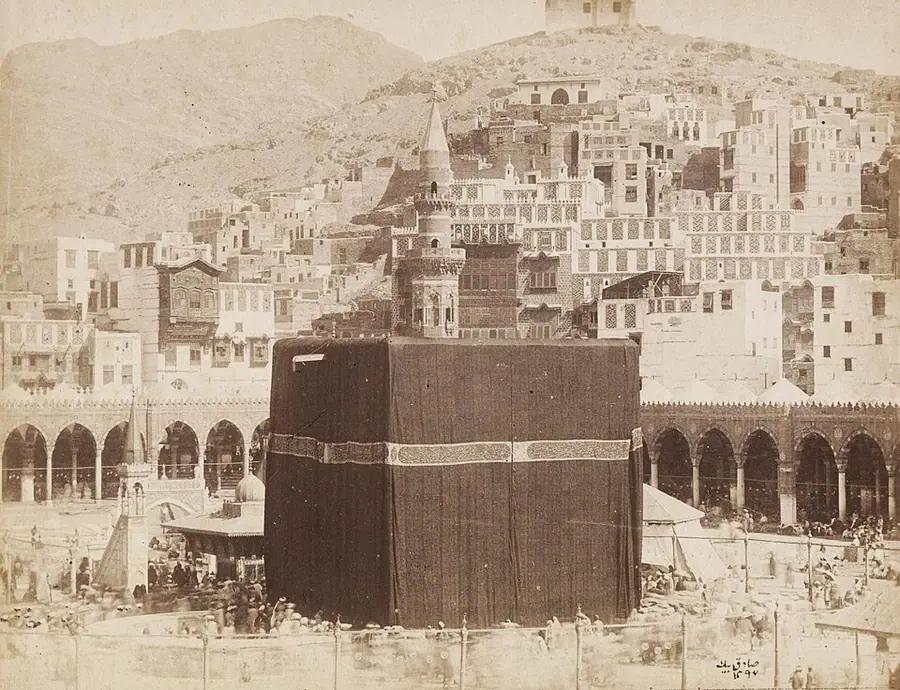
The short version: yes. Whether Muhammad existed is a different question from whether he was a prophet. Muslims believe God spoke to him; others do not. But historians of early Islam, whatever they believe, agree almost without exception that a man called Muhammad preached in western Arabia in the early seventh century and founded the community that became Islam.[1][2] Consensus What follows is why they think so, what the case against looks like, and where the real arguments lie.
How historians decide that someone existed
For a seventh-century Arabian there is no birth record, no portrait and no document written in his own lifetime. Historians accept that a person existed when several kinds of evidence, some of them independent of one another and written close to the time, refer to him in ways that are hard to explain if he were invented. For Muhammad there are four such kinds: Christian writers who were not Muslims and did not use Muslim books, the Qur’an, dated documents from the first Islamic century, and the Muslim tradition itself (How We Know).[1][2] Consensus
Silence from his own lifetime is what would be expected. Most of seventh-century Arabia left no written trace at all, and the few early documents that survive are receipts, graffiti and building inscriptions, not biographies (How We Know). Consensus
The outside witnesses
The strongest evidence comes from people who had no reason to invent him.
A prophet among the Saracens, 634. The Doctrina Jacobi, a Greek Christian dialogue set in Carthage in the summer of 634, reports news from Palestine: the Romans’ commander has been killed by the Saracens, and “a prophet has appeared, coming with the Saracens”, proclaiming the coming of the anointed one. An old man learned in the scriptures says the prophet is false, “for the prophets do not come armed with a sword”.[3] The prophet is not named, but this is the earliest surviving reference to a prophet among the Arab conquerors, from within two years of the traditional date of Muhammad’s death. Majority on the date.
“The Arabs of Muhammad”, c. 640. A Syriac chronicle by a priest named Thomas, written about 640 and preserved in a manuscript copied in 724, records that “on Friday 4 February [634] at the ninth hour, there was a battle between the Romans and the Arabs of Muhammad in Palestine twelve miles east of Gaza”.[4] It is the earliest datable text to name him, written within about eight years of his death by a Christian with no interest in promoting him. Consensus
The merchant who taught the God of Abraham, 660s. The Armenian history attributed to Sebeos, finished soon after 661, describes a man of the sons of Ishmael called Mahmet, a merchant, who preached to the Arabs and taught them to know the God of Abraham, drawing on the story of Moses, and then tells of the conquests.[5][2] Majority on the date and reading.
These writers were Christians, often hostile, and some of what they say differs from the Muslim tradition (below). But they confirm its outline: an Arab prophet, a monotheist preaching in Abraham’s name, and conquests launched by his followers in the 630s (Muhammad). Consensus
The Qur’an and the first documents
The Qur’an names Muhammad four times (3:144, 33:40, 47:2, 48:29), calls him “God’s Messenger and the seal of the prophets”, and addresses a prophet in conflict with his own people who later leads believers in war.[6][7] It says he is “only a messenger; messengers have passed away before him”.[8] Leaves of the Qur’an survive on parchment radiocarbon-dated to the first decades of Islam (see How old is the oldest Qur’an?), so the text that names him is early. Consensus on what the text says.
The documents carry their own dates. PERF 558, a Greek–Arabic receipt for sheep from Egypt, is dated in the year 22 of the Hijri era, 643 CE: twenty-one years after the emigration to Medina from which the era counts.[9] A silver coin struck at Bīshāpūr in Iran in 66 AH, 685–686, carries the words “In the name of God, Muhammad is the messenger of God”, the earliest dated Muslim document to name him.[10] Consensus
The Muslim tradition is unanimous on the outline of his life, across rival schools, sects and regions, from the earliest reports onward.[11] Majority
The doubters
The question is asked often online and almost never by specialists. In the 1970s the “revisionists” John Wansbrough and Patricia Crone with Michael Cook questioned how much of the traditional account could be trusted; they did not deny that Muhammad existed.[12][13] More recently a few writers, among them Karl-Heinz Ohlig of the “Saarbrücken school” in Germany, have argued that muḥammad (“the praised”) began as an honorific title for Jesus and was only later read as a name. The idea has found almost no support among specialists (Muhammad). Consensus
The reasons are simple. A Syriac text of about 640 names “the Arabs of Muhammad” as the followers of a leader; an Armenian account of the 660s describes him as a man who preached; and the tradition remembers him unanimously. All of this is hard to explain without a historical person and easy to explain with one.[14][2] The historian Joshua Little, reviewing the evidence in 2025, concluded that “there can be no reasonable doubt that the founding prophet of Islam existed in history”.[14] Consensus
| Doubt | Usual reply |
|---|---|
| Nothing was written in his lifetime | Almost nothing was written about anyone in seventh-century Arabia; a Christian names him within about eight years of his death |
| Muslim documents do not name him until 685–686 | Outside writers name him from about 640; the early Muslim documents are receipts and building inscriptions that name God and the caliph |
| “Muhammad” was a title, not a name | The Syriac chronicler uses it as the name of the leader whose Arabs fought near Gaza; the idea has almost no support among specialists |
| The biographies are late | They are, which is why historians rely on the outside witnesses and the documents for the fact that he existed |
Where the real arguments are
That Muhammad existed is settled. What his life was like, beyond the outline, is not.
- The biographies are late. The earliest full life, Ibn Isḥāq’s, was written in the 750s or 760s, about 120 years after his death, and survives only in later editions.[15][11] Historians weigh each story on its own (How We Know). Consensus
- Some dates are schematic. His birth in the “Year of the Elephant”, about 570, and his call at forty use round numbers that historians doubt.[16] Contested
- His death. The tradition is unanimous for 632. Several early Christian, Jewish and Samaritan texts seem to place the prophet alive at the start of the invasion of Palestine in 634; Stephen Shoemaker argues that they preserve an early tradition later revised, and most historians read them as second-hand and keep 632.[17][2] Contested
- His name on Muslim documents. It appears on dated Muslim documents only from 685–686. Some read the silence as the sign of a religion still defining itself; most think it reflects the kind of document that happens to survive.[2][1] Contested on what the silence means.
What the evidence does not show
That Muhammad existed is a historical judgement. That God spoke to him is a matter of faith. Historians can date when the Qur’an was written down and when beliefs about him are first attested; whether he received revelation is outside what historical method can test, in either direction (How We Know). Consensus The consensus that he lived is therefore not a consensus that Islam is true, and denying his existence would not disprove it; the denial simply fails on the evidence. Majority
Common misconceptions
- “There is no evidence outside Muslim sources.” A Syriac chronicle of about 640 and an Armenian history of the 660s mention him, and a Greek text set in 634 mentions a prophet with the Arab invaders.[4][5][3] Consensus
- “Scholars who accept him are all Muslims.” Most of the scholars cited here are not; the outside witnesses themselves were Christians, often hostile. Consensus
- “If he existed, the biographies must be accurate.” Existence is one question; the reliability of each story is another, argued case by case (Muhammad). Consensus
- “The revisionists said he never existed.” Wansbrough, Crone and Cook questioned the traditional account, not his existence.[12][13] Majority
References
- ^ a b c Fred M. Donner Muhammad and the Believers: At the Origins of Islam. Belknap Press of Harvard University Press, 2010. Islam's origins in the early seventh-century preaching of Muhammad.
- ^ a b c d e f Robert G. Hoyland Seeing Islam as Others Saw It: A Survey and Evaluation of Christian, Jewish and Zoroastrian Writings on Early Islam. Darwin Press, 1997. The non-Muslim sources of the first Islamic century and a half, translated and discussed.
- ^ a b Doctrina Jacobi nuper baptizati V.16 — Teaching of Jacob, Newly Baptised. set in 634 CE; written c. 634. Greek. A Jew reports that 'a prophet has appeared, coming with the Saracens', who claims the keys of paradise; the earliest reference to the prophet of the conquerors. about
- ^ a b Thomas the Presbyter, Chronicle (British Library Add. MS 14,643) — Syriac Chronicle of 640. c. 640 CE (manuscript copied 724). Syriac. Records a battle on 4 February 634 between the Romans and 'the Arabs of Muhammad' twelve miles east of Gaza: the earliest datable text to name Muhammad. about
- ^ a b History attributed to Sebeos (trans. R. W. Thomson and J. Howard-Johnston, 1999) — Armenian History. soon after 661 CE. Armenian. Describes Mahmet, a merchant of the sons of Ishmael, who taught the Arabs the God of Abraham, followed by an account of the conquests. about
- ^ Qur'an 33:40 — The Qur'an. 610–632 CE (recited); standard text c. 650. Arabic. Muhammad is 'God's Messenger and the seal of the prophets'; one of the four places the Qur'an names him. read the text
- ^ Qur'an 48:29 — The Qur'an. 610–632 CE (recited); standard text c. 650. Arabic. 'Muhammad is the Messenger of God': the Qur'an names him and describes his followers. read the text
- ^ Qurʾan 3:144 — Qurʾan, Sūrat Āl ʿImrān. 7th c. CE. Arabic. 'Muhammad is only a messenger; messengers have passed away before him': one of four places the Qur'an names Muhammad. read the text
- ^ PERF 558 (Austrian National Library, Papyrus Erzherzog Rainer) — Greek–Arabic receipt from Herakleopolis. Jumādā I 22 AH / 25 April 643 CE. Arabic and Greek. Receipt by the commander ʿAbd Allāh ibn Jābir for 65 sheep; the earliest dated Arabic papyrus, dated by the Hijri era, with dotted letters; the Greek calls the Arabs magaritai. about
- ^ Arab-Sasanian drachm of ʿAbd al-Malik ibn ʿAbd Allāh, Bīshāpūr (British Museum) — Silver coin. 66 AH / 685–686 CE. Arabic and Middle Persian. Margin legend 'bism Allāh Muḥammad rasūl Allāh': the earliest dated Muslim text to name Muhammad, struck for a Zubayrid governor. about
- ^ a b Gregor Schoeler The Biography of Muhammad: Nature and Authenticity. Routledge, 2011. How the sīra was transmitted and what can be traced early.
- ^ a b John Wansbrough Quranic Studies: Sources and Methods of Scriptural Interpretation. Oxford University Press, 1977. The form-critical case for a late, composite canon.
- ^ a b Patricia Crone and Michael Cook Hagarism: The Making of the Islamic World. Cambridge University Press, 1977. Origins reconstructed from non-Muslim sources alone.
- ^ a b Joshua J. Little Did Muhammad Exist? An Academic Response to a Popular Question. Islamic Origins (blog), 2025. Reviews the evidence and concludes there is no reasonable doubt that Muhammad existed.
- ^ Ibn Isḥāq, Sīrat Rasūl Allāh — The Life of Muhammad (recension of Ibn Hishām). mid-8th c. CE (Ibn Hishām's recension, early 9th c.). Arabic. The earliest surviving Muslim biography of Muhammad; source for his alliance and conflicts with the Jewish tribes of Medina (Qaynuqāʿ, Naḍīr, Qurayẓa) and the conquest of Khaybar. about
- ^ Lawrence I. Conrad Abraha and Muḥammad: Some Observations apropos of Chronology and Literary Topoi in the Early Arabic Historical Tradition. Bulletin of the School of Oriental and African Studies 50, 1987. The Year of the Elephant as a chronological topos rather than a remembered date.
- ^ Stephen J. Shoemaker The Death of a Prophet: The End of Muhammad's Life and the Beginnings of Islam. University of Pennsylvania Press, 2012. The non-Muslim reports of the prophet alive at the conquest of Palestine.