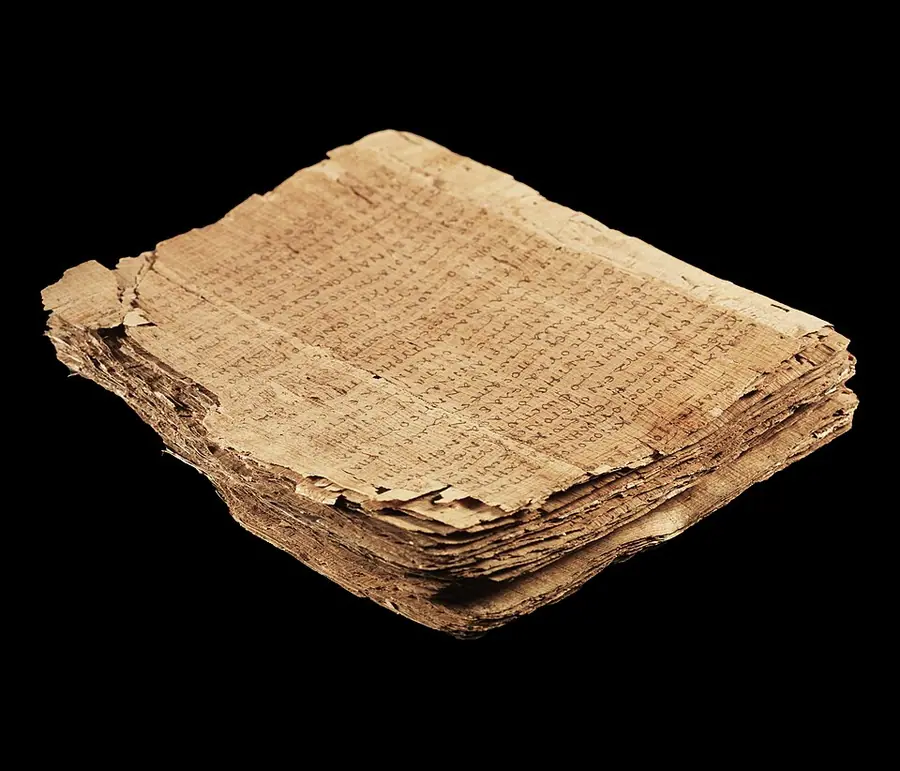
The short version: the Gospels do not say who wrote them, and the names we use come from second-century tradition. That tradition may be partly right, but the books themselves give little support to the idea that any of them was written by one of the Twelve. Most scholars think the authors were educated Greek-speaking Christians writing between about 70 and 110 CE, a generation or two after Jesus, from written sources and oral tradition.[1][2] Majority Some scholars think the traditional names are closer to the truth than that. Nearly all agree on the order, and most on the approximate dates. Majority
What the Gospels say about themselves
Read without their titles, the four books are anonymous. None begins “I, Matthew”, and none uses a first-person author except in passing:
- Luke opens with a preface to “most excellent Theophilus”, saying that many had “undertaken to set down an orderly account” of events handed on by “those who from the beginning were eyewitnesses”, and that he too decided to write one.[3] The author places himself among those who received the tradition, not among the eyewitnesses. Consensus
- John ends by naming its source: “This is the disciple who is testifying to these things and has written them, and we know that his testimony is true”.[4] The “we” is a group vouching for the Beloved Disciple, who is never named in the text (§4). Consensus
- Mark and Matthew say nothing about their authors. Matthew describes the call of a tax collector named Matthew in the third person, in a scene it adapts from Mark, where he is called Levi. Consensus
Where the names come from
The earliest testimony is from Papias, bishop of Hierapolis, around 110–130, preserved by Eusebius two centuries later. Papias reports what “the Elder” told him: that Mark, Peter’s interpreter, wrote down accurately what he remembered of the Lord’s words and deeds, “not, indeed, in order”, and that Matthew “collected the oracles in the Hebrew language”.[5] Consensus on what Papias said.
Around 155, Justin Martyr in Rome refers to “the memoirs of the apostles”, which “are called Gospels”, read aloud at the Sunday gathering, without naming their authors.[6][7] Around 180, Irenaeus of Lyon names all four and argues that there can be only four Gospels, as there are four zones of the world and four principal winds.[8][9] Consensus
The manuscripts point the same way. Where a Gospel’s opening survives, its title is of the same form, “(Gospel) according to …”, as in kata Maththaion, “according to Matthew”; Papyrus 66, a codex of John usually dated around 200, carries “Gospel according to John” on its first page.[10][11] No manuscript attributes a canonical Gospel to anyone else. Consensus
Why most scholars doubt the traditional names
The doubts come from the texts themselves, not from scepticism about tradition in general.
- Matthew copies Mark. Matthew reproduces about 90 percent of Mark’s content, often word for word, in Greek (§0). An eyewitness among the Twelve would be unlikely to depend so heavily on the account of a non-eyewitness, and Papias’ Matthew wrote “in the Hebrew language”, while our Matthew is a Greek book built on a Greek source.[12][13] Majority
- The dates. Mark’s prophecy of the Temple’s destruction, with its aside “let the reader understand”, reads as written during or after the war of 66–70;[14] Matthew’s parable has a king who “burned their city”.[15][16] Most scholars therefore date Matthew and Luke after 70 and John later still, when few of Jesus’ original followers would have been alive. Majority
- The setting. Mark explains Jewish customs and translates Aramaic for his readers; John speaks of believers being “put out of the synagogue”, which most scholars place in the late first century.[17] Majority
- Second-century naming. Christians in the second century had every reason to attach authoritative names to the books they read, as other works were attributed to Peter, Thomas and Mary. That the four canonical names stuck does not show they were original. Majority
None of this proves the traditional names wrong. Mark, who on this account was not an eyewitness anyway, could well be the author of the Gospel bearing his name, and the author of Luke and Acts may have known Paul, as tradition says of the “beloved physician” of Colossians 4:14; the passages in Acts that switch to “we” might preserve a travel diary of one of his companions, or might be a literary device.[18][19] Contested Most date Luke and Acts to about 80–90; Richard Pervo argued for about 115.[20] Contested
The case on each side
| View | Argument | Main proponents |
|---|---|---|
| Anonymous, later names | The texts are anonymous; Matthew and Luke copy Mark; the dates and settings point to the second and third Christian generations; names were attached as the books gained status | Most critical scholars; Ehrman, Brown[1][2] |
| Never truly anonymous | The uniform titles show the names circulated with the books from the start, probably before 100, as soon as two Gospels were read side by side | Hengel; Gathercole[10][11] |
| Eyewitness testimony | The Gospels preserve the testimony of named eyewitnesses closely, much as ancient historians relied on witnesses; Papias is a good guide to how they were made | Bauckham[21] |
| Early dates throughout | No New Testament book clearly describes the fall of the Temple as past; all may predate 70 | J. A. T. Robinson; a minority[22] |
Contested The first view is the majority among critical scholars; Hengel, Gathercole and Bauckham represent a substantial minority, and Robinson’s early dates a smaller one. Majority
What does not depend on the names
The order of composition (Paul’s letters, then Mark, then Matthew and Luke, then John) is accepted across all these positions, and so is the use of Mark by Matthew and Luke. Majority The historian’s methods described in §0 (looking for independent attestation, for details that embarrassed the early church, for what fits Judea in the 20s CE) do not require knowing who held the pen. Whether the author of Mark was a companion of Peter matters for how much weight to give a particular story; it does not decide whether Jesus existed or what he broadly taught. Majority
Common misconceptions
- “The Gospels were written centuries after Jesus.” All four were written within about forty to eighty years of the crucifixion, and the oldest fragment of John, P52, is often dated to the second century, though its date is debated (§0). Majority
- “The Church chose the authors at Nicaea.” The four names were in use by 180, nearly a century and a half before the council, which did not discuss the canon at all (§6). Consensus
- “Anonymous means unreliable.” Many ancient works do not name their author in the text, carrying the name only in a title or tag; anonymity raises questions about sources, but does not settle them. Majority
- “Matthew and John were eyewitnesses, so their Gospels are the earliest.” Mark is the earliest, and John the latest, on almost every view. Majority
Why it matters
For believers the names carry authority: an apostle’s account is a witness’s account. For historians the more useful question is how each Gospel was put together and for whom: what Mark’s audience feared during the war, what Matthew’s community was arguing with its neighbours about, why Luke wrote history for a Roman patron, and why John’s Jesus speaks so differently (§4). Those questions can be answered from the texts, whoever wrote them.
References
- ^ a b Bart D. Ehrman The New Testament: A Historical Introduction to the Early Christian Writings. Oxford University Press, 7th ed., 2020. The standard critical introduction.
- ^ a b Raymond E. Brown An Introduction to the New Testament. Doubleday, 1997. The Catholic standard introduction, fair to every position.
- ^ Luke 1:1–4 — Gospel of Luke (New Testament). c. 80–90 CE. Greek. Luke's preface: many have compiled accounts handed on by eyewitnesses; he writes an orderly account for 'most excellent Theophilus'. read the text
- ^ John 21:24 — Gospel of John (New Testament). c. 90–110 CE. Greek. 'This is the disciple who is testifying to these things and has written them, and we know that his testimony is true.' read the text
- ^ Eusebius, Ecclesiastical History 3.39 — Ecclesiastical History. early 4th c. CE (quoting Papias, c. 110–130). Greek. Papias' testimony that Mark wrote down Peter's recollections and Matthew collected the oracles 'in the Hebrew language'. read the text
- ^ Justin Martyr, First Apology 66 — First Apology. c. 155 CE. Greek. The apostles' memoirs, 'which are called Gospels', hand down Jesus' words over the bread and cup. read the text
- ^ Justin Martyr, First Apology 67 — First Apology. c. 155 CE. Greek. On Sunday 'the memoirs of the apostles or the writings of the prophets are read, as long as time permits', followed by the Eucharist. read the text
- ^ Irenaeus, Against Heresies 3.1.1 — Against Heresies. c. 180 CE. Greek (Latin translation). The earliest list naming Matthew, Mark, Luke and John as authors of the four Gospels. read the text
- ^ Irenaeus, Against Heresies 3.11.8 — Against Heresies. c. 180 CE. Greek (Latin translation). There can be neither more nor fewer than four Gospels, as there are four zones of the world and four principal winds. read the text
- ^ a b Martin Hengel The Four Gospels and the One Gospel of Jesus Christ. SCM Press / Trinity Press International, 2000. Argues that the Gospel titles were attached early, when the Gospels circulated among churches.
- ^ a b Simon Gathercole The Alleged Anonymity of the Canonical Gospels. Journal of Theological Studies 69: 447–476, 2018. Argues that the Gospel titles are early and uniform and that the Gospels were never truly anonymous.
- ^ John S. Kloppenborg Q, the Earliest Gospel: An Introduction to the Original Stories and Sayings of Jesus. Westminster John Knox, 2008. The leading Q scholar's introduction for general readers.
- ^ Mark Goodacre The Case Against Q: Studies in Markan Priority and the Synoptic Problem. Trinity Press International, 2002. The main modern defence of the Farrer hypothesis.
- ^ Joel Marcus Mark 1–8 (Anchor Yale Bible 27). Doubleday, 2000. Dates Mark to the Jewish revolt, c. 69–70.
- ^ Mark 13:14 — Gospel of Mark (New Testament). c. 70 CE. Greek. The 'desolating sacrilege' and the aside 'let the reader understand': Mark's readers are told to flee Judea, usually read as written during or just after the war of 66–70. read the text
- ^ Matthew 22:7 — Gospel of Matthew (New Testament). c. 80–90 CE. Greek. In the parable of the wedding banquet the king sends troops who 'burned their city', often read as Jerusalem in 70. read the text
- ^ John 9:22 — Gospel of John (New Testament). c. 90–110 CE. Greek. Anyone confessing Jesus as Messiah would be 'put out of the synagogue' (aposynagōgos), usually read as reflecting the late first century. read the text
- ^ Colossians 4:14 — Letter to the Colossians (New Testament). c. 60–90 CE. Greek. 'Luke, the beloved physician, and Demas greet you', the basis of the tradition that Luke was a physician. read the text
- ^ Acts 16:10–17 — Acts of the Apostles (New Testament). c. 80–90 CE. Greek. The first of the passages in which Acts switches to 'we'. read the text
- ^ Richard I. Pervo Dating Acts: Between the Evangelists and the Apologists. Polebridge Press, 2006. Argues for a date of Acts around 115.
- ^ Richard Bauckham Jesus and the Eyewitnesses: The Gospels as Eyewitness Testimony. Eerdmans, 2nd ed., 2017. The strongest modern case that the Gospels rest on named eyewitnesses; widely debated.
- ^ John A. T. Robinson Redating the New Testament. SCM Press, 1976. The case that every New Testament book predates 70 CE.