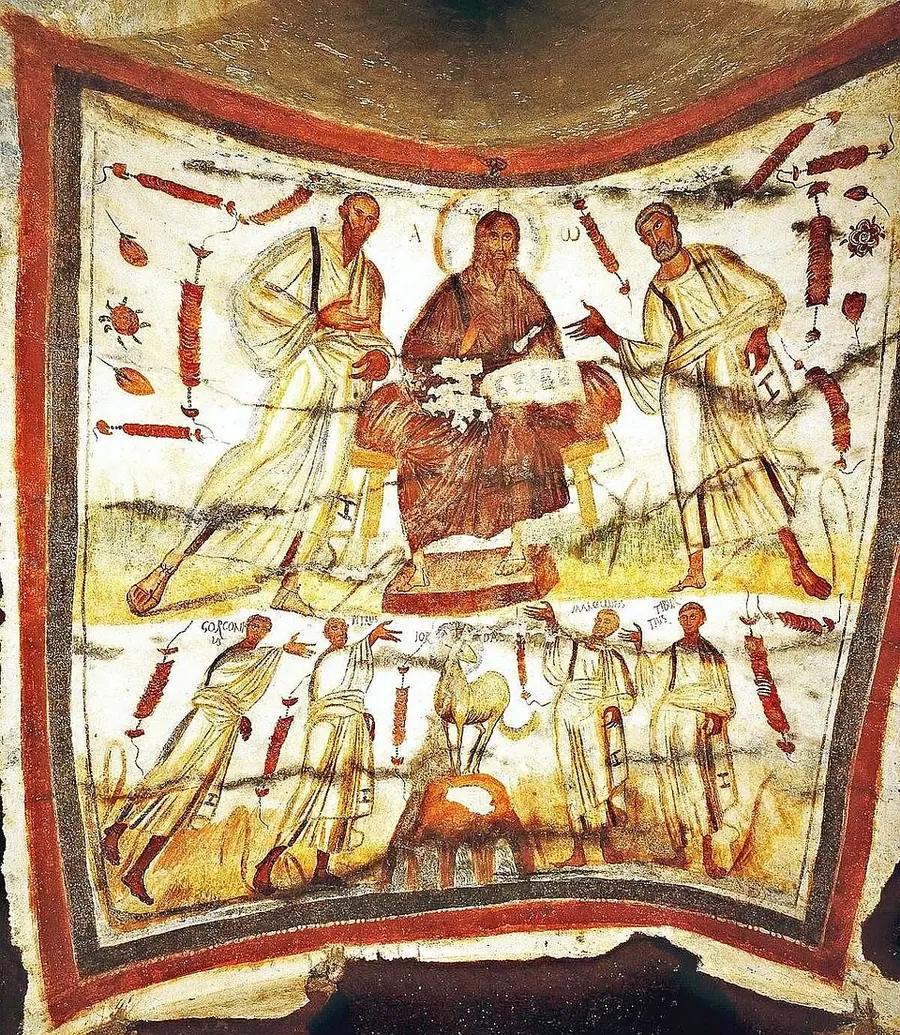
The short version: Paul did not invent the worship of Jesus, the belief in his resurrection or the Christian rituals; his own letters show that all of them were older than his involvement. He did something narrower and, in the long run, just as consequential. He insisted that non-Jews who joined the movement should not become Jews, and he won that argument. A Jewish messianic movement open to gentiles on those terms would, within a century of his death, become a separate religion. Whether that makes Paul its founder depends on what “founder” means. Majority
Why people ask
The question is old. In 1904 the German scholar William Wrede argued that Paul turned a Jewish preacher’s message about God’s kingdom into a religion about Jesus himself, and called him the “second founder” of Christianity.[1] In 1986 Hyam Maccoby argued that Paul, not Jesus, created Christianity, drawing on Greek mystery religion and Gnosticism.[2] Contested
The question has force because the contrast is real. Jesus in the Synoptic Gospels preaches God’s kingdom, tells parables and argues about the Jewish law; Paul writes almost nothing about Jesus’ life and preaches about his death and resurrection. Paul never met Jesus during his ministry; his authority rested on a vision of the risen Jesus, which he says made him an apostle to the gentiles.[3] Consensus
What Paul received
Paul’s letters, written about 50–60 CE, are the oldest Christian texts (§0). In them he quotes material he says he was given:
- The creed that Christ died for our sins, was buried, was raised on the third day, and appeared to Cephas, to the Twelve, to more than five hundred, to James and to all the apostles, “as of first importance what I in turn had received”.[4] Most scholars date it to within a few years of the crucifixion. Majority
- The Lord’s Supper, with Jesus’ words over the bread and cup, “received from the Lord” and handed on.[5] Majority
- An Aramaic prayer, maranatha, “Our Lord, come!”, which Paul leaves untranslated in a letter to Greek speakers in Corinth.[6] A prayer to Jesus in Aramaic must come from the Aramaic-speaking believers of Judea and Syria, before Paul’s mission. Majority
- A two-stage formula: Jesus “descended from David according to the flesh” and “declared to be Son of God with power… by resurrection from the dead”.[7] Majority that it is pre-Pauline.
Paul also persecuted the movement before he joined it, which shows that it already existed and already provoked opposition; and he describes a church in Jerusalem led by James, Peter and John, who had been in it longer than he had.[3][8] Consensus
How early was Jesus worshipped?
The hardest version of the question is whether Paul made Jesus divine. Within twenty years of the crucifixion, Paul’s communities prayed to Jesus, sang hymns about him, and applied to him scriptures about Israel’s God: Philippians 2 takes Isaiah’s “to me every knee shall bow” and gives it to Jesus.[9] In 1 Corinthians 8:6 Paul rewrites the Shema, Israel’s confession of one God, as “one God, the Father… and one Lord, Jesus Christ”.[10] Consensus on the texts.
Larry Hurtado and Richard Bauckham argue that this devotion was early and already Jewish, not a Pauline innovation: Paul shares it with the communities he did not found and never has to defend it.[11][12] Bart Ehrman sees a development, from a man exalted by God at his resurrection to a pre-existent heavenly being, already under way in Paul.[13] Paula Fredriksen places it within ancient Jewish ways of speaking about exalted figures.[14] Contested All four agree that Paul did not originate the worship of Jesus, and that the language of the later creeds, such as “of one substance with the Father”, belongs to the fourth century (§6). Majority
What Paul changed
What Paul argued for, against other leaders of the movement, was the terms on which gentiles belonged. He told gentile men not to be circumcised, “if you let yourselves be circumcised, Christ will be of no benefit to you”, and defended that position at a meeting in Jerusalem around 48–49 and in a public quarrel with Peter at Antioch.[15][8][3] Majority
The choice was not Paul’s alone. According to Acts, believers whose names it does not give had already preached to Greeks at Antioch before Barnabas brought Paul there, and the Jerusalem leaders accepted his mission to gentiles (§3).[16][8] But Paul’s letters argued the case most forcefully, and because they were preserved and became scripture, his version of the argument shaped what came after. Majority
He did not, in his own terms, leave Judaism. He calls himself a Hebrew born of Hebrews and, as to the law, a Pharisee; he tells Jewish believers not to undo their circumcision; and he insists that God has not rejected Israel and that “all Israel will be saved”.[17][18][19] Krister Stendahl argued that he was “called” rather than “converted”, given a new task within the same religion.[20][21] Majority
The case on each side
| View | Argument | Main proponents |
|---|---|---|
| Founder | Paul turned a Jewish preacher’s message about the kingdom into a religion about Jesus himself, open to gentiles and free of the law | Wrede; Maccoby[1][2] |
| Continuator | Worship of Jesus, the resurrection creed, baptism and the Lord’s Supper predate Paul; he inherited them and argued over the terms of gentile membership | Hurtado; Dunn; most scholars[11][22] |
| Neither | A religion separate from Judaism did not exist in Paul’s lifetime; it emerged over the next century from choices Paul helped make | Fredriksen; Eisenbaum[14][23] |
Majority for continuity on worship and ritual; Contested on how much Paul changed.
Common misconceptions
- “Paul never mentions Jesus’ life.” He mentions little, but he mentions his descent from David, his brother James, the Twelve, his last meal, his teaching on divorce and his crucifixion.[7][3][4][5][24] Consensus
- “Paul founded the churches of the whole empire.” He founded churches in Asia Minor, Macedonia and Greece; the churches of Jerusalem, Damascus, Antioch and Rome existed before him. Consensus
- “Paul abolished the Jewish law.” He told gentiles not to take it on; he did not tell Jews to abandon it, and the “Paul within Judaism” school argues that he kept it himself (§3). Majority
- “Paul was the first Christian.” Neither he nor anyone else in his letters is called a Christian; the name first appears in Acts, 1 Peter and Ignatius of Antioch, around 80–110 (§0).[25][26][27] Consensus
Why it matters
The answer shapes how Christians and Jews see each other. If Paul invented Christianity, the break with Judaism was his doing and came early. If he inherited a Jewish faith in Jesus and argued about who could share it, the break came later and was gradual, the work of the generations after him (§4). Most of the evidence supports the second picture. It also means that Paul’s letters, read in their own setting, are among the best evidence for the Jewish movement around Jesus in its first generation. Majority
References
- ^ a b William Wrede Paulus. Gebauer-Schwetschke, Halle (Religionsgeschichtliche Volksbücher), 1904. Paul as the 'second founder of Christianity'.
- ^ a b Hyam Maccoby The Mythmaker: Paul and the Invention of Christianity. Harper & Row, 1986. Argues that Paul, not Jesus, founded Christianity; a minority view.
- ^ a b c d Galatians 1:13–2:14 — Paul, Letter to the Galatians. c. 50–55 CE. Greek. Paul's own account: he persecuted the church, received a revelation, stayed with Cephas and met 'James the Lord's brother', and later confronted Peter at Antioch. read the text
- ^ a b 1 Corinthians 15:3–8 — Paul, First Letter to the Corinthians. c. 54 CE. Greek. A creed Paul 'received': Christ died, was buried, was raised on the third day, and appeared to Cephas, the Twelve, five hundred, James, all the apostles and Paul. read the text
- ^ a b 1 Corinthians 11:23–26 — Paul, First Letter to the Corinthians. c. 54 CE. Greek. Paul hands on the words over the bread and cup 'on the night when he was betrayed', the oldest account of the Last Supper. read the text
- ^ 1 Corinthians 16:22 — Paul, First Letter to the Corinthians. c. 54 CE. Greek. Paul closes with the Aramaic prayer maranatha, 'Our Lord, come!', preserved untranslated in a Greek letter. read the text
- ^ a b Romans 1:3–4 — Paul, Letter to the Romans. c. 56–57 CE. Greek. Jesus 'descended from David according to the flesh' and 'declared to be Son of God… by resurrection from the dead'. read the text
- ^ a b c Galatians 2:1–10 — Paul, Letter to the Galatians. c. 50–55 CE. Greek. After fourteen years Paul, Barnabas and Titus meet James, Cephas and John, who give 'the right hand of fellowship'. read the text
- ^ Philippians 2:6–11 — Paul, Letter to the Philippians. c. 50s CE. Greek. A hymn, probably pre-Pauline: Christ Jesus 'in the form of God' empties himself, is exalted, and every knee bows at his name. read the text
- ^ 1 Corinthians 8:4–6 — Paul, First Letter to the Corinthians. c. 54 CE. Greek. 'For us there is one God, the Father… and one Lord, Jesus Christ, through whom are all things.' read the text
- ^ a b Larry W. Hurtado Lord Jesus Christ: Devotion to Jesus in Earliest Christianity. Eerdmans, 2003. The case that worship of Jesus began very early, within Jewish monotheism.
- ^ Richard Bauckham Jesus and the God of Israel. Eerdmans, 2008. Argues that the earliest Christians included Jesus within the identity of Israel's one God.
- ^ Bart D. Ehrman How Jesus Became God: The Exaltation of a Jewish Preacher from Galilee. HarperOne, 2014. A developmental account of early Christology and the resurrection visions.
- ^ a b Paula Fredriksen Paul: The Pagans' Apostle. Yale University Press, 2017. Paul as an apocalyptic Jew whose mission was to bring gentiles, as gentiles, to Israel's God.
- ^ Galatians 5:2–6 — Paul, Letter to the Galatians. c. 50–55 CE. Greek. 'If you let yourselves be circumcised, Christ will be of no benefit to you.' read the text
- ^ Acts 11:19–26 — Acts of the Apostles (New Testament). c. 80–90 CE. Greek. Believers at Antioch preach to Greeks; Barnabas brings Saul from Tarsus. read the text
- ^ Philippians 3:5 — Paul, Letter to the Philippians. c. 50s CE. Greek. Paul describes himself as circumcised on the eighth day, of the tribe of Benjamin, a Hebrew of Hebrews, 'as to the law a Pharisee'. read the text
- ^ 1 Corinthians 7:17–20 — Paul, First Letter to the Corinthians. c. 54 CE. Greek. The circumcised should not remove its marks, and the uncircumcised should not seek circumcision. read the text
- ^ Romans 11:25–29 — Paul, Letter to the Romans. c. 56–57 CE. Greek. 'And so all Israel will be saved'; 'the gifts and the calling of God are irrevocable'. read the text
- ^ Krister Stendahl The Apostle Paul and the Introspective Conscience of the West. Harvard Theological Review 56: 199–215, 1963. Argues that the introspective Western reading of Paul, from Augustine to Luther, is not Paul's own concern.
- ^ Krister Stendahl Paul Among Jews and Gentiles. Fortress Press, 1976. Includes 'Call Rather Than Conversion', the case that Paul received a new task within Judaism.
- ^ James D. G. Dunn The New Perspective on Paul. Bulletin of the John Rylands Library 65: 95–122, 1983. The 1982 Manson lecture that named the New Perspective.
- ^ Pamela Eisenbaum Paul Was Not a Christian: The Original Message of a Misunderstood Apostle. HarperOne, 2009. Paul as a Jew who remained within Judaism, writing to gentiles.
- ^ 1 Corinthians 7:10–11 — Paul, First Letter to the Corinthians. c. 54 CE. Greek. Paul cites a command 'not I but the Lord' forbidding divorce, an independent witness to a teaching of Jesus also in Mark. read the text
- ^ Acts 11:26 — Acts of the Apostles (New Testament). c. 80–90 CE. Greek. At Antioch 'the disciples were first called Christians'. read the text
- ^ 1 Peter 4:16 — First Letter of Peter (New Testament). c. 80–100 CE. Greek. 'If any of you suffers as a Christian, do not consider it a disgrace', one of the earliest uses of the name. read the text
- ^ Ignatius, To the Magnesians 10 — Letters of Ignatius of Antioch. c. 110 CE. Greek. The earliest known use of the word Christianismos, 'Christianity', set against Ioudaismos. read the text