How It Evolved
Christianity · Chapter 9 · Byzantium and the Orthodox World Majority view

Byzantium and Orthodoxy: Icons, Athos and the Old Believers

Icons and monks, the conversion of the Slavs, the church under the Ottomans, Moscow as the Third Rome, and the schism of the Old Believers

By Published 23 min read 33 sources cited

Region Constantinople, Mount Athos, the Balkans, Kiev and Muscovy

In brief

  • Orthodox Christianity is the Greek church of the Byzantine Empire and the churches it formed among the Slavs and in the Balkans; for most of its history it was organised around a liturgy, monasteries and several patriarchs, in an uneasy partnership with the emperor, rather than around a single bishop.
  • Icons were confirmed as central to Orthodox worship when the long controversy over images ended in 843, an event the Orthodox still celebrate every year as the Triumph of Orthodoxy.
  • Hesychasm, the monks' practice of silent prayer, was defended by Gregory Palamas and upheld by councils in Constantinople between 1341 and 1351; its teaching that God is known through his uncreated energies remains distinctive of Orthodox theology.
  • After 1453 the patriarch of Constantinople served under Ottoman sultans; the idea that Mehmed II founded a formal 'millet system' for Christians is now thought to be a later construction.
  • The 'Third Rome' formula comes from one monk's letter of about 1523–24 and appears officially in the charter of the Moscow patriarchate (1589); historians debate how much it ever meant to Muscovy's rulers.
  • Patriarch Nikon's reforms of the 1650s, which changed the Russian rite to match Greek practice, led to the schism of the Old Believers, who kept the old rite through long periods of persecution until toleration in 1905.
Where it happened
ConstantinopleMount AthosThessalonicaVelehradOhridKievMoscowPskovBrestSolovetsky MonasteryPustozersk1234567891011
The 11 places on the map
  1. 1Constantinople: Hagia Sophia dedicated, 537; falls to the Ottomans, 1453
  2. 2Mount Athos: The Great Lavra, 961–963; the hesychasts
  3. 3Thessalonica: Home of Cyril and Methodius, and of Palamas as archbishop
  4. 4Velehrad: Later shrine of the Great Moravian mission of 863; the ninth-century centre lay nearby
  5. 5Ohrid: Clement's school after 886
  6. 6Kiev: Christianisation of Kiev, traditionally c. 988
  7. 7Moscow: Patriarchate from 1589; the council of 1666–67
  8. 8Pskov: Filofei's 'Third Rome' letter, c. 1523–24
  9. 9Brest: The Union of Brest, 1596
  10. 10Solovetsky Monastery: Held out against the new books, 1668–76
  11. 11Pustozersk: Avvakum's exile and death, 1682
On this page
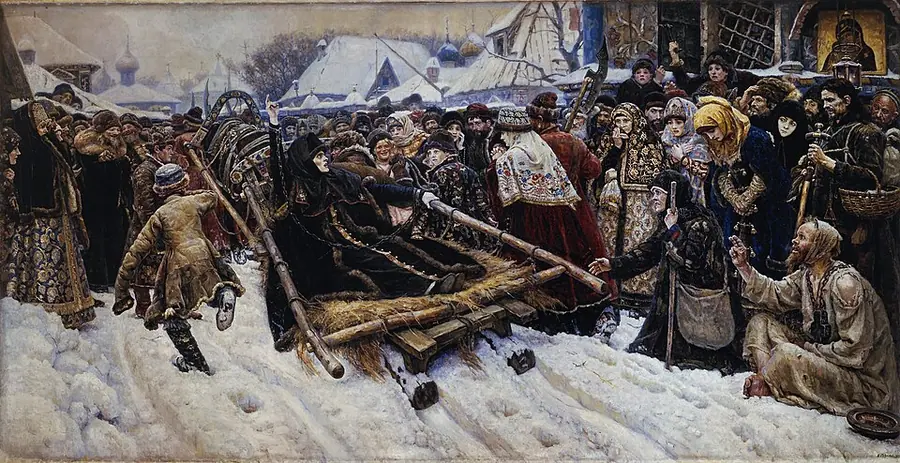
Vasily Surikov's painting Boyarynya Morozova (1887): the Old Believer noblewoman Feodosia Morozova, chained on a sledge in a snowy Moscow street, raises two fingers in the old sign of the cross as the crowd watches
Vasily Surikov (photograph: Google Art Project) · Public domain · Wikimedia Commons
How religions evolved 370 370 400 400 450 450 500 500 550 550 600 600 650 650 700 700 750 750 800 800 850 850 900 900 1000 1000 1050 1050 1100 1100 1200 1200 1250 1250 1300 1300 1400 1400 1500 1500 1525 1525 1550 1550 1600 1600 1650 1650 1700 1700 1725 1725 1750 1750 1800 1800 1850 1850 1875 1875 1900 1900 1925 1925 1930 1930 compressed scale Christianity c. 30 CE – present 15 chapters · 22 dated firsts · 20 branches and offshoots chapters dated firsts turning points §6 Constantine, the Creeds and the Councils, 312 – 451 An emperor's conversion, an argument about the Son, and the empire that made one Christianity official §6 §7 Beyond Rome, 300 – 1400 Armenia, Georgia and Ethiopia, the Church of the East from Persia to China, the Thomas Christians, and Christians under Islam §7 Beyond Rome §8 The Medieval West, 500 – 1300 Monks and popes, the conversion of the north, the split with the East, and a church that defined purgatory and pursued heretics §8 The Medieval West §9 Byzantium and the Orthodox World, 500 – 1800 Icons and monks, the conversion of the Slavs, the church under the Ottomans, Moscow as the Third Rome, and the schism of the Old Believers §9 Byzantium and the Orthodox World §10 Reformations, 1517 – 1648 Luther's protest, the Swiss and the radicals, England's break, Trent's answer, and a century of religious war §10 Reformations §11 Mission and Empire, 1492 – 1900 Conquest and its critics, converts who made the faith their own, slavery, and the Protestant missionary century §11 Mission and Empire §12 Revival, Reason and Criticism, 1650 – 1900 Pietists and Methodists, the Bible's critics, Darwin, infallibility, new churches and the Rapture §12 Revival, Reason and Criticism §13 The Twentieth Century, 1900 – 1990 Tongues of fire, fundamentalists, the churches under Stalin and Hitler, Vatican II and a southern turn §13 The Twentieth Century The Jesus movement, a Jewish sect · c. 30 CE · majority Jesus of Nazareth crucified under Pilate, probably in 30 or 33; his followers proclaim him raised. Ebionites: Jewish believers who kept the Law · described c. 180 · majority Irenaeus describes them around 180; Jewish believers persisted for centuries after the parting of the ways. Valentinians and the 'Gnostics' · c. 136 · majority Valentinus teaches in Rome from c. 136; whether 'Gnosticism' was one movement is disputed. Marcionites · c. 144 · majority Marcion breaks with the Roman church with the first fixed list of Christian scripture; a 'synagogue of the Marcionites' is still inscribed in Syria in 318–319. Donatists · 313 · consensus The North African schism over clergy who had lapsed in persecution, heard at Rome and Arles at Constantine's request. Church of the East · 410 · 424 · majority The church of the Persian Empire organises separately under its own catholicos (410) and rejects appeals to 'the Western fathers' (424), decades before the quarrel over Christ's natures; its Antiochene theology follows in the 480s. It reaches China in 635 and India's Thomas Christians. The Chalcedonian churches: Greek East and Latin West · 451 · consensus The churches that accept the Council of Chalcedon's 'two natures': the imperial church of Constantinople and the Latin West, still one communion until they divide in 1054. Each family holds that it kept the faith of the earlier councils. Oriental Orthodox churches · 451 · consensus The churches of Egypt, Syria, Armenia (Dvin, 554) and Ethiopia reject Chalcedon's 'two natures' and keep Cyril's 'one incarnate nature'; they call themselves miaphysite, not 'Monophysite'. Separate hierarchies form over the following century, and each side holds that it kept the faith of Ephesus. Catholic Church · 1054 · consensus The Latin West after the excommunications of 1054; the break with the East became final after 1204. Each side holds that it is the continuing church. Eastern Orthodox churches · 1054 · consensus Mutual excommunications in Hagia Sophia on 16 July 1054; the estrangement was already centuries old and the Fourth Crusade's sack of Constantinople (1204) made it final. Each side holds that it is the continuing church. Cathars · 12th–14th c. · contested Crushed by the Albigensian Crusade (1209–29) and the inquisitions; whether 'Catharism' was one coherent religion or an inquisitors' construction is disputed. Hussites · 1415 · consensus Jan Hus burned at the Council of Constance; the Bohemian Brethren who followed re-emerge as the Moravians. Lutheran · 1517 · consensus Luther's Ninety-five Theses (31 October 1517); the Augsburg Confession (1530); princes choose at Augsburg (1555). Reformed (Zwingli, Calvin) · 1522 · 1536 · consensus Zwingli's reform begins in Zurich (1522); Luther and Zwingli fail to agree at Marburg (1529); Calvin's Institutes (1536). Anabaptists (Mennonites, Amish) · January 1525 · consensus First adult baptisms in Zurich; radical Anabaptists hold Münster in 1534–35; the pacifist majority survives as the Mennonites. Anglican (Church of England) · 1534 · consensus The Act of Supremacy makes Henry VIII 'supreme head' of the Church of England; the Elizabethan settlement (1559–63). Evangelical revivals · 1734–1741 · consensus Edwards at Northampton (1734–35), Wesley's heart 'strangely warmed' (1738), Whitefield's tours; a religion of conversion that crosses the Protestant churches. Methodist · 1784 · consensus Wesley ordains ministers for America; the Methodist Episcopal Church is founded in Baltimore. The African Methodist Episcopal Church follows in 1816. Latter-day Saints (Mormons) · 1830 · consensus The Book of Mormon published and Joseph Smith's church organised in the 'burned-over district' of New York. Seventh-day Adventists · 1844 · 1863 · consensus The Millerites' 'Great Disappointment' of 22 October 1844; the church organised in 1863. Jehovah's Witnesses · 1879 · consensus Charles Taze Russell's Zion's Watch Tower, from the same Adventist expectation. Pentecostal · 1901 · 1906 · consensus Speaking in tongues at Parham's school in Topeka (1901); the Azusa Street revival under William Seymour (1906); the Assemblies of God (1914). Hundreds of millions today. African-initiated churches · 1892 · 1921 · consensus The Ethiopian Church in Pretoria (1892); Kimbangu's healing ministry in Congo (1921); the Aladura churches of Nigeria; the Zion Christian Church (1924). ❾ Ukrainian and Belarusian Greek Catholics (Union of Brest)" data-detail="Orthodox bishops of Poland–Lithuania enter communion with Rome while keeping the Byzantine rite: the Ukrainian Greek Catholic Church. Its legitimacy is still disputed between Catholics and Orthodox.">❾ Ukrainian and Belarusian Greek Catholics (Union of Brest) · 1595–96 · consensus Orthodox bishops of Poland–Lithuania enter communion with Rome while keeping the Byzantine rite: the Ukrainian Greek Catholic Church. Its legitimacy is still disputed between Catholics and Orthodox. ❿ Old Believers" data-detail="Those who refused Patriarch Nikon's reforms of the Russian rite, anathematised by the Great Moscow Council in 1667 and persecuted until toleration in 1905; divided into priestly and priestless communities.">❿ Old Believers · 1653 · 1666–67 · consensus Those who refused Patriarch Nikon's reforms of the Russian rite, anathematised by the Great Moscow Council in 1667 and persecuted until toleration in 1905; divided into priestly and priestless communities. 380 CE: Nicene Christianity as the religion of the empire. Addressed to Constantinople and aimed at rival Christians, the edict was later read and codified as establishing Nicene Christianity across the empire. Source: Theodosius I, Cunctos populos. Confidence: majority. 431 CE: Mary as Theotokos, "God-bearer". The council deposed Nestorius and affirmed the title Theotokos for Mary. Source: Council of Ephesus. Confidence: consensus. 451 CE: Christ "in two natures". The formula that split the East into Chalcedonian, Oriental Orthodox and Church of the East families. Source: Definition of the Council of Chalcedon. Confidence: consensus. c. 530 CE: A Rule for monks. Benedict's Rule, drawing heavily on the anonymous Rule of the Master, became the standard of Western monasticism. Source: The Rule of Benedict. Confidence: majority. 591 CE: Mary Magdalene as the repentant sinner. Gregory merged her with the sinful woman of Luke 7 and Mary of Bethany and read her sins as sexual; the Roman calendar separated them again in 1969. Source: Gregory the Great, Homily 33. Confidence: majority. 635 CE arrival; stele 781: Christianity in Tang China. Alopen of the Church of the East reached Chang'an in 635; the stele erected in 781 tells the community's story. Source: The Xi'an Stele. Confidence: consensus. ❷ 863 · approved 868" data-text="The liturgy in the people's own Slavonic" data-detail="A new alphabet, Glagolitic, is created for it; Pope Hadrian II approves the Slavonic liturgy in Rome in 868." data-hl="7">❷ 863 · approved 868: The liturgy in the people's own Slavonic. A new alphabet, Glagolitic, is created for it; Pope Hadrian II approves the Slavonic liturgy in Rome in 868. Source: Life of Constantine-Cyril 14. Confidence: consensus. c. 1014 CE: The filioque sung in Rome's creed. Long used in Spain and the Frankish church, the addition "and the Son" entered the creed at Rome in the early eleventh century. Source: Roman liturgical practice under Henry II. Confidence: majority. 16 July 1054: Mutual excommunications of the papal legates and the patriarch. One event in a long drift; the sack of Constantinople in 1204 made the break real, and the excommunications were lifted in 1965. Source: The bull laid on the altar of Hagia Sophia. Confidence: majority. 1215 CE: Transubstantiation and annual confession. The council defined the change of bread and wine and required every adult to confess and receive communion at least once a year. Source: Fourth Lateran Council, canons 1 and 21. Confidence: consensus. 1274 CE: Purgatory set out in a council. Prayers for the dead are early; the noun purgatorium appears in the late twelfth century, and Lyon II gave the first conciliar statement. Source: Profession of faith accepted at the Second Council of Lyon. Confidence: consensus. ❺ 1338–41 · councils 1341–1351" data-text="God known through his uncreated energies" data-detail="Palamas's distinction between God's unknowable essence and his energies, in which humans can share, becomes Orthodox doctrine." data-hl="12">❺ 1338–41 · councils 1341–1351: God known through his uncreated energies. Palamas's distinction between God's unknowable essence and his energies, in which humans can share, becomes Orthodox doctrine. Source: Gregory Palamas, Triads. Confidence: consensus. 1517–1520: Justification by faith alone; Scripture as supreme authority. Luther's programme: sinners are justified by faith, Scripture stands above popes and councils, and all baptised believers are priests. Source: Luther's Ninety-five Theses and treatises of 1520. Confidence: consensus. January 1525: Adult baptism of believers. The Anabaptist movement begins, rejecting infant baptism. Source: First adult baptisms in Zurich. Confidence: consensus. 1537: Indigenous Americans declared rational and free. The bull declared that the peoples of the Americas were truly human and could not be deprived of liberty or property. Source: Paul III, Sublimis Deus. Confidence: consensus. April 1546: The canon fixed as dogma, with the deuterocanonical books. Trent defined the list of biblical books as a matter of faith for the first time. Source: Council of Trent, Session IV. Confidence: consensus. 24 May 1738: The heart "strangely warmed": evangelical conversion. The experience at the root of Methodism and of the evangelical religion of the heart. Source: John Wesley's journal, Aldersgate Street. Confidence: consensus. 1774–1778: A historical Jesus written against the Gospels. The first attempt to reconstruct the historical Jesus in opposition to the Gospel accounts. Source: Reimarus' fragments, published by Lessing. Confidence: consensus. early 1830s: A pre-tribulation Rapture. Darby developed the teaching that believers will be caught up before a final tribulation; the Scofield Reference Bible spread it from 1909. Source: John Nelson Darby among the Brethren. Confidence: majority. 1854: Mary's Immaculate Conception defined. Defined as dogma for Catholics, long after it had become a widespread belief. Source: Pius IX, Ineffabilis Deus. Confidence: consensus. 18 July 1870: Papal infallibility. The council defined that the pope speaking ex cathedra on faith and morals is infallible. Source: First Vatican Council, Pastor aeternus. Confidence: consensus. 1 January 1901: Speaking in tongues as Spirit baptism. One of several starting points of Pentecostalism; the Azusa Street revival followed from 1906. Source: Agnes Ozman at Parham's Bethel Bible School, Topeka. Confidence: consensus. copper plates, 849: Thomas Christians of Kerala. The Tharisapalli plates grant land to a church at Quilon; brought under Portuguese Latin control at Diamper in 1599. Confidence: consensus. ❹ c. 988" data-text="Baptism of Rus'" data-detail="Vladimir of Kiev is baptised; the year is disputed. The Russian church stands on the Orthodox side after 1054." data-hl="24">❹ c. 988: Baptism of Rus'. Vladimir of Kiev is baptised; the year is disputed. The Russian church stands on the Orthodox side after 1054. Confidence: majority. 1075: Gregorian reform: the papal monarchy. Gregory VII's Dictatus papae claims the pope may depose emperors; the papal monarchy of the high Middle Ages. Confidence: majority. 1216 · 1223: The friars: Dominicans and Franciscans. Orders of preaching and poverty for the new towns; Dominican friars staff the inquisitions from 1231. Confidence: consensus. 1722–1727: Moravians at Herrnhut. Refugees settle on Zinzendorf's estate; the first Moravian missionaries sail in 1732. Confidence: consensus. 1540 · 1545–1563: Catholic reform: Trent and the Jesuits. The Society of Jesus approved (1540); the Council of Trent answers the reformers point by point. Confidence: consensus. 1833: The Oxford Movement. Keble's 'National Apostasy' sermon; Anglo-Catholic revival; Newman becomes a Catholic in 1845. Confidence: consensus. 1854 · 1870: Papal infallibility defined. The Immaculate Conception (1854) and the First Vatican Council (1870): the papacy's answer to the modern state. Confidence: consensus. 1910–1915: Fundamentalism. The Fundamentals distributed free; the Scopes trial (1925). Confidence: consensus. ❶ 843" data-text="The Triumph of Orthodoxy: icons restored" data-detail="The regent Theodora and Patriarch Methodios restore the veneration of icons; the Synodikon is read every year on the Sunday of Orthodoxy." data-hl="32">❶ 843: The Triumph of Orthodoxy: icons restored. The regent Theodora and Patriarch Methodios restore the veneration of icons; the Synodikon is read every year on the Sunday of Orthodoxy. Confidence: consensus. ❸ 863 · 868" data-text="Cyril and Methodius: a Slavonic liturgy" data-detail="The Moravian mission brings the liturgy and Gospels in Slavonic, in a new alphabet; Pope Hadrian II approves it in 868." data-hl="33">❸ 863 · 868: Cyril and Methodius: a Slavonic liturgy. The Moravian mission brings the liturgy and Gospels in Slavonic, in a new alphabet; Pope Hadrian II approves it in 868. Confidence: consensus. ❻ 1338–41 · 1351" data-text="Hesychasm upheld: Gregory Palamas" data-detail="Palamas defends the monks' silent prayer and their vision of God's uncreated light; councils in Constantinople uphold him (1341–1351)." data-hl="34">❻ 1338–41 · 1351: Hesychasm upheld: Gregory Palamas. Palamas defends the monks' silent prayer and their vision of God's uncreated light; councils in Constantinople uphold him (1341–1351). Confidence: consensus. ❼ 1453 · 1454" data-text="Constantinople falls; the patriarch under the sultan" data-detail="Mehmed II takes the city and invests Gennadios Scholarios as patriarch; whether he founded a formal 'millet system' is doubted." data-hl="35">❼ 1453 · 1454: Constantinople falls; the patriarch under the sultan. Mehmed II takes the city and invests Gennadios Scholarios as patriarch; whether he founded a formal 'millet system' is doubted. Confidence: consensus. ❽ 1448 · 1589" data-text="The patriarchate of Moscow" data-detail="The Russian church elects its own metropolitan in 1448; Jeremias II of Constantinople consecrates Job as first patriarch of Moscow in 1589." data-hl="36">❽ 1448 · 1589: The patriarchate of Moscow. The Russian church elects its own metropolitan in 1448; Jeremias II of Constantinople consecrates Job as first patriarch of Moscow in 1589. Confidence: consensus. ⓫ 1721" data-text="Peter the Great's Holy Synod replaces the patriarch" data-detail="The Spiritual Regulation puts the Russian church under a synod of bishops and, from 1722, a lay chief procurator, until 1917." data-hl="37">⓫ 1721: Peter the Great's Holy Synod replaces the patriarch. The Spiritual Regulation puts the Russian church under a synod of bishops and, from 1722, a lay chief procurator, until 1917. Confidence: consensus. described c. 180: Ebionites: Jewish believers who kept the Law. Irenaeus describes them around 180; Jewish believers persisted for centuries after the parting of the ways. Confidence: majority. c. 136: Valentinians and the 'Gnostics'. Valentinus teaches in Rome from c. 136; whether 'Gnosticism' was one movement is disputed. Confidence: majority. c. 144: Marcionites. Marcion breaks with the Roman church with the first fixed list of Christian scripture; a 'synagogue of the Marcionites' is still inscribed in Syria in 318–319. Confidence: majority. 1892 · 1921: African-initiated churches. The Ethiopian Church in Pretoria (1892); Kimbangu's healing ministry in Congo (1921); the Aladura churches of Nigeria; the Zion Christian Church (1924). Confidence: consensus. Donatists · 313 · consensus The North African schism over clergy who had lapsed in persecution, heard at Rome and Arles at Constantine's request.Donatists 313 Church of the East · 410 · 424 · majority The church of the Persian Empire organises separately under its own catholicos (410) and rejects appeals to 'the Western fathers' (424), decades before the quarrel over Christ's natures; its Antiochene theology follows in the 480s. It reaches China in 635 and India's Thomas Christians.Church of the East 410 · 424 The Chalcedonian churches: Greek East and Latin West · 451 · consensus The churches that accept the Council of Chalcedon's 'two natures': the imperial church of Constantinople and the Latin West, still one communion until they divide in 1054. Each family holds that it kept the faith of the earlier councils.The Chalcedonian churches: Greek East and Latin West 451 Oriental Orthodox churches · 451 · consensus The churches of Egypt, Syria, Armenia (Dvin, 554) and Ethiopia reject Chalcedon's 'two natures' and keep Cyril's 'one incarnate nature'; they call themselves miaphysite, not 'Monophysite'. Separate hierarchies form over the following century, and each side holds that it kept the faith of Ephesus.Oriental Orthodox churches 451 Catholic Church · 1054 · consensus The Latin West after the excommunications of 1054; the break with the East became final after 1204. Each side holds that it is the continuing church.Catholic Church 1054 Eastern Orthodox churches · 1054 · consensus Mutual excommunications in Hagia Sophia on 16 July 1054; the estrangement was already centuries old and the Fourth Crusade's sack of Constantinople (1204) made it final. Each side holds that it is the continuing church.Eastern Orthodox churches Cathars · 12th–14th c. · contested Crushed by the Albigensian Crusade (1209–29) and the inquisitions; whether 'Catharism' was one coherent religion or an inquisitors' construction is disputed.Cathars Hussites · 1415 · consensus Jan Hus burned at the Council of Constance; the Bohemian Brethren who followed re-emerge as the Moravians.Hussites 1415 Lutheran · 1517 · consensus Luther's Ninety-five Theses (31 October 1517); the Augsburg Confession (1530); princes choose at Augsburg (1555).Lutheran 1517 Reformed (Zwingli, Calvin) · 1522 · 1536 · consensus Zwingli's reform begins in Zurich (1522); Luther and Zwingli fail to agree at Marburg (1529); Calvin's Institutes (1536).Reformed (Zwingli, Calvin) 1522 · 1536 Anabaptists (Mennonites, Amish) · January 1525 · consensus First adult baptisms in Zurich; radical Anabaptists hold Münster in 1534–35; the pacifist majority survives as the Mennonites.Anabaptists (Mennonites, Amish) Anglican (Church of England) · 1534 · consensus The Act of Supremacy makes Henry VIII 'supreme head' of the Church of England; the Elizabethan settlement (1559–63).Anglican (Church of England) 1534 Evangelical revivals · 1734–1741 · consensus Edwards at Northampton (1734–35), Wesley's heart 'strangely warmed' (1738), Whitefield's tours; a religion of conversion that crosses the Protestant churches.Evangelical revivals Methodist · 1784 · consensus Wesley ordains ministers for America; the Methodist Episcopal Church is founded in Baltimore. The African Methodist Episcopal Church follows in 1816.Methodist 1784 Latter-day Saints (Mormons) · 1830 · consensus The Book of Mormon published and Joseph Smith's church organised in the 'burned-over district' of New York.Latter-day Saints (Mormons) Seventh-day Adventists · 1844 · 1863 · consensus The Millerites' 'Great Disappointment' of 22 October 1844; the church organised in 1863.Seventh-day Adventists Jehovah's Witnesses · 1879 · consensus Charles Taze Russell's Zion's Watch Tower, from the same Adventist expectation.Jehovah's Witnesses Pentecostal · 1901 · 1906 · consensus Speaking in tongues at Parham's school in Topeka (1901); the Azusa Street revival under William Seymour (1906); the Assemblies of God (1914). Hundreds of millions today.Pentecostal ❾ Ukrainian and Belarusian Greek Catholics (Union of Brest) · 1595–96 · consensus Orthodox bishops of Poland–Lithuania enter communion with Rome while keeping the Byzantine rite: the Ukrainian Greek Catholic Church. Its legitimacy is still disputed between Catholics and Orthodox.❾ Ukrainian and Belarusian Greek Catholics (Union of Brest) ❿ Old Believers · 1653 · 1666–67 · consensus Those who refused Patriarch Nikon's reforms of the Russian rite, anathematised by the Great Moscow Council in 1667 and persecuted until toleration in 1905; divided into priestly and priestless communities.❿ Old Believers 380 CE: Nicene Christianity as the religion of the empire. Addressed to Constantinople and aimed at rival Christians, the edict was later read and codified as establishing Nicene Christianity across the empire. Source: Theodosius I, Cunctos populos. Confidence: majority. 380 CE Nicene Christianity as the religion of the empire 431 CE: Mary as Theotokos, "God-bearer". The council deposed Nestorius and affirmed the title Theotokos for Mary. Source: Council of Ephesus. Confidence: consensus. 431 CE Mary as Theotokos, "God-bearer" 451 CE: Christ "in two natures". The formula that split the East into Chalcedonian, Oriental Orthodox and Church of the East families. Source: Definition of the Council of Chalcedon. Confidence: consensus. 451 CE Christ "in two natures" c. 530 CE: A Rule for monks. Benedict's Rule, drawing heavily on the anonymous Rule of the Master, became the standard of Western monasticism. Source: The Rule of Benedict. Confidence: majority. c. 530 CE A Rule for monks 591 CE: Mary Magdalene as the repentant sinner. Gregory merged her with the sinful woman of Luke 7 and Mary of Bethany and read her sins as sexual; the Roman calendar separated them again in 1969. Source: Gregory the Great, Homily 33. Confidence: majority. 591 CE Mary Magdalene as the repentant sinner 635 CE arrival; stele 781: Christianity in Tang China. Alopen of the Church of the East reached Chang'an in 635; the stele erected in 781 tells the community's story. Source: The Xi'an Stele. Confidence: consensus. 635 CE arrival; stele 781 Christianity in Tang China ❷ 863 · approved 868: The liturgy in the people's own Slavonic. A new alphabet, Glagolitic, is created for it; Pope Hadrian II approves the Slavonic liturgy in Rome in 868. Source: Life of Constantine-Cyril 14. Confidence: consensus. ❷ 863 · approved 868 The liturgy in the people's own Slavonic c. 1014 CE: The filioque sung in Rome's creed. Long used in Spain and the Frankish church, the addition "and the Son" entered the creed at Rome in the early eleventh century. Source: Roman liturgical practice under Henry II. Confidence: majority. c. 1014 CE The filioque sung in Rome's creed 16 July 1054: Mutual excommunications of the papal legates and the patriarch. One event in a long drift; the sack of Constantinople in 1204 made the break real, and the excommunications were lifted in 1965. Source: The bull laid on the altar of Hagia Sophia. Confidence: majority. 16 July 1054 Mutual excommunications of the papal legates and the patriarch 1215 CE: Transubstantiation and annual confession. The council defined the change of bread and wine and required every adult to confess and receive communion at least once a year. Source: Fourth Lateran Council, canons 1 and 21. Confidence: consensus. 1215 CE Transubstantiation and annual confession 1274 CE: Purgatory set out in a council. Prayers for the dead are early; the noun purgatorium appears in the late twelfth century, and Lyon II gave the first conciliar statement. Source: Profession of faith accepted at the Second Council of Lyon. Confidence: consensus. 1274 CE Purgatory set out in a council ❺ 1338–41 · councils 1341–1351: God known through his uncreated energies. Palamas's distinction between God's unknowable essence and his energies, in which humans can share, becomes Orthodox doctrine. Source: Gregory Palamas, Triads. Confidence: consensus. ❺ 1338–41 · councils 1341–1351 God known through his uncreated energies 1517–1520: Justification by faith alone; Scripture as supreme authority. Luther's programme: sinners are justified by faith, Scripture stands above popes and councils, and all baptised believers are priests. Source: Luther's Ninety-five Theses and treatises of 1520. Confidence: consensus. 1517–1520 Justification by faith alone; Scripture as supreme authority January 1525: Adult baptism of believers. The Anabaptist movement begins, rejecting infant baptism. Source: First adult baptisms in Zurich. Confidence: consensus. January 1525 Adult baptism of believers 1537: Indigenous Americans declared rational and free. The bull declared that the peoples of the Americas were truly human and could not be deprived of liberty or property. Source: Paul III, Sublimis Deus. Confidence: consensus. 1537 Indigenous Americans declared rational and free April 1546: The canon fixed as dogma, with the deuterocanonical books. Trent defined the list of biblical books as a matter of faith for the first time. Source: Council of Trent, Session IV. Confidence: consensus. April 1546 The canon fixed as dogma, with the deuterocanonical books 24 May 1738: The heart "strangely warmed": evangelical conversion. The experience at the root of Methodism and of the evangelical religion of the heart. Source: John Wesley's journal, Aldersgate Street. Confidence: consensus. 24 May 1738 The heart "strangely warmed": evangelical conversion 1774–1778: A historical Jesus written against the Gospels. The first attempt to reconstruct the historical Jesus in opposition to the Gospel accounts. Source: Reimarus' fragments, published by Lessing. Confidence: consensus. 1774–1778 A historical Jesus written against the Gospels early 1830s: A pre-tribulation Rapture. Darby developed the teaching that believers will be caught up before a final tribulation; the Scofield Reference Bible spread it from 1909. Source: John Nelson Darby among the Brethren. Confidence: majority. early 1830s A pre-tribulation Rapture 1854: Mary's Immaculate Conception defined. Defined as dogma for Catholics, long after it had become a widespread belief. Source: Pius IX, Ineffabilis Deus. Confidence: consensus. 1854 Mary's Immaculate Conception defined 18 July 1870: Papal infallibility. The council defined that the pope speaking ex cathedra on faith and morals is infallible. Source: First Vatican Council, Pastor aeternus. Confidence: consensus. 18 July 1870 Papal infallibility 1 January 1901: Speaking in tongues as Spirit baptism. One of several starting points of Pentecostalism; the Azusa Street revival followed from 1906. Source: Agnes Ozman at Parham's Bethel Bible School, Topeka. Confidence: consensus. 1 January 1901 Speaking in tongues as Spirit baptism copper plates, 849: Thomas Christians of Kerala. The Tharisapalli plates grant land to a church at Quilon; brought under Portuguese Latin control at Diamper in 1599. Confidence: consensus. copper plates, 849 Thomas Christians of Kerala ❹ c. 988: Baptism of Rus'. Vladimir of Kiev is baptised; the year is disputed. The Russian church stands on the Orthodox side after 1054. Confidence: majority. ❹ c. 988 Baptism of Rus' 1075: Gregorian reform: the papal monarchy. Gregory VII's Dictatus papae claims the pope may depose emperors; the papal monarchy of the high Middle Ages. Confidence: majority. 1075 Gregorian reform: the papal monarchy 1216 · 1223: The friars: Dominicans and Franciscans. Orders of preaching and poverty for the new towns; Dominican friars staff the inquisitions from 1231. Confidence: consensus. 1216 · 1223 The friars: Dominicans and Franciscans 1722–1727: Moravians at Herrnhut. Refugees settle on Zinzendorf's estate; the first Moravian missionaries sail in 1732. Confidence: consensus. 1722–1727 Moravians at Herrnhut 1540 · 1545–1563: Catholic reform: Trent and the Jesuits. The Society of Jesus approved (1540); the Council of Trent answers the reformers point by point. Confidence: consensus. 1540 · 1545–1563 Catholic reform: Trent and the Jesuits 1833: The Oxford Movement. Keble's 'National Apostasy' sermon; Anglo-Catholic revival; Newman becomes a Catholic in 1845. Confidence: consensus. 1833 The Oxford Movement 1854 · 1870: Papal infallibility defined. The Immaculate Conception (1854) and the First Vatican Council (1870): the papacy's answer to the modern state. Confidence: consensus. 1854 · 1870 Papal infallibility defined 1910–1915: Fundamentalism. The Fundamentals distributed free; the Scopes trial (1925). Confidence: consensus. 1910–1915 Fundamentalism ❶ 843: The Triumph of Orthodoxy: icons restored. The regent Theodora and Patriarch Methodios restore the veneration of icons; the Synodikon is read every year on the Sunday of Orthodoxy. Confidence: consensus. ❶ 843 The Triumph of Orthodoxy: icons restored ❸ 863 · 868: Cyril and Methodius: a Slavonic liturgy. The Moravian mission brings the liturgy and Gospels in Slavonic, in a new alphabet; Pope Hadrian II approves it in 868. Confidence: consensus. ❸ 863 · 868 Cyril and Methodius: a Slavonic liturgy ❻ 1338–41 · 1351: Hesychasm upheld: Gregory Palamas. Palamas defends the monks' silent prayer and their vision of God's uncreated light; councils in Constantinople uphold him (1341–1351). Confidence: consensus. ❻ 1338–41 · 1351 Hesychasm upheld: Gregory Palamas ❼ 1453 · 1454: Constantinople falls; the patriarch under the sultan. Mehmed II takes the city and invests Gennadios Scholarios as patriarch; whether he founded a formal 'millet system' is doubted. Confidence: consensus. ❼ 1453 · 1454 Constantinople falls; the patriarch under the sultan ❽ 1448 · 1589: The patriarchate of Moscow. The Russian church elects its own metropolitan in 1448; Jeremias II of Constantinople consecrates Job as first patriarch of Moscow in 1589. Confidence: consensus. ❽ 1448 · 1589 The patriarchate of Moscow ⓫ 1721: Peter the Great's Holy Synod replaces the patriarch. The Spiritual Regulation puts the Russian church under a synod of bishops and, from 1722, a lay chief procurator, until 1917. Confidence: consensus. ⓫ 1721 Peter the Great's Holy Synod replaces the patriarch described c. 180: Ebionites: Jewish believers who kept the Law. Irenaeus describes them around 180; Jewish believers persisted for centuries after the parting of the ways. Confidence: majority. described c. 180 Ebionites: Jewish believers who kept the Law c. 136: Valentinians and the 'Gnostics'. Valentinus teaches in Rome from c. 136; whether 'Gnosticism' was one movement is disputed. Confidence: majority. c. 136 Valentinians and the 'Gnostics' c. 144: Marcionites. Marcion breaks with the Roman church with the first fixed list of Christian scripture; a 'synagogue of the Marcionites' is still inscribed in Syria in 318–319. Confidence: majority. c. 144 Marcionites 1892 · 1921: African-initiated churches. The Ethiopian Church in Pretoria (1892); Kimbangu's healing ministry in Congo (1921); the Aladura churches of Nigeria; the Zion Christian Church (1924). Confidence: consensus. 1892 · 1921 African-initiated churches
This chapter on the chart · Christianity, 370–1930. Numbers mark this chapter's events and the sections that tell them. Open the full chart →

The church that the Latin West called “Greek”, and that called itself Orthodox, was for a thousand years the church of the Roman Empire in the East, ruled from Constantinople. It shared the creeds and the councils of §6 with the West, but it developed its own shape: a liturgy at the centre of religious life, icons as a way of seeing the holy, monks as its spiritual authorities, and an emperor whose role in the church was never fully defined. From the ninth century it spread north among the Slavs, who received the faith in their own language. After Constantinople fell to the Ottomans in 1453 the patriarch served under a Muslim sultan, and the largest Orthodox church became that of Muscovy, which had its own patriarch from 1589. In the 1650s an attempt to bring the Russian rite into line with Greek practice split the Russian church, and the dissenters, the Old Believers, kept the old ways through two centuries of persecution.[1]​[2]​[3] Consensus

This chapter follows that tradition on its own terms, from Justinian to Peter the Great. The quarrels with the West that end in the excommunications of 1054 and the sack of 1204 are told in §8; the churches beyond the empire, the Oriental Orthodox and the Church of the East, in §6 and §7; and the Orthodox churches under Soviet rule in §13.


Timeline

DateEvent or evidenceConfidence
27 December 537Justinian’s Hagia Sophia is dedicated in Constantinople[4]​[2]Consensus
11 March 843Icons are restored after the second iconoclasm; the Synodikon of Orthodoxy is read on the first Sunday of Lent[5]​[6]Majority (exact day); Consensus (year)
862–863Rastislav of Moravia asks Byzantium for a teacher; Constantine-Cyril and Methodius bring a Slavonic liturgy in a new alphabet[7]​[8]Consensus
864/865Boris I of Bulgaria is baptised[8]Majority (year)
868Pope Hadrian II approves the Slavonic liturgy in Rome[8]Majority
886Methodius’s disciples Clement and Naum reach Bulgaria; the Ohrid and Preslav schools follow[8]Majority
961–963Athanasios the Athonite builds the Great Lavra on Mount Athos[9]Consensus
c. 971–972John Tzimiskes’ typikon, the Tragos, regulates the monks of Athos[10]​[9]Majority
c. 988Vladimir of Kiev is baptised; the year is disputed[11]​[12]Majority
1338–1341Gregory Palamas writes the Triads in defence of the hesychasts[13]​[14]Consensus
1341–1351Councils at Constantinople uphold Palamas against Barlaam and his successors[14]Consensus
6 July 1439The Union of Florence between the Greek and Latin churches is signed; most Orthodox reject it[15]Consensus
1448Russian bishops consecrate Jonah metropolitan without Constantinople’s consent[16]​[1]Consensus
29 May 1453Constantinople falls to Mehmed II[17]Consensus
January 1454Mehmed II invests Gennadios Scholarios as patriarch[18]​[17]Majority (date rests on one source)
c. 1523–1524Filofei of Pskov’s letter calls Moscow the third Rome[19]​[20]Majority (date)
26 January 1589 (Old Style)Jeremias II of Constantinople consecrates Job as first patriarch of Moscow[21]​[1]Consensus
1595–1596The Union of Brest: Orthodox bishops in Poland–Lithuania enter communion with Rome[22]Consensus
1652–1666Nikon is patriarch of Moscow: he reforms the Russian rite from 1653 and withdraws from office in 1658[23]​[16]Consensus
1666–1667The Great Moscow Council deposes Nikon and anathematises the old rites (13 May 1667)[24]​[23]Consensus
1668–1676The Solovetsky Monastery resists the new books until it is stormed[25]Consensus
14 April 1682Archpriest Avvakum is burned at Pustozersk[26]​[25]Consensus
1721Peter the Great’s Spiritual Regulation replaces the patriarch with the Holy Synod[27]​[1]Consensus
17 April 1905 (Old Style)Nicholas II’s edict of toleration gives the Old Believers legal freedom of worship[25]Consensus

Where: from Constantinople to Moscow

For its first half-millennium the Orthodox world was the Byzantine Empire itself: Constantinople, Asia Minor, Greece, the islands and, until the Arab conquests of the seventh century, Syria, Palestine and Egypt. Its spiritual centres were the patriarchate in Constantinople and, from the tenth century, the monasteries of Mount Athos in northern Greece. From the ninth century the faith spread north into Bulgaria, Serbia and the lands of the Rus’ around Kiev, a world Dimitri Obolensky called the “Byzantine Commonwealth”: peoples outside the empire who took its religion, law and art.[8] Consensus on the spread; Majority on the term.

The centre moved twice more. After 1453 the patriarch lived under Ottoman rule, and the Orthodox of the Balkans and the Middle East with him. Meanwhile Muscovy, which had thrown off Mongol overlordship, became the one large independent Orthodox state, and its church the largest in the Orthodox world. Smaller Orthodox principalities survived as Ottoman vassals, above all Moldavia and Wallachia, whose princes became the chief patrons of Athos and of the patriarchate after 1453.[1]​[17] Consensus


The church of the empire

Justinian and Hagia Sophia

Justinian (527–565) rebuilt the great church of Constantinople, Hagia Sophia, “Holy Wisdom”, after riots destroyed its predecessor in 532. It was dedicated on 27 December 537. His historian Procopius wrote that the dome seemed not to rest on masonry at all but to hang from heaven (see Primary sources). The first dome collapsed in 558 and was rebuilt higher.[4]​[2] Consensus

The building fixed an idea of worship. In Orthodox Christianity the liturgy, above all the Eucharist celebrated in the Liturgy of St John Chrysostom, is the centre of religious life, and the church building is meant to be heaven on earth. Teaching, preaching and doctrine matter, but the tradition has always presented itself first as a way of worshipping.[1]​[3] Majority

Emperor and patriarch

Byzantine law spoke of a harmony, symphonia, between the emperor, who governed human affairs, and the priesthood, which served divine ones. In practice emperors called councils, appointed and removed patriarchs, and legislated on church matters; patriarchs and monks sometimes defied them, and some emperors who imposed doctrine, such as the iconoclast emperors, were later condemned. Western writers called this “caesaropapism”, the emperor as pope. Gilbert Dagron’s study argues that the label is a Western polemic: the emperor’s claims to a quasi-priestly role were real but always contested, an unresolved tension rather than a system.[28] Majority


Icons after iconoclasm

The quarrel over images, from the 720s or 730s to 843, is told in §8. It ended when the regent Theodora, governing for her son Michael III, and the patriarch Methodios restored the veneration of icons in March 843. The restoration is still celebrated each year on the first Sunday of Lent, the Sunday of Orthodoxy, when the Synodikon is read: a list of acclamations for those who defended images and anathemas for those who attacked them.[5]​[6] Consensus on the event; Majority on the exact date of 11 March, which rests on the liturgical tradition.

The theology behind it had been set out by John of Damascus and the Second Council of Nicaea (787): an icon is venerated, not worshipped, and “the honour passes to the prototype”, to the person shown. Because God became visible in Christ, he could be depicted. From then on icons were not decoration in Orthodox churches but part of worship, arranged by the later Middle Ages into a screen, the iconostasis, between the nave and the altar.[1]​[6] Consensus Leslie Brubaker and John Haldon argue that much of the traditional story of iconoclasm was written afterwards by the victors, so the scale of the destruction is uncertain. Majority


Monks and the holy mountain

Athos

Monasticism began in Egypt and Syria (§6), and in the Byzantine world monks were the people believers most trusted. The peninsula of Mount Athos in northern Greece had hermits by the ninth century. In 961–963 Athanasios the Athonite, with the backing of the emperor Nikephoros Phokas, built the first great monastery there, the Great Lavra, and around 971–972 the emperor John Tzimiskes issued a rule for the whole mountain, known as the Tragos (“goat”) because it was written on goatskin.[10]​[9] Majority on the date of the typikon. Athos became, and remains, a self-governing monastic republic with twenty ruling monasteries, seventeen Greek and one each Russian, Serbian and Bulgarian (Iviron was founded by Georgians), from which women have been excluded since the Middle Ages.[9] Consensus
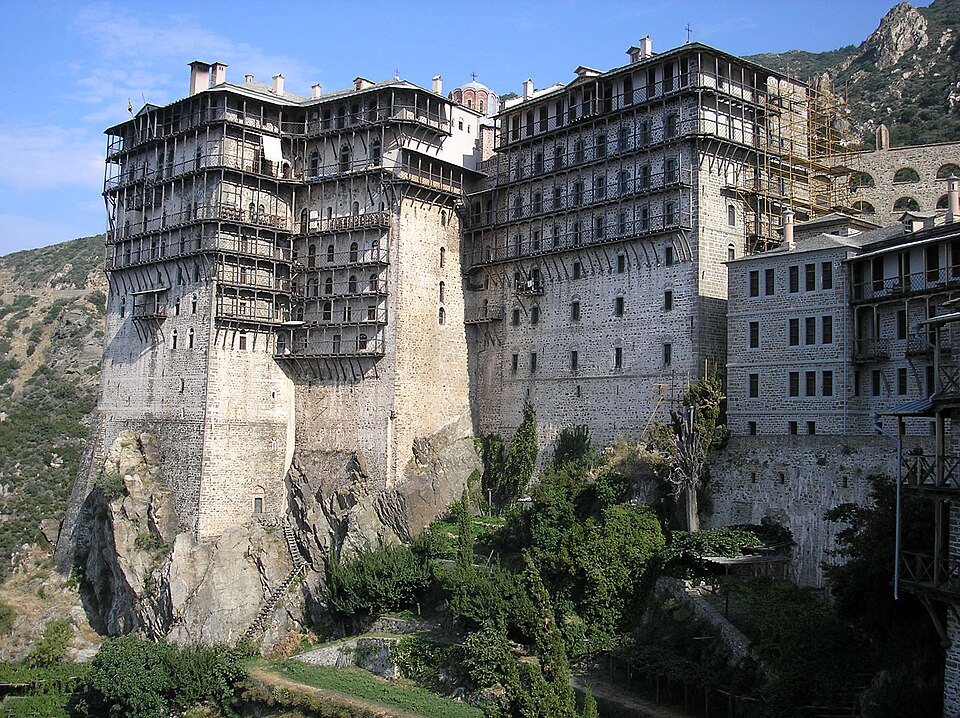
The monastery of Simonopetra on Mount Athos, its stone walls and wooden balconies rising straight from a rock above the sea
The monastery of Simonopetra on Mount Athos, built on a rock above the sea. Athos became the spiritual centre of the Orthodox world, and its monasteries drew monks from every Orthodox people.Michalis Famelis · CC BY-SA 3.0 · Wikimedia Commons

Hesychasm and Gregory Palamas

The monks of Athos practised hesychia, “stillness”: silent, inward prayer built around the repeated Jesus Prayer (“Lord Jesus Christ, Son of God, have mercy on me”), sometimes with controlled breathing and posture. Some reported seeing a divine light, which they identified with the light that shone from Christ at his Transfiguration. In the 1330s the Calabrian-born monk Barlaam attacked them: no one could see God, and the monks’ methods were superstition. Gregory Palamas, an Athonite monk and later archbishop of Thessalonica, answered him in the Triads (1338–41).[13]​[14] Consensus

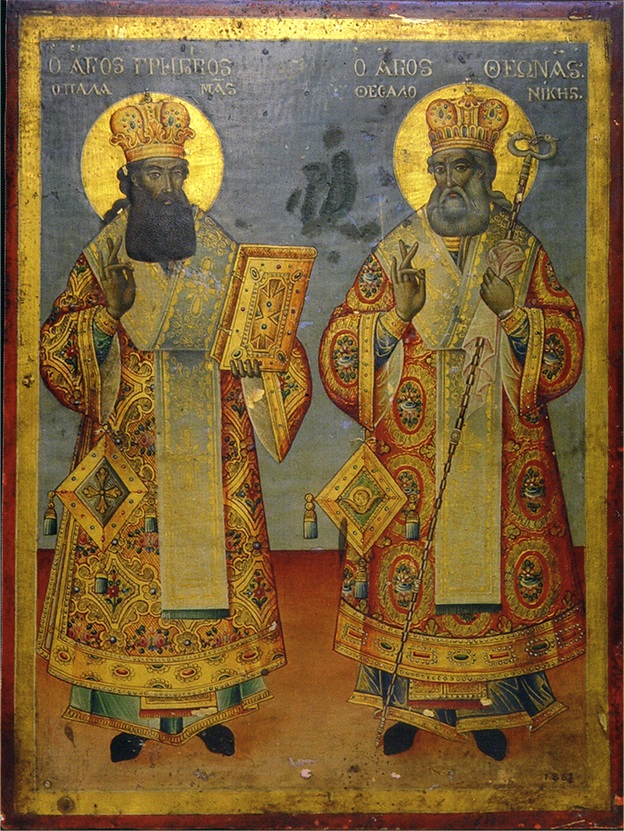
Palamas distinguished God’s essence, which no creature can know, from his energies, his activity in the world, which are uncreated and are God himself, and in which human beings can truly share. The light the monks saw was one of these energies. Councils in Constantinople in 1341, 1347 and 1351 upheld him, after a period of civil war in which his opponents briefly condemned him (1344); he died in 1359 (some date it 1357) and was proclaimed a saint in 1368.[14]​[1] Consensus The distinction between essence and energies, and the goal of theosis, becoming divine by grace, remain characteristic of Orthodox theology, and one of the points on which it differs most from Western, scholastic theology.[1]​[3] Majority

An 1861 icon from the Pantokratoros monastery on Mount Athos showing Saint Gregory Palamas, holding a gospel book, beside Saint Theonas of Thessalonica
Saint Gregory Palamas (left) with Saint Theonas of Thessalonica, in an icon of 1861 from the Pantokratoros monastery on Athos. Palamas’s defence of the hesychast monks became Orthodox doctrine in the councils of 1341–1351.Unknown iconographer · Public domain · Wikimedia Commons

The Slavic commonwealth

Cyril and Methodius

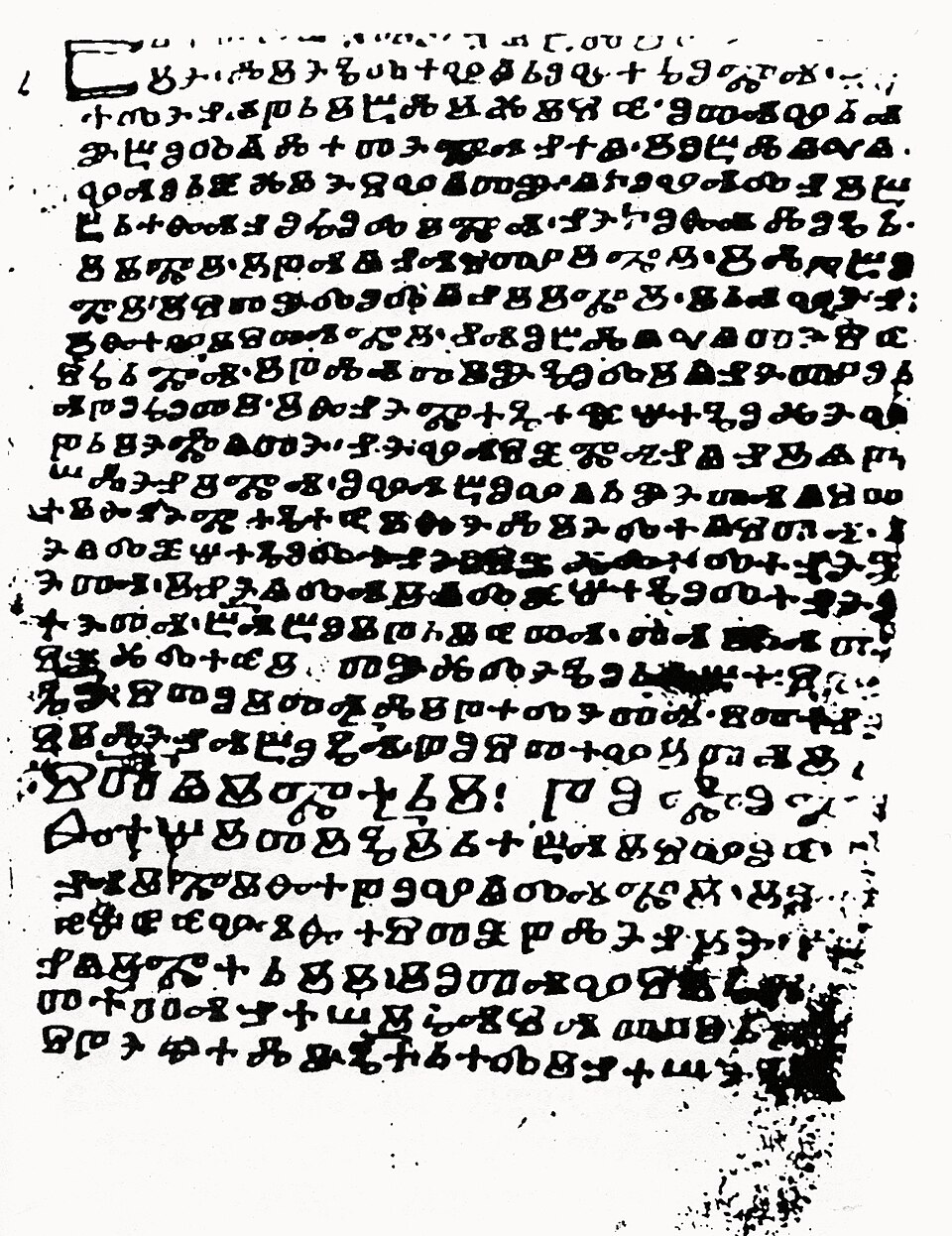
In 862 Rastislav, ruler of Great Moravia (in today’s Czech Republic and Slovakia), asked Constantinople for a teacher who could explain the faith to his people in their own language, partly to be less dependent on Frankish missionaries. The emperor sent two brothers from Thessalonica, Constantine (who took the name Cyril as a monk shortly before his death) and Methodius, who knew the Slavonic of the Thessalonica region. Constantine created an alphabet for it, now called Glagolitic, and the brothers translated the liturgy and the Gospels.[7]​[8] Consensus

The mission ran into the Frankish bishops, who held that the liturgy could be said only in Hebrew, Greek or Latin. The brothers went to Rome, and in 868 Pope Hadrian II approved the Slavonic liturgy. Cyril died in Rome in 869; Methodius, made an archbishop, died in 885, and soon afterwards his disciples were expelled from Moravia, which turned to the Latin rite.[8]​[29] Consensus

A page of the Kiev Missal, a Glagolitic manuscript of the tenth century, in the alphabet created for the mission of Constantine-Cyril and Methodius
A page of the Kiev Missal, a tenth-century manuscript in Glagolitic, the alphabet created for the Moravian mission. Cyrillic, named after Cyril but developed later in Bulgaria, replaced it in most of the Orthodox Slavic world.Unknown scribe · Public domain · Wikimedia Commons

Bulgaria and the Rus’

The expelled disciples found a welcome in Bulgaria, whose ruler Boris I had been baptised in 864 or 865 and had weighed Rome against Constantinople before choosing the Greek church. Clement and Naum arrived in 886; Clement taught in the region of Ohrid and Naum at the royal centres of Pliska and later Preslav. In this Bulgarian circle, probably at Preslav under Tsar Simeon (893–927), a new alphabet based on Greek letters was developed. It was named Cyrillic in Cyril’s honour, though he did not create it, and it became the script of the Orthodox Slavs.[8] Majority

The Rus’ of Kiev took the same faith a century later. The Primary Chronicle, compiled around 1113, tells how Vladimir, about 986–987, sent envoys to examine the religions of his neighbours, and how they chose the Greek one because in Hagia Sophia “we knew not whether we were in heaven or on earth” (see Primary sources). Vladimir was baptised, probably in 988, and married the emperor’s sister Anna.[11]​[12] Consensus on the baptism; Majority on the year. Simon Franklin and Jonathan Shepard read the “testing of the faiths” as a literary set piece written long after the event; the alliance with Byzantium, and the marriage, explain the choice better than the envoys do.[12] Majority The Slavs received the liturgy and the Scriptures in Church Slavonic, a language close to their own speech, unlike the Latin of the West; it later became a learned language in its turn, and some historians argue that it cut the Slavs off from Greek learning.[8]​[1] Majority

The churches founded this way became national churches with heads of their own. Bulgaria had a patriarch from 927, and again from 1235; Sava, son of the Serbian ruler, obtained an independent archbishopric for Serbia in 1219, raised to a patriarchate at Peć in 1346.[8] Consensus The “commonwealth” was a family of churches, not a single one run from Constantinople.


Under the Ottomans

1453 and the patriarch

The union with Rome agreed at the Council of Florence in 1439, in the hope of Western help against the Turks, was rejected by most of the Greek clergy and people (§8). The help that came was too little. On 29 May 1453 Constantinople fell to the Ottoman sultan Mehmed II, and Hagia Sophia became a mosque.[17]​[15] Consensus

Mehmed needed the Orthodox to be governed, and in January 1454, on the traditional date of 6 January, he invested the monk Gennadios Scholarios as patriarch. Gennadios had supported the union at Florence before becoming the leader of its opponents. The Greek historian Kritovoulos is the only contemporary account of the appointment; the date and the ceremony, modelled on the one an emperor had once performed, come from later sources.[18]​[17] Majority Over the following centuries the patriarch became responsible to the sultan for the Orthodox under Ottoman rule: for their church courts in matters of family and inheritance, and for the taxes and loyalty of the community.[17]​[30] Majority Christians were tolerated as protected subjects, paid higher taxes and faced restrictions, including, from the fourteenth century to the seventeenth, the devşirme, the levy of Christian boys who were converted to Islam and trained for the sultan’s service. Most Orthodox did not convert, and those executed for returning to Christianity after conversion were venerated as new martyrs.[17] Consensus

Was there a millet system?

Older histories said that Mehmed founded a “millet system”, a formal arrangement dividing the empire’s subjects into self-governing religious nations, the Orthodox millet under the patriarch. Benjamin Braude argued in 1982 that no such system existed in the fifteenth and sixteenth centuries: the word millet meant something else then, arrangements varied from place to place and were negotiated case by case, and the formal system was largely an eighteenth- and nineteenth-century development, projected back onto the conquest, including the story of a charter given to Gennadios.[30] Majority

Under the Ottomans the patriarchate grew more powerful within the church even as it grew weaker outside it. From the seventeenth century it was dominated by wealthy Greek families of the Phanar district of Istanbul, and patriarchs were frequently deposed and reinstated as factions paid for office. In 1766 and 1767 Constantinople abolished the autonomous patriarchate of Peć and the archbishopric of Ohrid and absorbed their dioceses, a centralisation that Serbian and Bulgarian historians have long criticised as Hellenisation.[17] Consensus on the events; Political on how to judge them.


Moscow, the Third Rome

A church on its own

Moscow’s church, under a metropolitan of “Kiev and all Rus’”, had been appointed from Constantinople. Its metropolitan Isidore signed the Union of Florence; when he returned to Moscow in 1441 and proclaimed it, Grand Prince Vasily II had him arrested. In 1448 the Russian bishops consecrated their own metropolitan, Jonah, without Constantinople’s consent. From then on the Russian church was in practice independent, and after 1453 Muscovy was the one great independent Orthodox state.[16]​[1] Consensus

Filofei’s letter

Around 1523–24 Filofei, a monk of the Eleazar monastery near Pskov, wrote to a Muscovite official, Mikhail Misiur-Munekhin, that the first Rome had fallen into heresy, the second, Constantinople, had fallen to the Turks, and that Moscow was the third, “and a fourth there shall not be” (see Primary sources).[19] Majority on the date. The phrase became one of the most quoted in Russian history, read as the creed of Russian imperial and messianic ambition. Marshall Poe has argued that it was nothing of the kind in Muscovy. The formula did enter one official text, the 1589 charter founding the Moscow patriarchate, and was printed again in a church book of 1648 that the Old Believers later prized; but otherwise it was rare, a churchmen’s idea rather than a state ideology, until nineteenth-century writers made it famous after the letters were published.[20]​[21] Majority among historians; the older reading survives in popular accounts.

The patriarchate, 1589

In 1589 the patriarch of Constantinople, Jeremias II, visiting Moscow to raise funds, was persuaded, under considerable pressure, to consecrate the metropolitan Job as patriarch of Moscow, on 26 January 1589. Synods of the eastern patriarchs confirmed the new patriarchate in 1590 and 1593, ranking it fifth after Constantinople, Alexandria, Antioch and Jerusalem.[21]​[1] Consensus

The Union of Brest

The Orthodox of the Polish–Lithuanian Commonwealth, in today’s Ukraine and Belarus, lived under a Catholic king. In 1595 most of their bishops agreed to enter communion with Rome while keeping the Byzantine liturgy, Church Slavonic and married priests, and the union was proclaimed at Brest in October 1596. A rival synod at Brest rejected it, and the Orthodox and the new united church, called “Uniate” by its opponents (a name its members find pejorative), competed for the same people for centuries; today’s Ukrainian and Belarusian Greek Catholic Churches descend from it.[22]​[1] Consensus Its Catholic defenders long presented it as a model for reunion; many Orthodox see it as a defection achieved under pressure. In the Balamand statement of 1993 the official Catholic–Orthodox commission rejected such unions as a method for the future while accepting that the Eastern Catholic churches have the right to exist, and Brest remains a sore point between the churches. Political

In 1686 the patriarch of Constantinople allowed the patriarch of Moscow to consecrate the metropolitan of Kiev, and from then on the metropolis was in practice governed from Moscow.[31] Consensus What the documents of 1686 granted became, three centuries later, the centre of the dispute over the Orthodox Church of Ukraine (§14): Moscow reads them as a permanent transfer of jurisdiction, while Constantinople holds that they gave only a conditional permission to ordain, which it revoked in 2018.[32] Political


Nikon and the Old Believers

The reforms

By the seventeenth century Russian and Greek practice had diverged: Russians made the sign of the cross with two fingers, sang “alleluia” twice rather than three times, spelled the name of Jesus Isus rather than Iisus, and walked processions clockwise.[23]​[16] Consensus Since the work of the Russian church historians Golubinsky and Kapterev in the nineteenth century, scholars have accepted that much of this was older Byzantine usage that Russia had kept and the Greeks had since changed; the two-fingered sign, for one, had once been Greek practice too. Many Russians believed that their own rite was the pure one and that the Greeks, who had accepted Florence and fallen to the Turks, had lost theirs, and on the history they were partly right.[23]​[1] Majority

Nikon, patriarch from 1652, set out to bring the Russian rite into line with current Greek practice, with the backing of Tsar Alexei. Before Lent in 1653 he ordered that the sign of the cross be made with three fingers and that full prostrations in the Lenten prayer of St Ephrem be replaced by bows. New service books were issued, corrected from Greek and Ukrainian printed editions rather than from the ancient manuscripts the dissenters later appealed to.[23]​[16] Consensus Nikon also claimed for the patriarch a dignity close to the tsar’s; he quarrelled with Alexei, left his post in 1658, and was deposed in 1666.[16] Consensus
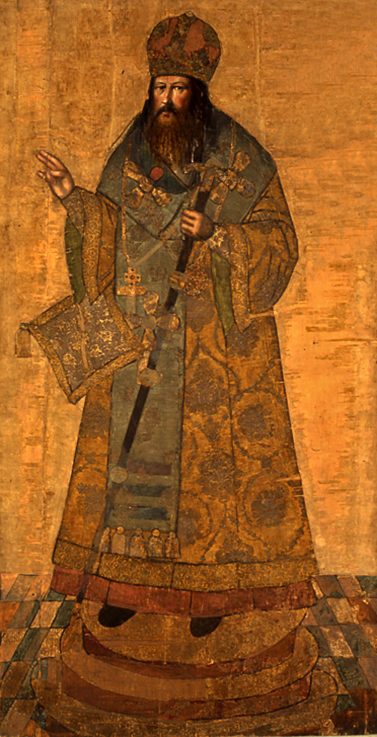
Portrait of Patriarch Nikon of Moscow in full vestments, holding a staff and blessing, attributed to Ivan Bezmin, 1680s
Patriarch Nikon in full vestments, in a portrait attributed to Ivan Bezmin, 1680s. Nikon’s reforms aligned the Russian rite with Greek practice and set off the schism of the Old Believers.Bezmin, Ivan Artemyev · Public domain · Wikimedia Commons

The council of 1666–67

The tsar kept the reforms while dropping the reformer. The Great Moscow Council of 1666–67, attended by Patriarch Paisios of Alexandria and Patriarch Makarios of Antioch, deposed Nikon and, on 13 May 1667, anathematised everyone who kept the old rites. The dissent became a schism, the raskol, and its adherents were called raskolniki, schismatics; they called themselves the Old Believers, or Old Ritualists.[24]​[23] Consensus

Persecution

The state treated refusal as rebellion. The Solovetsky Monastery on the White Sea held out against the new books from 1668 until it was betrayed and stormed in January 1676. The archpriest Avvakum, the movement’s most famous voice, spent years in Siberian exile and an earthen pit at Pustozersk, where he wrote his Life, often called the first Russian autobiography, before he was burned at the stake with three companions on 14 April 1682 (see Primary sources). The noblewoman Feodosia Morozova died of starvation in prison in 1675. In the 1670s and 1680s thousands of Old Believers, expecting the end of the world, burned themselves to death in their wooden churches rather than submit.[26]​[25]​[23] Consensus on the events; Majority on the scale of the self-immolations.

Ritual, or something more?

Why would anyone die for two fingers rather than three? For the Old Believers the rite was the faith: a church that changed the sign of the cross had changed what it confessed, and a tsar who enforced it might be the Antichrist. Older histories therefore treated the schism as a single religious movement of conservatives against reform. Georg Michels has argued that in the seventeenth century there was no united Old Belief: resistance was scattered and local, led by monks, hermits and unemployed priests, and often a refusal of the church’s and the state’s authority rather than of the new books as such; the unified movement took shape later.[23] Contested Robert Crummey’s study of the priestless community on the Vyg River in the far north shows how one such community built an organised life, and a working relationship with the state, over the eighteenth century.[33] Consensus

Priests, the priestless and toleration

Without bishops, the Old Believers could not ordain priests. The popovtsy (“priestly”) accepted priests who came over from the official church, and from 1846 had their own bishops through the Belokrinitsa hierarchy, founded in Habsburg Bukovina when a deposed Orthodox metropolitan joined them. The bezpopovtsy (“priestless”) concluded that the true priesthood had ended and lived without priests or most sacraments, divided into several groups.[25]​[33] Consensus Persecution eased under Peter III and Catherine II from 1762, returned under Nicholas I, and ended with Nicholas II’s edict of toleration of 17 April 1905.[25] Consensus

How many Old Believers there were is uncertain, because people under persecution do not answer census-takers honestly. Official counts around 1900 were about two million, and historians generally regard them as far too low.[25] Majority
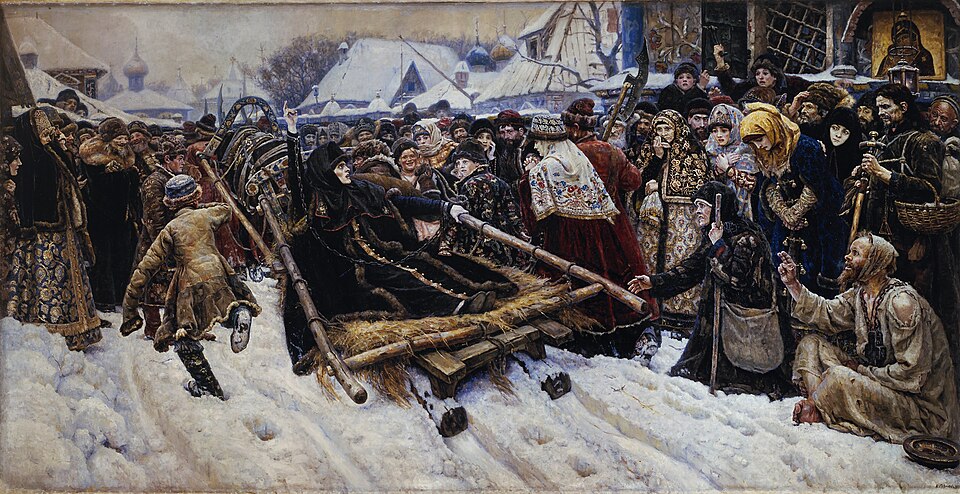
Vasily Surikov's painting Boyarynya Morozova (1887): the Old Believer noblewoman Feodosia Morozova, chained on a sledge in a snowy Moscow street, raises two fingers in the old sign of the cross as the crowd watches
Vasily Surikov’s Boyarynya Morozova (1887). The Old Believer noblewoman Feodosia Morozova, arrested in 1671, is taken through Moscow on a sledge, raising the two fingers of the old sign of the cross. She died in prison in 1675. The painting is a nineteenth-century vision of the schism, not a record of it.Vasily Surikov (photograph: Google Art Project) · Public domain · Wikimedia Commons

Peter the Great and the synodal church

When Patriarch Adrian died in 1700, Peter the Great allowed no successor to be elected. In 1721 his Spiritual Regulation, drafted by Bishop Feofan Prokopovich, replaced the patriarch with a “Spiritual College”, soon renamed the Most Holy Governing Synod, a committee of bishops supervised from 1722 by a lay official, the chief procurator. The Regulation argued that a council was less likely to err than one man and could not become a rival to the sovereign (see Primary sources).[27]​[1] Consensus The Russian church was governed this way, as something close to a department of state, until 1917, when a church council restored the patriarchate and elected Tikhon, weeks after the Bolsheviks took power (§13).[1]​[31] Consensus


The evidence

WhatEvidenceConfidence
Liturgy at the centreHagia Sophia’s design and Procopius’s description; the Byzantine liturgical booksMajority
Icons restored, 843The Synodikon of Orthodoxy, read annually since; Brubaker and Haldon on the later shaping of the storyConsensus (event); Majority (scale of iconoclasm)
Athos as a monastic republicTzimiskes’ typikon; the monasteries’ archivesConsensus
HesychasmPalamas’s Triads; the tomes of the councils of 1341–1351Consensus
The Slavonic liturgyThe Life of Constantine-Cyril; the Kiev Missal and other early Glagolitic manuscriptsConsensus
The conversion of Rus’The Primary Chronicle, compiled c. 1113, read criticallyMajority
The patriarch under the sultanKritovoulos; later Greek and Ottoman documentsMajority
A “millet system”Braude: largely an 18th–19th-c. constructionMajority
The Third RomeFilofei’s letters; Poe on their receptionMajority
The Old Believer schismThe acts of the council of 1666–67; Avvakum’s Life; government recordsConsensus
The synodal churchThe Spiritual Regulation, 1721Consensus

Primary sources

Show the 7 primary sources

1. A dome suspended from heaven: Procopius on Hagia Sophia, c. 550s

“Yet it seems not to rest upon solid masonry, but to cover the space with its golden dome suspended from Heaven.” (Buildings 1.1.46, trans. H. B. Dewing)[4]

What it proves. Within a generation of its building, Justinian’s own historian described the church as an image of heaven, not only a large building. Procopius wrote for the emperor and praises everything he built, so the passage shows the ideal more reliably than the experience of ordinary worshippers. Consensus

2. “We knew not whether we were in heaven or on earth”: the Primary Chronicle, s.a. 987

“Then we went on to Greece, and the Greeks led us to the edifices where they worship their God, and we knew not whether we were in heaven or on earth. For on earth there is no such splendor or such beauty, and we are at a loss how to describe it. We only know that God dwells there among men, and their service is fairer than the ceremonies of other nations.” (trans. S. H. Cross, 1930)[11]

What it proves. Not why Vladimir converted: the chronicle was compiled around 1113, more than a century later, and the tour of the religions is a literary set piece. It proves what twelfth-century Kievan monks thought the faith’s strongest argument was, the beauty of the liturgy, which is itself a statement about Orthodoxy.[12] Majority

3. The uncreated light: Gregory Palamas, Triads, 1338–41

“This hypostatic light, seen spiritually by the saints, they know by experience to exist, as they tell us, and to exist not symbolically only, as do manifestations produced by fortuitous events; but it is an illumination immaterial and divine, a grace invisibly seen and ignorantly known. What it is, they do not pretend to know.” (II.iii.8, trans. Nicholas Gendle)[13]

What it proves. Palamas rests his case on the monks’ experience: what they see is real and divine, but not God’s essence, which remains unknowable. That distinction, between God’s essence and his energies, became Orthodox doctrine at the councils of 1341–1351.[14] Consensus

4. Two Romes have fallen: Filofei of Pskov to Misiur-Munekhin, c. 1523–24

Да вѣси, христолюбче и боголюбче, яко вся христианская царства приидоша в конец и снидошася во едино царство нашего государя… два убо Рима падоша, а третий стоит, а четвертому не быти.

“Know, lover of Christ and lover of God, that all the Christian kingdoms have come to an end and are gathered into the one kingdom of our sovereign… for two Romes have fallen, and the third stands, and a fourth there shall not be.” (text ed. V. V. Kolesov; literal translation ours)[19]

What it proves. That a monk of Pskov placed Moscow at the end of a sequence of Christian empires. It does not prove that Muscovy’s rulers held the idea: apart from the 1589 charter of the patriarchate, the formula survives mainly in monastic letters and becomes famous only in the nineteenth century.[20] Majority

5. “Our hearts froze”: Avvakum on Nikon’s order, 1653

“Nikon inscribed his letter with the year and the date, ‘According to the tradition of the holy Apostles and the Fathers, it is not seemly to make obeisance in church to the knee, it should be no lower than the girdle, and moreover it behoves you to sign yourselves with three fingers’. We met together and took counsel. It was as if Winter was of a mind to come; our hearts froze, our limbs shook.” (trans. Jane Harrison and Hope Mirrlees, 1924, pp. 53–54)[26]

And on the march into Siberian exile with his wife:

“And she, poor soul, began to complain to me, saying, ‘How long, archpriest, are these sufferings to last?’ And I said, ‘Markovna! till our death’. And she, with a sigh, answered, ‘So be it, Petrovitch; let us be getting on our way’.” (p. 80)

What it proves. How the reforms looked to the clergy who received them: an order from above that changed the prayers they had always said. Avvakum wrote decades later, in prison, as the movement’s champion, so the Life is testimony, not a neutral record. Consensus

6. The anathema: the Great Moscow Council, 13 May 1667

“But if any one does not hearken to what is commanded by us, nor will obey the holy Eastern Church and this sacred synod, or begins to gainsay or to oppose us, we, if any such person be of the sacred order, by the power given us of the Holy Ghost degrade him and deprive him of all sacerdotal functions and grace, and deliver him over to anathema: but if he is of the order of the laity, we excommunicate him… as a heretic and a rebel.” (as translated in William Palmer, The Patriarch and the Tsar, 1873)[24]

What it proves. That the council, with two Eastern patriarchs present, made the new rites, among them crossing with three fingers, a matter of obedience to the whole Orthodox church, and called refusal heresy and rebellion together. From then on the state could treat dissent as both. Consensus

7. “A second sovereign”: the Spiritual Regulation, 1721

“For the ignorant Vulgar People do not consider how far the Spiritual Power is removed from, and inferior to the Regal, but in Admiration of the Splendor and Dignity of an High-Priest, consider such a Ruler as a second Sovereign, equal in Power to the King himself, or above him.” (trans. Thomas Consett, 1729)[27]

What it proves. Peter’s own government said openly why it abolished the patriarchate: a single head of the church could become a rival to the tsar. The memory of Nikon’s claims was half a century old. Consensus


What is absent

  • Ordinary believers before the modern period. Almost everything we know of Byzantine and Muscovite religion comes from churchmen, monks and rulers. How peasants in Thrace or Novgorod understood icons, fasts or the liturgy has to be inferred.
  • The early Old Believers’ own writings. Many were destroyed, confiscated or kept hidden; the movement’s early history is known disproportionately from its persecutors and from a few famous authors such as Avvakum.
  • Numbers. There are no reliable figures for Orthodox populations under the Ottomans, or for Old Believers at any point before the twentieth century.
  • Women’s religious lives, beyond a few exceptional figures such as Theodora, the regent who restored the icons in 843, or Feodosia Morozova, and the convents whose records rarely survive.

Debates

Was Byzantium “caesaropapist”?

Western historians long described the Byzantine church as subordinate to the emperor, a “caesaropapism” contrasted with the papacy’s independence. Dagron argues that the emperor’s religious role was real but never settled, contested by patriarchs and monks and denied by the councils that condemned iconoclast emperors; the label says more about Western polemic than about Byzantium.[28] Majority

Was Moscow really “the Third Rome”?

For a century and a half historians read Filofei’s formula as the key to Russian political ideology. Poe’s reading, that apart from the 1589 charter it was marginal until the nineteenth century, is now widely accepted, though some historians still find echoes of it in sixteenth-century court culture.[20] Majority

Was there a millet system?

Braude’s argument that the classic millet system was a later construction is the current majority view; historians still debate how much autonomy the Orthodox community actually had in the fifteenth and sixteenth centuries, and how far it depended on place and period.[30]​[17] Majority

Were the Old Believers about ritual or about the state?

The older view saw a religious movement defending the true rite; Michels sees diverse, local protest against church and state authority, only later unified as Old Belief. The two are not exclusive: for the dissenters, a state that imposed a new rite was itself a religious problem.[23]​[33] Contested


Further reading

Show further reading (7 works)
  • Timothy (Kallistos) Ware, The Orthodox Church (new ed., Penguin, 2015): the standard introduction.
  • Averil Cameron, Byzantine Christianity: A Very Brief History (SPCK, 2017).
  • John Anthony McGuckin, The Orthodox Church: An Introduction to its History, Doctrine, and Spiritual Culture (Wiley-Blackwell, 2008).
  • Dimitri Obolensky, The Byzantine Commonwealth: Eastern Europe, 500–1453 (1971).
  • John Meyendorff, St Gregory Palamas and Orthodox Spirituality (1974).
  • Steven Runciman, The Great Church in Captivity (Cambridge, 1968).
  • Georg Michels, At War with the Church: Religious Dissent in Seventeenth-Century Russia (Stanford, 1999).

References

  1. ^ a b c d e f g h i j k l m n o p Timothy (Kallistos) Ware The Orthodox Church: An Introduction to Eastern Christianity. Penguin, new ed., 2015. The standard introduction, updated for the post-communist revival.
  2. ^ a b c Averil Cameron Byzantine Christianity: A Very Brief History. SPCK, 2017. A short, current synthesis by a leading Byzantinist.
  3. ^ a b c John Anthony McGuckin The Orthodox Church: An Introduction to its History, Doctrine, and Spiritual Culture. Wiley-Blackwell, 2008. History, doctrine, liturgy and monasticism from inside the tradition.
  4. ^ a b c Procopius, Buildings 1.1.46 — On Buildings. c. 550s CE. Greek. Justinian's historian on Hagia Sophia: the dome seems 'suspended from Heaven'. about
  5. ^ a b Synodikon of Orthodoxy (843) — Read on the Sunday of Orthodoxy. 843 CE, expanded later. Greek. The acclamations that close the iconoclast controversy, read every year on the first Sunday of Lent. about
  6. ^ a b c Leslie Brubaker and John Haldon Byzantium in the Iconoclast Era, c. 680–850: A History. Cambridge University Press, 2011. Argues that much of the traditional story of iconoclasm was written later by the victors.
  7. ^ a b Life of Constantine-Cyril 14 — Vita Constantini. late 9th c. CE. Church Slavonic. Rastislav of Moravia asks Byzantium for a teacher who will explain the faith in the Slavs' own language. about
  8. ^ a b c d e f g h i j Dimitri Obolensky The Byzantine Commonwealth: Eastern Europe, 500–1453. Weidenfeld & Nicolson, 1971. The classic account of how Byzantine Christianity shaped the Slavic and Balkan world.
  9. ^ a b c d Graham Speake Mount Athos: Renewal in Paradise. Yale University Press, 2002. The history of the Holy Mountain from its foundation to its modern revival.
  10. ^ a b Typikon of John Tzimiskes (Tragos) — The first rule for Mount Athos. c. 971–972. Greek. The emperor's charter regulating the monks of the Holy Mountain, written on goatskin. about
  11. ^ a b c Russian Primary Chronicle, entries for 986–988 — Povest' vremennykh let. early 12th c. CE. Old East Slavic. Vladimir's envoys compare religions and are overwhelmed by the liturgy in Constantinople; Vladimir is baptised and marries a Byzantine princess. about
  12. ^ a b c d Simon Franklin and Jonathan Shepard The Emergence of Rus, 750–1200. Longman, 1996. Kievan Rus' and its conversion, read critically against the Primary Chronicle.
  13. ^ a b c Gregory Palamas, Triads — In Defence of the Holy Hesychasts. 1338–1341. Greek. Palamas defends the hesychast monks' claim to see the uncreated light of God. about
  14. ^ a b c d e John Meyendorff St Gregory Palamas and Orthodox Spirituality. St Vladimir's Seminary Press, trans. Adele Fiske, 1974. Hesychasm and Palamas's theology of the divine energies.
  15. ^ a b Henry Chadwick East and West: The Making of a Rift in the Church: From Apostolic Times until the Council of Florence. Oxford University Press, 2003. The schism as a long estrangement rather than an event.
  16. ^ a b c d e f Paul Bushkovitch Religion and Society in Russia: The Sixteenth and Seventeenth Centuries. Oxford University Press, 1992. Religious life in Muscovy before and around the schism.
  17. ^ a b c d e f g h i Steven Runciman The Great Church in Captivity: A Study of the Patriarchate of Constantinople from the Eve of the Turkish Conquest to the Greek War of Independence. Cambridge University Press, 1968. The Greek church under Ottoman rule.
  18. ^ a b Kritovoulos, History of Mehmed the Conqueror — History. 1460s. Greek. The only contemporary account of Mehmed II installing Gennadios Scholarios as patriarch. about
  19. ^ a b c Filofei of Pskov, Epistle to Misiur-Munekhin — Letter to the d'iak Mikhail Misiur-Munekhin. c. 1523–1524. Church Slavonic. 'Two Romes have fallen, the third stands, and a fourth there shall not be': the Third Rome formula. read the text
  20. ^ a b c d Marshall Poe Moscow, the Third Rome: The Origins and Transformations of a 'Pivotal Moment'. Jahrbücher für Geschichte Osteuropas 49: 412–429, 2001. Argues that the Third Rome idea was marginal in Muscovy and made central by nineteenth-century writers.
  21. ^ a b c Charter of the Moscow patriarchate (1589) — Ustavnaia gramota. May 1589 (after Job's installation on 26 January), confirmed 1590 and 1593. Church Slavonic. Jeremias II of Constantinople consecrates Job as first patriarch of Moscow; eastern synods confirm it. about
  22. ^ a b Union of Brest (1595–96) — Articles of union. 1595–1596. Ruthenian and Latin. Orthodox bishops of the Polish–Lithuanian Commonwealth accept communion with Rome while keeping the Byzantine rite. about
  23. ^ a b c d e f g h i Georg Bernhard Michels At War with the Church: Religious Dissent in Seventeenth-Century Russia. Stanford University Press, 1999. Argues that seventeenth-century dissent was diverse and local, not yet a unified Old Belief.
  24. ^ a b c Great Moscow Council (1666–67) — Acts of the council. 1666–1667. Church Slavonic. With the patriarchs of Alexandria and Antioch present, the council deposes Nikon and anathematises the old rites. about
  25. ^ a b c d e f g Roy R. Robson Old Believers. in James R. Millar (ed.), Encyclopedia of Russian History, Macmillan Reference, 2004. Short reference account of the schism, the persecutions and the toleration of 1905.
  26. ^ a b c Avvakum, Life — The Life of the Archpriest Avvakum, by Himself. c. 1669–1675, several redactions. Russian. The Old Believer archpriest's autobiography, written in exile at Pustozersk. about
  27. ^ a b c Spiritual Regulation (1721) — Dukhovnyi reglament. 25 January 1721. Russian. Peter the Great replaces the patriarch with a Spiritual College, the Holy Synod. about
  28. ^ a b Gilbert Dagron Emperor and Priest: The Imperial Office in Byzantium. Cambridge University Press, trans. Jean Birrell, 2003. Argues that 'caesaropapism' is a Western polemical label for a contested, unresolved relationship.
  29. ^ Ian Wood The Missionary Life: Saints and the Evangelisation of Europe, 400–1050. Longman, 2001. The missionaries and their biographers.
  30. ^ a b c Benjamin Braude Foundation Myths of the Millet System. in B. Braude and B. Lewis, eds., Christians and Jews in the Ottoman Empire, vol. 1 (Holmes & Meier), 1982. The argument that the millet system as usually described is a late construction projected back onto Mehmed II.
  31. ^ a b Dimitry Pospielovsky The Orthodox Church in the History of Russia. St Vladimir's Seminary Press, 1998. Includes the Soviet persecution and the 1943 settlement.
  32. ^ Tomos of autocephaly of the Orthodox Church of Ukraine — Ecumenical Patriarchate of Constantinople. 5–6 January 2019. Greek. Grants independence to the Orthodox Church of Ukraine; the Russian Orthodox Church had broken communion with Constantinople on 15 October 2018. about
  33. ^ a b c Robert O. Crummey The Old Believers and the World of Antichrist: The Vyg Community and the Russian State, 1694–1855. University of Wisconsin Press, 1970. The priestless Old Believer community on the Vyg and its dealings with the state.
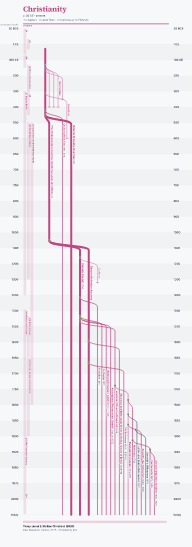
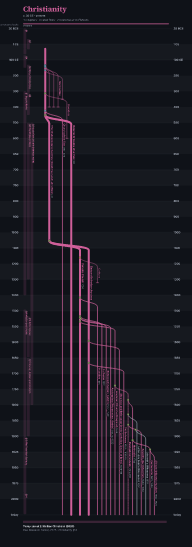
Quick answers

Short answers drawn from the chapter above; the evidence for each is cited there.

Who are the Old Believers?
Russian Orthodox Christians who refused the liturgical reforms of Patriarch Nikon in the 1650s, such as crossing oneself with three fingers instead of two, and were anathematised by the Moscow council of 1667. They divided into priestly and priestless groups, were persecuted for most of the next two centuries, and received legal toleration only in 1905. Communities survive in Russia and abroad.
What is hesychasm?
A tradition of silent, inward prayer practised by Orthodox monks, especially on Mount Athos, usually built around the repeated Jesus Prayer. In the fourteenth century Gregory Palamas defended the monks' claim to see the uncreated light of God against Barlaam of Calabria, and councils at Constantinople between 1341 and 1351 upheld him.
Why is Moscow called the Third Rome?
The phrase comes from a letter by Filofei, a monk of Pskov, written about 1523–24: Rome and Constantinople had fallen into error, Moscow was the third Rome, and there would be no fourth. It appears in the 1589 charter founding the Moscow patriarchate, but historians such as Marshall Poe argue that it otherwise stayed a churchmen's idea, not a state ideology, until nineteenth-century writers made it famous.
Did the Ottomans create a millet system for Christians?
Mehmed II installed Gennadios Scholarios as patriarch in 1454 and gave him authority over the Orthodox community, but historians since Benjamin Braude's 1982 study argue that a formal, empire-wide 'millet system' was built much later, mainly in the eighteenth and nineteenth centuries, and read back into the conquest.
What was the Union of Brest?
An agreement of 1595–96 by which most of the Orthodox bishops of the Polish–Lithuanian Commonwealth entered communion with Rome while keeping the Byzantine liturgy. Today's Ukrainian and Belarusian Greek Catholic Churches descend from it, and its legitimacy is still disputed between Catholics and Orthodox.
Cite this page
APA
Paudel, A. (2026). Byzantium and the Orthodox World. In How Christianity Evolved. How It Evolved. https://howitevolved.com/christianity/byzantium-orthodox-church-old-believers/
MLA
Paudel, Amrit. “Byzantium and the Orthodox World.” How Christianity Evolved, How It Evolved, 8 November 2026, howitevolved.com/christianity/byzantium-orthodox-church-old-believers/.
Chicago
Paudel, Amrit. “Byzantium and the Orthodox World.” How Christianity Evolved. How It Evolved. Last modified 8 November 2026. https://howitevolved.com/christianity/byzantium-orthodox-church-old-believers/.
BibTeX
@misc{howitevolved2026byzantiumorthodoxchu,
  author = {Paudel, Amrit},
  title = {Byzantium and the Orthodox World},
  howpublished = {\url{https://howitevolved.com/christianity/byzantium-orthodox-church-old-believers/}},
  year = {2026},
  note = {How Christianity Evolved. Last modified 2026-11-08}
}
Chart See this on the chart Christianity, 20 BCE–today Open the interactive chart →