Zionism and Judaism in one paragraph
Between the 1880s and the 1970s, Jewish religion was reshaped by three events it did not control: the rise of Zionism, a national movement led mostly by secular Jews; the murder of about six million Jews in the Holocaust; and the creation in 1948 of a Jewish state in the land the liturgy had prayed to return to for two thousand years. Each forced every Jewish religious movement to take a position. Most Orthodox and most Reform rabbis first opposed Zionism, for opposite reasons: the Orthodox because the return was God’s work, to be brought by the Messiah, and Reform because Judaism was now a religion, not a nation. A religious Zionist minority read the secular pioneers as unknowing agents of redemption. After the Holocaust most of these positions shifted toward support of a Jewish state, and after the 1967 war a messianic reading of that state became a political force. Majority
This chapter covers contested political history, and several of its questions are still argued as politics, not only as history. It tags those claims Political, states the main narratives with their sources and their strongest arguments, and keeps its focus on what changed in Jewish religion. It does not cover events after the mid-1970s, which belong to §13 and to the news. Consensus on the framing.
Timeline of Zionism, the Holocaust and Israel, 1862–1974
| Date | Event | Confidence |
|---|---|---|
| 1862 | Rabbi Zvi Hirsch Kalischer’s Derishat Tziyon argues that settling the land can begin the redemption; Moses Hess publishes Rome and Jerusalem[1] | Consensus |
| 1881–1882 | Pogroms in the Russian Empire; Leon Pinsker’s Auto-Emancipation; the first organised immigration to Palestine (the First Aliyah)[2][3] | Consensus |
| 1885 | American Reform rabbis adopt the Pittsburgh Platform: “no longer a nation, but a religious community”[4] | Consensus |
| 1896 | Theodor Herzl publishes Der Judenstaat, “The Jewish State”[5] | Consensus |
| 1897 | First Zionist Congress, Basel (29–31 August); the Basel Program; German rabbis publicly protest[6][7] | Consensus |
| 1902 | Mizrachi, the religious Zionist organisation, founded in Vilna by Rabbi Isaac Jacob Reines[8] | Consensus |
| 1904 | Rabbi Abraham Isaac Kook arrives in Palestine as rabbi of Jaffa[9] | Consensus |
| 1912 | Agudath Israel, the non-Zionist Orthodox organisation, founded at Kattowitz[9] | Consensus |
| 1917 | The Balfour Declaration: Britain favours “a national home for the Jewish people” in Palestine[10] | Consensus |
| 1921 | Kook becomes the first Ashkenazi Chief Rabbi of Palestine under the British Mandate[9] | Consensus |
| 1937 | Reform’s Columbus Platform affirms the duty to help build a Jewish homeland[11] | Consensus |
| 1938 | Neturei Karta breaks away from Agudath Israel in Jerusalem[9] | Consensus |
| 1939–1945 | The Holocaust: about six million Jews murdered[12] | Consensus |
| 19 June 1947 | Ben-Gurion’s “status quo” letter to Agudath Israel on Sabbath, kashrut, marriage and schools[13] | Consensus |
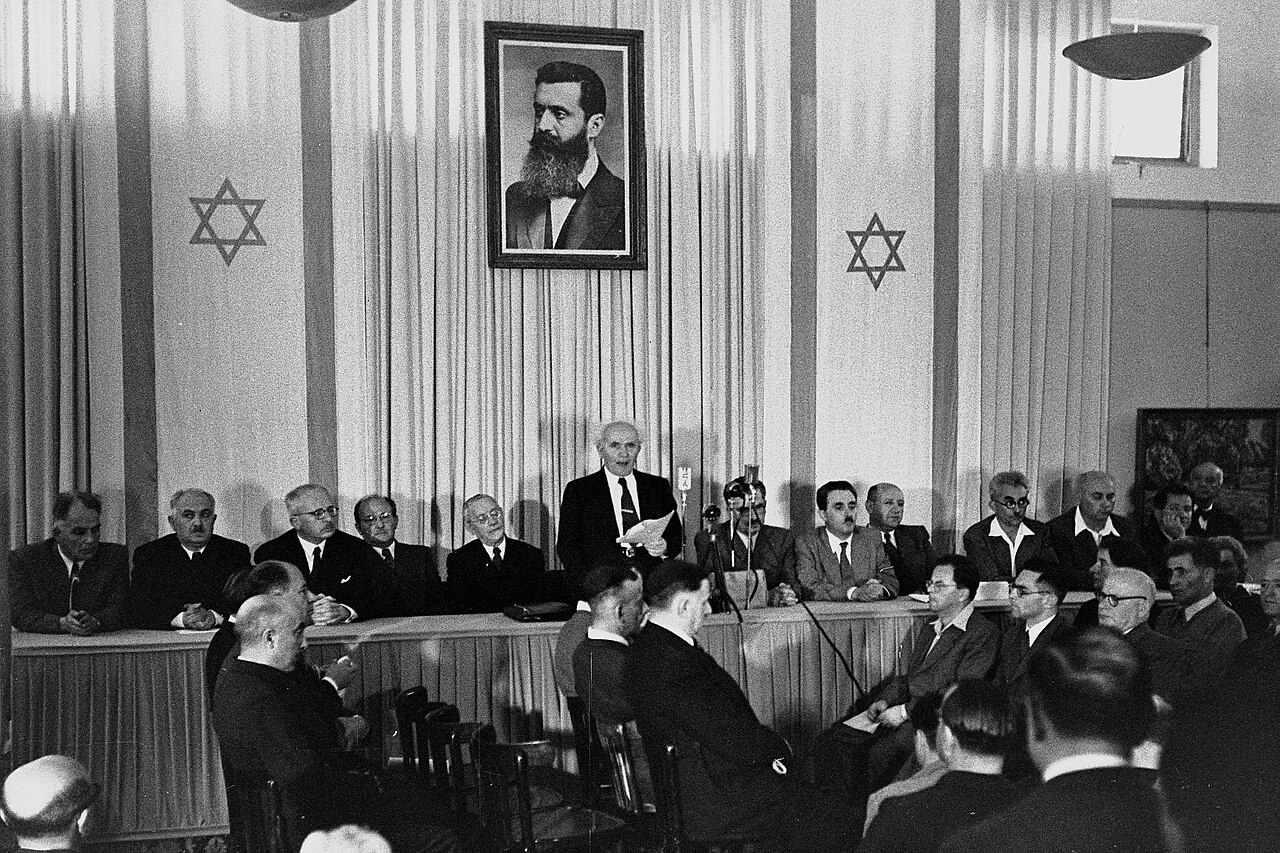
| 14 May 1948 | Declaration of the State of Israel, “with trust in the Rock of Israel”[14] | Consensus |
| 1947–1949 | The war; about 700,000 Palestinian Arabs flee or are expelled; Zureiq calls the defeat a nakba[15][16][17] | Consensus (numbers); Political (causes) |
| 1948–1970s | About 850,000–900,000 Jews leave Arab and Muslim countries, most for Israel[3] | Majority |
| 1950 | The Law of Return: “Every Jew has the right to come to this country”[18] | Consensus |
| 1956 | Joseph B. Soloveitchik’s Kol Dodi Dofek reads the state as God’s “knock”[19][20] | Consensus |
| 1961 | Joel Teitelbaum’s Vayoel Moshe: the state is a violation of the Three Oaths[21] | Consensus |
| 1966–1967 | Rubenstein’s After Auschwitz; Fackenheim’s “614th commandment”[22][23] | Consensus |
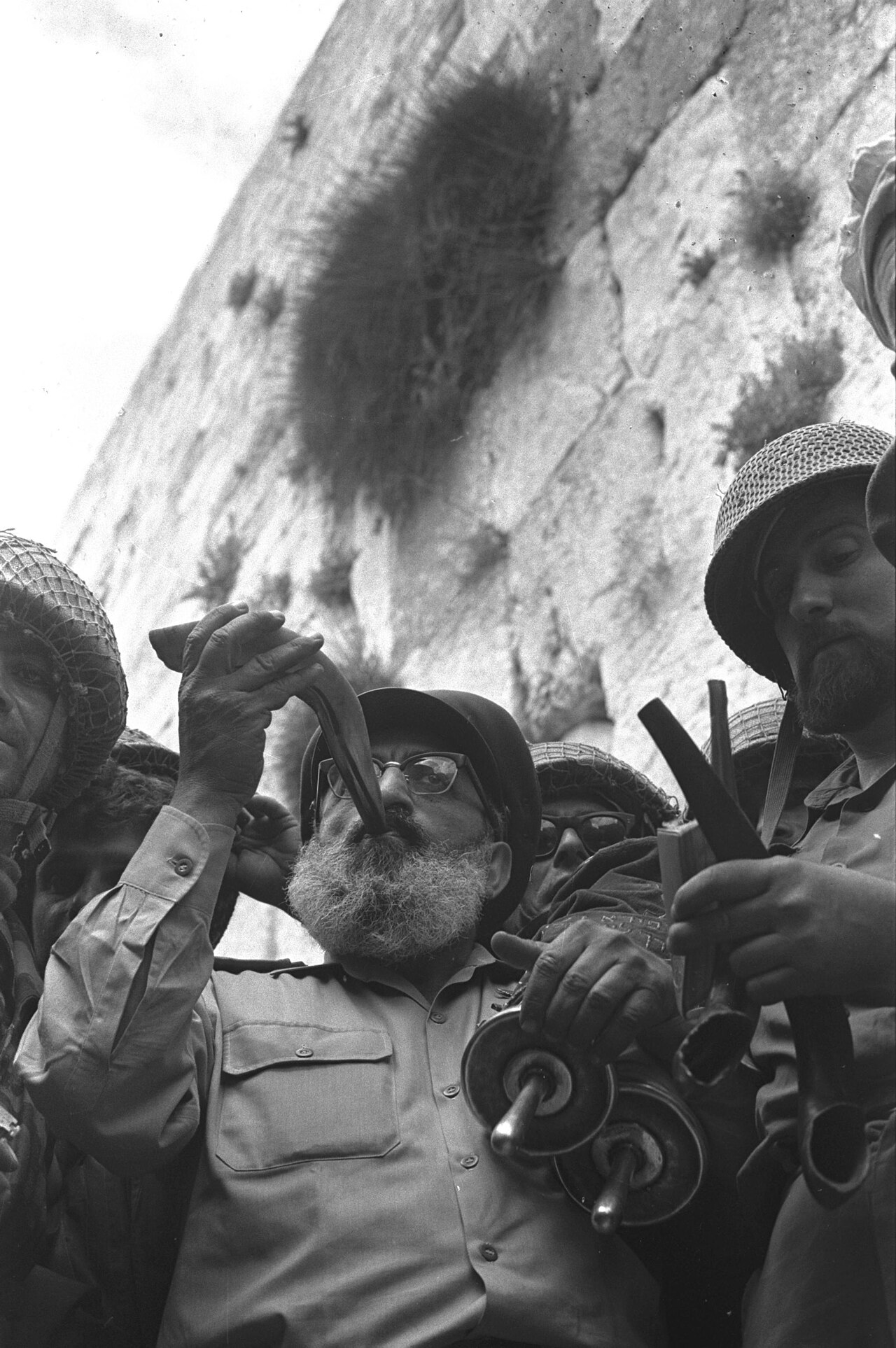
| 5–10 June 1967 | The Six-Day War; Rabbi Shlomo Goren sounds the shofar at the Western Wall (7 June)[24] | Consensus |
| 1970 | The Law of Return defines a Jew for its purposes[18] | Consensus |
| February 1974 | Gush Emunim founded by students of Zvi Yehuda Kook[9][25] | Consensus |
Return to Zion before Zionism
The return to Zion was a religious hope long before it was a political programme. The daily Amidah prays, “And may our eyes behold Your merciful return to Zion”;[26] the Passover Seder and the Day of Atonement end with “Next year in Jerusalem”; mourners are comforted “among the mourners of Zion and Jerusalem”. Small numbers of Jews had always lived in the land, and pious Jews moved there to pray, study and be buried, supported by charity from the diaspora. Consensus
What the tradition did not generally teach was that Jews should bring the return about by politics or force. In rabbinic thought the exile was a punishment and a discipline, and its end belonged to God and the Messiah. A short passage of the Babylonian Talmud records that God made Israel swear “not to go up as a wall” and “not to rebel against the nations of the world”, and made the nations swear not to oppress Israel “too much”.[27] Medieval authorities differed on how much weight this aggadic passage carried, and Maimonides does not include it in his code, but it expressed a widely shared stance of waiting. The false messiahs of the seventeenth century (§10) had made rabbis more suspicious, not less, of movements promising an early end to exile.[9] Majority
In the mid-nineteenth century two rabbis on the eastern edges of Central Europe argued otherwise. Yehuda Alkalai, born in Sarajevo and rabbi of Semlin on the Habsburg–Ottoman border, and Zvi Hirsch Kalischer of Thorn in Prussia taught that the redemption would come in stages and that its natural first stage was Jewish settlement and farming in the land; Kalischer’s Derishat Tziyon (1862) urged that this human effort would prepare the miraculous end. They are usually called “forerunners” of Zionism. Their contemporaries mostly ignored them.[1] Consensus
Herzl and political Zionism: a secular movement
Modern Zionism grew out of the failure, or perceived failure, of emancipation (§11). The Russian pogroms of 1881–1882 and the restrictions that followed drove hundreds of thousands of Jews west and a few thousand to Palestine, organised in groups such as Ḥovevei Tziyon, the “Lovers of Zion”. In Auto-Emancipation (1882), the Odessa physician Leon Pinsker argued that a people without land or organisation appeared to the nations as “the ghostlike apparition of a living corpse”, and that the fear and hatred it aroused would last until Jews had a land of their own.[2][1] Consensus
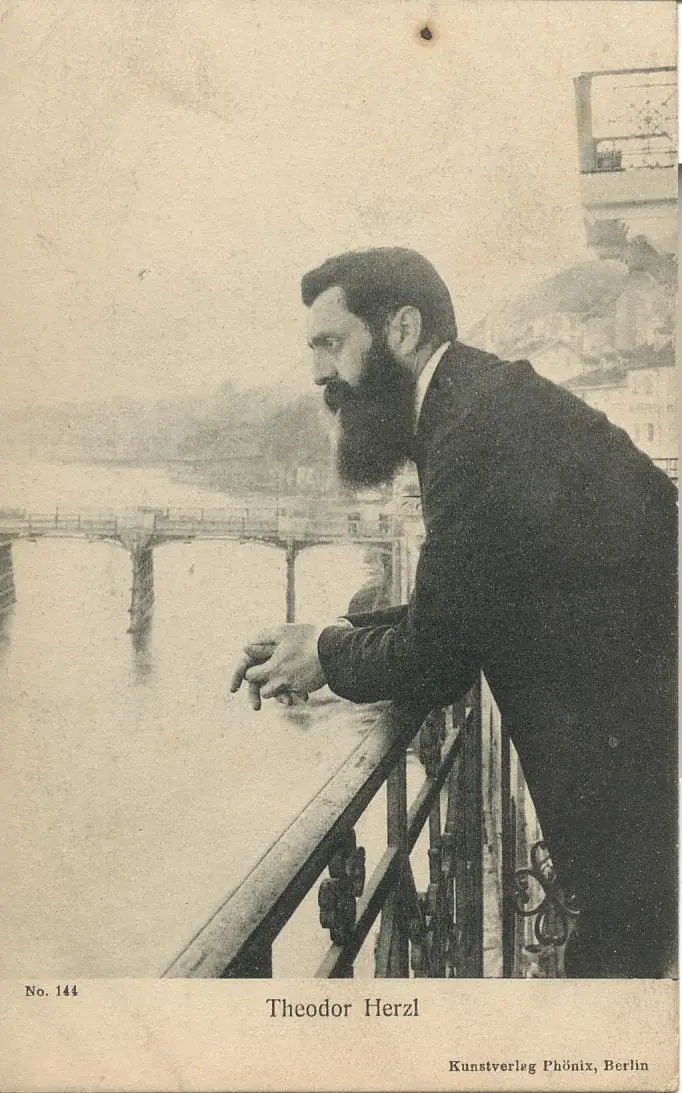
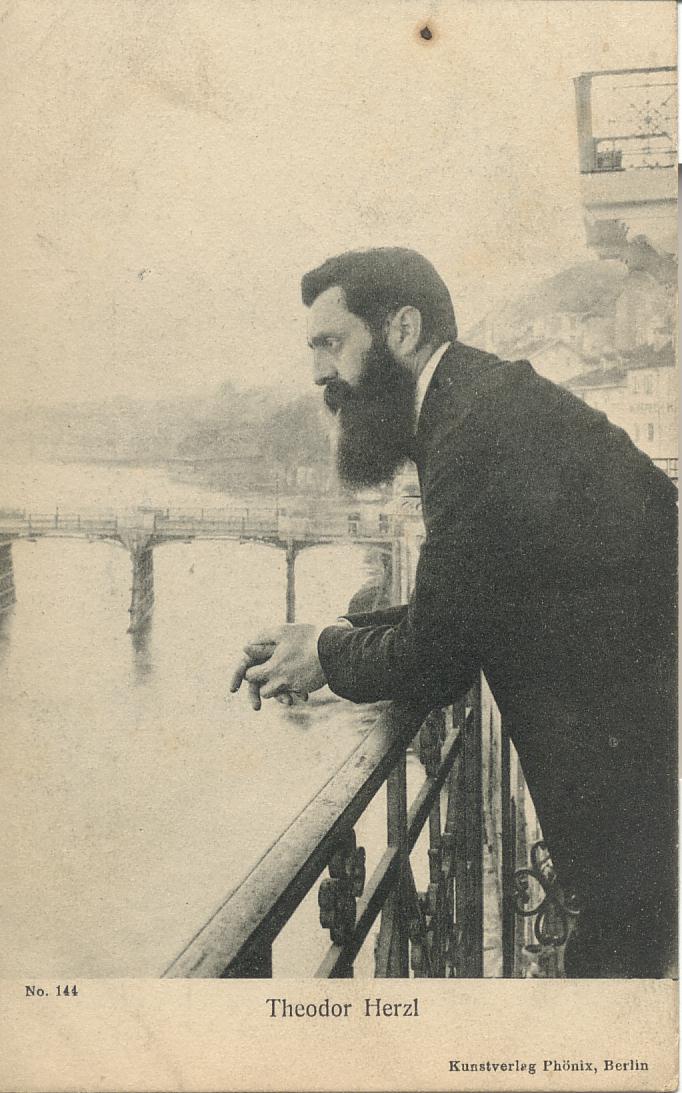
Theodor Herzl, a Viennese journalist with little Jewish education, reached the same conclusion independently, under the impact of French antisemitism in the years of the Dreyfus Affair. Der Judenstaat (1896) proposed that the Jewish question was a national question, to be solved by international agreement creating a Jewish state, ideally in Palestine.[5][8] In August 1897 he convened the First Zionist Congress in Basel, which adopted the movement’s programme: “Zionism seeks to establish a home in Palestine for the Jewish people, secured under public law.”[6] Consensus
Herzl’s vision was not religious. Der Judenstaat asks whether the state will be a theocracy and answers “No”: “We shall keep our priests within the confines of their temples in the same way as we shall keep our professional army within the confines of their barracks.”[5] Most of the movement’s leaders, and almost all of its later labour wing, were secular, and many of the young pioneers who reached Palestine in the Second Aliyah (1904–1914) saw themselves as rebels against the religion of their parents. They revived Hebrew as a spoken language, not as the holy tongue but as a national one.[3][8] Consensus
The cultural Zionist Aḥad Haʿam (Asher Ginzberg) attacked Herzl from another side. A Jewish state, he argued, would not solve the problem of the Jews, who were too many to move; what was needed was a “spiritual centre” in the land of Israel that would renew Jewish culture for the whole diaspora. His Judaism was national and cultural, not theological: the Sabbath, he wrote, had kept the Jews more than the Jews had kept the Sabbath.[1][28] Consensus
Zionism therefore offered Jews a new way of being Jewish without religious belief: as members of a nation with a land, a language and a history. That is why religious Jews could not treat it as a neutral political question. Majority
Three religious answers to Zionism
1. Orthodox opposition: the Three Oaths
The great majority of Orthodox rabbis in Eastern and Central Europe opposed Zionism in its first generation. Their objections were of three kinds. Theologically, the end of exile was God’s to bring; to force it was to rebel against the Three Oaths and to repeat the error of the false messiahs. Practically, the Zionist leaders were mostly irreligious, and a state built by them would be a Jewish nation without the Torah, which they regarded as a contradiction. And pastorally, they feared that the movement would draw young people away from observance.[9] Majority
In 1912 Orthodox leaders from Germany, Poland and Hungary founded Agudath Israel at Kattowitz to give Torah-loyal Jews a political voice independent of Zionism.[9] It was “non-Zionist” rather than anti-Zionist in practice: in the 1930s it negotiated immigration certificates with the Zionist authorities, and in 1947 it accepted the status quo arrangements (below). A stricter wing in Jerusalem broke away in 1938 as Neturei Karta, the “guardians of the city”, which rejects the state outright.[9] Consensus
The fullest theological case was made after the state existed, by the Satmar Rebbe Joel Teitelbaum (1887–1979), in Vayoel Moshe (1961). He argued that the Three Oaths are binding law, that Zionism violated them, and that the catastrophes of the twentieth century were connected with that violation; a Jewish state before the Messiah was, for him, not a step toward redemption but an obstacle to it.[21][9] Consensus on what he argued; his reading of the Holocaust was and is rejected by most Jews, including most Haredim.
2. Reform opposition: “no longer a nation”
Classical Reform opposed Zionism for the opposite reason. Reform had redefined Judaism as a universal religious mission, carried by Jews who were loyal citizens of the countries they lived in (§11). The Pittsburgh Platform of 1885, adopted by American Reform rabbis, put it in a sentence: “We consider ourselves no longer a nation, but a religious community, and therefore expect neither a return to Palestine, nor a sacrificial worship under the sons of Aaron, nor the restoration of any of the laws concerning the Jewish state.”[4] Consensus
In 1897 the executive of the association of German rabbis, Orthodox and Liberal together, publicly declared that Zionism contradicted Judaism’s messianic hopes; the protest helped move the First Congress from Munich to Basel, and Herzl mocked its authors as Protestrabbiner.[7][29] Consensus
Reform opinion moved with events. Immigration from Eastern Europe filled American Reform with Jews who had grown up with Zionism, and the persecutions of the 1930s made a refuge urgent. The Columbus Platform of 1937 declared: “In the rehabilitation of Palestine, the land hallowed by memories and hopes, we behold the promise of renewed life for many of our brethren. We affirm the obligation of all Jewry to aid in its upbuilding as a Jewish homeland by endeavoring to make it not only a haven of refuge for the oppressed but also a center of Jewish culture and spiritual life.”[11][29] A minority founded the anti-Zionist American Council for Judaism in 1942, but after 1948 most Reform Jews became supporters of the state.[29] Consensus
3. Religious Zionism: the secular pioneer as unknowing messenger
A third group joined the Zionist movement and tried to give it a religious meaning. Mizrachi, from merkaz ruḥani, “spiritual centre”, was founded in Vilna in 1902 by Rabbi Isaac Jacob Reines; its best-known slogan became “the Land of Israel for the people of Israel according to the Torah of Israel”. Reines himself treated Zionism mainly as a practical rescue of Jews, not as messianism; in 1903 he and many Mizrachi delegates voted for Herzl’s proposal to accept a territory in East Africa as a temporary refuge.[8] Majority
The theology that made religious Zionism distinctive came from Rabbi Abraham Isaac Kook (1865–1935). Kook arrived in Jaffa in 1904, became Chief Rabbi of Jerusalem, and in 1921 the first Ashkenazi Chief Rabbi of Palestine under the British Mandate; in 1924 he founded the yeshiva later called Mercaz HaRav. In his mystical, kabbalistic reading of history (§9), the return of the Jewish people to its land was the beginning of redemption, and the secular pioneers who drained swamps and built settlements were, without knowing it, doing holy work. Their rebellion against religion was a stage in a dialectic that would end in a deeper return to faith.[30][9] Consensus on his teaching.
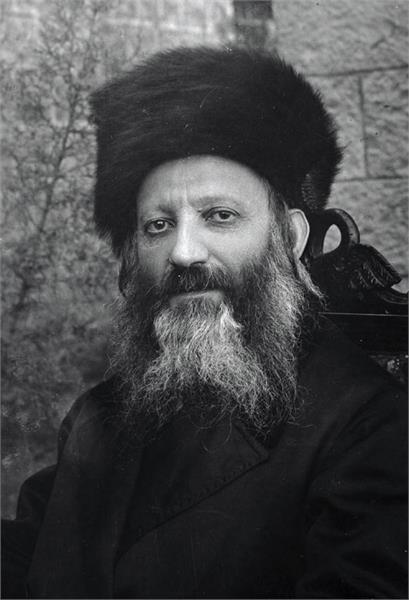
Kook’s view was a minority one among rabbis of his time, and many of his Orthodox contemporaries attacked him for embracing Jews who openly broke the Sabbath. Its influence came later, through his son Zvi Yehuda Kook and the students of Mercaz HaRav (below).[9] Majority
The Holocaust and Jewish theology
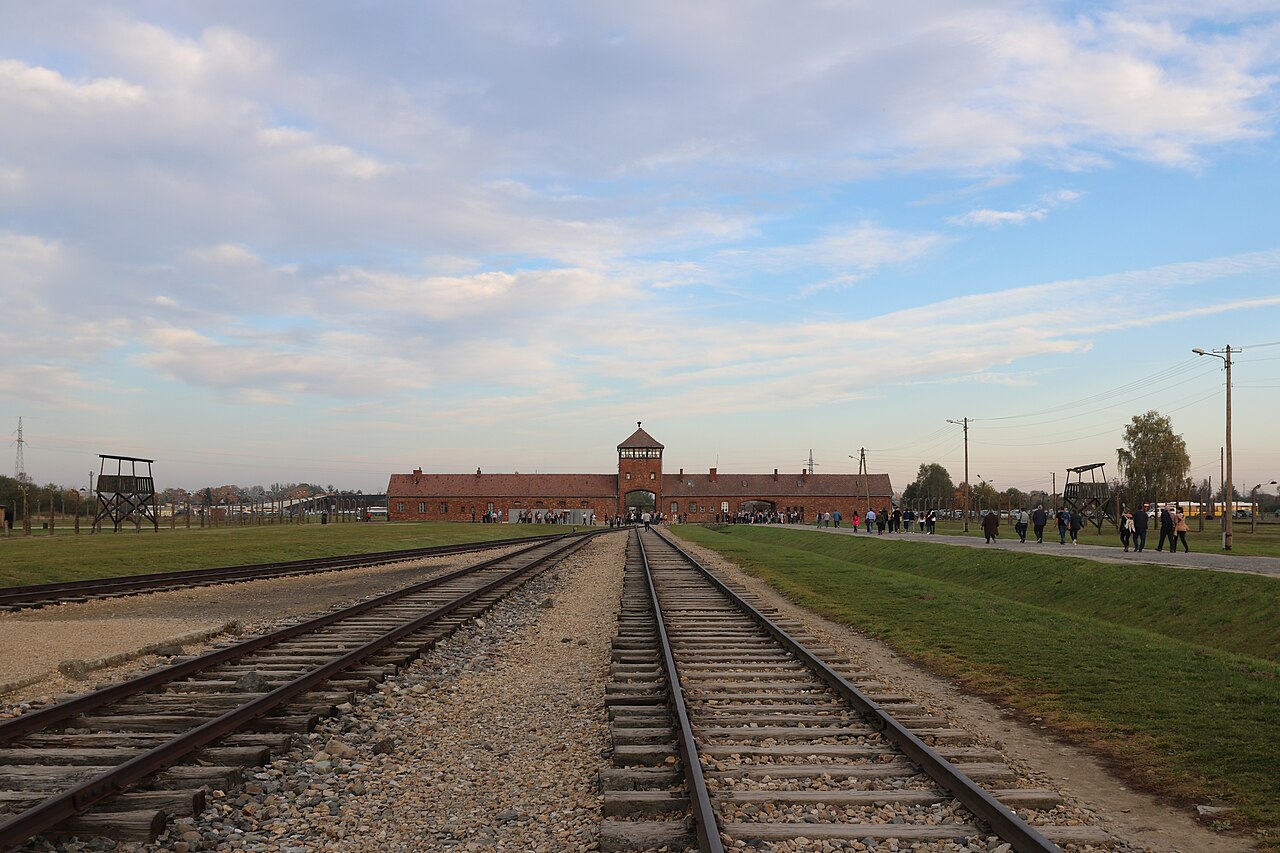
Between 1939 and 1945, Nazi Germany and its allies and collaborators murdered about six million Jews, roughly two-thirds of the Jews of Europe. Whole centres of Jewish religious life (the yeshivas of Lithuania, the Hasidic courts of Poland and Hungary, the communities of Salonica) were destroyed with their populations. Most of the Orthodox and Hasidic world that had opposed Zionism before the war died in it.[12][31][32] Consensus
The Holocaust changed Jewish religion in two ways: in what Jewish communities were left, and in how Jews thought about God. The first is the subject of §13. The second produced a body of theology best known from the 1960s and 1970s. Earlier responses, many by Orthodox writers during the war and just after it, existed but reached few readers outside their own communities until recent research recovered them.[33] Majority
| Thinker | Work | Position |
|---|---|---|
| Richard Rubenstein | After Auschwitz (1966) | The God who acts in history and chose Israel cannot be believed in after Auschwitz; Judaism survives as community and ritual, not as covenant[22] |
| Emil Fackenheim | Symposium of 1967; God’s Presence in History (1970) | Auschwitz is a “commanding voice”: the “614th commandment” forbids Jews to hand Hitler posthumous victories by abandoning Judaism, the people or hope[23][34] |
| Eliezer Berkovits | Faith after the Holocaust (1973) | God’s “hiding of the face” is the price of human freedom; faith may question but need not break[35] |
| Irving Greenberg | “Cloud of Smoke, Pillar of Fire” (1977) | “No statement, theological or otherwise, should be made that would not be credible in the presence of the burning children”; the covenant became voluntary[36] |
| Joel Teitelbaum | Vayoel Moshe (1961) and later writings | The catastrophe was connected with the sin of forcing the end through Zionism[21] |
Two features of this literature matter for the history of religion. First, many traditional Jews rejected the premise that the Holocaust required new theology at all: the tradition already had categories for catastrophe, from the destruction of the Temples to the Crusade massacres (§7, §9), and the medieval kinot (dirges) were extended to include it. Second, for many Jews, religious and secular, the state of Israel came to be read as a response to the Holocaust: the “614th commandment” was formulated in March 1967, weeks before the war that made Israel’s survival the central concern of diaspora Jewry.[33][23] Majority
Commemoration also became a religious question. Israel’s Knesset fixed 27 Nisan as Holocaust Remembrance Day (Yom HaShoah) by a resolution of 1951, given the force of law in 1959; the date, close to the anniversary of the Warsaw Ghetto rising, was chosen by a secular parliament. The Chief Rabbinate had already, in 1949, made the existing fast of the Tenth of Tevet a general day of Kaddish for those whose date of death is unknown, and many Haredi communities mourn the dead on that day or on Tisha b’Av rather than on Yom HaShoah.[37] Majority
1948: independence and Nakba
After the Second World War, Britain handed the Palestine question to the United Nations, whose General Assembly voted on 29 November 1947 to partition the country into a Jewish and an Arab state.[38] The Jewish leadership accepted the plan; the Arab Higher Committee and the Arab states rejected it. Civil war followed between Jews and Arabs in Palestine, and on 14 May 1948, as the Mandate ended, David Ben-Gurion declared the State of Israel. The armies of Egypt, Transjordan, Syria and Iraq, with Lebanese and other forces, entered the next day. By the armistices of 1949 Israel held about 78 percent of Mandatory Palestine; Jordan held the West Bank and East Jerusalem, including the Old City and the Western Wall, and Egypt held Gaza.[39] Consensus
Two narratives
The war is remembered in two narratives that share many facts and differ on their meaning. Both are stated here at their strongest, with their main historians. Political
The Israeli narrative of independence. A people almost destroyed in Europe accepted a compromise partition and was attacked first by Palestinian Arab forces and then by five Arab armies. It won a war for survival in which about 6,000 Jews, nearly one percent of the population, were killed, and in which the Jewish communities that fell to Arab forces, such as the Etzion bloc and the Jewish Quarter of Jerusalem’s Old City, were destroyed and their people killed, captured or expelled.[39] Defenders of the plan’s fairness note that much of the land given to the Jewish state was the arid Negev, and that the Jewish state would itself have held nearly as many Arabs as Jews.[39] In the traditional version, most Arab refugees left because of the war and at the urging or example of their own leaders, and the refugee problem was prolonged because Arab states refused to resettle them, while Israel absorbed a comparable number of Jews leaving Arab countries. Efraim Karsh and others continue to defend much of this account against its critics.[40][3]
The Palestinian narrative of the Nakba. An Arab majority that had not been consulted about the Balfour Declaration was dispossessed by a settler movement backed by an empire. The UN plan its leaders rejected would have given about 55 percent of the country to a Jewish state when Jews were about a third of the population.[38][39] About 700,000 Arabs, more than half of the Arab population of Palestine, were driven from their homes by attacks, massacres such as Deir Yassin (April 1948) and deliberate expulsions, as at Lydda and Ramle in July 1948; some 400 villages or more were depopulated (counts run from 369 localities in Benny Morris’s 1988 list, enlarged slightly in 2004, to 418 in Walid Khalidi’s All That Remains and 531 in Salman Abu Sitta’s register, which also counts Bedouin tribal lands), most were later destroyed, and the refugees were not allowed to return.[41][15][42][43] Walid Khalidi argued as early as 1961 that the Haganah’s Plan Dalet amounted to a master plan for this outcome; Rashid Khalidi places 1948 within a longer colonial history.[44][45]
What the archival research of the 1980s found. When Israeli state and military archives opened, the historian Benny Morris concluded in his 1988 study that “the Palestinian refugee problem was born of war, not by design, Jewish or Arab”.[41] He found no general Arab order to evacuate, but documented that some local Arab commanders ordered villages emptied; he found many expulsions and massacres by Israeli forces, especially from April 1948, and a decision in June 1948 to prevent return, but no single master plan of expulsion. His revised study (2004), using newly released documents, kept that conclusion but recorded more expulsions and massacres by Israeli forces, and also more orders by Arab leaders and commanders to move women, children and the old out of villages.[15] Critics on one side (Karsh) accuse him of exaggerating Israeli responsibility; critics on the other (Ilan Pappé, Walid Khalidi) argue that the pattern itself shows intent.[40][44][46] Political
Two facts are not seriously in dispute: about 700,000 Palestinian Arabs became refugees (the UN Conciliation Commission estimated 711,000 in its 1950 report; Israeli estimates ran lower, Palestinian ones higher),[16] and in the following decades roughly 850,000–900,000 Jews left Arab and Muslim countries, in some cases under severe pressure or after violence, in others by choice; most of them, around 650,000, went to Israel. Whether these movements should be thought of as an “exchange”, and how responsibility for each should be assigned, are political questions this series does not try to settle.[3][15] Consensus on the numbers; Political on their meaning.
The religious shape of the new state
The state that emerged was neither the secular state Herzl imagined nor a state governed by Jewish law. Its religious shape was set by compromise:
- The status quo letter of 19 June 1947, from Ben-Gurion and the Jewish Agency to Agudath Israel, promised that the Sabbath would be the official day of rest, that state kitchens would be kosher, that marriage and divorce would remain with religious courts, and that religious schools would keep their autonomy.[13] Consensus
- The Declaration of Independence closes “with trust in the Rock of Israel” (mitokh bitaḥon be-Tzur Yisrael). Religious signatories wanted God named; the secular left refused; “Rock of Israel”, a biblical title of God, allowed each to read it his own way.[14] Consensus
- The Chief Rabbinate’s prayer for the state, published in September 1948 and attributed to Chief Rabbi Isaac Herzog with the writer S. Y. Agnon, calls the state reshit tzemiḥat geʾulatenu, “the first flowering of our redemption”. Religious Zionist synagogues recite it; most Haredi synagogues do not.[47] Consensus
- The Law of Return (1950) gave every Jew the right to immigrate. Who counts as a Jew became a legal question: in 1962 the Supreme Court ruled that “Brother Daniel” Oswald Rufeisen, a Jew by birth who had become a Catholic monk, did not qualify; a 1970 amendment defined a Jew as “a person who was born of a Jewish mother or has become converted to Judaism and who is not a member of another religion”, while extending the right of return to non-Jewish children and grandchildren of Jews.[18][48] Consensus
Haredi leaders made their own accommodation. Ben-Gurion agreed to exempt a few hundred yeshiva students from military service, an arrangement that grew with the Haredi population into one of Israel’s most contested issues (§13). Agudath Israel sat in early governments while refusing to regard the state as religiously significant. Religious Zionists, organised from 1956 as the National Religious Party, sat in almost every coalition and ran the state religious school system.[3] Consensus
Diaspora Orthodoxy and the state
Outside Israel, the most influential Orthodox reading of the state came from Rabbi Joseph B. Soloveitchik of Yeshiva University, the leading figure of American Modern Orthodoxy. In Kol Dodi Dofek (“The voice of my beloved knocks”, Song of Songs 5:2), delivered on Israel’s Independence Day in 1956, he described the state’s founding as a series of divine “knocks” on the door of the Jewish people: political, military, theological, and above all the ingathering of exiles and the restoration of Jewish dignity: for the first time in exile, he said, the enemies of the Jews had learned “that Jewish blood is not cheap” (in Hebrew, eino hefker, not free for the taking). The knocks called for a response, but Soloveitchik avoided Kook’s language of a redemption already under way.[19][20] Consensus
His position marks a third way between the Haredi refusal to give the state religious meaning and the messianic reading that came to dominate religious Zionism after 1967.[9] Majority
1967: the war and the messianic turn
On the eve of Israel’s Independence Day in May 1967, three weeks before the war, Zvi Yehuda Kook addressed his father’s yeshiva. He recalled that on the night of the UN partition vote in 1947 he could not join the celebrations, because the prophet’s words “and they divided my land” (Joel 4:2) had come true, and cried out: “Where is our Hebron: are we forgetting it?! And where is our Shechem… And where is our Jericho… And where is our Transjordan?!”[49] In the Six-Day War of 5–10 June, Israel took the West Bank and East Jerusalem from Jordan, Gaza and Sinai from Egypt, and the Golan Heights from Syria. To his students the speech became prophecy, and the war became proof that the redemption his father had described was under way. Consensus on the events; their meaning is Political.
On 7 June the army’s chief rabbi, Shlomo Goren, blew the shofar and led prayer at the Western Wall, which Jews had been unable to reach since 1948. On the night of 10 June the Moroccan (Mughrabi) Quarter in front of the Wall, home to more than 600 people, was demolished to create the open plaza that now serves as an outdoor synagogue. The Chief Rabbinate reaffirmed the traditional ruling that Jews should not enter the Temple Mount itself because of laws of ritual purity, and the government left the Mount under the administration of the Muslim waqf.[24] Consensus
The religious consequences were large and divided Jews deeply:
- For religious Zionism, the war turned a theology into a programme. In February 1974 students of Zvi Yehuda Kook founded Gush Emunim, the “Bloc of the Faithful”, to settle the West Bank, which they called by its biblical names Judea and Samaria; settling the whole land was, in their reading, a religious commandment and a step in the redemption.[9][25] Political
- For many Jews in Israel and the diaspora, the capture of the Old City and the anxious weeks before the war intensified religious and ethnic identification with Israel; Jerusalem Day (28 Iyar) was added to the calendar in 1968. Majority
- Religious critics warned against the new mood. The Orthodox philosopher Yeshayahu Leibowitz argued that ruling over another people would corrupt both the state and Judaism, and mocked the new cult of the Western Wall as a “Discotel”; he denied that any state could be holy.[50][9] Consensus on what he argued.
- The Haredi world largely refused messianic readings of the victory, and the Satmar wing condemned the war’s celebration as a deepening of the original sin of Zionism.[9] Consensus
How the settlements in the territories taken in 1967, and the wider conflict, developed after the 1970s is the subject of political history, not of this series; §13 takes up the religious movements that grew from these decades. Consensus
The evidence ledger for religion and Zionism
| Question | What the evidence supports | Key evidence | Confidence |
|---|---|---|---|
| Was Zionism religious in origin? | No: its founders and most of its leaders were secular, though it drew on religious longing for Zion | Herzl, Der Judenstaat; the Basel Program[5][6] | Consensus |
| Did most rabbis oppose it at first? | Yes, most Orthodox and most Reform rabbis, for opposite reasons | Agudath Israel; the Pittsburgh Platform; the 1897 rabbis’ protest[9][4][29][7] | Majority |
| Where did religious Zionist theology come from? | From Mizrachi’s practical Zionism and above all Rav Kook’s mystical reading of redemption | Kook’s letters and essays[30][8] | Consensus |
| How did the Holocaust change Jewish attitudes to Zionism? | It made a Jewish state the majority position of almost every movement except the anti-Zionist Haredi wing | Reform’s shift; Agudah’s accommodation[11][29][13] | Majority |
| How many Palestinians became refugees in 1948? | About 700,000 | UN figures; Morris[16][15] | Consensus |
| Why did they leave? | A mix of flight from fighting, expulsion, massacres and local orders, in proportions still argued | Morris; Khalidi; Karsh[15][44][40] | Political |
| Is Israel a religious state? | No: a state with religious law in personal status and public religious arrangements set by compromise | Status quo letter; Declaration; Law of Return[13][14][18] | Consensus |
| Where did messianic settlement theology come from? | From Kook’s theology, radicalised by his son’s students after 1967 | Zvi Yehuda Kook’s 1967 speech; Gush Emunim[49][9] | Majority |
Primary sources
1. The Three Oaths: Babylonian Talmud, Ketubot 110b–111a
The passage is an aggadic (non-legal) reading, attributed to Rabbi Yose son of Rabbi Ḥanina, of a refrain in the Song of Songs, “I adjure you, daughters of Jerusalem”, which occurs three times.
Hebrew/Aramaic: shalosh shevuʿot hallalu lamah? aḥat she-lo yaʿalu yisraʾel ba-ḥomah, ve-aḥat she-hishbiʿa ha-qadosh barukh hu et yisraʾel she-lo yimredu be-ummot ha-ʿolam, ve-aḥat she-hishbiʿa ha-qadosh barukh hu et ha-goyim she-lo yishtabdu bahen be-yisraʾel yoter midai.
“What are these three oaths for? One, that Israel should not go up [to the land] as a wall; one, that the Holy One, blessed be He, adjured Israel not to rebel against the nations of the world; and one, that the Holy One, blessed be He, adjured the nations not to oppress Israel too much.”[27]
What it proves. That rabbinic tradition contained an explicit warrant for waiting for redemption rather than seizing it. It does not settle whether the oaths are law: religious Zionists answer that the passage is aggadah, absent from the codes; that the return came by individual immigration, not “as a wall”; that the nations gave permission through the Balfour Declaration and the UN vote; and that the nations broke their own oath in the Holocaust.[9] Consensus on the text; Contested on its force.
2. “In Basel I founded the Jewish state”: Herzl’s diary, 3 September 1897
German: In Basel habe ich den Judenstaat gegründet. Wenn ich das heute laut sagte, würde mir ein universelles Gelächter antworten. Vielleicht in fünf Jahren, jedenfalls in fünfzig wird es Jeder einsehen.
“At Basel, I founded the Jewish State. If I said this out loud today, I would be answered by universal laughter. Perhaps in five years, certainly in fifty, everyone will know it.” (trans. Harry Zohn)[51][52]
What it proves. That Herzl understood the Congress as a political act of state-founding, not a religious event. Fifty years and a few months later, the UN voted for partition. Consensus
3. “No longer a nation”: the Pittsburgh Platform, 1885
English (original): “We consider ourselves no longer a nation, but a religious community, and therefore expect neither a return to Palestine, nor a sacrificial worship under the sons of Aaron, nor the restoration of any of the laws concerning the Jewish state.”[4]
What it proves. That the Reform opposition to Zionism was a matter of principle, flowing from the redefinition of Judaism as a religion (§11). Its reversal in 1937 shows how far events, not theology, moved the movement. Consensus
4. “The old will be renewed”: Rav Kook’s letter from Jaffa, 1908
Hebrew: ha-yashan yitḥadesh ve-he-ḥadash yitqadesh.
“The old will be renewed, and the new will be sanctified.”[30]
What it proves. The phrase, from a letter Kook wrote in Jaffa in October 1908 to his friend Moshe Seidel (Igrot ha-Re’iyah 1, no. 164), compresses his programme: tradition would be revived by the national renewal, and the new secular culture would in time be made holy. It explains how a deeply traditional mystic could embrace a movement of Sabbath-breaking pioneers. Consensus
5. “The Rock of Israel”: the Declaration of Independence, 14 May 1948
Hebrew: mitokh bitaḥon be-Tzur Yisraʾel hinenu ḥotmim be-ḥatimat yadenu le-ʿedut ʿal hakhrazah zo.
“Placing our trust in the Rock of Israel, we affix our signatures to this proclamation.”[14]
What it proves. That the founders could not agree on God, and chose a phrase both sides could sign. “Rock of Israel” is a title of God in the Bible (2 Samuel 23:3; Isaiah 30:29) and in the morning prayer; secular readers could take it as the nation’s strength. Consensus
6. “A disaster in every sense”: Constantin Zureiq, August 1948
Arabic: laysat hazīmat al-ʿarab fī filasṭīn bi-l-naksa al-basīṭa aw bi-l-sharr al-hayyin al-ʿābir, wa-innamā hiya nakba bi-kull mā fī hādhihi al-kalima min maʿnā.
“The defeat of the Arabs in Palestine is no simple setback or light, passing evil. It is a disaster in every sense of the word and one of the harshest of the trials and tribulations with which the Arabs have been afflicted throughout their long history.” (trans. R. Bayly Winder, 1956, who renders nakba as “disaster”; “catastrophe” is the more common rendering today)[17][53]
What it proves. That nakba entered the vocabulary in the summer of 1948 itself, from a Syrian Arab nationalist historian writing about the defeat of the Arab states and its causes. The word later came to name above all the dispossession and exile of the Palestinians, and that meaning is the one commemorated on 15 May. Consensus
7. The 614th commandment: Emil Fackenheim, 1967
At a symposium of the journal Judaism in New York in March 1967, Fackenheim proposed that the Holocaust had produced a new commandment: “Jews are forbidden to hand Hitler posthumous victories.” In God’s Presence in History (1970) he spelled it out: Jews are commanded to survive as Jews, to remember the victims, not to despair of God, and not to despair of the world.[23][34]
What it proves. That the most influential post-Holocaust theology made Jewish survival itself a religious duty, binding on secular as well as religious Jews. That idea did much to shape the religious significance diaspora Jews gave to Israel after 1967. Majority
8. “Where is our Hebron?”: Zvi Yehuda Kook, Independence Day 1967
Hebrew (as published by his students; versions differ slightly): ve-ʾet ʾartzi ḥilleqū! ʾeifo ḥevron shellanu, anaḥnu shokhḥim ʾet zeh?! ve-ʾeifo shekhem shellanu, anaḥnu shokhḥim ʾet zeh?! ve-ʾeifo yeriḥo shellanu, anaḥnu shokhḥim ʾet zeh?! ve-ʾeifo ʿever ha-yarden shellanu?!
“‘And they have divided my land’! Where is our Hebron: are we forgetting it?! And where is our Shechem: are we forgetting it?! And where is our Jericho: are we forgetting it?! And where is our Transjordan?!”[49]
What it proves. That a messianic-territorial reading of the state existed among Kook’s students before the 1967 war; the war seemed to them to fulfil it, and they printed and distributed the sermon in large numbers afterwards, and it became known as “the Psalm 19 of the State of Israel” (the state was then nineteen years old). The wording survives in the version edited by his students and printed in his collected talks, Le-Netivot Yisrael. Majority
What is absent from the record before 1967
Several things now often taken for granted about Judaism and Israel were missing, or marginal, in this period.
- A religious majority for Zionism. Until the 1930s and 1940s, most religiously observant Jews in the world were not Zionists. Majority
- A messianic settler movement. Kook’s theology existed, but before 1967 it had little political form. Consensus
- Jewish prayer at the Western Wall plaza. Before 1967 the area in front of the Wall was a narrow alley about 28 metres long; between 1948 and 1967 Jews could not reach it at all. Consensus
- Holocaust theology. The best-known works date from 1966 onward; earlier responses, written during and soon after the war, mostly in Hebrew and Yiddish, were little read outside their own circles.[33] Majority
- Civil marriage in Israel. It has never existed; Jewish marriage and divorce in Israel remain with the rabbinical courts, under the status quo. Consensus
Debates about Zionism and Judaism
Is Zionism a continuation of Judaism or a break with it?
| View | Main argument | Main proponents |
|---|---|---|
| Continuity | The return to Zion is a constant of Jewish prayer and law; Zionism gave political form to a hope as old as the exile | Religious Zionism; Kook; much of Israeli historiography[1][30] |
| Revolution | Zionism replaced waiting for God with human action, and religion with nationality; its founders saw themselves as rebels | Gershom Scholem, Ravitzky (describing the founders’ self-understanding)[9] |
| Betrayal (Haredi) | Forcing the end violates the Three Oaths; a state without Torah is not Jewish redemption | Teitelbaum; Neturei Karta[21] |
| Betrayal (classical Reform) | Judaism is a universal religion, not a nationality; Zionism threatens Jews’ standing as citizens elsewhere | Pittsburgh Platform; the American Council for Judaism[4][29] |
Most historians describe Zionism as both: a modern national movement, shaped by European nationalism and antisemitism, that drew its symbols, its goal and much of its emotional power from Jewish religious tradition.[8] Majority
How should 1948 be described?
| View | Position | Main proponents |
|---|---|---|
| Traditional Israeli | A defensive war of independence; most refugees left because of the war and Arab leaders’ calls | Karsh[40] |
| “Born of war” | No master plan, but many expulsions and atrocities alongside flight; return deliberately prevented | Morris[15][39] |
| Planned dispossession | Plan Dalet and the pattern of expulsions amount to deliberate ethnic cleansing | Walid Khalidi, Pappé, Rashid Khalidi[44][46][45] |
Political. The figures for refugees and depopulated villages are agreed in their order of magnitude; the argument is about intent, responsibility and the right framework for naming what happened.
Was the Holocaust a theological turning point?
Rubenstein, Fackenheim and Greenberg held that it was: after Auschwitz, Jewish thought could not continue as before. Berkovits and many traditional thinkers answered that the tradition had faced catastrophe and divine hiddenness before, and that the Holocaust, however unprecedented in scale, did not require a new theology. A third, Haredi reading placed it within a traditional framework of sin and punishment, a view most other Jews found intolerable.[22][35][36] Contested
Was the 1967 victory religiously significant?
For Zvi Yehuda Kook’s students, it was a stage of redemption visible to all. For Soloveitchik’s followers, it was a knock that demanded a response but not a messianic reading. For Leibowitz, no political event could be holy, and conquest endangered both Judaism and the state. For most Haredim, it changed nothing religiously.[9][19] Political
Further reading
- Arthur Hertzberg, ed., The Zionist Idea: A Historical Analysis and Reader (1959) — the classic anthology, from the forerunners to Ben-Gurion.
- Aviezer Ravitzky, Messianism, Zionism, and Jewish Religious Radicalism (Chicago, 1996) — the best account of Haredi and religious Zionist responses.
- Gideon Shimoni, The Zionist Ideology (Brandeis, 1995).
- Michael A. Meyer, Response to Modernity: A History of the Reform Movement in Judaism (Oxford, 1988) — for the Reform opposition and its reversal.
- Anita Shapira, Israel: A History (Brandeis, 2012).
- Benny Morris, The Birth of the Palestinian Refugee Problem Revisited (Cambridge, 2004), and 1948: A History of the First Arab-Israeli War (Yale, 2008).
- Rashid Khalidi, The Hundred Years’ War on Palestine (Metropolitan, 2020), and Efraim Karsh, Palestine Betrayed (Yale, 2010) — two opposed accounts.
- Richard Rubenstein, After Auschwitz (1966); Emil Fackenheim, God’s Presence in History (1970); Eliezer Berkovits, Faith after the Holocaust (1973).
- Gershom Gorenberg, The Accidental Empire: Israel and the Birth of the Settlements, 1967–1977 (Times Books, 2006).
References
- ^ a b c d e Arthur Hertzberg, ed. The Zionist Idea: A Historical Analysis and Reader. Doubleday and Herzl Press, 1959. The classic anthology, from Alkalai and Kalischer to Ben-Gurion, with a long introduction.
- ^ a b Leon Pinsker, Autoemancipation! (1882) — Autoemancipation! Mahnruf an seine Stammesgenossen von einem russischen Juden (Berlin, 1882); English trans. D. S. Blondheim. 1882. German. Jews appear to the nations as 'the ghostlike apparition of a living corpse', a people without land or organisation; Judeophobia is an incurable 'psychic aberration', and the only remedy is a national territory of their own. read the text
- ^ a b c d e f Anita Shapira Israel: A History. Brandeis University Press, 2012. A balanced Israeli history from the first Zionists to the 2000s.
- ^ a b c d e Pittsburgh Platform — Conference of Reform rabbis, Pittsburgh. 16–19 November 1885. English. Classical Reform's charter: only the moral law binding; dietary and purity laws obsolete; Jews 'no longer a nation, but a religious community' expecting no return to Palestine. about
- ^ a b c d Herzl, Der Judenstaat (1896) — Theodor Herzl, Der Judenstaat: Versuch einer modernen Lösung der Judenfrage. 1896. German. The founding text of political Zionism: the Jewish question is a national question, to be solved by an internationally recognised Jewish state. Rejects theocracy: "We shall keep our priests within the confines of their temples." about
- ^ a b c Basel Program (1897) — Programme of the First Zionist Congress. 1897. German. "Zionism seeks to establish a home in Palestine for the Jewish people, secured under public law": the movement's founding aim, political rather than religious. about
- ^ a b c Executive of the Rabbinerverband in Deutschland, declaration against Zionism (1897) — Signed by S. Maybaum, M. Horovitz, J. Guttmann, A. Auerbach and C. Werner; English in The Jewish Chronicle, 9 July 1897, p. 9; repr. Posen Library, vol. 7. June–July 1897. German. Liberal and Orthodox rabbis declare that "the efforts of so-called Zionists to create a Jewish National State in Palestine are antagonistic to the messianic promises of Judaism"; Herzl answered by calling them Protestrabbiner. read the text
- ^ a b c d e f Gideon Shimoni The Zionist Ideology. Brandeis University Press, 1995. The ideas of the movement's main streams, secular and religious.
- ^ a b c d e f g h i j k l m n o p q r s t u Aviezer Ravitzky Messianism, Zionism, and Jewish Religious Radicalism. University of Chicago Press, 1996. The standard study of Haredi anti-Zionism, Kook's theology and its radicalisation after 1967.
- ^ Balfour Declaration (2 November 1917) — Letter of Arthur Balfour to Lord Rothschild. 1917. English. Britain views "with favour the establishment in Palestine of a national home for the Jewish people", without prejudice to "the civil and religious rights of existing non-Jewish communities". about
- ^ a b c Columbus Platform (1937) — The Guiding Principles of Reform Judaism (Central Conference of American Rabbis). 1937. English. Reform reverses course: "We affirm the obligation of all Jewry to aid in its upbuilding as a Jewish homeland." about
- ^ a b United States Holocaust Memorial Museum Documenting Numbers of Victims of the Holocaust and Nazi Persecution. Holocaust Encyclopedia, USHMM, Washington DC, 2023. open library Six million Jews murdered; breakdown by killing centre and method, including about one million at the Auschwitz complex.
- ^ a b c d Status quo letter (19 June 1947) — Letter of the Jewish Agency Executive (Ben-Gurion) to Agudath Israel. 1947. Hebrew. Promises the Sabbath as day of rest, kosher state kitchens, religious control of marriage and divorce, and autonomy for religious schools: the basis of Israel's religious arrangements. about
- ^ a b c d Declaration of the Establishment of the State of Israel (14 May 1948) — Megillat ha-Atzmaut. 1948. Hebrew. Closes "with trust in the Rock of Israel", a compromise between religious signatories who wanted God named and secular ones who refused. about
- ^ a b c d e f g Benny Morris The Birth of the Palestinian Refugee Problem Revisited. Cambridge University Press, 2004. The revised archival study of why some 700,000 Palestinians left. Keeps the 1988 conclusion that the problem was born of war, not by design, while recording more expulsions and massacres and more Arab orders to evacuate women, children and the old.
- ^ a b c UN Conciliation Commission for Palestine, General Progress Report (1950) — General Progress Report and Supplementary Report, 11 December 1949 to 23 October 1950 (A/1367/Rev.1). 23 October 1950. English. Estimates the number of Arab refugees from the territory held by Israel at about 711,000. read the text
- ^ a b Constantin Zureiq, Ma'na al-Nakba (August 1948) — The Meaning of the Disaster (Beirut: Dar al-Ilm lil-Malayin). 1948. Arabic. Calls the Arab defeat in Palestine "no simple setback" but a nakba, "a catastrophe in every sense of the word": the first analytical use of the term. about
- ^ a b c d Law of Return (1950; amended 1970) — Knesset legislation. 1950, 1970. Hebrew. "Every Jew has the right to come to this country as an oleh"; the 1970 amendment defines a Jew as one born of a Jewish mother or converted, and not a member of another religion, and extends the right to children and grandchildren of Jews. about
- ^ a b c Joseph B. Soloveitchik, Kol Dodi Dofek (1956) — Address on Israel's Independence Day, Yeshiva University. 1956. Hebrew. Reads the founding of the state as six divine "knocks" calling the Jewish people to respond, without claiming that redemption has begun.
- ^ a b Joseph B. Soloveitchik; David Z. Gordon, trans.; Jeffrey R. Woolf, ed. Kol Dodi Dofek: Listen—My Beloved Knocks. Yeshiva University and Ktav, 2006. open library Annotated English translation of the 1956 address, including the six 'knocks' and the line that 'Jewish blood is not cheap' (dam yehudi eino hefker).
- ^ a b c d Joel Teitelbaum, Vayoel Moshe (1961) — Vayoel Moshe. 1961. Hebrew. The Satmar Rebbe's legal and theological case that the Three Oaths are binding and that a Jewish state before the Messiah is forbidden. about
- ^ a b c Richard L. Rubenstein After Auschwitz: Radical Theology and Contemporary Judaism. Bobbs-Merrill, 1966. The 'death of God' after the Holocaust.
- ^ a b c d Fackenheim, "Jewish Values in the Post-Holocaust Future" symposium (1967) — Judaism 16, no. 3 (Summer 1967). 1967. English. First statement of the "614th commandment": Jews are forbidden to hand Hitler posthumous victories.
- ^ a b Gershom Gorenberg The Accidental Empire: Israel and the Birth of the Settlements, 1967–1977. Times Books, 2006. The Western Wall, the Mughrabi Quarter and the first settlements after 1967.
- ^ a b Ian S. Lustick For the Land and the Lord: Jewish Fundamentalism in Israel. Council on Foreign Relations, 1988. Gush Emunim's origins and ideology.
- ^ Amidah, seventeenth blessing (Avodah) — Daily Amidah, Siddur Ashkenaz (Metsudah translation). rabbinic period; fixed text medieval. Hebrew. "And may our eyes behold Your merciful return to Zion. Blessed are You … Who returns His Divine Presence to Zion": the return to Zion prayed for three times daily. read the text
- ^ a b Babylonian Talmud, Ketubot 110b–111a — Talmud Bavli, tractate Ketubot. c. 500–600 CE (redaction). Hebrew/Aramaic. The Three Oaths: Israel is not to go up to the land 'as a wall' or rebel against the nations, and the nations are not to oppress Israel too much. The main rabbinic text cited against Zionism. read the text
- ^ Ahad Haʿam, "Shabbat ve-Tziyonut" (1898) — Ha-Shiloaḥ (1898), in the column "Yalkut katan"; reprinted in Al parashat derakhim. 1898. Hebrew. "More than Israel has kept the Sabbath, the Sabbath has kept them" (yoter mi-she-yisraʾel shamru et ha-shabbat, shamrah ha-shabbat otam): the Sabbath valued as the guardian of the nation, not as divine command.
- ^ a b c d e f Michael A. Meyer Response to Modernity: A History of the Reform Movement in Judaism. Oxford University Press, 1988. The standard history of Reform in Germany and America.
- ^ a b c d Igrot ha-Re'iyah, vol. 1, no. 164 — Abraham Isaac Kook, collected letters. 26 Tishri 5669 (21 October 1908). Hebrew. Letter from Jaffa to Moshe Seidel, October 1908: "the old will be renewed and the new will be sanctified" (ha-yashan yitḥadesh ve-he-ḥadash yitqadesh), Kook's programme for a national revival that would be made holy.
- ^ United States Holocaust Memorial Museum Introduction to the Holocaust. Holocaust Encyclopedia, USHMM, Washington DC, 2024. open library Six million Jews murdered, nearly two out of every three European Jews.
- ^ Raul Hilberg The Destruction of the European Jews. Yale University Press, 3rd ed., 3 vols., 2003. The foundational history of the Holocaust; Hilberg's own estimate is 5.1 million Jewish dead, lower than the commonly cited figure of about six million.
- ^ a b c Steven T. Katz, Shlomo Biderman and Gershon Greenberg, eds. Wrestling with God: Jewish Theological Responses during and after the Holocaust. Oxford University Press, 2007. Anthology showing that theological responses, many by Orthodox writers, began during the war itself, long before the better-known works of the 1960s.
- ^ a b Emil L. Fackenheim God's Presence in History: Jewish Affirmations and Philosophical Reflections. New York University Press, 1970. The 614th commandment developed.
- ^ a b Eliezer Berkovits Faith after the Holocaust. Ktav, 1973. A traditional response: God's hiding of the face and human freedom.
- ^ a b Irving Greenberg Cloud of Smoke, Pillar of Fire: Judaism, Christianity, and Modernity after the Holocaust. In Eva Fleischner, ed., Auschwitz: Beginning of a New Era? (Ktav), 1977. The 'burning children' test and the voluntary covenant.
- ^ Tom Segev The Seventh Million: The Israelis and the Holocaust. Hill and Wang, 1993. How Israel remembered and used the Holocaust, including Yom HaShoah.
- ^ a b UN General Assembly Resolution 181 (II), 29 November 1947 — Future Government of Palestine (Plan of Partition with Economic Union). 29 November 1947. English. Adopted 33 to 13 with 10 abstentions: recommends ending the Mandate and partitioning Palestine into a Jewish state, an Arab state and an international regime for Jerusalem, joined in economic union. read the text
- ^ a b c d e Benny Morris 1948: A History of the First Arab-Israeli War. Yale University Press, 2008. Military and political narrative of the war.
- ^ a b c d Efraim Karsh Palestine Betrayed. Yale University Press, 2010. Defends the view that Arab leaders bear the main responsibility for the Palestinian exodus.
- ^ a b Benny Morris The Birth of the Palestinian Refugee Problem, 1947–1949. Cambridge University Press, 1988. The first archival study: "the Palestinian refugee problem was born of war, not by design, Jewish or Arab". Its list of abandoned localities (about 370) is the shortest of the standard counts.
- ^ Walid Khalidi, ed. All That Remains: The Palestinian Villages Occupied and Depopulated by Israel in 1948. Institute for Palestine Studies, 1992. Village-by-village survey of 418 depopulated localities.
- ^ Salman Abu Sitta The Palestinian Nakba 1948: The Register of Depopulated Localities in Palestine. Palestinian Return Centre, London, 2000. The longest count, 531 localities, including Bedouin tribal lands in the Beersheba district.
- ^ a b c d Walid Khalidi Plan Dalet: Master Plan for the Conquest of Palestine. Journal of Palestine Studies 18, no. 1, 1988. Reprint of the 1961 article (Middle East Forum) arguing that the Haganah's Plan D aimed at the expulsion of the Arab population.
- ^ a b Rashid Khalidi The Hundred Years' War on Palestine: A History of Settler Colonialism and Resistance, 1917–2017. Metropolitan Books, 2020. A Palestinian historian's account placing 1948 within a colonial history.
- ^ a b Ilan Pappé The Ethnic Cleansing of Palestine. Oneworld, 2006. Argues that the expulsions of 1948 were planned.
- ^ Prayer for the Welfare of the State of Israel (1948) — Chief Rabbinate of Israel (attributed to Isaac Herzog, edited by S. Y. Agnon). 1948. Hebrew. Calls the state "the first flowering of our redemption" (reshit tzemiḥat ge'ulatenu); recited in religious Zionist synagogues, mostly not in Haredi ones. about
- ^ Rufeisen v. Minister of the Interior, HCJ 72/62 (1962) — Supreme Court of Israel. December 1962. Hebrew. By four to one, the court held that Oswald Rufeisen (Brother Daniel), born Jewish but a Carmelite monk, was not a Jew for the purposes of the Law of Return: a Jew who adopts another religion is not a Jew in ordinary Jewish understanding. about
- ^ a b c Zvi Yehuda Kook, Independence Day address at Mercaz HaRav (May 1967) — Sermon on the eve of Independence Day, 5 Iyar 5727 (14 May 1967), known as "Mizmor 19 shel Medinat Yisrael"; edited by his students and printed in Le-Netivot Yisrael, vol. 2. 1967. Hebrew. Recalling the UN partition vote of 1947 ("and they divided my land", Joel 4:2): "Where is our Hebron: are we forgetting it?! … And where is our Transjordan?!" Delivered three weeks before the Six-Day War; his students later read it as prophecy. about
- ^ Yeshayahu Leibowitz; Eliezer Goldman, ed. Judaism, Human Values, and the Jewish State. Harvard University Press, 1992. open library Leibowitz's essays in English, including 'The Territories' (1968): ruling over a hostile Arab population would corrupt the state and destroy it as the state of the Jewish people.
- ^ Herzl, diary, 3 September 1897 — Theodor Herzl, Tagebücher. 1897. German. "At Basel I founded the Jewish State… Perhaps in five years, and certainly in fifty, everyone will see it."
- ^ Theodor Herzl; Raphael Patai, ed.; Harry Zohn, trans. The Complete Diaries of Theodor Herzl. Herzl Press and Thomas Yoseloff, 5 vols., 1960. open library The standard English translation of Herzl's diaries, including the entry of 3 September 1897.
- ^ Constantine K. Zurayk; R. Bayly Winder, trans. The Meaning of the Disaster. Khayat's College Book Cooperative, Beirut, 1956. open library English translation of Maʿnā al-Nakba (August 1948), the essay that gave the word nakba its modern sense.