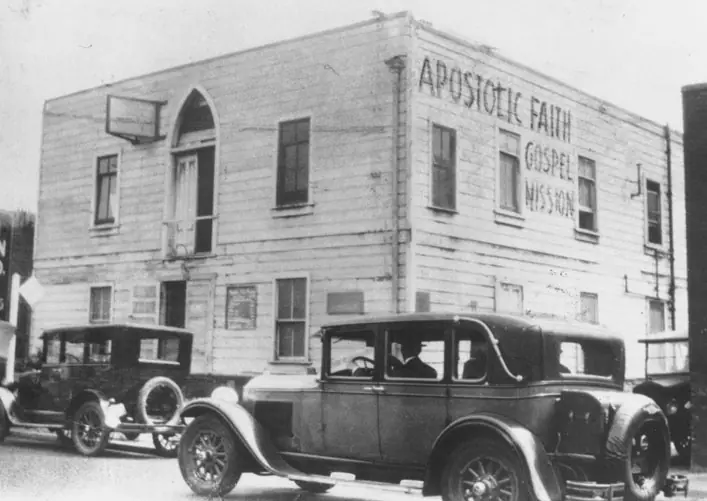
The short version: Pentecostalism was born at the start of the twentieth century, out of a revival tradition a century old, in several places at once. Its American story runs from a Bible school in Topeka in 1901 to a former church building on Azusa Street in Los Angeles in 1906; its global story includes revivals in Wales, India, Korea and Chile in the same decade. What was new was a single claim: that speaking in tongues, as in Acts 2, was the evidence of a “baptism in the Holy Spirit” open to every believer.[1][2] Majority
The name, and the text behind it
Pentecostals take their name from the Jewish festival of Pentecost, when, according to Acts, the disciples were “filled with the Holy Spirit and began to speak in other languages, as the Spirit gave them ability”.[3] Paul’s first letter to the Corinthians discusses tongues, prophecy and healing as gifts of the Spirit in his churches in the 50s, and tries to regulate their use in worship.[4][5] Consensus on the texts. One further verse, “they will speak in new tongues”, comes from the longer ending of Mark, which is absent from the earliest manuscripts (§0).[6] Consensus
Ecstatic speech and prophecy recur in Christian history: the “New Prophecy” of Montanus, Priscilla and Maximilla in second-century Phrygia (§5) is the best-known early case.[7] Edward Irving’s circle in 1830s London had called tongues the “standing sign” of Spirit baptism, but no lasting movement was built on the claim until 1901.[8] Majority
The Holiness roots
The direct ancestor of Pentecostalism is the Holiness movement of nineteenth-century America, which grew out of Methodism (§11).[9][10] Consensus
- Wesley’s “Christian perfection”. John Wesley taught that after conversion a believer could receive a second work of grace, “entire sanctification”, in which the heart was made perfect in love.[11] Consensus
- Phoebe Palmer. From 1840 the Methodist laywoman Phoebe Palmer led the Tuesday Meeting for the Promotion of Holiness in New York, begun by her sister Sarah Lankford in 1835, and in The Way of Holiness (1843) taught that sanctification could be received at once, by faith.[12][9] Consensus
- Camp meetings. In 1867 a holiness camp meeting at Vineland, New Jersey, formed the National Camp Meeting Association for the Promotion of Christian Holiness; independent holiness churches multiplied in the following decades.[9] Consensus
- The language of Spirit baptism. From the 1870s many holiness preachers called the second blessing “the baptism of the Holy Spirit”, and some sought further experiences of power for mission and healing.[10] Majority
Donald Dayton identified four themes that Pentecostalism inherited from this world: Christ as saviour, as baptiser in the Spirit, as healer and as coming king.[10] What the Pentecostals added was the claim that tongues were the evidence of the Spirit baptism. Majority
Topeka, 1901
Charles Fox Parham, a Holiness preacher in Kansas, taught that speaking in tongues, glossolalia, was the “Bible evidence” of baptism in the Holy Spirit, as at Pentecost. On 1 January 1901 one of his students at Bethel Bible School in Topeka, Agnes Ozman, began to speak in what she and Parham took to be an unlearned language. Parham expected that missionaries would no longer need to learn foreign languages.[1][2] Consensus on the events.
Azusa Street, 1906
In Houston in the winter of 1905–06, William J. Seymour, the son of formerly enslaved parents, attended Parham’s classes, sitting outside the classroom door under the rules of segregation. Invited to preach in Los Angeles in 1906, he led a revival that from April met in a former church building at 312 Azusa Street. The meetings ran almost daily for three years and drew visitors from across the world. The mission’s own paper, The Apostolic Faith, announced in its first issue, in September 1906, that “Pentecost Has Come”.[13][1] Consensus
What struck observers was who worshipped together: Black and white, Latino, men and women, the poor and a few of the comfortable. Frank Bartleman, a white participant, wrote that “the color line was washed away in the blood”.[14] Parham visited in October 1906, condemned the racial mixing and the style of worship, and broke with Seymour. Within a decade American Pentecostalism had largely separated along racial lines: the Church of God in Christ, led by Charles H. Mason, became the main Black denomination, and the Assemblies of God, founded in 1914, a largely white one.[1][2] Majority The Azusa Street building itself was demolished in 1931.[15]
Not one origin but several
The older story made Azusa Street the single source from which Pentecostalism spread around the world. Allan Anderson and others argue that it had several origins.[2] Majority
- Wales, 1904–1905. A national revival, widely reported, which many early Pentecostals took as a sign of what was coming.
- India, 1905–1906. At Pandita Ramabai’s Mukti mission near Pune, a revival among the young women of the mission included tongues and prophecy.
- Korea, 1907. The Pyongyang revival in the Presbyterian and Methodist churches shaped Korean Protestant worship.
- Chile, 1909–1910. In Valparaíso the Methodist missionary Willis Hoover’s congregation experienced a revival, was expelled by its own church, and founded the Methodist Pentecostal Church.
Each of these had contacts with the others through missionary papers, and some had links to Azusa Street; but they did not simply copy it.[2] Majority In Brazil, two Swedish Pentecostal missionaries from the United States, Gunnar Vingren and Daniel Berg, founded what became the Assemblies of God at Belém in 1911; it is now one of the largest Protestant churches in the world.[2][16] Consensus
The case on each side
| View | Where Pentecostalism began | Main proponents |
|---|---|---|
| Azusa as the source | A single American revival, under Seymour, from which missionaries carried the movement abroad | Many older denominational histories; Synan, Robeck[9][15] |
| Black and oral roots | The movement’s worship drew on African American spirituality; Seymour, not Parham, was its real founder | Hollenweger (1997), Nelson (1981)[17][18] |
| Several origins | Parallel revivals in Asia, Latin America and Europe, linked but not derived from Azusa | Anderson[2] |
| American Holiness theology | The movement’s ideas came from Wesleyan and Holiness teaching; the experience gave them a new form | Dayton[10] |
Contested on emphasis. The views overlap more than they conflict: almost all historians accept the Holiness background, the importance of Azusa Street and the existence of other early centres. They disagree about which to treat as primary.
A precursor: Scotland and London, 1830
Seventy years before Topeka, in 1830, speaking in tongues and healings were reported in a revival in the west of Scotland, among them members of the MacDonald family of Port Glasgow, and in 1831 they spread to the London congregation of the preacher Edward Irving. Irving was deposed by the Church of Scotland in 1833, and his followers formed the Catholic Apostolic Church.[8] Majority The same Scottish circle features in the debate over the origins of the Rapture (see where the Rapture came from). Historians treat the Irvingites as a precursor, not an ancestor: there is no direct line from them to Topeka.[2] Majority
How large it became
Later in the century a “charismatic” movement brought the same practices into the older churches, Episcopalian from 1960 and Catholic from 1967.[2] Majority Pew, using estimates from the Center for the Study of Global Christianity, counted about 279 million Pentecostals and 305 million charismatics in 2010, together about 27 per cent of all Christians; the Center’s 2025 figures put “Pentecostals/charismatics” above 660 million.[19][20] Contested on every such figure, because the categories blur (§13).
Common misconceptions
- “Pentecostalism began at Azusa Street.” Azusa Street was its most influential early centre, but Topeka came first and other revivals ran in parallel. Majority
- “Speaking in tongues was unknown before 1901.” Ecstatic speech is reported in several earlier movements; what began in 1901 was a movement built on it as the evidence of Spirit baptism. Majority
- “It is an American export.” Its largest churches today are in Africa, Latin America and Asia, and several of them grew from local revivals rather than American missions (§13). Majority
- “Pentecostal” and “charismatic” mean the same. Pentecostals belong to Pentecostal denominations; charismatics share the practices within Catholic, Anglican and other older churches. Consensus
Why it matters
Pentecostalism is the clearest case in this series of a new kind of Christianity arising in modern times and spreading without a council, a creed or a central authority. It began among the poor, gave women and Black Christians leadership in mixed-race congregations that the older churches did not, and within a century had become one of the largest forms of the faith. Its origins also show how historians’ questions change: a story once told from one American address is now told from several continents.
References
- ^ a b c d Grant Wacker Heaven Below: Early Pentecostals and American Culture. Harvard University Press, 2001. Early American Pentecostals, from Topeka and Azusa Street to the 1920s.
- ^ a b c d e f g h i Allan Heaton Anderson An Introduction to Pentecostalism: Global Charismatic Christianity. Cambridge University Press, 2nd ed., 2014. The standard global history, arguing for Pentecostalism's many origins.
- ^ Acts 2:1–4 — Acts of the Apostles (New Testament). c. 80–90 CE. Greek. At Pentecost the disciples are filled with the Holy Spirit and 'began to speak in other languages, as the Spirit gave them ability'. read the text
- ^ 1 Corinthians 12:4–11 — Paul, First Letter to the Corinthians. c. 54 CE. Greek. The Spirit's varieties of gifts: wisdom, knowledge, faith, gifts of healing, miracles, prophecy, discernment, tongues and their interpretation. read the text
- ^ 1 Corinthians 14:26–33 — Paul, First Letter to the Corinthians. c. 54 CE. Greek. Orderly worship: each brings a hymn, a lesson, a revelation, a tongue or an interpretation. read the text
- ^ Mark 16:17 — Gospel of Mark, longer ending (New Testament). 2nd c. CE (added ending). Greek. 'They will speak in new tongues', in the longer ending of Mark that is absent from the earliest manuscripts. read the text
- ^ Eusebius, Ecclesiastical History 5.16 — Ecclesiastical History. c. 325 CE (quoting 2nd-c. sources). Greek. An anonymous anti-Montanist writer on Montanus, Priscilla and Maximilla and their ecstatic prophecy in Phrygia. read the text
- ^ a b Gordon Strachan The Pentecostal Theology of Edward Irving. Darton, Longman & Todd, 1973. The tongues and healings of the west-of-Scotland revival of 1830 and Irving's London congregation.
- ^ a b c d Vinson Synan The Holiness–Pentecostal Tradition: Charismatic Movements in the Twentieth Century. Eerdmans, 1997. The standard history of Pentecostalism's Holiness roots; revised from his 1971 study.
- ^ a b c d Donald W. Dayton Theological Roots of Pentecostalism. Francis Asbury Press, 1987. Traces the 'fourfold gospel' of Christ as saviour, Spirit-baptiser, healer and coming king to nineteenth-century Holiness teaching.
- ^ John Wesley, A Plain Account of Christian Perfection (1766) — A Plain Account of Christian Perfection. 1766. English. Wesley's statement of 'entire sanctification': a second work of grace after conversion in which the believer is made perfect in love. read the text
- ^ Phoebe Palmer, The Way of Holiness (1843) — The Way of Holiness. 1843. English. Palmer's teaching that entire sanctification can be received at once, by faith, the basis of the Holiness movement's 'altar theology'. about
- ^ The Apostolic Faith, vol. 1 no. 1 (September 1906) — The Apostolic Faith (Apostolic Faith Mission, Los Angeles). September 1906. English. The Azusa Street mission's paper reports the revival under the headline 'Pentecost Has Come'. about
- ^ Frank Bartleman How Pentecost Came to Los Angeles. the author, Los Angeles, 1925. An eyewitness memoir of the Azusa Street revival.
- ^ a b Cecil M. Robeck Jr. The Azusa Street Mission and Revival: The Birth of the Global Pentecostal Movement. Thomas Nelson, 2006. The standard history of the Azusa Street mission, including its building's demolition in 1931.
- ^ Paul Freston Evangelicals and Politics in Asia, Africa and Latin America. Cambridge University Press, 2001. Includes the growth of Brazilian Pentecostalism.
- ^ Walter J. Hollenweger Pentecostalism: Origins and Developments Worldwide. Hendrickson, 1997. Traces five roots of Pentecostalism, among them a Black oral root.
- ^ Douglas J. Nelson For Such a Time as This: The Story of Bishop William J. Seymour and the Azusa Street Revival. PhD thesis, University of Birmingham, 1981. Argues that Seymour, not Parham, was the movement's real founder.
- ^ Pew Research Center Global Christianity: A Report on the Size and Distribution of the World's Christian Population. Pew Forum on Religion & Public Life, 2011. open access Uses CSGC figures for about 279 million Pentecostals and 305 million charismatics in 2010.
- ^ Gina A. Zurlo World Christianity 2025: Regional Perspectives. International Bulletin of Mission Research, 2025. doi The CSGC's annual figures: 2.6 billion Christians (32.3 per cent) in 2025, 69 per cent in the global South.