The short version: yes, as far as historians can tell. The question of whether Jesus existed is separate from the question of who he was. Christians believe he was the Son of God, and many others do not; but the scholars who study the ancient world, whatever they believe, agree almost without exception that a Jewish preacher called Jesus lived in Galilee in the first century and was crucified in Jerusalem under Pontius Pilate.[1][2] Consensus What follows is why they think so, what the case against looks like, and what the evidence cannot show.
How historians decide that someone existed
For almost no one in first-century Judea is there a birth record, a portrait or a document from their own lifetime. Historians accept that a person existed when several independent sources, written close to the time, refer to them in ways that are hard to explain if they were invented. By that standard Jesus is unusually well attested for a provincial figure of no rank: letters by a man who knew his brother, four narrative accounts within a lifetime of his death, and two mentions by non-Christian historians within a century.[2] Majority
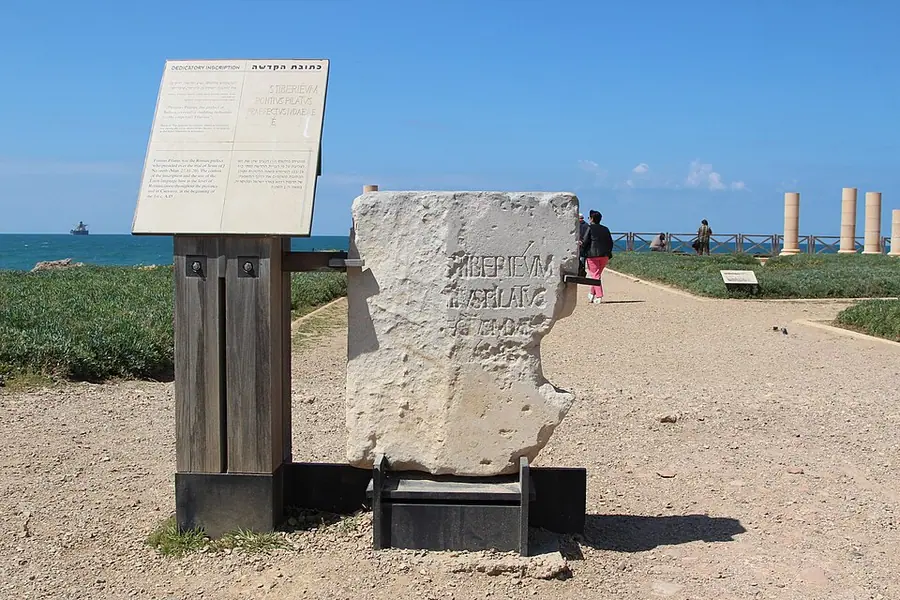
Silence from his own lifetime is what would be expected. Jesus wrote nothing, held no office and was executed as a troublemaker; the records of Pilate’s prefecture, if there were any, do not survive. The only inscription securely naming Pilate himself was found in 1961.[3] Consensus
Paul: the brother and the disciple
The oldest Christian writings are Paul’s letters of the 50s CE (§0). Paul was not a follower of Jesus in his lifetime, and his letters say little about it, but they contain two details that matter here.
In Galatians, Paul says that about three years after his conversion he went up to Jerusalem, stayed fifteen days with Cephas, the Aramaic name of Peter, “but I saw none of the other apostles except James the Lord’s brother”.[4] That puts Paul in a house in Jerusalem, within about five years of the crucifixion, with Jesus’ leading disciple and his brother.
In 1 Corinthians, Paul quotes a formula he had “received” about Jesus’ death, burial and appearances (§2), and passes on Jesus’ words over the bread and cup and his teaching on divorce as “the Lord’s” command.[5][6][7] Paul is arguing with other Christian leaders, some of whom knew Jesus; neither he nor they show any sign that his existence was in question. Majority
The Gospels
Mark, the earliest Gospel, was written around 70 CE; Matthew and Luke used it about 80–90, and John followed around 90–110 (§0). They were written to persuade, and historians do not take them at face value. But they preserve details that their authors found awkward, which is a sign that they were handed down rather than invented: that Jesus was baptised by John, whose baptism was “for the forgiveness of sins” (Mark 1:4), that his family thought he was “out of his mind”, that he was a craftsman from an obscure village, and that he was executed by Rome as “the King of the Jews”.[8][9][10][11][12] Majority
Nazareth itself, which some mythicists once claimed did not exist in Jesus’ day, has yielded first-century houses and tombs, and a Hebrew inscription from Caesarea names it as a home of a priestly family.[13][14] Consensus
Outside witnesses
Josephus. The Jewish historian’s Antiquities, written in Rome around 93–94 CE, refers to the execution in 62 CE of “James, the brother of Jesus who was called the Christ”.[15] Almost all scholars accept the passage as genuine. A longer passage, the Testimonium Flavianum, was expanded by Christian copyists: the early Christian writer Origen, around 248, says Josephus did not believe Jesus was the Christ, though the surviving text calls him so.[16][17] Most scholars think a shorter, neutral notice of Jesus lies underneath; a tenth-century Arabic paraphrase published by Shlomo Pines in 1971 gives a more cautious version.[18] Majority
Tacitus. Writing around 116 CE about Nero’s persecution after the fire of Rome, Tacitus explains that the name Christians came from “Christus”, who “suffered the extreme penalty during the reign of Tiberius at the hands of one of our procurators, Pontius Pilatus” (trans. Church and Brodribb).[19] Tacitus despised the Christians and had no motive to invent their founder. Consensus
Pliny the Younger (c. 112) and Suetonius (c. 121) mention Christians, or perhaps a “Chrestus”, but say nothing that independently confirms Jesus’ life.[20][21] Later rabbinic traditions about a “Yeshu” are centuries later and of disputed relevance.[22] Contested
The mythicist case
The view that Jesus never existed goes back to the late eighteenth century and was argued in Germany by Bruno Bauer and Arthur Drews. Its fullest academic statement today is Richard Carrier’s On the Historicity of Jesus (2014).[23] In outline, mythicists argue:
- that the earliest Christians, including Paul, believed in a heavenly Christ who was crucified in a spiritual realm, and that the Gospels later turned him into a man on earth;
- that “brother of the Lord” is a title for any believer, not a family relationship;
- that the Josephus passages are both Christian insertions, and Tacitus repeats Christian claims;
- that the Gospel stories are built from Jewish scripture and pagan myth.
Specialists, including scholars with no religious commitment, reject these arguments.[1][24][25] Paul calls other believers “brothers” constantly but uses “brother(s) of the Lord” only for Jesus’ actual brothers, naming James and setting “the brothers of the Lord” apart from the apostles and Cephas (1 Cor 9:5), and Josephus independently calls James “the brother of Jesus”. Paul’s Jesus was “born of a woman, born under the law” and “descended from David according to the flesh”, which is hard to square with a purely heavenly figure.[26][27][28] And a movement inventing a Messiah would not have invented one who was baptised for the forgiveness of sins, rejected by his family and crucified as a criminal. Consensus among specialists that Jesus existed.
| Mythicist claim | Usual reply |
|---|---|
| Paul knew only a heavenly Christ | Paul met Jesus’ brother and chief disciple, and calls Jesus “born of a woman” and a descendant of David |
| “Brother of the Lord” is a religious title | Paul never uses it of ordinary believers; Josephus independently names James as Jesus’ brother |
| Josephus was wholly interpolated | The James passage is incidental and un-Christian in tone; most scholars accept a neutral core of the longer passage |
| The Gospels are myth and midrash | They contain embarrassing and incidental details that do not serve any myth: the baptism, the family’s doubts, the crucifixion |
What the evidence does not show
That Jesus existed is a historical judgement. That he was the Messiah, the Son of God, that he worked miracles or rose from the dead are claims of faith. Historians can date when his followers began to believe that God had raised him, within a few years of the crucifixion (§2), but cannot test whether the belief is true.[5] Consensus The historical consensus that Jesus lived is therefore not a consensus that Christianity is true, and the mythicist case would not disprove Christian belief even if it succeeded; it simply fails on the evidence. Majority
Common misconceptions
- “There is no evidence outside the Bible.” Josephus and Tacitus are not Christian sources, and Paul’s letters were written decades before any Bible existed. Consensus
- “No historian of the time mentions him.” Few historians of the time mention anyone in rural Galilee; the surviving writers of the period who deal with Judea in detail, Philo and Josephus, are the ones to check, and Josephus does mention him. Majority
- “Scholars who say Jesus existed are all believers.” Many are not: Bart Ehrman is agnostic, Geza Vermes was a Jewish historian, Maurice Casey was not a Christian.[1][29][24] Consensus
- “If Jesus existed, the Gospels must be accurate.” Existence is one question; the reliability of each story is another, argued case by case (§2). Consensus
Why it matters
The question is often asked as a proxy for whether Christianity is true. It is better asked on its own terms: what can historians know about a man who left no writings? The answer is a modest but firm outline (a Galilean Jew, baptised by John, a preacher of God’s coming kingdom, executed by Rome) and a great deal of argument about everything else. That outline is shared by believers and non-believers alike, and is the starting point for every chapter of this series.
References
- ^ a b c Bart D. Ehrman Did Jesus Exist? The Historical Argument for Jesus of Nazareth. HarperOne, 2012. An agnostic scholar's answer to the mythicists.
- ^ a b John P. Meier A Marginal Jew: Rethinking the Historical Jesus, vol. 1: The Roots of the Problem and the Person. Doubleday, 1991. The outside sources, the criteria, and the 'unpapal conclave'.
- ^ Pilate Stone — Dedicatory inscription, Caesarea Maritima (Israel Museum). 26–36 CE. Latin. '[Pon]tius Pilatus, [prae]fectus Iuda[ea]e' dedicates a building in honour of Tiberius; the only inscription securely naming Pontius Pilate, and the source of his title. about
- ^ Galatians 1:13–2:14 — Paul, Letter to the Galatians. c. 50–55 CE. Greek. Paul's own account: he persecuted the church, received a revelation, stayed with Cephas and met 'James the Lord's brother', and later confronted Peter at Antioch. read the text
- ^ a b 1 Corinthians 15:3–8 — Paul, First Letter to the Corinthians. c. 54 CE. Greek. A creed Paul 'received': Christ died, was buried, was raised on the third day, and appeared to Cephas, the Twelve, five hundred, James, all the apostles and Paul. read the text
- ^ 1 Corinthians 11:23–26 — Paul, First Letter to the Corinthians. c. 54 CE. Greek. Paul hands on the words over the bread and cup 'on the night when he was betrayed', the oldest account of the Last Supper. read the text
- ^ 1 Corinthians 7:10–11 — Paul, First Letter to the Corinthians. c. 54 CE. Greek. Paul cites a command 'not I but the Lord' forbidding divorce, an independent witness to a teaching of Jesus also in Mark. read the text
- ^ Mark 1:9–11 — Gospel of Mark (New Testament). c. 70 CE. Greek. Jesus comes from Nazareth and is baptised by John in the Jordan. read the text
- ^ Matthew 3:13–15 — Gospel of Matthew (New Testament). c. 80–90 CE. Greek. John protests that Jesus should baptise him; Jesus answers that it is proper 'to fulfil all righteousness'. read the text
- ^ Mark 3:21 — Gospel of Mark (New Testament). c. 70 CE. Greek. Jesus' family go out to restrain him, 'for people were saying, He has gone out of his mind'. read the text
- ^ Mark 6:3 — Gospel of Mark (New Testament). c. 70 CE. Greek. 'Is not this the carpenter, the son of Mary and brother of James and Joses and Judas and Simon, and are not his sisters here with us?' read the text
- ^ Mark 15:26 — Gospel of Mark (New Testament). c. 70 CE. Greek. The charge posted on the cross: 'The King of the Jews.' read the text
- ^ Ken Dark Roman-Period and Byzantine Nazareth and its Hinterland. Routledge, 2020. The archaeology of first-century Nazareth, including the house under the Sisters of Nazareth convent.
- ^ Caesarea inscription of the priestly courses — Hebrew inscription, Caesarea Maritima. 3rd–4th c. CE. Hebrew. Lists the 24 priestly courses and their towns of residence; the course of Happizzez is placed at Nazareth. about
- ^ Josephus, Antiquities 20.200 — Jewish Antiquities. c. 93 CE. Greek. The high priest Ananus has 'the brother of Jesus who was called Christ, whose name was James' stoned in 62 CE; the passage is generally accepted as authentic. read the text
- ^ Josephus, Antiquities 18.63–64 (Testimonium Flavianum) — Jewish Antiquities. c. 93 CE (received text later expanded). Greek. Jesus as 'a wise man', 'a doer of surprising deeds', condemned to the cross by Pilate; the received text's Christian phrases are generally thought to be interpolations. read the text
- ^ Origen, Against Celsus 1.47 — Against Celsus. c. 248 CE. Greek. Origen says Josephus 'did not believe in Jesus as the Christ', evidence that his text of Josephus lacked the Testimonium's Christian phrases. read the text
- ^ Shlomo Pines An Arabic Version of the Testimonium Flavianum and Its Implications. Israel Academy of Sciences and Humanities, 1971. Publishes Agapius' tenth-century paraphrase of Josephus.
- ^ Tacitus, Annals 15.44 — Annals. c. 116 CE. Latin. Explaining the name of the Christians blamed for the fire of Rome, Tacitus says Christus was executed in the reign of Tiberius by the procurator Pontius Pilate.
- ^ Pliny the Younger, Letters 10.96 — Letters. c. 112 CE. Latin. The governor of Bithynia-Pontus reports that Christians met before dawn to sing 'a hymn to Christ as to a god', and that he tortured two enslaved women called ministrae. about
- ^ Suetonius, Claudius 25.4 — Lives of the Caesars. c. 121 CE. Latin. Claudius 'expelled the Jews from Rome, since they were constantly making disturbances at the instigation of Chrestus'. about
- ^ Peter Schäfer Jesus in the Talmud. Princeton University Press, 2007. The Talmud's Jesus passages as late counter-narratives to the Gospels.
- ^ Richard Carrier On the Historicity of Jesus: Why We Might Have Reason for Doubt. Sheffield Phoenix Press, 2014. The fullest academic statement of the case that Jesus did not exist; rejected by most specialists.
- ^ a b Maurice Casey Jesus: Evidence and Argument or Mythicist Myths?. Bloomsbury T&T Clark, 2014. A non-Christian Aramaic specialist answers the mythicists.
- ^ Daniel N. Gullotta On Richard Carrier's Doubts: A Response to Richard Carrier's On the Historicity of Jesus. Journal for the Study of the Historical Jesus 15: 310–346, 2017. doi A detailed scholarly review of the leading mythicist case, concluding that it fails.
- ^ Galatians 4:4–7 — Paul, Letter to the Galatians. c. 50–55 CE. Greek. God sent his Son, 'born of a woman, born under the law', and the Spirit of his Son into our hearts, crying 'Abba! Father!' read the text
- ^ Romans 1:3–4 — Paul, Letter to the Romans. c. 56–57 CE. Greek. Jesus 'descended from David according to the flesh' and 'declared to be Son of God… by resurrection from the dead'. read the text
- ^ 1 Corinthians 9:1–18 — Paul, First Letter to the Corinthians. c. 54 CE. Greek. 'Have I not seen Jesus our Lord?' Paul defends his apostleship and his refusal of support. read the text
- ^ Geza Vermes Jesus the Jew: A Historian's Reading of the Gospels. Collins, 1973. Jesus as a Galilean charismatic in the line of Ḥoni and Ḥanina ben Dosa.