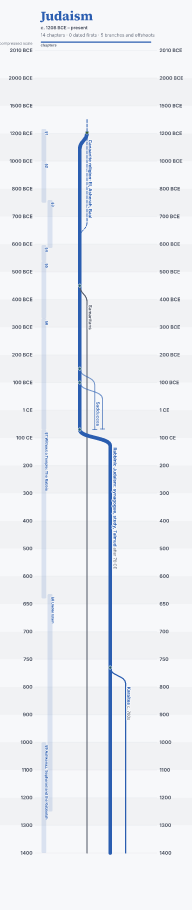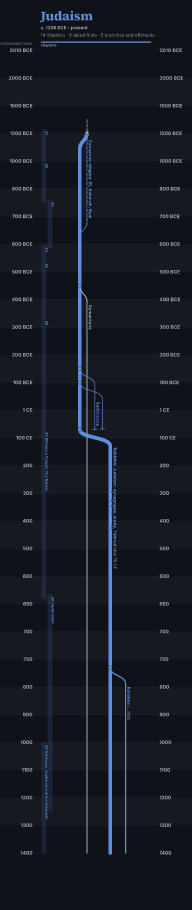
The short version: Judaism has no founder and no founding date that historians can point to; it depends what you count. Jewish tradition begins with Abraham’s covenant and the Torah given to Moses at Sinai, dated in rabbinic chronology to 1313 BCE, while the evidence shows a people called Israel in Canaan by c. 1208 BCE and a religion that became recognisably Judaism in stages, through the Babylonian exile of the sixth century BCE and the Persian period that followed.[1][2][3] The rabbis who rebuilt it after 70 CE gave it the form every modern Jewish movement descends from.
When was Judaism founded?
There is no single date. If “Judaism” means the religion of the Bible’s own story, it starts with Abraham or with Sinai. If it means a religion defined by one God and a written Torah, most historians put its starting point in the sixth to fourth centuries BCE, between the exile and the end of Persian rule. Contested
The difficulty is that the people, the god, the belief in one God, the book and the word “Judaism” each appear at a different time. This series calls the early stages “the religion of Israel and Judah” and keeps “Judaism” for the later ones, while stressing that the continuity between them is real (Judaism §0). The English word itself comes from the Greek Ioudaismos, first found in 2 Maccabees, written in the late second or first century BCE, for the way of life of the Judeans as opposed to Greek ways.[4] Consensus on the text.
Who founded Judaism?
No one person, on the historical evidence. Jewish tradition gives two founding figures, Abraham, who made the covenant, and Moses, who received the Torah, and neither is mentioned in any source outside the Bible. Consensus
Abraham. In Genesis God makes a covenant with Abraham and gives circumcision as its sign. Later Jewish tradition adds that Abraham recognised the one God on his own and broke his father’s idols, a story told in the midrash Genesis Rabbah.[5][6] Historians note that Abraham is barely mentioned in the prophets before the exile, that the genealogy joining Abraham, Isaac and Jacob into one family is probably later, and that the chapter making circumcision the “sign of the covenant” belongs to the Priestly writing, usually dated to the exile and after (Judaism §2, §4). Konrad Schmid has argued that the ancestor stories and the Exodus were once two separate accounts of where Israel came from.[7] Majority
Moses. For most of Jewish history, Sinai has been the founding moment. The Mishnah opens its tractate Avot with the chain of tradition: “Moses received the Torah at Sinai and transmitted it to Joshua”, and on through the prophets to the sages.[8] The rabbinic chronology Seder Olam places Sinai in the year 2448 from Creation, conventionally 1313 BCE.[1] No source outside the Bible mentions Moses, and most historians think his existence cannot be settled either way; some think a leader of a small group that left Egypt lies behind the figure (Judaism §1; see Did the Exodus happen?). Contested A historian can describe the traditional answer but not test it. What a historian can date is the evidence, and it comes in layers.
Where did Judaism originate?
In the central hill country of Canaan, west of the Jordan, where the first Israelite villages appeared around 1200 BCE; and then, as a religion of a book, in Jerusalem and among the exiles in Babylonia. Majority
Around 1200 BCE the highlands went from about 25 inhabited sites to about 250. The settlers’ houses, pottery, language and alphabet were Canaanite, and most archaeologists think they were mostly of local origin, with smaller groups from outside, perhaps including one that remembered Egypt.[9][10][11] Israel’s god may have come from further south. Some of the oldest biblical poems have Yahweh march out of Seir and Edom, and an Egyptian list of c. 1390–1350 BCE names a “land of the Shasu, Yhw” among the nomads of the region, though whether that name is connected to the god is debated.[12][13] Contested For that question, see Where did Yahweh come from?
The later name of the religion comes from the southern kingdom, Judah. Babylonian ration tablets of 592/591 BCE list the captive king Jehoiachin as “king of the land of Yahudu”, the name that, through Hebrew Yehudi, Greek Ioudaios and Latin Iudaeus, gives English “Jew”.[14] Consensus
When did Judaism start? The layers historians date
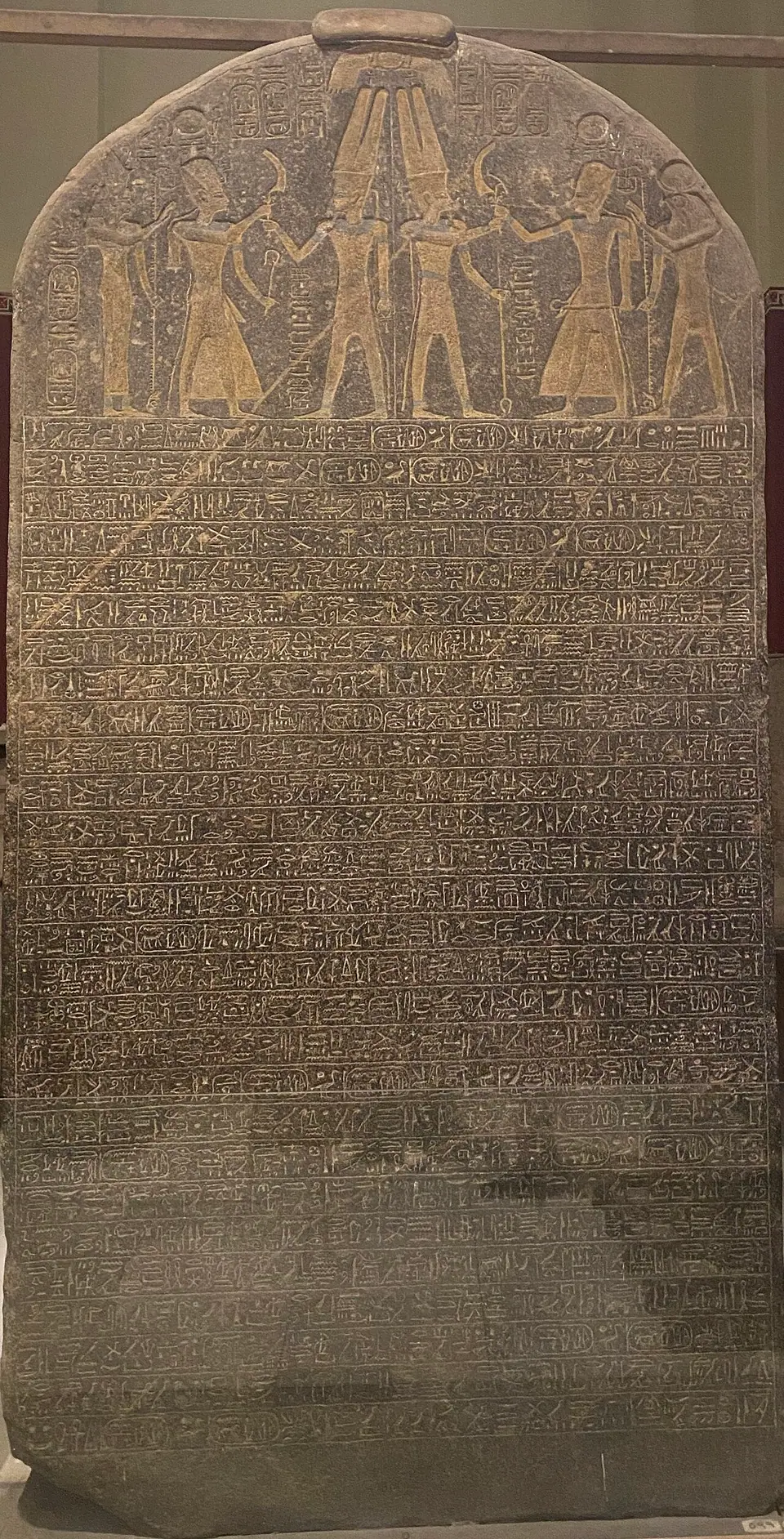
c. 1208 BCE: a people called Israel. The earliest mention of Israel anywhere is on the victory stele of Pharaoh Merneptah: “Israel is laid waste, his seed is not.” The name carries the sign for a people, not a city or a land.[2] The stele says nothing about Israel’s religion or where it came from. Consensus
c. 840 BCE: Yahweh named as Israel’s god. The Moabite king Mesha boasts that he took “the vessels of Yahweh” from the Israelite town of Nebo and dragged them before his own god Chemosh. It is the earliest securely dated mention of Yahweh as a god.[15] In this period Yahweh was worshipped among other gods: around 800 BCE inscriptions at Kuntillet ʿAjrud bless people “by Yahweh of Samaria and his asherah”, and Yahweh had temples in more than one place (Judaism §2).[16] Consensus on the inscriptions; see also Did God have a wife?
622 BCE: Yahweh alone. According to 2 Kings 22–23, a “book of the law” was found in the Temple in Josiah’s eighteenth year, and the king purged Baal, Asherah and the host of heaven from the Temple and banned sacrifice outside Jerusalem.[17][18] Since Wilhelm de Wette in 1805 most scholars have identified the book with an early form of Deuteronomy.[19] This was monolatry, the worship of one god, not yet the claim that no other exists, and how far the reform reached in practice is debated (Judaism §3). Majority on the event.
587/586 BCE and after: exile and one God. Babylon burned Jerusalem and its Temple and deported much of Judah’s elite.[20] The exiles’ religion came to rest on what could be carried: the Sabbath, circumcision and the stories and laws that became the Torah. In the 540s an anonymous prophet whose words were added to the book of Isaiah made the first clear claim that no other god exists: “I am Yahweh, and there is no other”.[21] The chapter on the exile calls what came out of it “recognisably the ancestor of Judaism” (Judaism §4). Majority See When did Judaism become monotheistic?
539–332 BCE: the Torah. Under Persian rule the Temple was rebuilt by about 515 BCE, and priests and scribes gave the five books of the Torah approximately the form they have now. The oldest Torah manuscripts from Qumran, of the third and second centuries BCE, fix the latest date.[7][22] Not every Judean community had the book yet: the Judean garrison at Elephantine in Egypt ran its own temple of YHW in the fifth century and never mentions Moses, the Exodus or a written Torah, which Reinhard Kratz calls a “non-biblical Judaism”.[23] By the time Alexander arrived in 332 BCE there was a book, a temple and a people called Yehudim, and the Persian-period chapter treats that combination as the starting point of Judaism (Judaism §5). Majority See Who wrote the Torah?
70 CE and after: rabbinic Judaism. The Romans burned the Second Temple in 70 CE, ending sacrifice and the priesthood’s central role.[24] The rabbis rebuilt the religion around prayer, the synagogue and the study of Torah, compiling the Mishnah around 200 CE and then the two Talmuds.[25] Every modern form of Judaism descends from their version (Judaism §7). Majority
How old is Judaism?
About 3,200 years if you count from the first mention of Israel, about 2,500 if you count from the exile and the first explicit monotheism, and nearly 2,000 if you count from the rabbis. Tradition counts from Sinai, about 3,300 years ago on the rabbinic chronology. Each is a defensible answer to a different question. Contested
The figure most often quoted, around 4,000 years, comes from placing Abraham around 2000 BCE using the Bible’s own chronology, which was written down many centuries later and cannot be checked against outside evidence (Judaism §1). For how the dates compare with another very old tradition, see Is Judaism older than Hinduism?, and for every contender, What is the oldest religion in the world?
A short timeline
| Date | Event | Confidence |
|---|---|---|
| c. 1208 BCE | “Israel” on the Merneptah Stele[2] | Consensus |
| c. 1200–1000 BCE | Highland villages grow from about 25 sites to about 250[9] | Majority |
| c. 840 BCE | Yahweh named on the Mesha Stele[15] | Consensus |
| 622 BCE | Josiah’s reform; an early Deuteronomy[17] | Majority |
| 587/586 BCE | Jerusalem and the Temple destroyed by Babylon[20] | Consensus (event); Contested (year) |
| c. 550–539 BCE | Second Isaiah: “there is no other”[21] | Majority |
| c. 515 BCE | The Second Temple completed[26] | Majority |
| 5th–4th c. BCE | The Torah takes approximately its final form[7] | Majority |
| Late 2nd or 1st c. BCE | The word Ioudaismos in 2 Maccabees[4] | Consensus |
| 70 CE | The Romans destroy the Second Temple[24] | Consensus |
| c. 200 CE | The Mishnah compiled[25] | Majority |
What scholars disagree about
Whether there was a break at all. Yehezkel Kaufmann argued that Israelite religion was distinct from its neighbours’ from the beginning, so that Judaism’s core is as old as Israel.[27] The majority view is that belief in one God developed in stages and was first stated clearly in the sixth century BCE.[28][3] Tradition reads the Bible’s long struggle against other gods as a falling away from an original faith, not the road towards one (Judaism §4). Majority
Whether “post-exilic Judaism” was a decline. Julius Wellhausen, whose work of 1878 shaped the study of the Torah, drew a sharp line between ancient Israel and the “Judaism” that followed the exile and presented the later stage as a decline into legalism. That judgement is now recognised as a product of nineteenth-century Protestant prejudice and is no longer defended.[29][30] Dating Judaism to the Persian period today carries no such verdict. Consensus
Why the Torah was finished when it was. Peter Frei proposed that Persia authorised the Torah as local law for Yehud; many scholars now think Persian rule created the conditions without commissioning the book, and that priestly and Deuteronomic circles reached a compromise.[31][32][7] Jewish tradition holds that Ezra restored a Torah already given to Moses (Judaism §5). Contested
When “Judean” became “Jew”. Shaye Cohen argues that Ioudaios gained a religious sense in the late second century BCE, when outsiders could join by adopting the god and laws of Judea; Steve Mason argues it meant “Judean” throughout antiquity.[33][34] Contested
Whether rabbinic Judaism was continuity or invention. The rabbis presented their teaching as an unbroken chain from Sinai. Jacob Neusner and Cohen saw a new system built after 70 CE from older material; Seth Schwartz argued it became the norm only in late antiquity (Judaism §7).[35][36][37] Contested
Common misconceptions
- “Abraham founded Judaism around 2000 BCE.” Abraham is the father of the covenant in tradition, but the date comes from biblical chronology, and there is no evidence for him outside the Bible. Historians cannot confirm or rule him out; they can only say the date cannot be checked.
- “Moses founded Judaism at Sinai in 1313 BCE.” That is the rabbinic dating of a revelation, not a historical record. The Torah that tradition ascribes to Moses took approximately its final form in the Persian period, on most scholars’ reading.[7]
- “Judaism was monotheistic from the start.” The earliest inscriptions show Yahweh worshipped alongside other gods and, in some places, with Asherah; the explicit claim that no other god exists comes in the sixth century BCE.[16][21]
- “The Judaism of today is the religion of the Hebrew Bible.” Biblical religion centred on the Temple and its sacrifices; synagogue prayer, Torah study and the Talmud are the rabbis’ rebuilding after 70 CE, from much older tradition.
Why it matters
The question “who founded Judaism?” assumes a religion begins with a founder and a date. Judaism does not fit that shape, and the reason is the most interesting thing about it: it is the religion of a people that existed before its scripture did, and it survived the loss of its kingdom, its land and twice its Temple by making what could be carried, a book, a calendar and a way of life, its centre. Tradition and history agree that its story starts with a covenant people; they disagree about when that people came to understand its God and its Torah as Judaism does now. For the full evidence, start with Israel’s origins in Judaism §1 and follow the series through the exile and the making of the Torah.
References
- ^ a b Seder Olam Rabbah — Seder Olam Rabbah (Hebrew). c. 2nd c. CE (attributed to Yose ben Halafta). Hebrew. The rabbinic chronology from creation to Alexander, on which the traditional Jewish dating of the Exodus to the year 2448 from creation rests. read the text
- ^ a b c Merneptah Stele — Egyptian Museum, Cairo. c. 1208 BCE. Egyptian (hieroglyphic). A victory hymn of Pharaoh Merneptah naming "Israel" as a people: the earliest mention of Israel outside the Bible. about
- ^ a b Mark S. Smith The Early History of God: Yahweh and the Other Deities in Ancient Israel. Eerdmans, 2nd ed., 2002. open library How Israelite religion emerged from its Canaanite setting and became monotheistic.
- ^ a b 2 Maccabees 2:21 — 2 Maccabees. late 2nd–1st c. BCE. Greek. Praises those who fought bravely 'for Judaism' (Ioudaismos): the earliest attestation of the word. read the text
- ^ Gen 17:9–14 — Genesis (Hebrew Bible, Priestly source). c. 6th–5th c. BCE. Hebrew. Circumcision as 'the sign of the covenant' between God and Abraham's descendants. read the text
- ^ Genesis Rabbah 38:13 — Genesis Rabbah. c. 400–500 CE. Hebrew. The midrash of Abraham breaking the idols in his father Terah's shop: the traditional view that monotheism began with Abraham. read the text
- ^ a b c d e Konrad Schmid Genesis and the Moses Story: Israel's Dual Origins in the Hebrew Bible. Eisenbrauns, 2010. The main European alternative: patriarchs and exodus as rival origin stories joined late.
- ^ m. Avot 1:1 — Mishnah. c. 200 CE. Hebrew. Moses received the Torah at Sinai and handed it to Joshua, the elders, the prophets and the men of the Great Assembly. read the text
- ^ a b Israel Finkelstein The Archaeology of the Israelite Settlement. Israel Exploration Society, 1988. The survey data behind the local-origin view: about 250 Iron I hill-country sites where there had been some 25.
- ^ William G. Dever Who Were the Early Israelites and Where Did They Come From?. Eerdmans, 2003. The 'proto-Israelites' as Canaanite farmers resettling the hills.
- ^ Avraham Faust Israel's Ethnogenesis: Settlement, Interaction, Expansion and Resistance. Equinox, 2006. Israelite identity as a process, with an egalitarian ethos shaped against Canaanites and Philistines.
- ^ Judges 5:4–5 — Song of Deborah (Hebrew Bible). c. 1100–900 BCE (debated). Hebrew. Yahweh marches out from Seir and the field of Edom as a storm god; the mountains quake before "the One of Sinai". Among the oldest poems locating Yahweh in the south. read the text
- ^ Soleb temple list, "Land of the Shasu, Yhw" — Temple of Amenhotep III at Soleb, Nubia. c. 1390–1350 BCE. Egyptian (hieroglyphic). Names a land or group of Shasu nomads as Yhw, possibly the earliest trace of the name Yahweh; repeated in a list of Ramesses II at Amara West. Whether it refers to the god is debated. about
- ^ Jehoiachin ration tablets — Ration lists from the Southern Palace, Babylon (VAT 16378 and others). c. 592/591 BCE. Akkadian. Oil rations issued from Nebuchadnezzar's stores to 'Ya'u-kinu, king of the land of Yahudu' and his five sons: King Jehoiachin held at the Babylonian court. about
- ^ a b Mesha Stele — Louvre AO 5066. c. 840 BCE. Moabite. King Mesha of Moab names Omri king of Israel and boasts of taking the vessels of YHWH from Nebo and dragging them before Chemosh: the earliest certain mention of Yahweh outside the Bible. about
- ^ a b Kuntillet ʿAjrud, Pithos A — Kuntillet ʿAjrud inscriptions (Meshel 2012). c. 800 BCE. Hebrew. Blessing written on a storage jar at a Sinai way-station: 'I bless you by Yahweh of Samaria and by his Asherah.' A second jar names 'Yahweh of Teman and his Asherah'. about
- ^ a b 2 Kgs 22:8 — 2 Kings (Hebrew Bible). c. 6th c. BCE. Hebrew. The high priest Hilkiah 'finds the book of the law' in the Temple in Josiah's reign (622 BCE); since de Wette (1805) identified with an early form of Deuteronomy. read the text
- ^ 2 Kings 23:4–7 — Kings (Hebrew Bible). c. late 7th–6th c. BCE. Hebrew. Josiah removes from the Temple the vessels made for Baal, Asherah and the host of heaven, burns the asherah, and destroys the houses where women wove for Asherah. read the text
- ^ Wilhelm Martin Leberecht de Wette Dissertatio critica qua Deuteronomium a prioribus Pentateuchi libris diversum, alius cuiusdam recentioris auctoris opus esse monstratur. Jena, 1805. The doctoral dissertation that identified Josiah's book of the law with Deuteronomy, a later work than the rest of the Torah.
- ^ a b Jer 52:28–30 — Jeremiah (Hebrew Bible). c. 6th c. BCE. Hebrew. Lists three Babylonian deportations, 3,023 in 597, 832 in 587/586 and 745 in 582, 'four thousand six hundred persons in all'. read the text
- ^ a b c Isa 45:1–7 — Isaiah (Hebrew Bible). c. 550–539 BCE. Hebrew. Yahweh calls Cyrus his 'anointed' and declares 'I am Yahweh and there is no other; besides me there is no god ... I form light and create darkness, I make peace and create evil': the Bible's first explicit monotheism. read the text
- ^ Emanuel Tov Textual Criticism of the Hebrew Bible. Fortress Press, 3rd ed., 2012. The standard work on the Masoretic text, Septuagint, Samaritan Pentateuch and Scrolls.
- ^ Reinhard G. Kratz Historical and Biblical Israel: The History, Tradition, and Archives of Israel and Judah. Oxford University Press, 2015. Contrasts the 'non-biblical Judaism' of Elephantine with the biblical Judaism of the Torah.
- ^ a b Josephus, Jewish War 6.236–266 — Jewish War. c. 75–79 CE. Greek. An eyewitness on the Roman side describes Titus's council of war and the burning of the Temple in the summer of 70 CE, claiming Titus wished to spare it. read the text
- ^ a b H. L. Strack and Günter Stemberger Introduction to the Talmud and Midrash. Fortress Press, 2nd ed., 1996. The standard reference on the dates, manuscripts and editions of rabbinic texts.
- ^ Ezra 6:15 — Ezra (Hebrew Bible). c. 4th c. BCE (composition). Aramaic. The house is finished on the third of Adar in the sixth year of Darius, about 515 BCE. read the text
- ^ Yehezkel Kaufmann The Religion of Israel: From Its Beginnings to the Babylonian Exile. University of Chicago Press (trans. Moshe Greenberg), 1960. The classic argument that Israelite religion was monotheistic from the start.
- ^ Mark S. Smith The Origins of Biblical Monotheism: Israel's Polytheistic Background and the Ugaritic Texts. Oxford University Press, 2001. How the divine council of Ugarit shrank into the one God of the Bible.
- ^ Julius Wellhausen Geschichte Israels I (from 1883: Prolegomena zur Geschichte Israels). Reimer, Berlin, 1878. full text The classic Documentary Hypothesis, and the argument that the Priestly law came after the prophets. Its view of post-exilic Judaism as decline is long discarded.
- ^ Jon D. Levenson The Hebrew Bible, the Old Testament, and Historical Criticism: Jews and Christians in Biblical Studies. Westminster/John Knox Press, 1993. A Jewish biblical scholar's essays on the Protestant assumptions, including Wellhausen's, built into historical criticism.
- ^ Peter Frei Zentralgewalt und Lokalautonomie im Achämenidenreich. in P. Frei and K. Koch, Reichsidee und Reichsorganisation im Perserreich (OBO 55), Universitätsverlag Freiburg / Vandenhoeck & Ruprecht, 1984. The original statement of the imperial-authorisation theory.
- ^ Jean-Louis Ska Introduction to Reading the Pentateuch. Eisenbrauns, 2006. Accessible survey of how the Torah was composed, critical of imperial authorisation.
- ^ Shaye J. D. Cohen The Beginnings of Jewishness: Boundaries, Varieties, Uncertainties. University of California Press, 1999. When Ioudaios came to mean a religious identity, and how conversion and matrilineal descent arose.
- ^ Steve Mason Jews, Judaeans, Judaizing, Judaism: Problems of Categorization in Ancient History. Journal for the Study of Judaism 38, 2007. Argues that Ioudaios should be translated 'Judean' throughout antiquity.
- ^ Jacob Neusner Judaism: The Evidence of the Mishnah. University of Chicago Press, 1981. The Mishnah as a utopian system built after the loss of the Temple.
- ^ Shaye J. D. Cohen The Significance of Yavneh: Pharisees, Rabbis, and the End of Jewish Sectarianism. Hebrew Union College Annual 55, 27–53, 1984. Yavneh as a 'grand coalition' that ended sectarianism by tolerating dissent.
- ^ Seth Schwartz Imperialism and Jewish Society, 200 B.C.E. to 640 C.E.. Princeton University Press, 2001. Argues Jewish society largely dissolved after 135 and was rebuilt around synagogues in the Christian empire.