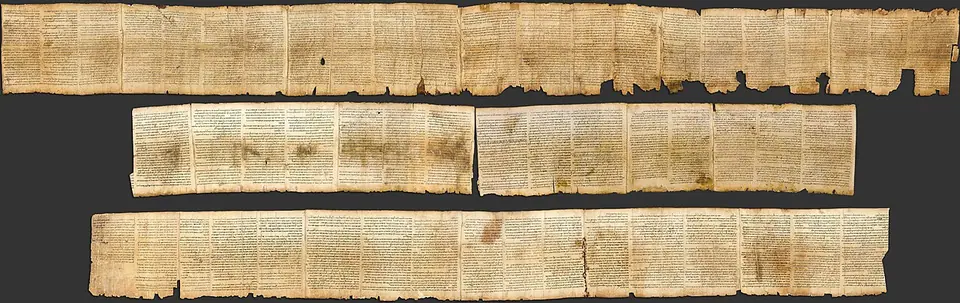
The short version: in stages, over about three centuries, with the decisive step during the Babylonian exile. The Hebrew Bible contains all the stages side by side, because it was written and edited over the whole period, and the final editors kept older texts that assumed other gods existed. Historians distinguish three positions, and the date at which Judaism “became monotheistic” depends on which one is meant.[1][2]
| Position | Meaning |
|---|---|
| Polytheism with a chief god | Several gods exist and are worshipped; one leads them |
| Monolatry | Several gods exist, but this people must worship only one |
| Monotheism | Only one god exists |
Stage one: Yahweh among the gods (was early Israel polytheistic?)
The oldest evidence shows Yahweh as Israel’s chief god, not its only one. Psalm 82 opens with God standing “in the assembly of El”, judging “in the midst of the gods”, and sentencing them to die “like men”.[3] The older reading of Deuteronomy 32:8–9, preserved at Qumran, has the Most High divide the nations among “the sons of God”, with Yahweh receiving Israel.[4] Around 800 BCE travellers at Kuntillet ʿAjrud blessed one another “by Yahweh of Samaria and by his asherah”.[5]
What it proves. In the ninth and early eighth centuries BCE, Israelite religion imagined a heaven with many divine beings, and some Israelites worshipped other deities beside Yahweh. No text of this period says that no other god exists. Consensus
Stage two: Yahweh alone
From the eighth century the demand changes. Hosea, in the northern kingdom, has Yahweh say: “You know no god but me, and besides me there is no saviour.”[6] The first commandment, “You shall have no other gods before me”, forbids worship, not existence.[7] Deuteronomy, whose core most scholars link to King Josiah’s reform of 622 BCE, demands loyalty to Yahweh alone in the language of an Assyrian vassal treaty, and its most famous verse, the Shema, probably meant in its original setting “Yahweh is our God, Yahweh alone”.[8][9] Josiah then removed the vessels of Baal, Asherah and the host of heaven from the Temple.[10]
What it proves. The prophets and reformers of the eighth and seventh centuries demanded exclusive worship. They argued about which gods Israel should worship, not whether other gods existed. Majority
Morton Smith and Bernhard Lang described the people behind this demand as a “Yahweh-alone movement”: a minority of prophets, priests and officials who won royal backing under Hezekiah and Josiah and whose writings shaped the Bible.[11][12][13] Jeremiah 44 shows they did not convince everyone: Judahite refugees in Egypt told the prophet that things had gone well while they made offerings to “the queen of heaven” and badly since they stopped.[14] Majority
Stage three: no other god
Jerusalem fell to Babylon in 587/586 BCE.[15] Among the exiles, an anonymous prophet whose words are preserved in Isaiah 40–55 made a new claim, repeatedly and without qualification:
ʾănî YHWH wĕʾên ʿôd, zûlātî ʾên ʾĕlōhîm
“I am Yahweh, and there is no other; besides me there is no god.”[16]
The same prophet says Yahweh “forms light and creates darkness, makes peace and creates evil” (45:7), and mocks the gods of Babylon as wood and metal carried on pack animals.[17][18] Deuteronomy 4, an exilic addition to the book, says the same in prose: “Yahweh is God; there is no other besides him.”[19][1]
What it proves. This is the first unambiguous denial in the Bible that any other god exists. It answered the crisis of the exile: if Yahweh controls all history, Babylon’s victory was his doing, not his defeat, and the gods of the conquerors are nothing. Majority
Even this was recent enough to leave seams. The same chapter of Deuteronomy says that Yahweh allotted the sun, moon and stars to the other nations to worship (4:19).[19]
The case on each side
In the exile (the majority view). Explicit denials of other gods first appear in Isaiah 40–55 and Deuteronomy 4; everything earlier assumes their existence. Mark Smith, Thomas Römer and Rainer Albertz hold versions of this view.[1][2][20] Majority
Early, from Israel’s beginnings. Yehezkel Kaufmann argued that Israelite religion was different in kind from its neighbours’ from the start, and that the biblical writers did not even understand how polytheism worked. His strongest evidence is onomastic: Jeffrey Tigay found that Hebrew personal names in inscriptions and seals are built on Yahweh by a very wide margin. If Israelites had widely worshipped other gods, more of their children’s names would show it.[21][22] Contested
Never quite, in the Bible. Nathan MacDonald argues that “monotheism”, a word coined in the seventeenth century, misdescribes even Deuteronomy, whose claims are about Yahweh’s uniqueness and Israel’s loyalty rather than a philosophical denial of other divine beings; the Bible’s heaven stays full of angels, the host of heaven and, later, the satan.[23] Peter Hayman made the same point about all of ancient Judaism: its God remained a king ruling a court of powerful heavenly beings.[24] Contested
The traditional account. In rabbinic tradition Abraham recognised the one God and broke his father’s idols; at Sinai all Israel heard the commandment to have no other gods; and the prophets called the people back to what they had always been commanded.[25] On this view the Bible’s long story of Israel turning to other gods is a story of unfaithfulness to an original monotheism, not of the road toward it. Consensus that this is the traditional view.
The traditional and critical readings agree on one point: the Bible itself depicts a long struggle between Yahweh and other gods. They differ on whether it was a falling away from monotheism or the path to it.
Was Judaism the first monotheistic religion?
Probably not the first experiment. In Egypt, the pharaoh Akhenaten (c. 1350–1335 BCE) promoted the exclusive worship of the sun disc, the Aten, and closed the temples of other gods; his reform was reversed after his death.[26] Jan Assmann has traced how the memory of that suppressed revolution resurfaced in later Egyptian and Greek stories about Moses.[27] Some scholars also see a tendency toward a single supreme god in the Zoroastrian Gathas, which present Ahura Mazda as the wise creator; Mary Boyce dated them before 1000 BCE, but their date is disputed and many scholars place them later.[28] Neither became the long-lasting, text-based monotheism that Judaism developed, and there is no evidence that Akhenaten’s reform influenced Israel directly. Majority
Common misconceptions
- “The Ten Commandments teach monotheism.” “You shall have no other gods before me” forbids Israel to worship other gods. It is the classic statement of monolatry, which later readers understood as monotheism.
- “The Shema was always a statement that God is one.” In its seventh-century setting, Deuteronomy 6:4 probably meant that Yahweh alone was Israel’s god; later Jewish tradition read it as a statement of the unity and uniqueness of God, and in that sense it became the centre of Jewish prayer.[8]
- “Monotheism means there are no other spiritual beings.” Jewish monotheism from the Persian period on included angels, named archangels and the satan, all subordinate to God (§5, §6). The satan of Job and the archangel Michael of Daniel serve the one God, and even the rebel angels of 1 Enoch are judged by him.[29][30][31]
Why it matters
Monotheism was the most consequential religious idea to come out of ancient Judah, inherited by Christianity and Islam. Its history shows that it was not a starting point but a conclusion, reached by a small kingdom’s thinkers in the aftermath of their kingdom’s destruction, and that Judaism preserved the earlier stages in its own scripture.
For the exile and Second Isaiah, see Chapter 4: Exile and the Birth of Monotheism. For the prophets and Josiah’s reform, see Chapter 3: The Prophets and the Yahweh-Alone Movement. For Yahweh among the gods, see Chapter 2: Yahweh Among the Gods.
References
- ^ a b c Mark S. Smith The Origins of Biblical Monotheism: Israel's Polytheistic Background and the Ugaritic Texts. Oxford University Press, 2001. How the divine council of Ugarit shrank into the one God of the Bible.
- ^ a b Thomas Römer The Invention of God. Harvard University Press (trans. Raymond Geuss), 2015. Readable account from Yahweh's southern origins to biblical monotheism.
- ^ Psalm 82 — Psalms (Hebrew Bible). c. 8th–6th c. BCE (debated). Hebrew. God stands "in the assembly of El" and judges among the gods, sentencing them to die like mortals: the divine council in session. read the text
- ^ Deuteronomy 32:8–9 (MT, 4QDeutj, LXX) — Song of Moses (Hebrew Bible). c. 8th–6th c. BCE (debated). Hebrew. The Most High divides the nations "according to the number of the sons of God" (Qumran, Septuagint) or "the sons of Israel" (Masoretic text); Yahweh's portion is Israel. Trace of the divine council. read the text
- ^ Kuntillet ʿAjrud, Pithos A — Kuntillet ʿAjrud inscriptions (Meshel 2012). c. 800 BCE. Hebrew. Blessing written on a storage jar at a Sinai way-station: 'I bless you by Yahweh of Samaria and by his Asherah.' A second jar names 'Yahweh of Teman and his Asherah'. about
- ^ Hosea 13:4 — Hosea (Hebrew Bible). c. 750–725 BCE. Hebrew. "You know no god but me, and besides me there is no saviour": the demand for exclusive worship, tied to the Exodus. Monolatry, not a denial that other gods exist. read the text
- ^ Exodus 20:2–3 (cf. Deuteronomy 5:6–7) — Exodus (Hebrew Bible). uncertain; Torah complete by the Persian period. Hebrew. 'I am Yahweh your God, who brought you out of the land of Egypt … You shall have no other gods before me': a ban on worshipping other gods, not a denial that they exist. read the text
- ^ a b Deuteronomy 6:4–5 — Deuteronomy (Hebrew Bible). core 7th c. BCE. Hebrew. The Shema: "Hear, O Israel: Yahweh is our God, Yahweh alone" (or "Yahweh is one"), with the command to love Yahweh with all the heart: exclusive loyalty in the language of treaty. read the text
- ^ Hans Ulrich Steymans Deuteronomium 28 und die adê zur Thronfolgeregelung Asarhaddons: Segen und Fluch im Alten Orient und in Israel. Universitätsverlag Freiburg / Vandenhoeck & Ruprecht (OBO 145), 1995. The detailed case that Deuteronomy 28 adapts Esarhaddon's treaty curses.
- ^ 2 Kings 23:4–7 — Kings (Hebrew Bible). c. late 7th–6th c. BCE. Hebrew. Josiah removes from the Temple the vessels made for Baal, Asherah and the host of heaven, burns the asherah, and destroys the houses where women wove for Asherah. read the text
- ^ Morton Smith Palestinian Parties and Politics That Shaped the Old Testament. Columbia University Press, 1971. The 'Yahweh-alone party' as the minority whose writings became the Bible.
- ^ Bernhard Lang Monotheism and the Prophetic Minority: An Essay in Biblical History and Sociology. Almond Press, Sheffield, 1983. How a minority of prophets turned the worship of Yahweh alone into Israel's religion.
- ^ 2 Kings 18:4 — Kings (Hebrew Bible). composed 7th–6th c. BCE. Hebrew. Hezekiah removes the high places, breaks the standing stones, cuts down the asherah and breaks the bronze serpent Nehushtan "that Moses had made", to which Israelites had been making offerings. read the text
- ^ Jeremiah 44:15–19 — Jeremiah (Hebrew Bible). after 586 BCE. Hebrew. Judahite refugees in Egypt, led by women, refuse to stop offering to "the queen of heaven": things went well while they did, and badly after they stopped. The reform's opponents in their own words. read the text
- ^ Oded Lipschits The Fall and Rise of Jerusalem: Judah under Babylonian Rule. Eisenbrauns, 2005. Archaeology and demography of Judah after 586: continuity in Benjamin, collapse around Jerusalem.
- ^ Isa 45:1–7 — Isaiah (Hebrew Bible). c. 550–539 BCE. Hebrew. Yahweh calls Cyrus his 'anointed' and declares 'I am Yahweh and there is no other; besides me there is no god ... I form light and create darkness, I make peace and create evil': the Bible's first explicit monotheism. read the text
- ^ Isa 44:6–20 — Isaiah (Hebrew Bible). c. 550–539 BCE. Hebrew. 'I am the first and I am the last; besides me there is no god', followed by the satire of the carpenter who cooks over half a log and worships the other half. read the text
- ^ Isa 46:1–2 — Isaiah (Hebrew Bible). c. 550–539 BCE. Hebrew. 'Bel bows down, Nebo stoops': the gods of Babylon carried off as burdens on pack animals. read the text
- ^ a b Deut 4:35, 39 — Deuteronomy (Hebrew Bible). c. 6th c. BCE. Hebrew. 'Yahweh is God; there is no other besides him': an exilic framing of Deuteronomy that also says the heavenly bodies were allotted to the other nations (4:19). read the text
- ^ Rainer Albertz Israel in Exile: The History and Literature of the Sixth Century B.C.E.. Society of Biblical Literature, 2003. The standard full history of the exilic period and its writings.
- ^ Yehezkel Kaufmann The Religion of Israel: From Its Beginnings to the Babylonian Exile. University of Chicago Press (trans. Moshe Greenberg), 1960. The classic argument that Israelite religion was monotheistic from the start.
- ^ Jeffrey H. Tigay You Shall Have No Other Gods: Israelite Religion in the Light of Hebrew Inscriptions. Scholars Press, 1986. Personal names in Hebrew inscriptions: Yahweh dominates by a wide margin.
- ^ Nathan MacDonald Deuteronomy and the Meaning of "Monotheism". Mohr Siebeck, 2003. Argues that 'monotheism' is a modern category that misreads Deuteronomy's claims.
- ^ Peter Hayman Monotheism — A Misused Word in Jewish Studies?. Journal of Jewish Studies 42, pp. 1–15, 1991. doi Argues that Jewish ideas of God stayed 'monarchistic', a king ruling a court of powerful heavenly beings, until the medieval philosophers.
- ^ Genesis Rabbah 38:13 — Genesis Rabbah. c. 400–500 CE. Hebrew. The midrash of Abraham breaking the idols in his father Terah's shop: the traditional view that monotheism began with Abraham. read the text
- ^ Erik Hornung (trans. David Lorton) Akhenaten and the Religion of Light. Cornell University Press, 1999. The standard account of Akhenaten's exclusive cult of the Aten and its reversal.
- ^ Jan Assmann Moses the Egyptian: The Memory of Egypt in Western Monotheism. Harvard University Press, 1997. The Exodus as cultural memory, mirrored in Egyptian traditions.
- ^ Mary Boyce Zoroastrians: Their Religious Beliefs and Practices. Routledge & Kegan Paul, 1979. open library Argues for an early date for Zarathustra; most scholars now place him later, and the range is wide.
- ^ Job 1:6–12 — Job (Hebrew Bible). probably Persian period (debated). Hebrew. 'The satan' comes among the sons of God before Yahweh and, with Yahweh's permission, tests Job: a member of the divine council, not a rebel. read the text
- ^ Daniel 12:1–3 — Book of Daniel (Hebrew Bible). c. 165 BCE. Hebrew. Michael the great prince arises; 'many of those who sleep in the dust of the earth shall awake, some to everlasting life, and some to shame and everlasting contempt': the first clear biblical statement of resurrection and judgment. read the text
- ^ 1 Enoch 1–36 (Book of the Watchers) — 1 Enoch. 3rd c. BCE. Aramaic (surviving complete in Ge'ez). Two hundred Watchers descend to Mount Hermon, father giants and teach forbidden arts; evil comes from fallen angels. Aramaic fragments at Qumran date from the early 2nd c. BCE. about