Buddhism · Timeline · Free to reuse
A timeline of Buddhism, from the Buddha to the present
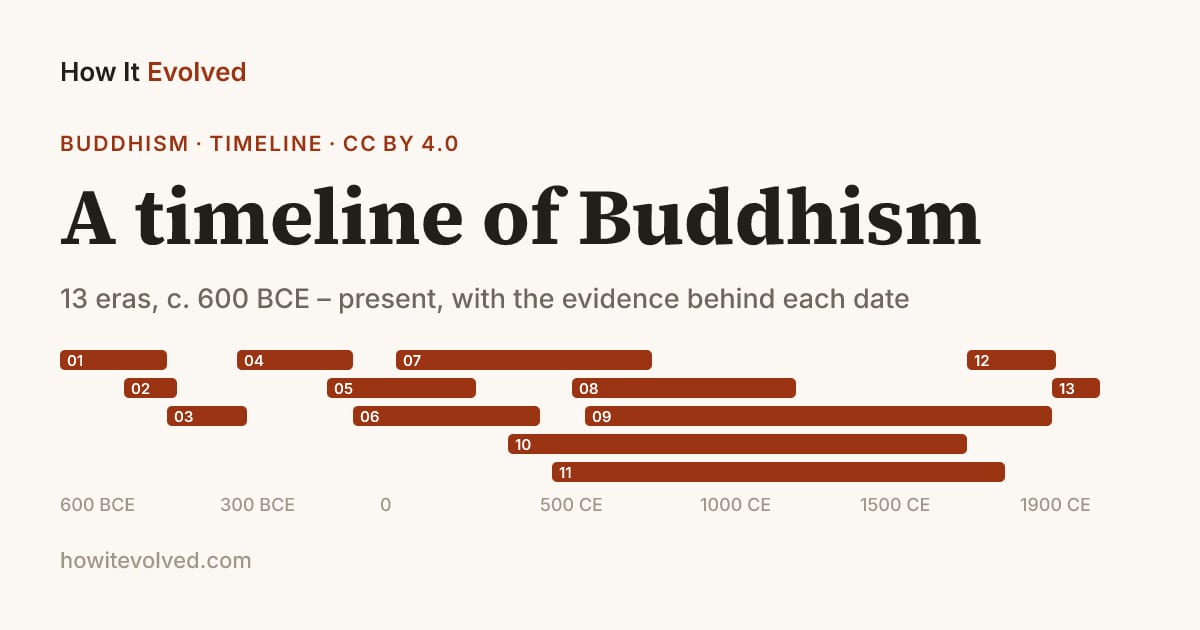
Buddhism's history in 13 eras, from the world the Buddha entered to the global Buddhism of today. Each era is one chapter of the series, shown with its date range, its key takeaways and the 31 dated firsts it argues, from Ashoka's inscriptions to the first Buddha image and the first printed book. Every date is the first datable attestation in the surviving record, and each era links to the chapter that cites the evidence.
Free to embed or reuse under CC BY 4.0. Get the embed code ↓
The whole span
Time axis compressed — each labelled interval gets equal width
Bars overlap where periods do — §9 Tibet, §10 Theravāda and §11 Japan run side by side for over a thousand years, because Buddhism was spreading on several fronts at once.
Era by era
-
c. 600 – 400 BCE Chapter 1 Majority view
The World the Buddha Entered
Cities, coins, clan republics and a crowd of rival ascetics
The middle Ganga plain: Magadha, Kosala, the Vajjī and Malla republics and the Śākya country
- c. 5th c. BCE Renunciation as a recognised way of life. The Buddha joined an existing world of wandering renunciants; leaving home was not his invention. Pali discourses on the śramaṇa field; DN 2 (the six rival teachers)
- c. 4th c. BCE Karma redefined as intention. Karma stops meaning ritual action and becomes a matter of the mind, open to anyone regardless of birth. AN 6.63: "It is intention that I call deeds"
- Buddhism began in the eastern Ganga plain in a new world of cities, coined money and rival kingdoms, roughly 500–400 BCE.
- The Buddha's people, the Śākyas, and their neighbours the Vajjīs and Mallas were clan republics run by assemblies; the Buddhist order borrowed their name and procedures.
- The Buddha was one teacher among many: Jains, Ājīvikas, materialists and sceptics competed for the same lay support.
- According to the Vinaya, monks adopted the rainy-season retreat and fortnightly meetings because other ascetic groups already kept them.
- The Buddha accepted karma and rebirth but redefined karma as intention: "It is intention that I call deeds."
-
c. 480 – 380 BCE Chapter 2 Majority view
The Buddha
What can be known about Gotama of the Sakyas, and how the life story grew
The middle Ganga plain: Kosala, Magadha and the Śākya country at the foot of the Himalaya
- c. 4th–3rd c. BCE Not-self (anattā) and dependent origination. Present in every early school's canon, so probably older than the first splits; how the Buddha himself worded it is less certain. Core shared by the Pali Nikāyas and the Chinese Āgamas
- c. 4th–3rd c. BCE The four noble truths as a set formula. Shared by all early schools, but K. R. Norman argued from its grammar that the formula in the first sermon is a later insertion. SN 56.11 and its parallels (the first sermon)
- c. 249 BCE A line of past Buddhas. An emperor is already building for an earlier Buddha, the belief the four-sights story later depends on (enlarged c. 255, recorded c. 249). Nigali Sagar pillar (stupa of Konākamana enlarged)
- c. 1st–2nd c. CE A complete life of the Buddha. The palace, the four sights and the midnight departure appear as one connected story some five centuries after the Buddha. Aśvaghoṣa, Buddhacarita
- The Buddha probably died around 400 BCE, give or take twenty years; the traditional 544 BCE and the textbook 483 BCE are both older reckonings.
- Ashoka worshipped at Lumbini c. 249 BCE "because here the Buddha was born": the earliest dated evidence for the Buddha as a person tied to a place.
- The Śākyas were a clan governed by an assembly and subject to Kosala; the palace, the four sights and the midnight flight are later layers of the story.
- In the oldest account of his leaving home, he goes in daylight while his parents weep, and the four sights are told about a different, earlier Buddha.
- The early texts allow monks to eat meat they did not see, hear or suspect was killed for them, and the Buddha refused to make vegetarianism a rule.
-
c. 400 – 250 BCE Chapter 3 Majority view
The Early Saṅgha, the Councils and the First Split
How a community of renunciants kept a teaching in memory, argued about rules, and divided
Rājagaha, Vesālī and Pāṭaliputra in the middle Ganga plain
- c. 5th–4th c. BCE A fortnightly code of monastic rules (pātimokkha). Every school's list agrees on the serious offences and differs mainly in minor rules, which is why schools could split over discipline without splitting over doctrine. Vinaya of all schools; Mahāvagga 2 (the uposatha)
- c. 5th–4th c. BCE An order of nuns. The order is early; the eight 'heavy rules' and the prediction of decline in its founding story are probably later additions. Vinayas of all schools; AN 8.51
- c. 300–250 BCE Monastic schools and schism. The first split was probably over monastic discipline, not doctrine; its cause and date are disputed. Sthavira–Mahāsāṃghika split; Ashoka's schism edicts
- The early saṅgha kept the Buddha's teaching alive by group recitation, with specialist reciters (bhāṇaka) for each collection; inscriptions at Bharhut name such reciters as donors.
- The First Council at Rājagaha is best read as a founding story; the Second Council at Vesālī, about a hundred years after the Buddha, is more plausibly historical and was about monastic rules, including handling money.
- The first split, between the Sthaviras and the Mahāsāṃghikas, was possibly over the Vinaya rather than doctrine.
- The 'Third Council' under Ashoka appears only in Theravāda sources and reflects that school's later self-understanding.
- The nuns' order is old, but the eight 'heavy rules' and the prediction that women would shorten the teaching's life are probably later additions to its founding story.
-
c. 268 – 50 BCE Chapter 4 Majority view
Ashoka and the Making of a Pan-Indian Religion
An emperor's inscriptions, the legend that grew around him, and the stupas where lay Buddhism took shape
The Mauryan empire, from Afghanistan to Karnataka; then central India under the Śuṅgas
- c. 3rd–2nd c. BCE Relics enshrined in stupas. Relic worship is as old as the canon's account of the Buddha's death; Ashoka made it empire-wide. DN 16 (eight shares of relics); Piprahwa vase inscription
- c. 125–75 BCE The Buddha shown by symbols, not in human form. Seats, trees, footprints and wheels mark his presence; whether this was a deliberate rule is argued over. Bharhut railing reliefs, with labels
- Ashoka's own inscriptions say he became a Buddhist lay follower after the Kalinga war and grew zealous only after he drew near to the saṅgha.
- His public dhamma was ethical rather than doctrinal, and his Greek inscription translates it as 'piety', so how Buddhist his policy was is still argued.
- The legends of 84,000 stupas, a hell-prison and the killing of 99 brothers come from texts written four to eight centuries after him.
- Sri Lankan chronicles send missionaries across Asia under Ashoka; relic caskets at Sanchi name two of them, but Ashoka himself never mentions sending monks.
- For about two centuries Buddhist art showed the Buddha only through seats, trees, footprints, wheels and stupas; whether this was a rule of absence is debated.
-
c. 100 BCE – 300 CE Chapter 5 Majority view
Writing It Down
Gandhāra, Sri Lanka and the first Buddha images
Gandhāra and Kashmir in the northwest, Mathurā on the Yamunā, and Anurādhapura in Sri Lanka
- c. 1st c. CE Abhidharma: systematic scholastic analysis. Each school builds its own system, which is why Abhidharma, unlike the discourses, does not match across schools. Abhidharma texts among the Gāndhārī scrolls
- c. 127–150 CE The Buddha in human form. The oldest image explicitly named as the Buddha; figures at Gandhāra and Mathurā may be somewhat earlier. Kaniṣka's gold coins labelled ΒΟΔΔΟ
- In Sri Lanka the canon was written down in a crisis of war and famine, and two rival monasteries at Anurādhapura then argued for a thousand years over which texts were authentic.
- Greek and Kushan kings of the northwest patronised Buddhism; the Indo-Greek king Menander became the questioner of the Milindapañha.
- The Buddha first appears in human form in the first century CE; Kaniṣka's coins, labelled ΒΟΔΔΟ, carry the oldest image explicitly named as the Buddha.
- Gandhāra and Mathurā both produced early Buddha images, in different styles, at about the same time; which came first is still argued.
- Abhidharma, the systematic philosophy of the schools, took shape in these centuries and differs from school to school.
-
c. 50 BCE – 500 CE Chapter 6 Contested
The Mahāyāna Turn
The bodhisattva path, the new sūtras and the argument about where they came from
Gandhāra and the northwest; Mathurā; Āndhra in the Deccan; the Central Asian routes
- c. 1st c. CE The bodhisattva path recommended to others. The oldest Mahāyāna manuscript is nearly as old as the oldest physical Buddhist texts of any kind. Split collection Aṣṭasāhasrikā (radiocarbon c. 47–147 CE)
- c. 1st c. CE Emptiness (śūnyatā) of all things. Nāgārjuna identifies emptiness with dependent origination, turning a sūtra theme into a philosophy. Perfection of Wisdom sūtras; later Nāgārjuna (c. 150–250)
- c. 153 CE Amitābha and a Pure Land. Amitābha does not reappear in Indian inscriptions for centuries; his cult found its audience in East Asia. Govindnagar pedestal, Mathurā; Lokakṣema's 179 CE translation naming Amitābha
- by 286 CE One vehicle and skilful means. The earlier paths are recast as provisional; all three carts in the burning house become one. Lotus Sūtra (Dharmarakṣa's Chinese translation)
- c. 4th–5th c. CE Mind-only (Yogācāra). Experience is explained as representation only, a second great Mahāyāna philosophy beside Madhyamaka. Asaṅga and Vasubandhu; Viṃśatikā
- Mahāyāna began as a vocation, the path of the bodhisattva who aims at full Buddhahood, followed by monks living in ordinary monasteries under ordinary monastic rules.
- The oldest Mahāyāna manuscript, a Gāndhārī Perfection of Wisdom on birch bark, dates to about the first century CE; a Chinese translation of the same text is dated 179 CE.
- In Indian inscriptions Mahāyāna is almost invisible until the fourth and fifth centuries; the one early exception is an Amitābha pedestal from Mathurā of about 153 CE.
- Where Mahāyāna came from is contested: a lay stupa cult, forest ascetics, a cult of the written book and a movement of preachers have all been proposed.
- Nāgārjuna (c. 150–250 CE) equated emptiness with dependent origination; Yogācāra (4th–5th c.) and Buddha-nature teaching followed.
-
c. 50 – 850 CE Chapter 7 Majority view
Into China
Translation and transformation, from a Han prince's offerings to the Tang purge of 845
The Silk Road oases, Luoyang and Chang'an, the southern capital at Jiankang; Korea, Japan and Vietnam
- 421 CE Buddha-nature in every being. A minority teaching in India that became a basic assumption of Chinese Buddhism and of Chan. Dharmakṣema's Mahāparinirvāṇa Sūtra; Tathāgatagarbha texts
- 510s–520s Monastic vegetarianism. The early Vinaya allowed meat under conditions; Chinese monasticism made abstention the rule. Emperor Wu of Liang's decree against meat and wine
- 732 A Chan lineage of patriarchs. The genealogy back through Bodhidharma to the Buddha is assembled in Tang China; the 547 Bodhidharma knows nothing of it. Shenhui's attack on the "Northern school" at Huatai
- 868 Printed scripture. The oldest complete dated printed book, made to spread merit by spreading the text. Dunhuang Diamond Sūtra
- Buddhism is first securely attested in China in 65 CE, when an imperial edict mentions a Han prince who honoured the Buddha alongside Huang-Lao and fed monks and lay followers.
- For two centuries Chinese read Buddhism through Daoist vocabulary; scholar-monks such as Dao'an and the translator Kumārajīva (in Chang'an from 401) worked to correct that.
- Chinese Buddhists also composed scriptures of their own: the Awakening of Faith is almost certainly Chinese, and the Heart Sūtra may be.
- Chan's line of patriarchs from Bodhidharma to Huineng was built in the eighth century; Dunhuang manuscripts show the Platform Sūtra being rewritten.
- Monastic vegetarianism in China rests on imperial decrees by Emperor Wu of Liang in the 510s–520s, not on the early Indian rules.
- In 845 the Tang court destroyed some 4,600 monasteries and returned 260,500 monks and nuns to lay life; Chan and Pure Land survived best.
-
c. 600 – 1300 CE Chapter 8 Majority view
Tantra and the Last Age of Indian Buddhism
The monastery-universities, the Vajrayāna, and the end of Buddhism's Indian institutions
Bihar and Bengal under the Pālas; Odisha; Kashmir and the northwest; the Kathmandu valley
- before 674 Esoteric ritual: mantra, maṇḍala, initiation. Tantric Buddhism develops inside the great monasteries, not on their margins. Mahāvairocana Sūtra; Sarvatathāgatatattvasaṃgraha (late 7th c.)
- c. 1025–1040 The Kālacakra and its end-time war. The last major Indian tantra, with a detailed and hostile account of Islam. Kālacakra Tantra and the Vimalaprabhā
- Nālandā was founded in the fifth century CE under the Guptas, not in the Buddha's time; it grew into a monastery-university supported by the revenue of some two hundred villages.
- Tantric Buddhism developed between about 600 and 1050 CE inside the great monasteries, from spells and ritual manuals to the transgressive yoginī tantras and the Kālacakra.
- Ronald Davidson reads esoteric Buddhism as a mirror of medieval feudal kingship; Alexis Sanderson has shown that some Buddhist tantras adapt long passages of Śaiva scripture.
- The Kālacakra Tantra, composed c. 1025–1040, names Muhammad and predicts a final war with the followers of Islam.
- Turkic raids around 1200 destroyed the last great monasteries of Bihar and Bengal, but Nālandā was still teaching about seventy monks in 1235.
-
c. 640 – 1950 CE Chapter 9 Majority view
Tibet: The Second Home
From an imperial cult to the land of lamas, c. 640–1950
The Tibetan plateau: Central Tibet (Ü-Tsang), western Tibet (Ngari), Amdo and Kham; and Mongolia
- 13th c. Recognised reincarnate lamas (tulku). Succession by rebirth becomes a Tibetan institution; the Dalai Lamas follow the pattern. Karma Pakshi recognised as Düsum Khyenpa's rebirth
- 1578 The title Dalai Lama. A Mongol title, applied retroactively to two predecessors; political rule follows in 1642. Altan Khan's title for Sonam Gyatso
- Buddhism became a state religion in Tibet under Trisong Detsen in the late eighth century, with the founding of Samye monastery around 779.
- The famous stories of Songtsen Gampo's Buddhist queens and Padmasambhava's conquest of Tibet's demons were written down centuries after the events.
- After the empire collapsed in 842, Buddhism survived locally; the monastic schools of Tibet grew out of an eleventh-century revival with new Indian teachers.
- The title Dalai Lama was given by the Mongol ruler Altan Khan in 1578; the Fifth Dalai Lama became ruler of Tibet in 1642 with Mongol troops.
- Whether Tibet was part of China or an independent state in the Qing and Republican periods is a political dispute, and the evidence is read in opposite ways.
-
c. 400 – 1800 CE Chapter 10 Majority view
Theravāda and Southeast Asia
How one Sri Lankan lineage became the Buddhism of the mainland
Sri Lanka, Burma, the Thai kingdoms, Laos and Cambodia, with Java and Sumatra for contrast
- Theravāda Buddhism as practised today rests less on the Pali canon alone than on the fifth-century commentaries of Buddhaghosa and his successors.
- Sri Lanka had rival monastic fraternities for a thousand years; King Parākramabāhu I merged them under the Mahāvihāra around 1165.
- Early Southeast Asia was religiously mixed: Borobudur is Mahāyāna and Angkor was Hindu and Mahāyāna before it turned Theravāda in the 13th–14th centuries.
- Theravāda spread to Burma, Thailand, Laos and Cambodia mainly through Sri Lankan ordination lineages backed by kings, between the 11th and 15th centuries.
- "Theravāda Buddhism" as the name of a branch of Buddhism is modern; before the 20th century it named a lineage of elders, not a denomination.
-
c. 538 – 1872 CE Chapter 11 Majority view
Japan and the Kamakura Reformations
From state temples to single practices, and from the danka registry to married priests
Yamato and Nara; Heian (Kyoto) and Mount Hiei; Kamakura; the provinces
- 1175 Exclusive nembutsu: reliance on Amida's vow. Hōnen makes reciting Amida's name the one sufficient practice; Shinran later grounds birth in the Pure Land in faith alone, and a married clergy follows. Hōnen's exclusive nembutsu; Shinran after him
- Buddhism reached the Japanese court from the Korean kingdom of Paekche in the mid-sixth century; the two traditional dates, 538 and 552, both come from texts compiled much later.
- For its first five centuries Japanese Buddhism was largely a state religion of rituals for the protection of the realm, culminating in Tōdaiji's Great Buddha (752).
- Hōnen, Shinran, Dōgen and Nichiren each reduced practice to one essential act: reciting Amida's name, entrusting oneself to it, sitting in meditation, or chanting the title of the Lotus Sūtra.
- Kuroda Toshio argued that these 'new' Kamakura schools stayed marginal for two or three centuries while the old Tendai, Shingon and Nara establishments dominated.
- Under the Tokugawa every household had to register at a Buddhist temple; in 1868 the Meiji state separated buddhas from kami, and in 1872 it stopped enforcing clerical celibacy.
-
c. 1800 – 1956 CE Chapter 12 Majority view
Colonial Encounter and Buddhist Modernism
How Europe named Buddhism, and how Asian reformers turned the name into a modern religion
Ceylon, Burma, Siam, Japan, China and India, with London, Paris and Chicago
- 1801 "Buddhism" as a single world religion. The word and the category are European; Buddhists spoke of the Buddha's teaching or dispensation. "Boudhism" in Asiatic Researches
- c. 1900–1923 Meditation as a practice for lay people. Insight meditation moves from the monastery to the laity, the root of the Western insight movement. Ledi Sayadaw's manuals in colonial Burma
- 1956 Navayāna: Buddhism as social liberation. A Buddhism that rejects caste and reinterprets karma and rebirth, embraced by hundreds of thousands in a day. Ambedkar's conversion at Nagpur and his 22 vows
- "Buddhism" is a European word, first printed as "Boudhism" in 1801; Europeans built the idea of one religion out of traditions that had seldom thought of themselves that way.
- Western scholars prized the Pali texts as a rational ethic and treated living Asian practice as decline from them.
- Asian reformers used that picture: Olcott and Dharmapāla in Ceylon, Mongkut in Siam, Ledi Sayadaw in Burma, Taixu in China and Suzuki in Japan all remade Buddhism to answer colonial and missionary pressure.
- Meditation for ordinary lay people became a mass practice in colonial Burma; for most of Buddhist history it was a specialist monastic pursuit.
- On 14 October 1956 Ambedkar and several hundred thousand followers converted at Nagpur, re-founding Buddhism in India as a movement against caste.
-
c. 1950 – 2026 CE Chapter 13 Majority view
Global and Contemporary Buddhism
Exile, the state, nationalism, converts, mindfulness and nuns since 1950
Asia, where 98 percent of Buddhists live, and the diasporas and converts of India, Europe, North America and Australia
- 1979 Secular mindfulness. Buddhist-derived attention training repackaged for medicine, detached from ethics and rebirth. Kabat-Zinn's Stress Reduction Clinic (MBSR)
- In July 2025 the Dalai Lama said the institution will continue and only his own trust may recognise his successor; Beijing says the choice needs a golden urn and its approval.
- Pew counts about 324 million Buddhists in 2020, down from 343 million in 2010: the only major religious group to shrink, mainly through disaffiliation and ageing in East Asia.
- Ambedkar's 1956 conversion created a new Indian Buddhism; most of India's 8.4 million Buddhists (2011 census) live in Maharashtra and come from Dalit families.
- Secular mindfulness began in a Massachusetts hospital clinic in 1979 and draws largely on the lay meditation movements of colonial Burma, not on ancient lay practice.
- Theravāda nuns' ordination was restarted in 1996–98 and is still not recognised by the state monastic hierarchies of Thailand or Myanmar.
How to read the dates
Era boundaries are the chapters' own ranges, and they are approximate; several overlap because the changes did. A date beside an idea is its first datable appearance, which is not the same as the date it began: Buddhist texts were recited for centuries before anyone wrote them down. The confidence tag on each era says how settled its evidence is. The dating methods are set out in How we know.
Embed or reuse this timeline
Teachers, students, writers and site owners may copy, adapt and republish this timeline, including commercially, under the Creative Commons Attribution 4.0 licence. The only condition is credit: name How It Evolved (howitevolved.com) and link back to this page. Photographs elsewhere on the site keep their own licences.
Embed code
<iframe src="https://howitevolved.com/embed/buddhism-timeline/" title="Timeline of Buddhism, c. 600 BCE to the present" width="100%" height="720" style="border:1px solid #e2dace;border-radius:8px;max-width:760px" loading="lazy"></iframe>
<p style="font-size:13px">Timeline: <a href="https://howitevolved.com/buddhism/timeline/">A timeline of Buddhism</a> by <a href="https://howitevolved.com/">How It Evolved</a>, licensed <a href="https://creativecommons.org/licenses/by/4.0/">CC BY 4.0</a>.</p>The embedded version is a plain page with no ads and no tracking, and it updates when the chapters do. Preview it.
Image version
1200 × 630 JPEG. Credit: How It Evolved (howitevolved.com), CC BY 4.0.