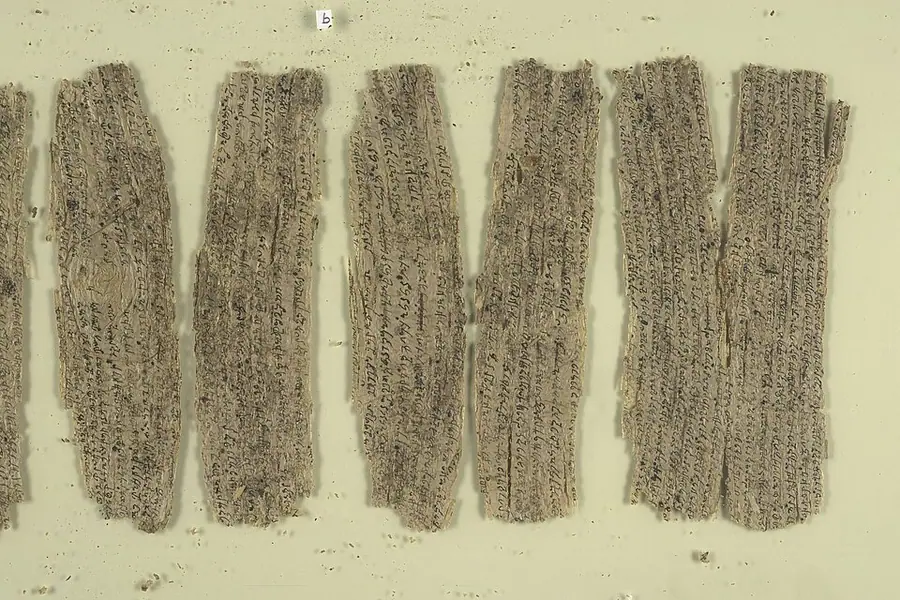
The Buddha wrote nothing. Neither did anyone who heard him. For at least two centuries after his death his teaching existed only in the memories of monks and nuns who recited it to one another, and the first time a Buddhist text can be seen as a physical object is on birch bark in Gandhāra, around the turn of the era.[1][2] Every later page of this series makes claims about what came before that. This one explains how those claims are made and where they stop.
The short answer: early Buddhism is reconstructed by comparing parallel versions of the same texts preserved by different schools in different languages, and by tying them to a small set of firm dates. Ashoka’s inscriptions (c. 250 BCE) are the first dated Buddhist evidence. Gandhāran manuscripts (first century BCE onward) are the first physical texts. Chinese translations carry their own dates (the earliest Mahāyāna one is from 179 CE).[3] Archaeology at Lumbini and other sites adds what the texts leave out. No single method is decisive. Where they agree, this series says so; where they do not, it says that too.
The problem: a teaching kept in memory
The canon describes itself as recited, not written, and so the first fact about every early Buddhist text is that it is the end product of a long oral transmission.
The tradition’s own account is the First Council at Rājagaha, held soon after the Buddha’s death, where Ānanda recited the discourses and Upāli the monastic rules. Most historians treat that council as a founding story rather than an event, but the picture it gives of the process is accurate: the texts were held by groups of specialist reciters (bhāṇaka), each responsible for one collection, and kept stable by communal recitation (§3).[4][5][1]
Oral transmission leaves marks that are still visible in the texts:
- Repetition. Stock passages recur word for word across hundreds of discourses, and lists are everywhere: the four truths, the five aggregates, the eight path factors, the twelve links. These are memory aids, not padding.[6]
- Formulaic frames. Nearly every discourse opens evaṃ me sutaṃ, “thus have I heard,” and places the Buddha at a named town or park. The frame gives the reciter a location to hang the text on.
- Variation in the details. The same teaching can appear with different settings, different audiences or a different number of items in a list. That is what independent oral lines produce.[6][7]
Writing came late. Indian writing is not securely attested before Ashoka (c. 250 BCE), apart from contested finds at Anuradhapura in Sri Lanka, and there is no sign that monks wrote down texts for some time after it became available.[8][9][10] Consensus The question is not whether the canon was transmitted orally, but how well.
Three canons, many languages
No single “original” Buddhist canon survives. What survives is several partial canons of different early schools, preserved in different languages, which can be compared.
| Collection | Language | School | How it reaches us |
|---|---|---|---|
| Pali Tipiṭaka (Sutta, Vinaya, Abhidhamma) | Pali | Theravāda (Mahāvihāra, Sri Lanka) | The only complete early canon in an Indian language; manuscripts mostly 18th–19th c.[11] |
| Chinese Āgamas | Classical Chinese | Dharmaguptaka, Sarvāstivāda, others | Four collections translated 384–443 CE from Indian originals now lost[7] |
| Sanskrit fragments | Buddhist Sanskrit | Sarvāstivāda, Mūlasarvāstivāda | Manuscripts from Central Asia (Turfan), Gilgit and Bamiyan |
| Gāndhārī scrolls | Gāndhārī | Dharmaguptaka and others | Birch-bark scrolls from Gandhāra, 1st c. BCE–3rd c. CE[2] |
| Tibetan Kangyur | Classical Tibetan | Mūlasarvāstivāda Vinaya and later texts | Translated mostly 8th–13th c. CE |
The Pali canon is the best known in the West, partly for an accident of history: it was the first complete early canon European scholars could read in an Indian language, and the Pali Text Society was founded in 1881 to publish it.[12] That gave it an authority it never claimed for itself. It is one school’s canon, closed and written down in Sri Lanka, with its own later additions.[11]
The Chinese Āgamas are the essential counterweight. The four collections correspond to the four main Pali Nikāyas: the Dīrgha Āgama to the Dīgha Nikāya, the Madhyama to the Majjhima, the Saṃyukta to the Saṃyutta and the Ekottarika to the Aṅguttara. They were translated from the canons of other schools, mostly the Dharmaguptakas and Sarvāstivādins, which split from the ancestors of the Theravāda in the third and second centuries BCE.[7] Consensus
The comparative method: what all versions share
Material that appears in the Pali Nikāyas, the Chinese Āgamas and the Gāndhārī or Sanskrit fragments is probably older than the split between the schools that preserved them. Material found in only one version is probably later.[7][13]
This is the most important tool in the field, and it works the same way as comparing manuscripts of any ancient text. If two schools that separated in the third century BCE both preserve the same discourse with the same core argument, the simplest explanation is that the discourse existed before they separated.
The classic demonstration is the Mahāparinibbāna Sutta, the account of the Buddha’s last months. Ernst Waldschmidt printed its Sanskrit and Tibetan versions in parallel with the Pali, together with a German translation of the Chinese, in 1950–51. They agree on the outline: the journey north, the last meal, the death at Kusinārā, the division of the relics. They disagree on episodes and speeches, which accumulate in some versions and not others.[14][15] Bhikkhu Anālayo has since done the same for every discourse in the Majjhima Nikāya and its parallels.[7]
The results point in a consistent direction:
- The doctrinal core is shared. The four noble truths, dependent origination, the five aggregates, not-self, the eightfold path and the four meditative absorptions (jhāna) appear across the schools in recognisably the same form.[13][7] Consensus
- The Vinaya rules are mostly shared. The schools’ lists of monastic rules (pātimokkha) agree on the serious offences and differ mainly in the minor rules of etiquette, which is why schools could split over discipline without splitting over doctrine (§3).[16] Consensus
- Narrative grows. Biography, miracle and cosmology expand from version to version. The life of the Buddha is the clearest case (§2).[14][5] Consensus
- Abhidharma does not match. Each school’s systematic philosophy is its own, which is why the Abhidharma is dated after the splits.[17] Consensus
The limit. Agreement shows a text is pre-sectarian, which means roughly before the third century BCE. It does not show the Buddha said it. The shared core could have been shaped during the century or more between his death and the first schism. How much of the core goes back to the Buddha himself is the real argument, and it is taken up below.[13][18] Majority
The language problem: Pali was not the Buddha’s dialect
The Buddha taught in the eastern Ganga plain, probably in a local Middle Indo-Aryan dialect. Pali is a literary language with a more western character, and the canon shows signs of having been translated into it.[11][1]
Two kinds of evidence point the same way:
- Eastern forms left behind. Scattered through the Pali canon are forms typical of eastern dialects, such as nominative singulars in -e where Pali normally has -o. Linguists since Heinrich Lüders have read these as fossils of an older eastern version that was translated into Pali but not completely.[1][11] Majority
- The tradition’s own name. Pāli originally meant “text,” the canonical line as opposed to the commentary. Theravāda tradition later called the language Māgadhī, the speech of Magadha, and identified it with the Buddha’s own. Linguists do not accept the identification.[1][11] Consensus
One Vinaya passage is often quoted on the question. Two monks of brahmin family complain that monks of different backgrounds are corrupting the Buddha’s words with their own dialects, and propose putting them into Vedic-style metre (chandaso). The Buddha refuses:
anujānāmi bhikkhave sakāya niruttiyā buddhavacanaṃ pariyāpuṇitun ti.
“I allow you, O Bhikkhus, to learn the word of the Buddhas each in his own dialect.” (trans. T. W. Rhys Davids and Hermann Oldenberg, 1885)[19][20]
What it proves. That early Buddhists thought about language and refused to sacralise one. The exact meaning of sakāya niruttiyā is disputed: Buddhaghosa read it as “in the Buddha’s own language,” which he took to be Māgadhī, while most modern scholars read it as “in each person’s own dialect.” Some recent translators follow Buddhaghosa: Bhikkhu Brahmali renders the ruling “You should learn the word of the Buddha using its own expressions.”[19] Either way the contrast with Vedic religion is sharp. The Veda was preserved syllable by syllable in one sacred language; Buddhism allowed translation from the start, and that is part of why it could later move across Asia.[1] Majority
Manuscripts: the oldest physical Buddhist texts
The oldest Buddhist manuscripts anywhere are birch-bark scrolls from Gandhāra, in today’s northwest Pakistan and eastern Afghanistan, written in the Gāndhārī language and Kharoṣṭhī script between about the first century BCE and the second century CE.[2]
Until 1994 the earliest Buddhist manuscripts known were Sanskrit fragments from Central Asia, several centuries younger. That year the British Library acquired twenty-nine birch-bark fragments that had been buried inside an inscribed clay pot, probably in eastern Afghanistan. Richard Salomon dated them to about the first century CE on grounds of script and language.[21] More collections followed: the Senior scrolls, the Bajaur collection (found in 1999) and the Split collection. Together they comprise dozens of scrolls, the oldest Indian manuscripts of any kind then known.[2] Consensus
The scrolls show three things that the later canons could not:
- Early texts existed in more than one language. One British Library fragment is a Gāndhārī version of the Rhinoceros Sūtra, the poem known in Pali as the Khaggavisāṇa Sutta (Sutta Nipāta 1.3). Its verses correspond closely to the Pali but are not a translation of it.[22][21] The Pali canon was one version among several. Consensus
- Schools had their own collections. The pot that held the British Library scrolls is inscribed as a gift to the Dharmaguptakas, one of the early schools whose Vinaya and Dīrgha Āgama survive in Chinese.[21] Majority
- Mahāyāna texts are almost as old as the earliest physical texts. A Split collection manuscript of the Perfection of Wisdom in 8,000 Lines (Aṣṭasāhasrikā Prajñāpāramitā) has been radiocarbon dated to roughly 47–147 CE.[23][24] Physically, Mahāyāna sūtras and early discourses appear in the record at nearly the same time, though most scholars still hold that the discourses are older (§6). Consensus on the date
The Gandhāran finds have a provenance problem that should be stated plainly. Almost none came from a controlled excavation. They reached the antiquities market from a border region at war, and their exact findspots are reported, not known. That affects what can be said about where they were used, not whether they are genuine or how old they are.[2]
The Pali manuscripts are much younger. The tropical climate of Sri Lanka and Southeast Asia destroys palm leaf, so almost every Pali manuscript is from the eighteenth or nineteenth century.[11] The oldest known is four Vinaya folios in the National Archives in Kathmandu, copied in the eighth or ninth century.[25][26] Older than any of them are twenty gold leaves inscribed with Pali passages, buried in a reliquary at the Pyu city of Śrī Kṣetra in Myanmar around the fifth or sixth century.[27] Consensus
When the Pali canon was written down
Sri Lanka’s chronicles say the Pali canon and its commentary were written down in the reign of Vaṭṭagāmaṇi Abhaya, in the first century BCE, after a period of famine and war.[28][29] The chronicles do not name the place; the Sinhala Pūjāvaliya (thirteenth century) and Nikāya Saṅgrahaya (fourteenth) put it at the Aluvihāra monastery.[1]
The oldest chronicle, the Dīpavaṃsa, gives the event in two verses:
piṭakattayapāḷiñ ca tassā aṭṭhakatham pi ca mukhapāṭhena ānesuṃ pubbe bhikkhū mahāmatī || hāniṃ disvāna sattānaṃ tadā bhikkhū samāgatā ciraṭṭhitatthaṃ dhammassa potthakesu likhāpayuṃ ||
“Before this time, the wise Bhikkhus had orally handed down the text of the three Piṭakas and also the Aṭṭhakathā. At this time, the Bhikkhus who perceived the decay of created beings, assembled and in order that the Religion might endure for a long time, they recorded (the above-mentioned texts) in written books.” (trans. Hermann Oldenberg, 1879)[30][31]
What it proves. That the Mahāvihāra tradition itself remembered a long oral period followed by a deliberate decision to write, prompted by fear of loss. The date is often given as 29 BCE, which comes from older reckonings of the Sri Lankan king list. Vaṭṭagāmaṇi’s reign is now usually placed in the first century BCE without that precision.[29][1] Majority
What was written then was not exactly the canon now printed. The commentaries compiled by Buddhaghosa in the fifth century CE show that the canon was still being arranged, and a few texts (the Abhidhamma’s Kathāvatthu, parts of the Khuddaka Nikāya) were added or expanded after the schools separated.[11] Consensus
Inscriptions: Ashoka and the first hard dates
Ashoka’s inscriptions, carved around 250 BCE, are the first dated evidence for Buddhism anywhere, and the only evidence from within roughly 150 to 200 years of the Buddha’s death.[32][33]
The absolute date comes from Rock Edict 13, which names five Hellenistic kings whose reigns are known from Greek sources.[34][35] Four Ashokan inscriptions bear directly on Buddhism:
- Rummindei pillar (Lumbini). In his twentieth regnal year Ashoka came in person and worshipped, the inscription says, because “here the Buddha was born, the Sakyamuni” (hida budhe jāte sakyamunī ti, rendered literally here), and freed the village of the bali tax, leaving it liable to only an eighth share.[36] The earliest evidence that a specific place was identified as the birthplace (§2).
- Nigali Sagar pillar. In his fourteenth year Ashoka doubled the size of the stupa of a past Buddha, Konākamana.[37] By c. 250 BCE Buddhists already believed in a line of earlier Buddhas and built monuments to them.
- Calcutta-Bairāṭ edict. Ashoka addresses the saṅgha and names seven texts he wants monks, nuns and lay followers to hear and reflect on often.[38]
- The schism edicts at Sarnath, Sanchi and Kauśāmbī order that monks or nuns who split the saṅgha be made to wear white and live apart.[39] Divisions were already a problem (§3).
The Bairāṭ list deserves attention, because it is the only place where a dated source names Buddhist texts:
| Ashoka’s title | Probable surviving text | Confidence |
|---|---|---|
| Vinaya-samukase | Uncertain; perhaps a Vinaya summary or the first sermon | Contested |
| Aliya-vasāṇi (“the noble lineages”) | AN 4.28, Ariyavaṃsa Sutta | Majority |
| Anāgata-bhayāni (“future dangers”) | AN 5.77–80 | Majority |
| Muni-gāthā (“verses of the sage”) | Sn 1.12, Muni Sutta | Majority |
| Moneya-sūte (“discourse on silence”) | Sn 3.11, Nālaka Sutta, second part | Majority |
| Upatisa-pasine (“Upatissa’s question”) | Uncertain; Upatissa is Sāriputta’s personal name | Contested |
| Lāghulovāde (“advice to Rāhula, on lying”) | MN 61, Ambalaṭṭhikārāhulovāda Sutta | Majority |
What it proves. Named texts existed in Ashoka’s time, and several can still be identified in the Pali canon.[38][40][41][5] The canon’s core is not a late invention. Majority
What the edicts leave out. Ashoka never mentions nirvana, not-self, the four noble truths or meditation. He speaks of moral conduct, generosity and reaching heaven (svaga).[42] The silence is not evidence that the doctrines did not exist. The edicts are public addresses to an empire, mostly to lay people, and they show what one powerful lay Buddhist thought ordinary people needed. That is itself a finding: from the start, Buddhism for householders was largely about merit and good rebirth, not liberation.[42][33] Majority
Archaeology: what the texts leave out
Archaeology shows Buddhism as it was practised, which was often not as the texts prescribe. Gregory Schopen made the argument that changed the field.
For most of the twentieth century scholars reconstructed early Buddhism from canonical texts and treated inscriptions and monuments as secondary. In a 1991 essay, Schopen argued that this preference was inherited from Protestant assumptions that the true religion lies in scripture. When inscriptions are read first, a different picture appears: monks and nuns who owned property, gave large donations in their own names and made merit for their dead parents, practices the texts either ignore or seem to forbid.[43] Majority
The donor inscriptions at Sanchi and Bharhut, from the second and first centuries BCE, bear this out. A large share of the donors are monks and nuns, many of them identified as reciters of the texts or as “knowing the five collections” (pacanekāyika).[43][44][45] The texts describe renunciants who own nothing; the stones record renunciants who paid for railings and gateways. Consensus on the inscriptions; Majority on the interpretation
Excavation also tests the stories directly. At Lumbini, Robin Coningham’s team dug beneath the Maya Devi temple in 2011–13 and found a sequence of brick structures with an earlier timber one below, which they dated to the sixth century BCE.[46] What that does and does not show about the Buddha’s dates is taken up in §2.
Dated translations: the Chinese clock
Chinese translations often carry dates and translators’ names, which makes them a clock for Indian texts: if a text was translated in a known year, its Indian original existed by then.
The first securely attributed translators worked in Luoyang in the second century CE. An Shigao, a Parthian who arrived around 148, translated meditation and Abhidharma texts.[47][48] Lokakṣema, from the Kushan lands, translated Mahāyāna sūtras; his version of the Perfection of Wisdom in 8,000 Lines is dated 179 CE.[3][49] Consensus
The method has a weakness. Chinese catalogues later attached famous names to anonymous translations, so an attribution is only as good as its catalogue. Jan Nattier’s guide sorts the genuine Han-dynasty translations from the misattributed ones, and is the basis for most dating of early Mahāyāna.[49] Beside the attribution problem is a translation problem: a Chinese version shows what an Indian text looked like in a given century, but filtered through a translator’s vocabulary and choices (§7).
Did the Buddha exist? The historicity question, stated fairly
Most scholars hold that the Buddha was a historical person whose teaching can be partly recovered. A minority argue that nothing reliable about him can be known.[50][18]
Majority, with a real dissent.
The sceptical case. David Drewes argues that two centuries of scholarship assumed a historical Buddha without proving one. The earliest texts were fixed long after the events, they are full of miracle and myth, and the method of peeling away the legend to leave a core assumes there is a core. On his reading, we know nothing about the historical Buddha, including whether he existed.[18]
The majority case. Alexander Wynne and Oskar von Hinüber answer that the early texts contain exactly the kind of detail invented scripture does not: the names of the Buddha’s two meditation teachers, Āḷāra Kālāma and Uddaka Rāmaputta; minor characters and places that served no later interest; awkward episodes, such as the first person he met after his awakening walking away unconvinced; and political and legal arrangements that fit the fifth century BCE and not later ones.[50][51][52] Add Ashoka at Lumbini 150 years or so later, honouring a named person at a named village, and the simplest explanation is a real teacher remembered by a real community.
Where this series lands. With the majority. The Buddha is treated as a historical person who lived in the fifth or early fourth century BCE,[32][53] whose core teaching is substantially preserved in the material common to the early schools. The biography is treated as a separate question, and most of it as later (§2). Where a claim depends on knowing what the Buddha himself said rather than what the early community taught, it is tagged accordingly.
What “Buddhism” means in this series
The word “Buddhism” is a European coinage of the early nineteenth century. Buddhists called their tradition the dhamma (Sanskrit dharma), “the teaching,” or the Buddha-sāsana, “the Buddha’s instruction.”[12]
“Buddhism” as the name of a single world religion with one founder and many national forms was assembled in the nineteenth century, when European scholars realised that the religions of Sri Lanka, Tibet, China and Japan all traced themselves to the same Indian teacher. Before then those traditions were often unaware of one another, and Western observers sometimes took them for separate religions (§12).[12][54] Consensus
That does not make the category false. The traditions really do share a founder figure, a body of texts and a monastic institution, and they knew themselves as heirs of the Buddha. But it means a history of Buddhism is a history of many lineages that only later came to be seen as one thing, much as the Hinduism series found for “Hinduism” (Hinduism §0).
Reading conventions used throughout
- Dates are BCE/CE, given as ranges where they are uncertain, with a confidence tag.
- Pali and Sanskrit appear in italic transliteration, then translation, then what the passage is being used to prove. Chinese and Tibetan sources are cited by their standard catalogue numbers.
- Spelling. Names are given in their Pali form for the early period (nibbāna, dhamma, Gotama) and in Sanskrit for Mahāyāna and later India (nirvāṇa, dharma, Gautama), with the common English form alongside the first time.
- Citations use standard abbreviations: DN (Dīgha Nikāya), MN (Majjhima Nikāya), SN (Saṃyutta
Nikāya), AN (Aṅguttara Nikāya), Sn (Sutta Nipāta), Dhp (Dhammapada), Vin (Vinaya), T (the Taishō
edition of the Chinese canon).
MN 26= Majjhima Nikāya, discourse 26. - Confidence tags: Consensus Majority Contested Speculative Political
Further reading
- Richard Salomon, The Buddhist Literature of Ancient Gandhāra (Wisdom, 2018) — every Gāndhārī collection, with translations.
- Oskar von Hinüber, A Handbook of Pāli Literature (De Gruyter, 1996).
- K. R. Norman, Pāli Literature (Harrassowitz, 1983).
- Bhikkhu Anālayo, A Comparative Study of the Majjhima-nikāya (2 vols., 2011).
- Gregory Schopen, “Archaeology and Protestant Presuppositions in the Study of Indian Buddhism,” History of Religions 31 (1991).
- Jan Nattier, A Guide to the Earliest Chinese Buddhist Translations (2008).
- David Drewes, “The Idea of the Historical Buddha,” JIABS 40 (2017), and Alexander Wynne, “Did the Buddha Exist?”, JOCBS 16 (2019) — read them as a pair.
References
- ^ a b c d e f g h K. R. Norman Pāli Literature. Harrassowitz, 1983. Short, dense and still reliable on the layers of the canon and the dialect problem.
- ^ a b c d e Richard Salomon The Buddhist Literature of Ancient Gandhāra: An Introduction with Selected Translations. Wisdom Publications, 2018. The best overview of every Gāndhārī collection found since 1994, with translations.
- ^ a b T 224 (Daoxing banruo jing) — Lokakṣema's translations. 179 CE. Classical Chinese. Lokakṣema's Chinese translation of the Perfection of Wisdom in 8,000 Lines, dated by its colophon to 179 CE. A dated translation proves the source text existed by that year. read the text
- ^ Cullavagga 11 (Pañcasatikakkhandhaka) — Vinaya Piṭaka. c. 300–100 BCE. Pali. The First Council at Rājagaha: Upāli recites the rules, Ānanda the discourses; Ānanda is charged with five faults; the saṅgha resolves to neither add nor remove rules; the monk Purāṇa keeps his own version. read the text
- ^ a b c Étienne Lamotte History of Indian Buddhism: From the Origins to the Śaka Era. Trans. Sara Webb-Boin, Institut Orientaliste, Louvain, 1988. Still the fullest survey of the councils, schools and early inscriptions.
- ^ a b Bhikkhu Anālayo "The Brahmajāla and the Early Buddhist Oral Tradition". Annual Report of the International Research Institute for Advanced Buddhology 17: 41–59, 2014. full text How repetition, formulas and variation between parallel versions reflect oral transmission, worked through one discourse and its parallels.
- ^ a b c d e f Bhikkhu Anālayo A Comparative Study of the Majjhima-nikāya. Dharma Drum, 2 vols., 2011. Every Majjhima discourse set beside its Chinese, Sanskrit and Tibetan parallels. The method of §0 carried out at full scale.
- ^ Richard Salomon Indian Epigraphy. Oxford University Press, 1998. open library The standard handbook for inscriptions and their dating.
- ^ Harry Falk "The Creation and Spread of Scripts in Ancient India". in Literacy in Ancient Everyday Life, De Gruyter, 2018. doi Brahmi as a deliberate Ashokan creation combining Greek graphic style with Kharoṣṭhī structure.
- ^ R. A. E. Coningham, F. R. Allchin, C. M. Batt & D. Lucy "Passage to India? Anuradhapura and the Early Use of the Brahmi Script". Cambridge Archaeological Journal 6, 1996. doi The one genuinely live claim for pre-Ashokan Brahmi. Never retracted, never formally rebutted.
- ^ a b c d e f g Oskar von Hinüber A Handbook of Pāli Literature. De Gruyter, 1996. The standard reference on what the Pali canon is, when its parts were fixed and how the language relates to what the Buddha spoke.
- ^ a b c Philip C. Almond The British Discovery of Buddhism. Cambridge University Press, 1988. How Victorian Britain constructed "Buddhism" as an object located in texts, and measured living Asian practice against it.
- ^ a b c Bhikkhu Sujato & Bhikkhu Brahmali The Authenticity of the Early Buddhist Texts. Journal of the Oxford Centre for Buddhist Studies, supplement to vol. 5, 2014. open access The case that the core of the Nikāyas and Āgamas goes back to the Buddha's time, argued from inside the tradition but with the scholarly apparatus.
- ^ a b Ernst Waldschmidt Das Mahāparinirvāṇasūtra. Akademie-Verlag, 3 parts, 1950–51, 1950. full text The Sanskrit and Tibetan versions of the last-days narrative printed against the Pali, with a German translation of the Chinese Mūlasarvāstivāda Vinaya parallel. The classic demonstration of the comparative method.
- ^ DN 16 — Mahāparinibbāna Sutta (Dīgha Nikāya). c. 400–200 BCE, with later layers. Pali. The last months of the Buddha's life: his age (80), the last meal of sūkaramaddava at Cunda's house, the death at Kusinārā and the division of the relics into eight shares. read the text
- ^ Charles S. Prebish Buddhist Monastic Discipline: The Sanskrit Prātimokṣa Sūtras of the Mahāsāṃghikas and Mūlasarvāstivādins. Pennsylvania State University Press, 1975. Two schools' rule lists set side by side: near agreement on the grave offences, most divergence in the minor training rules.
- ^ Rupert Gethin The Foundations of Buddhism. Oxford University Press, 1998. The clearest introduction to early Buddhist thought and to what the canon is.
- ^ a b c David Drewes "The Idea of the Historical Buddha". Journal of the International Association of Buddhist Studies 40, 2017. Argues scholarship has established nothing about the man. Answered by Wynne, Levman and von Hinüber.
- ^ a b Cullavagga 5.33.1 (Vin II 139) — Vinaya Piṭaka. c. 300–100 BCE. Pali. Two monks ask to put the Buddha's words into Vedic-style metre; the Buddha refuses and allows them to be learned "in one's own dialect". The phrase sakāya niruttiyā is read two ways. read the text
- ^ T. W. Rhys Davids & Hermann Oldenberg, trans. Vinaya Texts, Part III (Cullavagga IV–XII). Sacred Books of the East 20, Clarendon Press, 1885. The first full English translation of the Cullavagga; the version quoted for the 'own dialect' ruling (Cv V.33.1, p. 150).
- ^ a b c Richard Salomon Ancient Buddhist Scrolls from Gandhāra: The British Library Kharoṣṭhī Fragments. University of Washington Press, 1999. open library The discovery that put physical first-century Buddhist manuscripts on the table. Readable and careful about what the scrolls do and don't prove.
- ^ Gāndhārī Rhinoceros Sūtra (BL fragment 5B) — British Library Kharoṣṭhī fragments. c. 1st c. CE. Gāndhārī in Kharoṣṭhī. A Gāndhārī version of the poem known in Pali as the Khaggavisāṇa Sutta (Sn 1.3). Its verses match the Pali closely but not exactly: the clearest physical proof that early texts circulated in more than one language. read the text
- ^ Split collection Aṣṭasāhasrikā, parivarta 1 — Prajñāpāramitā (Gāndhārī). c. 47–147 CE (radiocarbon). Gāndhārī in Kharoṣṭhī. The oldest surviving Mahāyāna manuscript: a birch-bark copy of the Perfection of Wisdom in 8,000 Lines, close to the text Lokakṣema translated into Chinese in 179 CE. about
- ^ Harry Falk & Seishi Karashima "A First-Century Prajñāpāramitā Manuscript from Gandhāra — parivarta 1". Annual Report of the International Research Institute for Advanced Buddhology 15: 19–61, 2012. Edition and radiocarbon date of the oldest Mahāyāna manuscript.
- ^ Nepal Cullavagga folios — The Oldest Pāli Manuscript. c. 8th–9th c. CE. Pali. Four palm-leaf folios of the Cullavagga in the National Archives, Kathmandu. The oldest Pali manuscript known, more than a thousand years younger than the texts it carries. about
- ^ Oskar von Hinüber The Oldest Pāli Manuscript: Four Folios of the Vinaya-Piṭaka from the National Archives, Kathmandu. Akademie der Wissenschaften und der Literatur, Mainz, 1991. Edition of the eighth- or ninth-century Nepal folios.
- ^ Śrī Kṣetra gold leaves — Khin Ba stupa, Myanmar. c. 5th–6th c. CE. Pali. Twenty gold leaves inscribed with Pali passages, buried in a reliquary at the Pyu city of Śrī Kṣetra. The oldest physical Pali texts, centuries older than any Pali manuscript. about
- ^ Mahāvaṃsa 33 — Mahāvaṃsa. c. 5th–6th c. CE. Pali. Vaṭṭagāmaṇi's defeat by a brahmin rebel and Tamil invaders, fourteen years of exile, his return, the founding of the Abhayagiri and the writing down of the texts. read the text
- ^ a b Walpola Rahula History of Buddhism in Ceylon: The Anurādhapura Period. M. D. Gunasena, 1956. full text The standard account from the chronicles and commentaries, including the famine and the learning-versus-practice debate.
- ^ Dīpavaṃsa 20.20–21 — Dīpavaṃsa. c. 4th c. CE. Pali. Sri Lanka's oldest chronicle says that under King Vaṭṭagāmaṇi the monks, seeing beings decline, wrote down the Piṭakas and commentary, which had until then been passed on by mouth. read the text
- ^ Hermann Oldenberg, ed. and trans. The Dîpavaṃsa: An Ancient Buddhist Historical Record. Williams and Norgate, 1879. full text Pali text and English translation of Sri Lanka's oldest chronicle; the translation quoted for Dīpavaṃsa 20.20–21.
- ^ a b L. S. Cousins "The Dating of the Historical Buddha: A Review Article". Journal of the Royal Asiatic Society 6, 1996. doi Where the c. 400 BCE working default comes from.
- ^ a b Nayanjot Lahiri Ashoka in Ancient India. Harvard University Press, 2015. open library The current biography, strong on the archaeology.
- ^ Rock Edict 13 — Ashokan edicts. c. 256 BCE. Prakrit in Brāhmī. Names five Hellenistic kings whose reigns are independently dated — the peg the entire Indian chronology hangs from. read the text
- ^ E. Hultzsch Inscriptions of Asoka. Corpus Inscriptionum Indicarum I, Clarendon Press, 1925. full text The primary edition of the edicts. Public domain.
- ^ Rummindei pillar — Lumbinī. c. 249 BCE. Prakrit in Brāhmī. Lumbinī freed of the bali tax and liable to only an eighth share because "here the Buddha was born, the Sakyamuni" — the earliest datable evidence for veneration of the birthplace.
- ^ Nigali Sagar pillar — Nigali Sagar, Nepal. c. 249 BCE. Prakrit in Brāhmī. Ashoka records that he enlarged the stupa of the past Buddha Konākamana to double its size in his fourteenth year and came to worship in his twentieth. A cult of earlier Buddhas already existed by c. 250 BCE. read the text
- ^ a b Calcutta-Bairāṭ edict — Bairāṭ, Rajasthan. c. 250 BCE. Prakrit in Brāhmī. Ashoka addresses the saṅgha directly and names seven texts he wants monks, nuns and laypeople to hear often. The only Ashokan list of Buddhist texts, and several can be matched to suttas that still survive. read the text
- ^ Sarnath schism edict — Sarnath pillar. c. 250 BCE. Prakrit in Brāhmī. Ashoka orders that any monk or nun who splits the saṅgha be dressed in white and made to live apart. Division within the order was already a royal concern. read the text
- ^ AN 4.28 — Ariyavaṃsa Sutta (Aṅguttara Nikāya). c. 400–200 BCE. Pali. The four 'noble lineages' of a monk: contentment with robes, almsfood and lodging, and delight in meditation. Usually identified with Ashoka's Aliya-vasāṇi in the Bairāṭ edict. read the text
- ^ MN 61 — Ambalaṭṭhikārāhulovāda Sutta (Majjhima Nikāya). c. 400–200 BCE. Pali. The Buddha's advice to the boy Rāhula, opening on the wrongness of deliberate lying. Usually identified with Ashoka's Lāghulovāde 'spoken on falsehood'. read the text
- ^ a b Patrick Olivelle Ashoka: Portrait of a Philosopher King. Yale University Press, 2023. Reads Ashoka's dhamma as his own moral philosophy, shaped by Buddhism but addressed to everyone.
- ^ a b Gregory Schopen "Archaeology and Protestant Presuppositions in the Study of Indian Buddhism". History of Religions 31: 1–23, 1991. doi Why scholars trusted texts over inscriptions, and what changes when you reverse that. The most cited methodological essay in the field.
- ^ Heinrich Lüders Bharhut Inscriptions. Corpus Inscriptionum Indicarum II.2, rev. E. Waldschmidt & M. A. Mehendale, 1963. full text The standard edition of the Bharhut donor and label inscriptions.
- ^ Vidya Dehejia "The Collective and Popular Basis of Early Buddhist Patronage: Sacred Monuments, 100 BC–AD 250". In The Powers of Art: Patronage in Indian Culture, ed. Barbara Stoler Miller, Oxford University Press, 1992. Who paid for Sanchi and Bharhut: many small donors, monks and nuns among them.
- ^ R. A. E. Coningham, K. P. Acharya et al. "The Earliest Buddhist Shrine: Excavating the Birthplace of the Buddha, Lumbini (Nepal)". Antiquity 87: 1104–1123, 2013. doi The timber structure under the Maya Devi temple and its sixth-century BCE dates. Read the dating section closely before quoting the headline.
- ^ T 602 (Anban shouyi jing) — An Shigao's translations. c. 148–170 CE. Classical Chinese. An Shigao's text on mindfulness of breathing, one of the first Buddhist meditation manuals in Chinese, from the Parthian translator who began work in Luoyang about 148. read the text
- ^ Erik Zürcher The Buddhist Conquest of China: The Spread and Adaptation of Buddhism in Early Medieval China. Brill, 3rd ed., 2007. The classic account of how Buddhism entered Chinese elite culture up to the early fifth century. First published 1959.
- ^ a b Jan Nattier A Guide to the Earliest Chinese Buddhist Translations. International Research Institute for Advanced Buddhology, Soka University, 2008. Which Han-dynasty translations are really by whom, and therefore which texts existed when.
- ^ a b Alexander Wynne "Did the Buddha Exist?". Journal of the Oxford Centre for Buddhist Studies 16, 2019. The reply to Drewes.
- ^ Oskar von Hinüber "The Buddha as a Historical Person". Journal of the International Association of Buddhist Studies 42: 231–264, 2019. A specialist's reply to Drewes: personal names, place details and legal practice that make most sense as memories of a real person.
- ^ MN 26 — Ariyapariyesanā Sutta (Majjhima Nikāya). c. 400–200 BCE. Pali. The Buddha's own short account of leaving home: while young and black-haired, against the wishes of his weeping parents, he shaved his head and went forth. No palace, no secret flight at night. read the text
- ^ Heinz Bechert, ed. The Dating of the Historical Buddha. Vandenhoeck & Ruprecht, 3 vols., 1991. The symposium that unsettled the traditional dates — and reached no consensus.
- ^ Donald S. Lopez Jr., ed. Curators of the Buddha: The Study of Buddhism under Colonialism. University of Chicago Press, 1995. Essays on how the academic study of Buddhism grew up with empire.