Gandhāra, Sri Lanka and the first Buddha images in one paragraph
Between about 100 BCE and 300 CE Buddhism changed medium twice. Its texts, which had lived for centuries in recitation, were written down: in Sri Lanka on palm leaf, in Gandhāra on birch bark (§0). And the Buddha, who for two centuries or more had been shown only by symbols, acquired a body: a human figure, carved in stone and stamped on coins, that within two centuries became the most reproduced image in Asia. Both changes happened at the edges of the Indian world, not at its centre. In the south, a monastic establishment in Sri Lanka wrote its canon down in a crisis and then fought for a thousand years over what counted as canonical. In the northwest, Greek, Scythian and Kushan kings, foreigners with mixed religious loyalties, paid for the monasteries, stupas and sculpture that made Gandhāra the workshop of the new Buddhism. Meanwhile the schools turned the teaching into systems, the Abhidharma, each different from the next. Majority
Timeline from the Indo-Greeks to the Kushans
| Date | Event | Confidence |
|---|---|---|
| c. 165/155–130 BCE | Menander I (Milinda) rules the Indo-Greek kingdom from Sāgala (Sialkot); a Bajaur relic casket is dated in his reign[1][2] | Majority |
| c. 1st c. BCE | Vaṭṭagāmaṇi Abhaya in Sri Lanka: invasion, exile, return; Abhayagiri monastery founded; canon written down (at Aluvihāra, according to later tradition)[3][4][5] | Majority |
| c. 1st c. BCE–1st c. CE | Core of the Milindapañha composed in the northwest[6] | Contested |
| c. 1st c. CE | Gāndhārī scrolls of the British Library collection; Abhidharma and commentary texts among them[7] | Consensus |
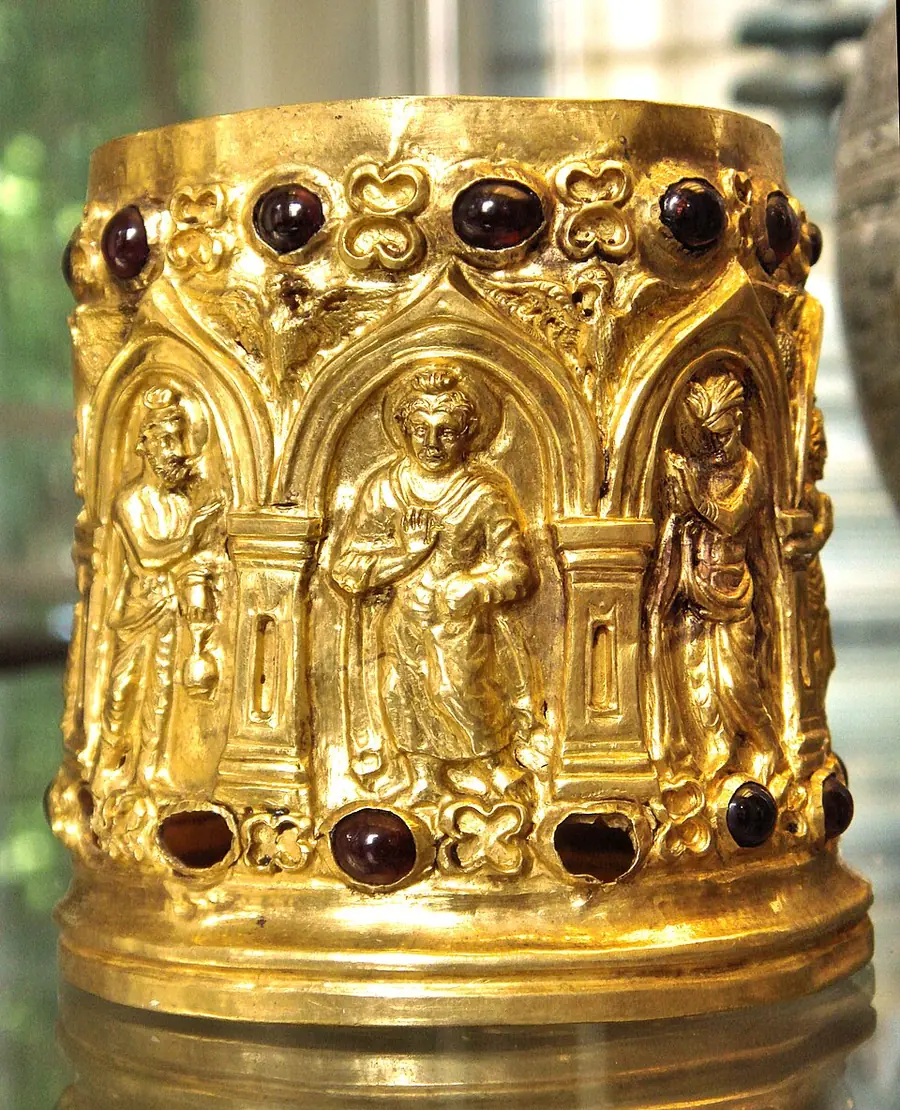
| c. 1st c. CE (disputed) | Bimaran reliquary, with one of the earliest Buddha figures[8][9] | Contested |
| late 1st–early 2nd c. CE | Early seated Buddhas at Mathurā, such as the Kaṭrā stele, labelled “bodhisattva”[10] | Majority |
| 127 CE | Kaniṣka I’s accession, on Harry Falk’s reading of the Kushan era[11][9][12] | Majority |
| c. 127–150 CE | Kaniṣka’s coins labelled ΒΟΔΔΟ, the oldest image explicitly named as the Buddha[13] | Consensus |
| c. 130 CE | Bala’s bodhisattva at Sarnath, dated year 3 of Kaniṣka[14] | Consensus |
| c. 2nd c. CE | The great Vibhāṣā commentary of the Sarvāstivādins compiled in Kashmir[15] | Majority |
| c. 2nd–3rd c. CE | Peak of Gandhāran sculpture[16][17] | Majority |
| late 3rd c. CE | King Mahāsena has the Mahāvihāra at Anurādhapura demolished in favour of its rival; later restored[18] | Majority |
Where: Gandhāra, Mathurā and Anurādhapura
Three regions carry this chapter, and two of them lay on the frontiers of the old Buddhist heartland in the Ganga plain.
Gandhāra is the valley of Peshawar and the hills around it, in today’s northwest Pakistan, with its neighbours Swat, Bajaur and eastern Afghanistan. It sat where the routes from Bactria and Iran came down into India, and in these centuries it was ruled by a succession of foreign dynasties: Indo-Greeks, Indo-Scythians (Śakas), Indo-Parthians and finally the Kushans, a people from the steppe north of the Oxus. Their mixed courts used Greek, Bactrian and Gāndhārī, and the art of the region mixed Greco-Roman form with Indian subject matter.[19][9]
Mathurā, on the Yamunā south of Delhi, was the Kushans’ chief city in the Ganga–Yamunā plain and a religious centre shared by Buddhists, Jains and the worshippers of Vāsudeva-Kṛṣṇa, Śiva and the yakṣa deities. Its workshops cut red-spotted sandstone and shipped finished images as far as Sarnath.[14] The same city appears in the Hinduism series as a cradle of image worship (Hinduism §7).
Anurādhapura, in the dry zone of northern Sri Lanka, was the island’s capital for over a thousand years. Buddhism reached it, by the chronicles’ account, through Ashoka’s son Mahinda (§4). Its great monasteries, the Mahāvihāra above all, preserved the Pali canon and wrote the chronicles that frame its history.
The evidence ledger for Gandhāra, Sri Lanka and the Kushans
| Dimension | What we can say | Evidence | Confidence |
|---|---|---|---|
| Texts | Written down in Sri Lanka in the first century BCE; earliest physical texts from Gandhāra in the first century BCE and first century CE | Chronicles; Gāndhārī scrolls, some radiocarbon-dated[4][3][19][20] | Majority |
| Patronage | Foreign kings of the northwest fund Buddhism alongside other cults | Shinkot casket; Kaniṣka casket; coinage with many gods[1][21][22] | Consensus |
| Images | The Buddha shown in human form from the first century CE, in Gandhāra and Mathurā | Bimaran reliquary; Kaṭrā stele; Kaniṣka coins; Bala bodhisattva[8][10][13][14] | Consensus |
| Schools | Named schools receive gifts: Sarvāstivādins at Peshawar, Dharmaguptakas in eastern Afghanistan | Kaniṣka casket; the British Library pot[21][7] | Consensus |
| Scholasticism | Systematic Abhidharma, different in each school | Theravāda Abhidhamma; Sarvāstivāda Vibhāṣā; Gāndhārī Abhidharma fragments[15][23] | Consensus |
| Monastic rivalry | Competing monasteries with royal backers in Sri Lanka | Mahāvaṃsa on Abhayagiri and Mahāsena[3][18][24] | Majority |
Sri Lanka: writing in a crisis
The Pali canon was written down because its keepers were afraid of losing it. The Sri Lankan chronicles place the event in a period of invasion, civil war and famine, and the commentaries preserve a debate from that time about what Buddhism needed most to survive.
Vaṭṭagāmaṇi Abhaya came to the throne at Anurādhapura in the first century BCE and lost it within months. According to the Mahāvaṃsa, a brahmin named Tissa rebelled while seven Tamil chiefs landed in the north; the king was defeated and fled, and the island was ruled for about fourteen years by a succession of five Tamil rulers before he regained the throne.[3] Later commentaries remember the same years as the time of a great famine, when monks scattered, many died, and the lines of reciters on which the texts depended were broken.[25]
The commentaries also record what the surviving monks argued about. One group, the “rag-robe” monks (paṃsukūlika), held that practice (paṭipatti) is the root of the teaching. The “teachers of the dhamma” (dhammakathika) held that learning (pariyatti) is the root, because without the texts there is nothing to practise. The learners won, and the decision shaped the Theravāda ever after: the scholar-monk, not the forest meditator, became the norm.[26][25] Majority
The writing down of the canon (§0) belongs to this setting. The Mahāvaṃsa says only that the monks, seeing that the people were falling away, came together and “wrote them down in books” (Geiger’s translation); the Aluvihāra is first named as the place in Sinhala histories of the thirteenth and fourteenth centuries.[3][4][5] Writing was a defensive measure taken by a monastic establishment that had just seen its oral tradition nearly fail. It did not end the oral tradition: recitation remained central to monastic training, and in Sri Lanka and Burma it still is.
Two monasteries, two canons
On his return, Vaṭṭagāmaṇi built a new monastery, the Abhayagiri, and gave it to a monk named Mahātissa who had helped him in exile. The older Mahāvihāra expelled Mahātissa for associating with the laity, and the island’s Buddhism split into rival fraternities.[3] Over the following centuries the Abhayagiri was more open: it accepted Mahāyāna and later tantric texts, which the Mahāvihāra rejected as Vetulla (Vaitulya) teaching, its name for Mahāyāna-type doctrine; the Mahāvaṃsa praises kings who suppressed it and banished Abhayagiri monks who had adopted it.[27] In the third century King Mahāsena, persuaded by a monk of the rival party, had the Mahāvihāra demolished and its property transferred; it was later rebuilt.[18][24]
This matters for everything that follows, because the Mahāvihāra wrote the history. The Dīpavaṃsa and Mahāvaṃsa, and the commentaries Buddhaghosa compiled in the fifth century, are Mahāvihāra works. The “Theravāda” that later spread to Burma, Thailand and Cambodia was the Mahāvihāra’s version, and it became the only one after King Parākramabāhu I unified the island’s orders under the Mahāvihāra in the twelfth century (§10).[28][24] The Abhayagiri’s books are almost entirely lost. Majority
When was the canon closed?
Later than the writing down. The commentaries and the chronicles show books still moving:
- The Kathāvatthu, the Abhidhamma book refuting other schools, is attributed to Moggaliputta Tissa at the council under Ashoka (§3) and so is post-sectarian by its own account.[29]
- Parts of the Khuddaka Nikāya, the “minor collection,” were still disputed: the Buddhavaṃsa, Apadāna and Cariyāpiṭaka are late by language and content, and reciters in different lineages counted the collection differently.[30]
- The canon is still not identical everywhere. The Burmese edition of the Sixth Council (1954–56) includes the Milindapañha, the Peṭakopadesa and the Nettippakaraṇa in the Khuddaka Nikāya; the Sri Lankan edition includes the last two but not the Milindapañha, and the Thai edition includes none of them.[30]
So the canon was written down in the first century BCE but closed by stages, and its outer edges were never fully fixed. Consensus
Greek kings and the Questions of Milinda
The first foreign rulers to patronise Buddhism on record were Indo-Greeks, the successors of Alexander’s Bactrian colonists, and the most famous of them became a character in a Buddhist dialogue.
Menander I, called Milinda in Pali, ruled a large kingdom in the northwest in the mid-second century BCE. His coins are bilingual, Greek on one side and Gāndhārī in Kharoṣṭhī on the other, where he is Menadra. Some of his bronze coins carry a wheel, which may or may not be a Buddhist symbol.[31]
Two independent sources connect him with Buddhism:
- The Shinkot casket, a steatite relic box from Bajaur, carries a Kharoṣṭhī inscription dated “in the reign of Mahārāja Minedra,” on the fourteenth day of the month Kārttika, recording a relic deposit. Later inscriptions on the same casket record its reuse by a local ruler, Vijayamitra.[1] Harry Falk has questioned whether the Menander inscription is genuine; Stefan Baums, editing the corpus of Gandhāran relic inscriptions, accepts it and calls it potentially the oldest preserved relic inscription from Gandhāra.[32][2] If genuine, it shows Buddhist relic cult in Menander’s territory. Majority
- Plutarch, writing in Greek around 100 CE, says that when Menander died in camp, his cities disputed his remains, and they agreed to divide the ashes and build monuments to him in each city.[33] That is how the Buddha’s own relics were divided (§2). Whether Plutarch’s story reflects a Buddhist funeral or simply a Hellenistic king’s is uncertain. Speculative
The Milindapañha
The Milindapañha, “Milinda’s Questions,” is a dialogue in which the king questions the monk Nāgasena about the teaching and is finally convinced. Its most famous passage is the opening exchange. Asked his name, Nāgasena says that “Nāgasena” is only a designation: there is no person to be found. The king objects; Nāgasena asks him how he came, and the king says by chariot. Is the chariot the pole, the axle, the wheels? None of them. Then “chariot” too is only a name for the assembled parts. Nāgasena caps the argument with a verse from the canon, spoken in the Saṃyutta Nikāya by the nun Vajirā:
yathā hi aṅgasambhārā hoti saddo ratho iti evaṃ khandhesu santesu hoti satto ti sammuti
“When the parts are assembled / we use the word ‘chariot’. / So too, when the aggregates are present / ‘sentient being’ is the convention we use.” (SN 5.10, trans. Bhikkhu Sujato)[6][34]
What it proves. That by the turn of the era Buddhist teachers were presenting not-self as a philosophical position that could be argued with an educated foreign king, using everyday analogies. The dialogue form, the king as sceptical questioner, has parallels in Greek philosophical literature, and its setting in Sāgala reflects real Indo-Greek geography. But the Pali text as it stands is a compilation built up over several centuries, with a core probably from the first century BCE or CE; a shorter Chinese translation preserves something closer to that core.[35][30] There is no evidence that Menander himself became a monk, as the later Pali text claims. Majority
The Kushans: an empire of many gods
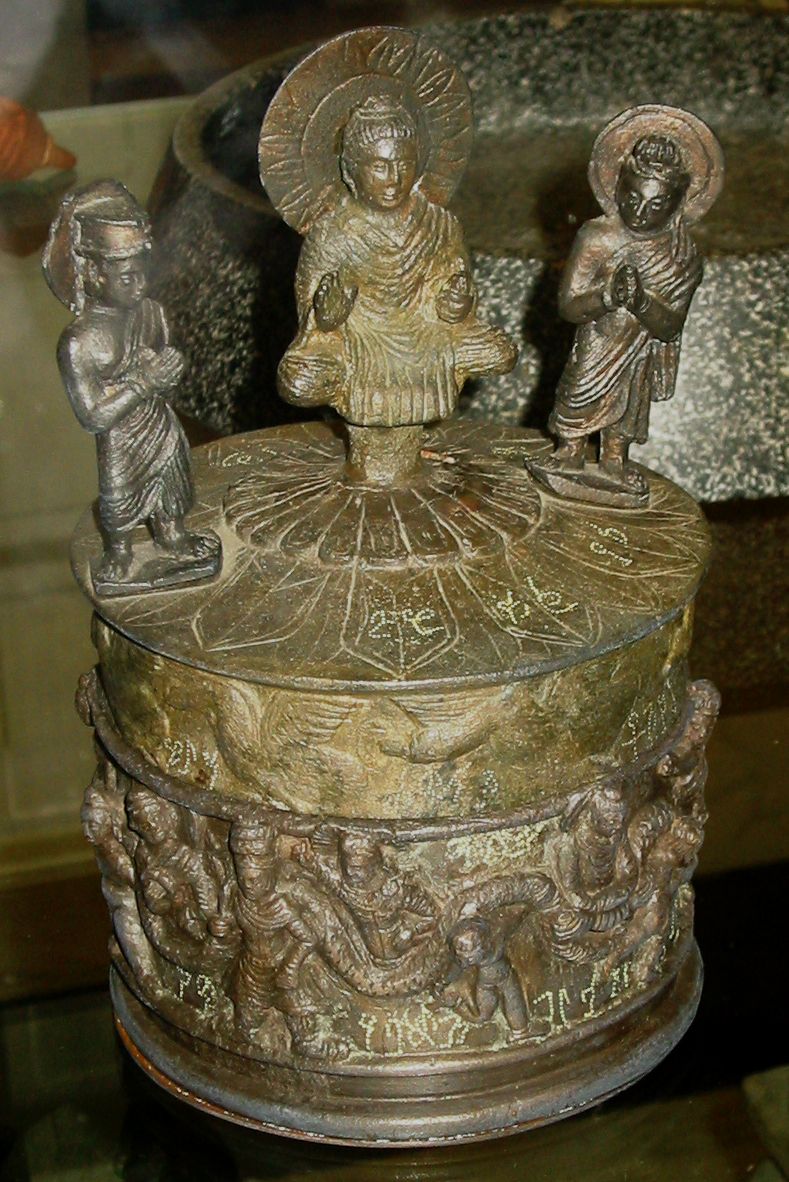
The Kushan empire, at its height under Kaniṣka in the second century CE, joined Bactria, Gandhāra and the Ganga plain as far as Sarnath; the Rabatak inscription claims cities as far east as Pāṭaliputra and Campā.[12][36] Buddhism flourished under it, but the Kushan court was not Buddhist in any exclusive sense.
The date of Kaniṣka, argued over for a century, is now generally taken from Harry Falk’s reading of a passage in an astrological text, which puts the start of his era in 127 CE; Joe Cribb’s coin sequences support the same date.[11][9] A minority, notably Gérard Fussman, has kept to the older date of 78 CE.[37] Majority The Rabatak inscription, found in northern Afghanistan in 1993 and written in Bactrian in Greek script, records his genealogy and his foundation of a temple. It says he received the kingship “from Nana and from all the gods,” names a list of mostly Iranian deities, and does not mention the Buddha.[12][36] His coins carry a crowded pantheon: the Iranian Miiro (Mithra), Athsho and Nana, the Greek Helios and Selene on early issues, Oesho (often identified with Śiva, though that reading is debated), and on a handful of issues the Buddha.[22][38]
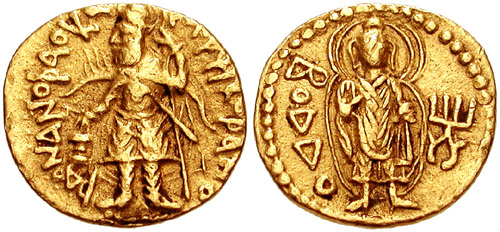
The Buddha coins. A small number of Kaniṣka’s gold coins show a standing Buddha, haloed, with the label ΒΟΔΔΟ (Boddo) in Greek letters. Copper coins show a seated or standing figure labelled ΣΑΚΑΜΑΝΟ ΒΟΥΔΟ, “Śākyamuni Buddha,” and another labelled ΜΕΤΡΑΓΟ ΒΟΥΔΟ, “Maitreya Buddha,” the future Buddha.[13][39] These are the earliest images that name the Buddha in writing, and they can be dated to within a quarter-century. They show that by the 130s CE a standard image of the Buddha existed and that the court thought it worth putting on gold. They also show the Buddha as one deity among many on the coinage. Consensus
The Kaniṣka stupa. Buddhist tradition remembers Kaniṣka as a second Ashoka. Chinese pilgrims describe a vast stupa he built outside Peshawar; Xuanzang gives its height as four hundred (Chinese) feet, which on the pilgrims’ figures would make it among the tallest structures of the ancient world.[40] Its base was excavated at Shāh-jī-kī-Ḍherī in 1908–09, and in the relic chamber lay a gilt-copper casket whose Kharoṣṭhī inscription names Kaniṣka and his monastery. Early readings took the casket as the king’s own gift; on Harry Falk’s rereading the donors were two architects, Mahasena and Saṃgharakṣita, who dedicated it for the acceptance of the Sarvāstivādin teachers.[21][41] The inscription names the school that received the monastery: gifts went to particular schools, and the Sarvāstivādins were the beneficiaries here. When the casket was deposited is debated. A coin of Huviṣka among the finds led Elizabeth Errington to place the deposit in his reign, on an enlargement of the stupa; Joe Cribb accepts that date for the deposit but argues from the coins that the royal figure on the casket is Kaniṣka I.[41][9] Consensus on the inscription; Contested on the date
Tradition also credits Kaniṣka with a council in Kashmir that produced the great Sarvāstivāda commentary. Xuanzang tells the story in the seventh century.[42] No inscription mentions the council, and most scholars treat it as a later legend attached to the compilation of the Vibhāṣā, which did take place in Kashmir in roughly this period. Majority
Abhidharma: the schools build systems
In these centuries each school turned the discourses into a system. The result, the Abhidharma (“higher teaching”), became the third basket of the canon, and it is the clearest evidence that the schools had become intellectual traditions with their own doctrines.
The discourses already analyse experience into lists: five aggregates, twelve sense bases, eighteen elements. The Abhidharma pushes the analysis to the bottom. Experience is broken into momentary elements, dharmas, each defined by its own characteristic, and the texts classify them and specify every way they can condition one another. The aim is practical as well as theoretical: a meditator who sees experience as a flow of impersonal elements sees through the idea of a self.
The schools did not agree:
- The Theravāda Abhidhamma has seven books in Pali, from the Dhammasaṅgaṇī, a matrix of mental and physical states, to the Paṭṭhāna, which sets out twenty-four types of conditional relation. Its systematisation was completed in Buddhaghosa’s commentaries in the fifth century.[30]
- The Sarvāstivāda, “the school that says everything exists,” held that dharmas exist in the past, present and future, and that only their activity is momentary. That explained how a past action could produce a future result and how the mind could know the past. Its great commentary, the Mahāvibhāṣā, was compiled in Kashmir around the second century CE; it survives in Xuanzang’s Chinese translation of 656–659 in two hundred fascicles.[15][23]
- Other schools, the Sautrāntikas among them, rejected Sarvāstivāda realism about past and future as un-Buddhist and held that only the present moment exists.[23]
Gandhāra yields Abhidharma texts and scholastic commentaries in Gāndhārī alongside the discourses, so the scholastic project was under way in the first century CE.[19] The arguments between the schools fed directly into the early Mahāyāna critique that all dharmas are empty (§6). Consensus
Primary sources
1. The Bimaran reliquary
A small gold cylinder, set with garnets, found by the explorer Charles Masson in a stupa at Bimaran near Jalalabad in the 1830s. Around it, under arches, stand a Buddha with a halo, his right hand raised, flanked by two figures usually identified as the gods Brahmā and Indra, repeated twice.[8]
What it proves. That the human Buddha, with halo, topknot and monastic robe, existed as a type in Gandhāra at the date of the reliquary. The date is the problem. It was found with coins in the name of the Indo-Scythian king Azes, which once suggested the first century BCE. Those coins are now thought to be posthumous issues struck by later local rulers, and estimates for the reliquary range from the early first century CE to the second. Joe Cribb, redating the associated coins to the late first or early second century, puts the casket at about 100 CE or slightly later; Juhyung Rhi counts it among the possible first-century attempts at a Buddha image.[9][16] If the earlier dates hold, it is one of the oldest Buddha images known; if the later, it is close in time to Kaniṣka’s coins. Contested
2. A seated Buddha that calls itself a bodhisattva
The Kaṭrā stele (Mathurā Museum A-1), red sandstone, late first or early second century CE. A seated figure with a shaven head under a spiral topknot, right hand raised, flanked by attendants and flying figures under a tree. The inscription on the base says that a woman named Amohāsī set up this “bodhisattva.”[10]
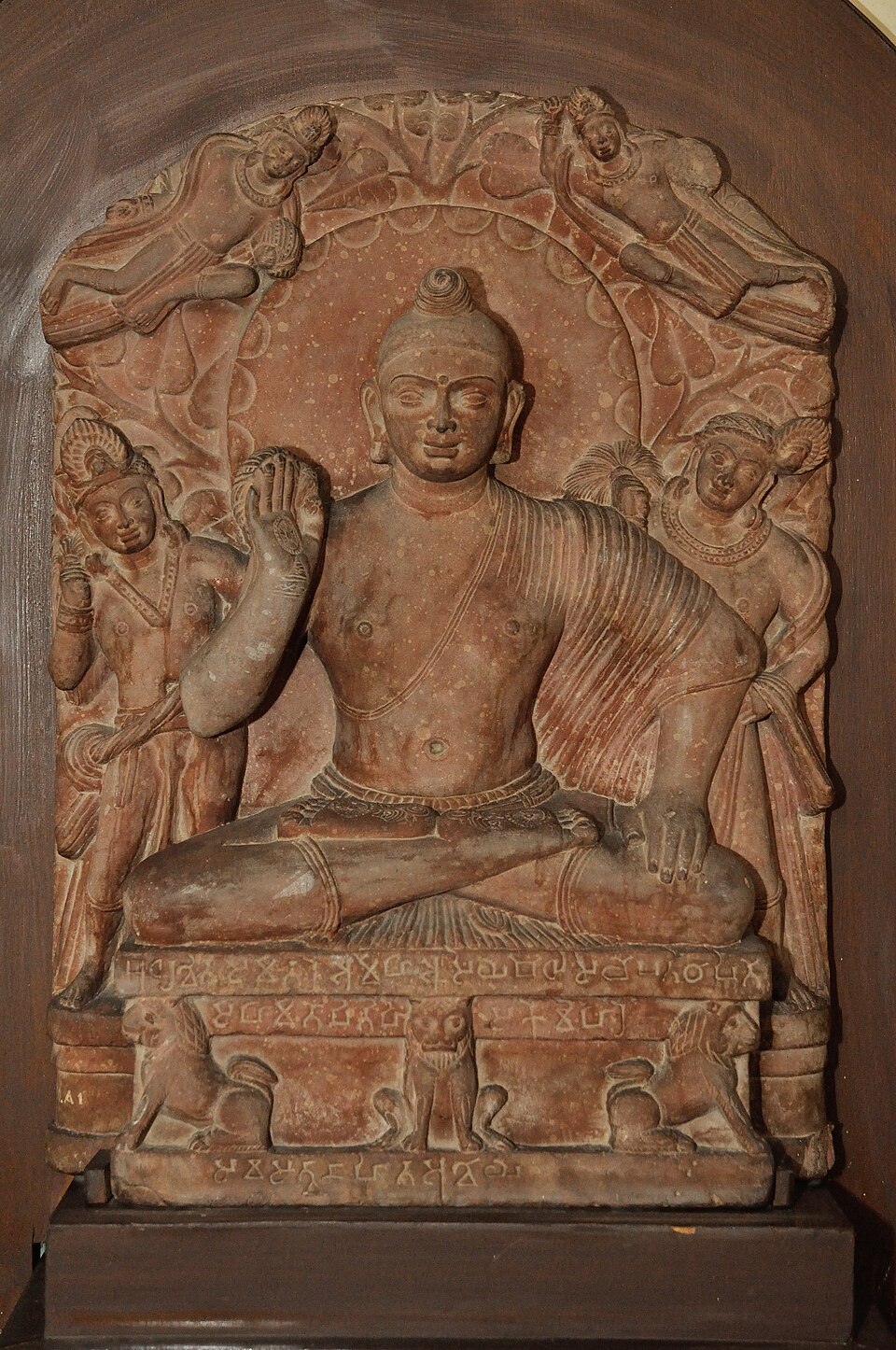
What it proves. Two things. First, Mathurā was producing finished, standardised Buddha images in its own idiom at the same time as Gandhāra: the massive body, the thin clinging robe and the frontal pose come from the Indian yakṣa figures carved in the same workshops, not from Greek sculpture. Second, early Mathurā inscriptions often call figures that look like Buddhas “bodhisattva.” That may mean the Buddha before his awakening, or it may reflect a reluctance to represent the fully awakened Buddha directly, which would fit the aniconic tradition that preceded it (§4). Majority on the style; Contested on the label
3. A dated image: Bala’s bodhisattva
A colossal standing figure in Mathurā sandstone, found at Sarnath with its stone umbrella. The inscription dates it to year 3 of Mahārāja Kaniṣka, about 130 CE on Falk’s era, and records that it was set up by the monk Bala, described as trepiṭaka, “master of the three baskets.” The figure is again called a bodhisattva. Bala set up similar images at Śrāvastī.[14]
What it proves. That large Buddha images were already being carved at Mathurā and transported hundreds of kilometres to the old sacred sites by the beginning of Kaniṣka’s reign, which makes it the earliest securely dated large Buddhist image. It also shows a monk paying for it. And the title trepiṭaka shows that the idea of a canon in three baskets was established in the Ganga plain by the early second century. Consensus
The first Buddha image: Gandhāra or Mathurā?
Both regions produced Buddha images by the early second century CE. Which came first, and how much the image owes to Greek art, is one of the oldest arguments in the study of Indian art, and it is not settled.
The Greek case. Alfred Foucher, in a work published from 1905 onward, argued that the Buddha image was invented in Gandhāra by artists trained in the Greco-Roman tradition, who gave the Indian teacher the face of Apollo, the wavy hair of Hellenistic sculpture and the draped robe of a Roman toga. Many Gandhāran Buddhas do look like that, and the region’s art borrowed freely from Greek and Roman models.[43]
The Indian case. Ananda Coomaraswamy answered in 1927 that Mathurā developed its own Buddha image from the Indian sculptural tradition of yakṣas and royal figures, independently of Gandhāra, and that the very idea of a Greek origin reflected a European assumption that Indians could not have made the image themselves.[44] The Kaṭrā stele and Bala’s bodhisattva show that Mathurā’s image owes little to Greek form.
Where the debate stands. Most scholars now think the two schools developed at about the same time, the late first and early second centuries CE, under Kushan rule, and that neither simply copied the other.[16][22] Two points complicate any simple answer:
- Gandhāran dating is weak. Very few Gandhāran sculptures carry dates, and those that do are in eras that are themselves disputed. Juhyung Rhi has argued that most of the surviving Gandhāran Buddha images are later than once assumed, mainly of the second and third centuries, and that the very early dates proposed for some pieces rest on stylistic guesses.[16] Kurt Behrendt’s phasing of Gandhāran monasteries places the main period of image production in the same centuries.[17]
- Mathurā’s dates are better. Mathurā images are more often inscribed with Kushan regnal years, which is why the earliest securely dated Buddha images are from there.[14]
The safest statement is that the human image of the Buddha appeared in the Kushan empire around the turn of the first and second centuries CE, in two regional styles: a Gandhāran one heavily indebted to Greco-Roman art and a Mathurā one rooted in Indian sculpture. Why it appeared then is a separate question. One likely factor is devotional: the same period saw the rise of practices centred on the Buddha as a present object of worship, which the Mahāyāna sūtras would express in their own way (§6). Contested
What is absent before 100 BCE
- Images of the Buddha in human form. The early stupas of Bhārhut and Sāñcī show him by symbols (§4). Consensus
- Written Buddhist texts. None is securely dated before the first century BCE. The oldest radiocarbon date for a Gāndhārī manuscript, a fragment of the Split collection, has a range of 184–46 BCE with its likeliest point around 70 BCE.[20] Majority
- Systematic Abhidharma. Lists and matrices exist in the discourses, but the developed systems, and the disputes between them, belong to these centuries. Consensus
- Royal patronage of named schools. Ashoka gave to “the saṅgha”; inscriptions naming particular schools as recipients appear in this period.[21][7] Majority
Debates about Gandhāra, Sri Lanka and the first images
Who made the first Buddha image?
See above. Gandhāra and Mathurā both have claims, the evidence from Gandhāra is poorly dated, and the strongest dated evidence, from Kaniṣka’s reign, comes after both styles were already established. The question has also carried a political charge since Coomaraswamy’s time: whether a central image of Asian religion was a Greek or an Indian creation. Contested
How Greek was Gandhāran Buddhism?
The art is visibly Hellenistic and Roman in style: acanthus capitals, Atlas figures, the Herakles-type Vajrapāṇi who attends the Buddha. The doctrine is not. Gāndhārī texts are Indian Buddhist texts, and the patrons named in inscriptions are mostly local, Scythian or Kushan, not Greek. The Greeks of the second century BCE had largely been absorbed by the time the sculpture flourished, and Rome’s influence came through trade rather than settlement. The common phrase “Greco-Buddhist” describes the art better than the religion. Majority
When did the Pali canon become fixed?
Written in the first century BCE, but closed in stages afterwards, with some books still disputed and editions still differing in the twentieth century. The Mahāvihāra’s victory over its rivals is part of why one version of the canon, and of the history, came down to us. Consensus
Was Kaniṣka a Buddhist?
A patron, certainly, and remembered as a great one. A convert in an exclusive sense, probably not: his own inscription credits the Iranian goddess Nana with his kingship, and the Buddha is a rare figure on his coinage. The Buddhist portrait of him as a second Ashoka is the tradition’s, not the evidence’s.[12][22] Majority
Further reading
- Richard Salomon, The Buddhist Literature of Ancient Gandhāra (Wisdom, 2018).
- John M. Rosenfield, The Dynastic Arts of the Kushans (California, 1967) — still the basic book on Kushan art and coinage.
- Wannaporn Rienjang and Peter Stewart, eds., Problems of Chronology in Gandhāran Art (Archaeopress, 2018) — open access, with Juhyung Rhi’s essay on dating the Buddha images.
- Ananda K. Coomaraswamy, “The Origin of the Buddha Image,” The Art Bulletin 9 (1927).
- Walpola Rahula, History of Buddhism in Ceylon: The Anurādhapura Period (1956).
- R. A. L. H. Gunawardana, Robe and Plough: Monasticism and Economic Interest in Early Medieval Sri Lanka (Arizona, 1979).
- I. B. Horner, trans., Milinda’s Questions (Pali Text Society, 1963–64).
- Charles Willemen, Bart Dessein and Collett Cox, Sarvāstivāda Buddhist Scholasticism (Brill, 1998).
References
- ^ a b c Shinkot casket — Bajaur reliquary. c. 150 BCE, with later additions. Gāndhārī in Kharoṣṭhī. A steatite relic box whose lid inscription is dated in the reign of Mahārāja Minedra (Menander I); later inscriptions record its reuse by the local ruler Vijayamitra. Probably the oldest inscribed Buddhist relic casket from Gandhāra. about
- ^ a b Stefan Baums "A Framework for Gandhāran Chronology Based on Relic Inscriptions". In Problems of Chronology in Gandhāran Art, ed. W. Rienjang & P. Stewart, Archaeopress, 53–70, 2018. open library Orders the dated Gandhāran relic inscriptions; defends the Shinkot casket's Menander inscription (p. 64) against doubts about its authenticity.
- ^ a b c d e f Mahāvaṃsa 33 — Mahāvaṃsa. c. 5th–6th c. CE. Pali. Vaṭṭagāmaṇi's defeat by a brahmin rebel and Tamil invaders, fourteen years of exile, his return, the founding of the Abhayagiri and the writing down of the texts. read the text
- ^ a b c Dīpavaṃsa 20.20–21 — Dīpavaṃsa. c. 4th c. CE. Pali. Sri Lanka's oldest chronicle says that under King Vaṭṭagāmaṇi the monks, seeing beings decline, wrote down the Piṭakas and commentary, which had until then been passed on by mouth. read the text
- ^ a b Pūjāvaliya and Nikāya-saṅgrahaya on the writing of the canon — Sinhala Buddhist histories. 13th and 14th c. CE. Sinhala. Sinhala works of the thirteenth and fourteenth centuries that first place the writing down of the Pali Canon at the Aluvihāra monastery, at a council of 500 monks. The older chronicles name no place.
- ^ a b Milindapañha 25–28 — Milindapañha. core c. 1st c. BCE–1st c. CE, expanded later. Pali. The monk Nāgasena tells the Indo-Greek king Milinda that his name is only a designation, using the chariot simile and a verse from SN 5.10. read the text
- ^ a b c Richard Salomon Ancient Buddhist Scrolls from Gandhāra: The British Library Kharoṣṭhī Fragments. University of Washington Press, 1999. open library The discovery that put physical first-century Buddhist manuscripts on the table. Readable and careful about what the scrolls do and don't prove.
- ^ a b c Bimaran reliquary — Bimaran stupa 2, Afghanistan. c. 1st–2nd c. CE (disputed). Gold reliquary set with garnets, showing a haloed standing Buddha between Brahmā and Indra. Found with coins in the name of Azes, now thought posthumous issues; dated anywhere from the early first to the second century CE. about
- ^ a b c d e f Joe Cribb "Numismatic Evidence and the Date of Kaniṣka I". In Problems of Chronology in Gandhāran Art, ed. W. Rienjang & P. Stewart, Archaeopress, 7–34, 2018. open library Builds the Kushan king list on Kaniṣka year 1 = 127 CE and places the Bimaran casket c. 100 CE or slightly later and the Kaniṣka casket's deposit under Huviṣka (p. 28).
- ^ a b c Kaṭrā stele (Mathurā Museum A-1) — Kaṭrā Keśavdev, Mathurā. late 1st–early 2nd c. CE. Prakrit in Brāhmī. Seated Buddha with attendants in Mathurā red sandstone; the base inscription records that Amohāsī set up this 'bodhisattva'. An early standardised Mathurā image in the Indian yakṣa idiom. about
- ^ a b Harry Falk "The yuga of Sphujiddhvaja and the Era of the Kuṣāṇas". Silk Road Art and Archaeology 7: 121–136, 2001. Fixes the start of Kaniṣka's era in 127 CE from an astrological text; now the standard Kushan chronology.
- ^ a b c d Rabatak inscription — Kaniṣka I, Afghanistan. c. 127 CE. Bactrian in Greek script. The Kuṣāṇa dynastic pantheon — Nana, Umma, Aurmuzd, Mihr and others. Oēśo is absent, which is one of the arguments against reading him as Śiva. about
- ^ a b c Kaniṣka's Buddha coins — Kushan coinage. c. 127–150 CE. Bactrian in Greek script. Gold coins with a standing Buddha labelled ΒΟΔΔΟ, and copper coins labelled ΣΑΚΑΜΑΝΟ ΒΟΥΔΟ (Śākyamuni) and ΜΕΤΡΑΓΟ ΒΟΥΔΟ (Maitreya). The earliest images that name the Buddha in writing. about
- ^ a b c d e Bala's bodhisattva, Sarnath — Sarnath. year 3 of Kaniṣka (c. 130 CE). Prakrit in Brāhmī. Colossal standing figure in Mathurā sandstone with its umbrella shaft, set up by the monk Bala, 'master of the three baskets' (trepiṭaka). The earliest securely dated large Buddhist image.
- ^ a b c T 1545 (Abhidharma-mahāvibhāṣā) — Sarvāstivāda Abhidharma. compiled c. 2nd c. CE; translated 656–659. Classical Chinese (from Sanskrit). The great Sarvāstivāda commentary compiled in Kashmir, defending the existence of dharmas in past, present and future; known from Xuanzang's two-hundred-fascicle translation. read the text
- ^ a b c d Juhyung Rhi "Positioning Gandhāran Buddhas in Chronology: Significant Coordinates and Anomalies". In Problems of Chronology in Gandhāran Art, ed. W. Rienjang & P. Stewart, Archaeopress, 2018. open access Argues that most Gandhāran Buddha images are second- and third-century, later than often assumed. The volume is open access.
- ^ a b Kurt A. Behrendt The Buddhist Architecture of Gandhāra. Brill, 2004. A phased chronology of Gandhāran monasteries and the place of images within them.
- ^ a b c Mahāvaṃsa 37 — Mahāvaṃsa. c. 5th–6th c. CE. Pali. King Mahāsena, under the influence of a monk of the rival party, has the Mahāvihāra demolished and its materials taken to the Abhayagiri; it is later restored. read the text
- ^ a b c Richard Salomon The Buddhist Literature of Ancient Gandhāra: An Introduction with Selected Translations. Wisdom Publications, 2018. The best overview of every Gāndhārī collection found since 1994, with translations.
- ^ a b Harry Falk "The 'Split' Collection of Kharoṣṭhī Texts". Annual Report of the International Research Institute for Advanced Buddhology 14: 13–23, 2011. Introduces the Split collection and reports a radiocarbon range of 184–46 BCE for a fragment of its avadāna manuscript, the oldest scientific date for a Buddhist manuscript.
- ^ a b c d Kaniṣka casket — Shāh-jī-kī-Ḍherī, Peshawar. deposited c. mid-2nd c. CE (reign of Huviṣka?). Gāndhārī in Kharoṣṭhī. Gilt-copper relic casket from the great stupa near Peshawar. Its Kharoṣṭhī inscription names Kaniṣka and his monastery; on Falk's rereading the donors were two architects, Mahasena and Saṃgharakṣita, who gave it for the acceptance of the Sarvāstivādin teachers. A coin of Huviṣka among the finds suggests it was deposited in his reign. read the text
- ^ a b c d John M. Rosenfield The Dynastic Arts of the Kushans. University of California Press, 1967. full text The classic statement of the Śiva reading of Oēśo, now contested.
- ^ a b c Charles Willemen, Bart Dessein & Collett Cox Sarvāstivāda Buddhist Scholasticism. Brill, 1998. The history and doctrine of the Sarvāstivāda Abhidharma.
- ^ a b c R. A. L. H. Gunawardana Robe and Plough: Monasticism and Economic Interest in Early Medieval Sri Lanka. University of Arizona Press, 1979. The economics behind the Mahāvihāra–Abhayagiri rivalry.
- ^ a b Walpola Rahula History of Buddhism in Ceylon: The Anurādhapura Period. M. D. Gunasena, 1956. full text The standard account from the chronicles and commentaries, including the famine and the learning-versus-practice debate.
- ^ Manorathapūraṇī on AN 1 — Buddhaghosa's commentary on the Aṅguttara Nikāya. 5th c. CE. Pali. Recalls a famine-era debate between monks who held practice to be the root of the teaching and monks who held learning to be; learning (pariyatti) won.
- ^ Mahāvaṃsa 36 — Mahāvaṃsa. c. 5th–6th c. CE. Pali. King Vohārika Tissa suppresses the Vetulya doctrine; King Goṭhābhaya banishes sixty Abhayagiri monks who had turned to it. The Mahāvihāra's view of Mahāyāna-type teaching as heresy. read the text
- ^ Gal Vihāra inscription — Polonnaruwa. c. 1165 CE. Sinhala. Parākramabāhu I records his reform of the order: an assembly under the elder Mahākassapa expels corrupt monks, unites the three fraternities under the Mahāvihāra and issues a code of conduct (katikāvata). about
- ^ Kathāvatthu — Abhidhamma Piṭaka. c. 250 BCE onward, with later additions. Pali. 'Points of Controversy': over two hundred debates refuting other schools' views, attributed by Theravāda tradition to Moggaliputta Tissa at the Third Council. read the text
- ^ a b c d Oskar von Hinüber A Handbook of Pāli Literature. De Gruyter, 1996. The standard reference on what the Pali canon is, when its parts were fixed and how the language relates to what the Buddha spoke.
- ^ Étienne Lamotte History of Indian Buddhism: From the Origins to the Śaka Era. Trans. Sara Webb-Boin, Institut Orientaliste, Louvain, 1988. Still the fullest survey of the councils, schools and early inscriptions.
- ^ Harry Falk "The Introduction of Stūpa-Worship in Bajaur". In Afghanistan, ancien carrefour entre l'Est et l'Ouest, ed. O. Bopearachchi & M.-F. Boussac, Brepols, 347–358, 2005. Questions the authenticity of the Menander inscription on the Shinkot casket.
- ^ Plutarch, Praecepta gerendae reipublicae 28 (821D–E) — Moralia. c. 100 CE. Greek. When Menander died in camp his cities disputed his remains and agreed to divide the ashes and build monuments to him in each city, as the Buddha's relics were divided. read the text
- ^ SN 5.10 — Vajirā Sutta (Saṃyutta Nikāya). c. 400–200 BCE. Pali. The nun Vajirā answers Māra: just as the word 'chariot' is used when the parts are assembled, 'sentient being' is a convention used when the aggregates are present. Nāgasena quotes the verse in the Milindapañha. read the text
- ^ I. B. Horner, trans. Milinda's Questions. Pali Text Society, 2 vols., 1963. The standard English translation, with a discussion of the text's layers.
- ^ a b Nicholas Sims-Williams & Joe Cribb "A New Bactrian Inscription of Kanishka the Great". Silk Road Art and Archaeology 4: 75–142, 1996. Edition of the Rabatak inscription, with its genealogy of the Kushan kings and its list of gods.
- ^ Wannaporn Rienjang & Peter Stewart, eds. Problems of Chronology in Gandhāran Art. Archaeopress, 2018. open library Open-access workshop volume on dating Gandhāran art; its introduction (pp. 1–5) records the near-consensus on 127 CE for Kaniṣka and the dissent of Fussman (78 CE).
- ^ Kuṣāṇa coinage (Oēśo) — Kaniṣka and successors. c. 127–200 CE. Greek script. Śiva with trident and bull on imperial state currency — standardized divine iconography.
- ^ Joe Cribb "Kaniṣka's Buddha Coins: The Official Iconography of Śākyamuni and Maitreya". Journal of the International Association of Buddhist Studies 3: 79–88, 1980. The Buddha coins catalogued and read.
- ^ Xuanzang, Record of the Western Regions 2 — Da Tang Xiyu ji. 646 CE. Classical Chinese. The legend of Kaniṣka's great stupa near Puruṣapura (Peshawar): he builds round a shepherd boy's small stupa until his reaches 400 (Chinese) feet, in five storeys, crowned with gilded copper discs. Beal's translation, vol. 1, pp. 99–100. about
- ^ a b Elizabeth Errington, with an appendix by Harry Falk "Numismatic Evidence for Dating the 'Kaniṣka' Reliquary". Silk Road Art and Archaeology 8: 101–120, 2002. Places the deposit of the Shāh-jī-kī-Ḍherī casket under Huviṣka; Falk's appendix rereads the inscription and names the donors as two architects, not the king.
- ^ Xuanzang, Record of the Western Regions 3 — Da Tang Xiyu ji. 646 CE. Classical Chinese. Tells how Kaniṣka convened five hundred monks in Kashmir to compose commentaries on the three baskets, engraved on copper plates and sealed in a stupa. about
- ^ Alfred Foucher L'art gréco-bouddhique du Gandhâra. Leroux, 2 vols. in 3, 1905. The classic argument that Greek-trained artists in Gandhāra invented the Buddha image. Published 1905–1951.
- ^ Ananda K. Coomaraswamy "The Origin of the Buddha Image". The Art Bulletin 9: 287–328, 1927. doi The case for an independent Indian origin at Mathurā, against Foucher.