Indian Buddhism’s last age in one paragraph
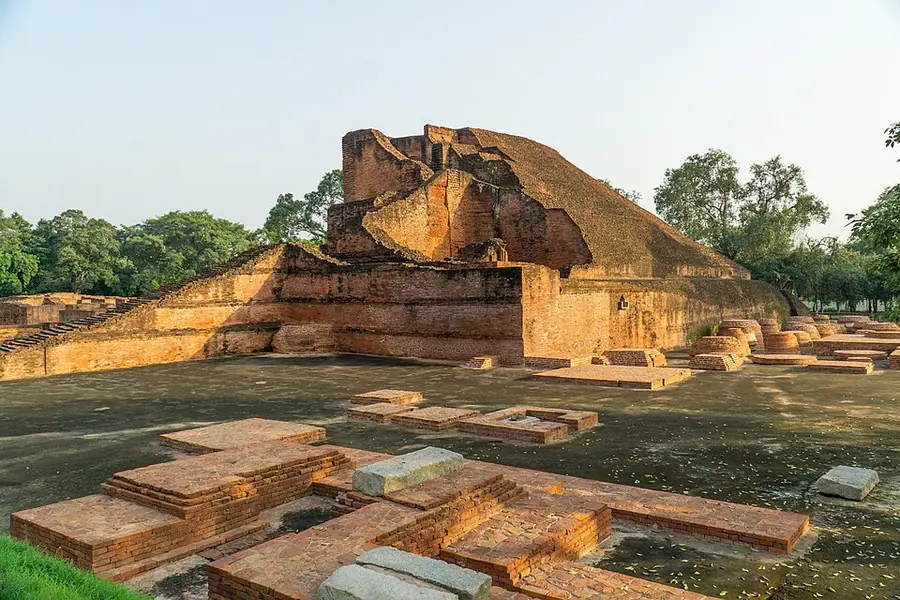
Between about 600 and 1200 CE, Indian Buddhism became a religion of great monasteries. Institutions such as Nālandā, Vikramaśīla and Somapura, funded by kings and by the revenue of granted villages, housed thousands of monks and taught logic, grammar and medicine alongside Buddhist philosophy. Inside them a new form of Buddhism took shape: the tantric or esoteric path, later called Vajrayāna, which promised Buddhahood in this life through initiation, mantra, ritual and yoga. Its later scriptures used deliberately shocking imagery of sex, death and impurity, and some drew directly on Śaiva sources. Majority
The same centuries saw Buddhism’s Indian base contract. Lay support moved toward temple Hinduism, and by the eleventh century Buddhism’s large institutions were concentrated in the east, under the Pāla kings of Bihar and Bengal. When Turkic armies conquered the region around 1200, the great monasteries were sacked or lost their patrons, and with them went Buddhism as an organised religion in most of India. Its tantric forms survived in Tibet (§9) and in the Kathmandu valley. Majority
Timeline of tantric Buddhism and the last Indian monasteries
| Date | Event | Confidence |
|---|---|---|
| 5th c. CE | Nālandā founded under the Guptas; Xuanzang names the founder Śakrāditya, usually identified with Kumāragupta I[1] | Majority |
| 630s | Xuanzang studies at Nālandā[1] | Consensus |
| c. 675–685 | Yijing at Nālandā: more than 3,000 monks, supported by more than 200 villages[2][3] | Consensus |
| before 674 | Mahāvairocana Sūtra composed; translated into Chinese in 724–725[4] | Majority |
| late 7th c. | Sarvatathāgatatattvasaṃgraha, the founding scripture of “yoga tantra”[5] | Majority |
| mid-8th c. | Gopāla, chosen as king, founds the Pāla dynasty in Bengal[6] | Majority |
| c. 775–850 | Dharmapāla builds the Somapura monastery; his son Devapāla founds Vikramaśīla (Tāranātha credits Dharmapāla)[7][8][9] | Majority |
| 8th–10th c. | Guhyasamāja, Laghuśaṃvara and Hevajra tantras[10][11][12] | Majority |
| mid-9th c. | Devapāla grants five villages to support a monastery built at Nālandā by Bālaputra, king of Suvarṇadvīpa[13] | Consensus |
| 9th–12th c. | The Caryāgīti songs of the siddhas in early Bengali[14] | Majority |
| c. 1025–1040 | Kālacakra Tantra and its Vimalaprabhā commentary; the system’s sixty-year calendar cycles are counted from 1027[15][16][17] | Majority |
| c. 1040 | Atiśa leaves Vikramaśīla for Tibet (§9)[18] | Consensus |
| c. 1200 | Muhammad Bakhtiyār Khalji sacks a fortified monastery called “Bihar”; Vikramaśīla razed[19][20] | Majority |
| 1235 | Dharmasvāmin finds Nālandā damaged but teaching about seventy monks[20] | Consensus |
| 1384–1468 | Vanaratna, a Bengali monk, makes three teaching journeys to Tibet from the Kathmandu valley[21][9] | Majority |
Where: the eastern monasteries and the margins
By the eighth century the centre of Indian Buddhism had moved east, to the Pāla kingdom of Bihar and Bengal. The northwest (Gandhāra and Kashmir), Odisha and the Kathmandu valley were the other important regions.
The Pāla kings (c. 750 to the late twelfth century) were the last major royal patrons of Buddhism in India. They did not patronise Buddhism alone: their copper plates also grant land to brahmins and record Śaiva and Vaiṣṇava foundations. Devapāla built a temple for Śiva’s consort as well as one for the Buddha, and Nayapāla took a Śaiva royal preceptor.[8] But they founded or expanded the great Buddhist monasteries of the east and carried their names on official seals.[7]
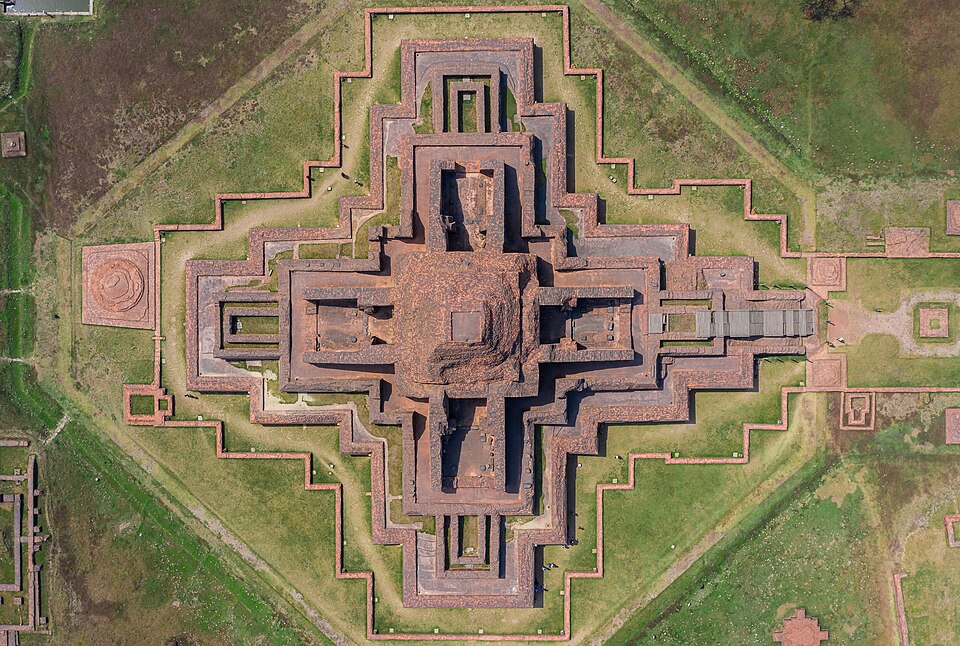
The principal institutions, as later Tibetan sources list them:
- Nālandā, near Rājgir in Bihar, the oldest and best documented, founded under the Guptas.
- Vikramaśīla, on the Ganges in Bhagalpur district, a royal foundation of the early ninth century, most likely by Devapāla, and the monastery that sent Atiśa to Tibet.[9][8]
- Odantapurī (Uddaṇḍapura), at modern Bihar Sharif, a town whose name preserves the word vihāra.[8][9]
- Somapura, at Paharpur in Bangladesh, built by Dharmapāla, now a World Heritage Site.[7]
- Jagaddala, in northern Bengal, a royal foundation that existed under Rāmapāla (r. c. 1072–1126); its founder is unknown.[8]
Outside the Pāla domains, Odisha sustained large monasteries at Ratnagiri, Lalitgiri and Udayagiri, rich in esoteric images;[8] Kashmir produced Buddhist scholars into the thirteenth century (the Kashmiri paṇḍita Śākyaśrībhadra, often called the last abbot of Vikramaśīla, reached Tibet in 1204);[9] and the Kathmandu valley became the place where Indian Buddhism’s Sanskrit texts and tantric rituals survived after the Indian monasteries were gone.[9][22]
The evidence ledger for Indian Buddhism, 600–1300
| Dimension | What we can say | Evidence | Confidence |
|---|---|---|---|
| Institutions | Buddhism was concentrated in large endowed monasteries with corporate seals | Nālandā and Somapura seals; excavated monastery blocks[23][7] | Consensus |
| Economy | Monasteries lived on the revenue of granted villages | Yijing’s 200 villages; Devapāla’s copper plate[2][13] | Consensus |
| Learning | The curriculum included grammar, logic and medicine as well as Buddhist texts | Xuanzang; Yijing[1][3] | Consensus |
| Ritual | Mantra, initiation and maṇḍala ritual became central to elite monastic Buddhism | The tantras; their Chinese and Tibetan translations[4][5][24] | Consensus |
| Relation to Śaivism | Some Buddhist tantras reuse Śaiva texts | Sanderson’s parallels for the Laghuśaṃvara; Ruegg’s shared-substratum model[8][11][25] | Majority on the borrowing; Contested on its extent |
| Encounter with Islam | The Kālacakra knows Islam in some detail and prophesies war with it | Kālacakra 1.154; Vimalaprabhā[15][26] | Consensus |
| End of the monasteries | Destroyed or abandoned around 1200 amid Turkic conquest | Minhāj al-Sirāj; Dharmasvāmin’s biography[19][20] | Majority |
| Survival | Tantric Buddhism continued in Tibet and among the Newars of Nepal | Tibetan canon; Newar ritual tradition[22] | Consensus |
Primary sources
1. A monastery with a seal
Excavations at Nālandā, carried out by the Archaeological Survey of India from 1915,[27] recovered many clay sealings bearing the monastery’s emblem, a wheel flanked by two deer, and its corporate name:
śrī-nālandā-mahāvihārīyārya-bhikṣu-saṅghasya
“Of the community of noble monks of the great monastery of glorious Nālandā” (our translation). The excavators recovered 775 of these sealings, 690 of them stored in a single room of Monastery 9.[23][28]
At Paharpur a seal names the founder: śrī-somapure śrī-dharmapāladeva-mahāvihāre, “in the Mahāvihāra of Dharmapāladeva at Somapura,” in Alexis Sanderson’s translation.[7][8]
What it proves. That these institutions acted as legal bodies. A seal authenticates documents: letters, receipts and above all land transactions. The saṅgha of a mahāvihāra had property, officers and correspondence in its own name. §3 traced the early order’s unease about money; by this period the great monasteries were, among other things, landlords. Consensus
2. Two hundred villages
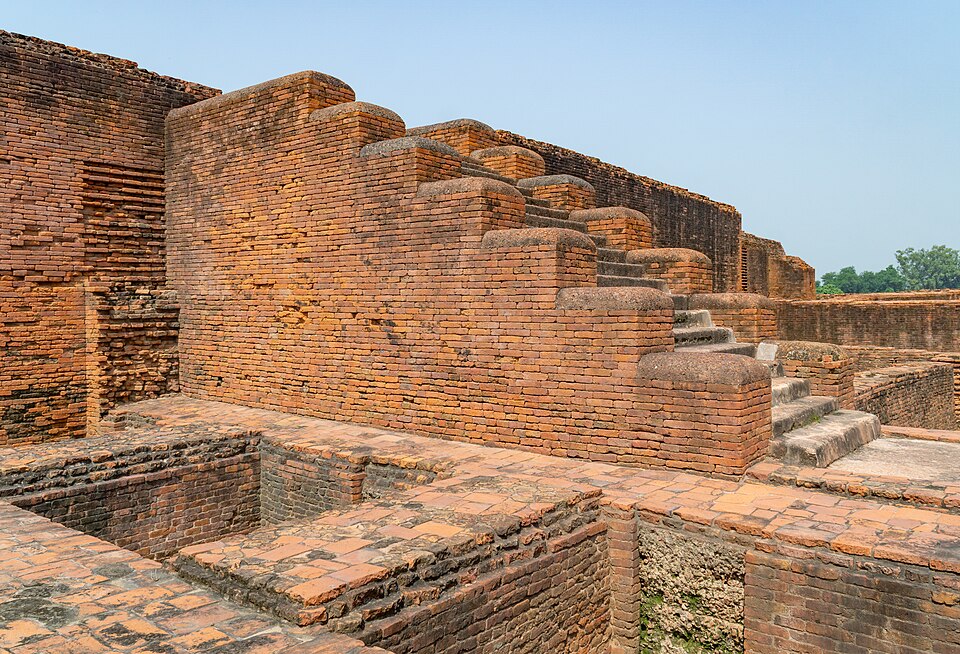
The Chinese pilgrim Yijing, who lived at Nālandā around 675–685, reports that the monastery housed more than three thousand monks and was supported by more than two hundred villages, granted by successive kings, whose revenue went to its upkeep.[2][3] Xuanzang, there a generation earlier, names the kings who added monastery buildings one after another, beginning with Śakrāditya.[1]
Two centuries later the mechanism can be seen in a document. A copper plate found in Monastery 1 at Nālandā records that Bālaputradeva, a Śailendra king of Suvarṇadvīpa (Sumatra and Java), built a monastery at Nālandā and asked the Pāla king Devapāla to grant villages for its upkeep. Devapāla granted five.[13]
What it proves. That Nālandā was an international institution, endowed from as far away as Indonesia, and that its wealth was agrarian: income from villages, not only gifts from pilgrims. That made it rich and stable while kings were friendly, and exposed when the political order that guaranteed its land changed. The pilgrims’ monk counts are not census figures, but they agree on an institution of thousands. Consensus
3. Bound by passion, released by passion
The Hevajra Tantra, one of the “yoginī” tantras of the ninth or tenth century, states the principle of tantric practice in a single verse (2.2.51):
rāgeṇa badhyate loko rāgeṇaiva vimucyate | viparītabhāvanā hy eṣā na jñātā buddhatīrthikaiḥ ||
“The world is bound by passion; by passion too it is released. This is the reversed practice, not known to [other] Buddhists or to outsiders” (our translation; text as edited by Snellgrove).[12][29]
What it proves. That the later tantras presented themselves as a reversal of ordinary Buddhist method. Earlier Buddhism treated desire as the cause of suffering, to be abandoned. The tantras teach that desire, rightly handled, is the material of awakening, and their rituals and imagery, from sexual union to charnel-ground offerings, enact that claim. Whether those rites were performed literally or read as meditation is a question the tradition itself argued over (see Debates). Consensus
4. The prophets of the barbarians
The Kālacakra Tantra, the “Wheel of Time”, was composed in India around 1025–1040, when Turkic Muslim armies had already raided the northwest. Its first chapter lists the teachers of the mleccha (“barbarian”) religion (1.154), here in Alexander Berzin’s translation:
“Adam, Noah, Abraham, and five others – Moses, Jesus, the White-Clad One, Muhammad, and Mahdi – with tamas, are in the asura-naga caste.”[15]
Its commentary, the Vimalaprabhā, names a year 403 of the barbarians’ era; read as the Islamic Hijra calendar, that is 1012–13 CE, which is one of the clues that fixes the text’s date.[16][26] The system’s own calendar counts its sixty-year cycles from 1027 CE, the epoch Tibetans later adopted for their calendar.[17] The tantra prophesies that a future king of Shambhala, Raudra Cakrin, will lead an army that defeats the barbarians in a final war, after which a golden age begins.[15][26]
What it proves. That Indian Buddhists of the early eleventh century knew Islam as a religion, with a line of prophets, a calendar and practices, and saw it as a mortal threat. John Newman judges the Kālacakra’s account of Islam broadly accurate, which is rare in Sanskrit literature.[26] Consensus
5. The fortress that was a college
The Persian historian Minhāj al-Sirāj Jūzjānī, writing his Ṭabaqāt-i Nāṣirī around 1260, describes how Muhammad Bakhtiyār Khalji’s troops took a fortified place in Bihar a few decades earlier:
”… they captured the fortress, and acquired great booty. The greater number of the inhabitants of that place were Brahmans, and the whole of those Brahmans had their heads shaven; and they were all slain. There were a great number of books there; and, when all these books came under the observation of the Musalmāns, they summoned a number of Hindūs that they might give them information respecting the import of those books; but the whole of the Hindūs had been killed. On becoming acquainted [with the contents of those books], it was found that the whole of that fortress and city was a college, and in the Hindūī tongue, they call a college Bihār.”[19][30]
What it proves. That a Buddhist monastery was sacked and its monks killed around 1200. The “Brahmans” with shaven heads are almost certainly monks, and bihār is vihāra, a monastery. The passage does not name the place. Identifications vary; Martin Delhey thinks Odantapurī (Uddaṇḍapura), at modern Bihar Sharif, the most likely, not Nālandā, and notes that the attackers seem to have mistaken the walled monastery for a fort.[9] (See Was Nālandā destroyed by Bakhtiyar Khilji?.) The often repeated story that Nālandā’s library burned for months does not come from this text. Majority on the event; Contested on the place
6. A Tibetan eyewitness
The Tibetan monk Chag Lotsāwa Chöjé Pel, known as Dharmasvāmin, travelled in Bihar in 1234–36. His biography says of Vikramaśīla:
“Vikramaśīla was still existing in the time of the Elder Dharmasvāmin and the Kashmir Paṇḍita, but when the Dharmasvāmin visited the country there were no traces of it left, the Turushka soldiery having razed it to the ground, and thrown the foundation stones into the Gaṅgā.”[20][31]
At Nālandā he found most of the buildings damaged and deserted, two still in use, and the ninety-year-old abbot Rāhulaśrībhadra teaching about seventy monks, who fled into hiding when raiding parties came.[20]
What it proves. That the destruction was real and was attributed by contemporaries to Turkic troops; and that it was not a single event. Nālandā survived its first damage and lingered for at least a generation, without the royal patronage that had built it. A monastery-university could outlive a raid. It could not outlive the loss of its villages and its kings. Majority
What the great monasteries taught
The mahāvihāras were not only places of meditation and ritual. They were the leading centres of learning in India, and their curriculum went well beyond Buddhist doctrine.
Xuanzang describes Nālandā as a place of constant debate, and claims that of the outsiders who came hoping to join its discussions, only two or three in ten were admitted.[1] Yijing lists the subjects a monk studied: Sanskrit grammar first, at length, then logic and Abhidharma, alongside medicine.[3] Later Tibetan accounts describe Vikramaśīla’s six “gatekeeper” scholars, senior masters each assigned to one of the monastery’s gates or its centre.[32][33]
The intellectual output of these centuries was large and lasting:
- Logic and epistemology. Dignāga (c. 480–540) and Dharmakīrti (seventh century) built a Buddhist theory of knowledge, perception and inference that Hindu and Jain philosophers had to answer, and that Tibetan monasteries still teach. Yijing, in the 670s–690s, already names both as authorities on logic.[3] Consensus
- Madhyamaka. Candrakīrti (seventh century) and Śāntideva (eighth century), whose Bodhicaryāvatāra became one of the most widely read Mahāyāna texts, are associated by tradition with Nālandā.[32] Majority
- Synthesis. Śāntarakṣita (eighth century), who combined Madhyamaka with Yogācāra and logic, later went to Tibet to found its first monastery (§9).[34] Consensus
This scholastic culture explains why Tibet, when it adopted Buddhism, adopted the monastic university as its model: the great Tibetan monasteries reproduced the Indian curriculum of debate, logic and Madhyamaka for centuries after the Indian institutions were gone.
How tantra entered the monasteries
Tantric Buddhism did not arrive from outside the monasteries. It grew out of Mahāyāna ritual over several centuries, was taught in the great monastic institutions, and was organised by its own tradition into stages.
From spells to systems. Mahāyāna sūtras already contained dhāraṇī, protective and memory spells, and rites for invoking bodhisattvas (§6). In the seventh century these elements were assembled into full ritual systems. The Mahāvairocana Sūtra, composed before 674 and translated into Chinese in 724–725, teaches the construction of a maṇḍala of Buddhas and initiation into it.[4] The Sarvatathāgatatattvasaṃgraha, of the late seventh century, teaches the practitioner to visualise himself as a Buddha and so to become one.[5] These texts reached China in the eighth century and Japan in the ninth, where they became the basis of Shingon (§7, §11). Majority
The later tantras. From the eighth century came texts of a different tone: the Guhyasamāja, then the “yoginī tantras” such as the Laghuśaṃvara (root of the Cakrasaṃvara cycle) and the Hevajra.[10][11][12] Their central deities are fierce, often shown in sexual union with a female partner, and surrounded by circles of yoginīs. Their rites include consecrations involving sexual union, the consumption of substances forbidden to monks, and practice in cremation grounds. Their yoga works with channels and energies within the body.
The siddhas. The tantras’ heroes are the mahāsiddhas, “great adepts”, wandering yogins who are often outcastes, kings who left their thrones, or scholars who abandoned their monasteries. Tibetan tradition, following Abhayadatta’s lives of the siddhas, counts eighty-four.[35][36] Their songs survive in Apabhraṃśa and in early Bengali: a manuscript of forty-seven caryā songs by twenty-three poets, found in the royal library of Nepal in 1907, is among the oldest literature in Bengali.[14] The songs mock both brahmin ritual and scholastic learning. Majority
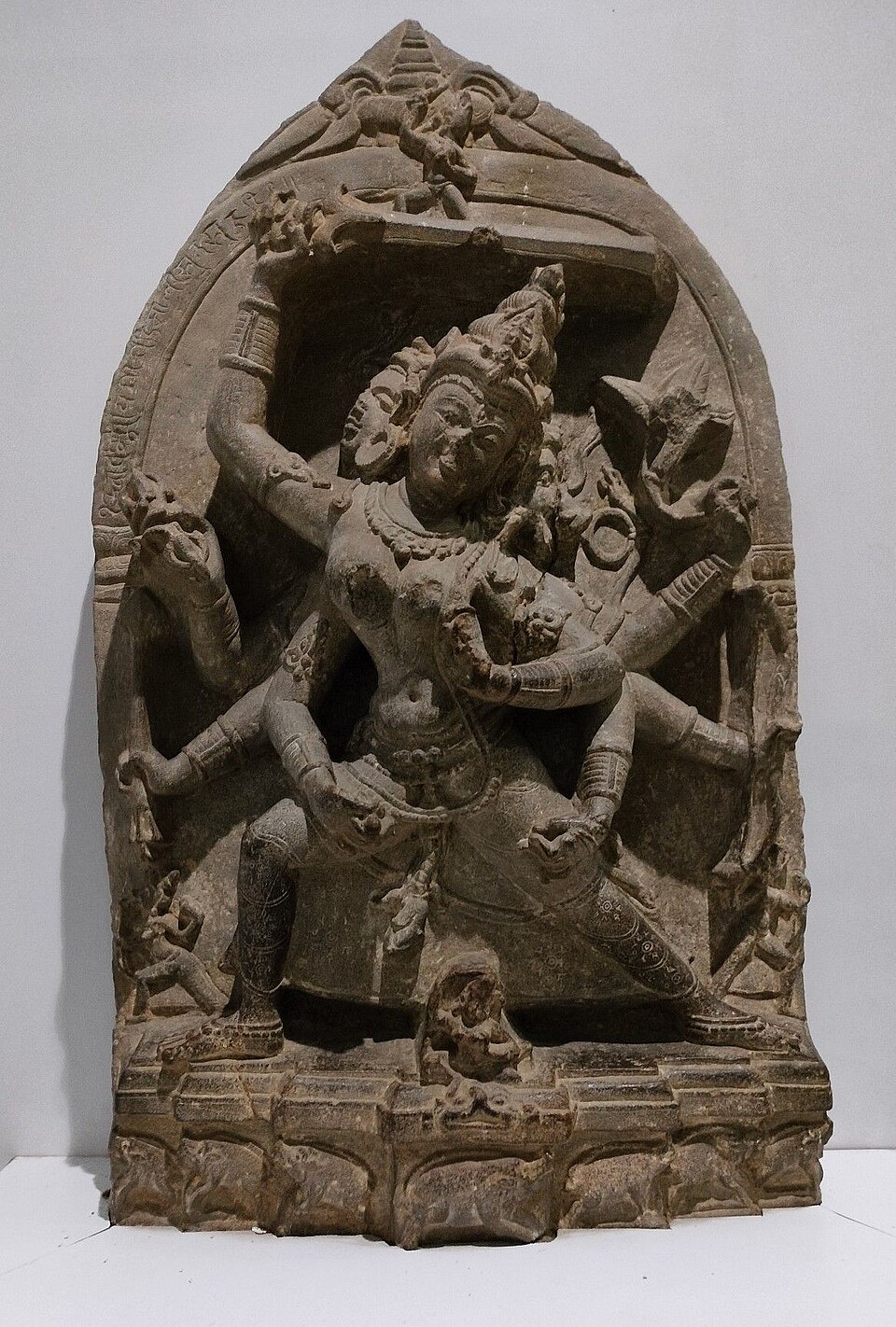
Inside the monasteries. For all their anti-monastic rhetoric, the tantras were copied, commented on and ritually performed in the great monasteries. Tāranātha’s history, written in Tibet in 1608, says that Dharmapāla built Vikramaśīla with fifty-three of its 108 temples dedicated to the secret tantras, and that Dharmapāla honoured masters of the Guhyasamāja;[32][33][8] many of the commentators were ordained monks.[24] The monks resolved the conflict between tantric practice and their vows by interpretation: the transgressive rites could be performed in visualisation, with a visualised partner, or reserved for the rare adept. The Kālacakra system, the last major Indian tantra, was taught by monks and designed to fit monastic life. Majority
Why did esoteric Buddhism arise?
Two influential explanations have been offered, one social and one textual. They are compatible.
Davidson: the monastery as a feudal court. Ronald Davidson argues that after the Gupta empire broke up, India became a world of competing regional kings and their vassals (sāmanta), bound by ritual consecration and oaths of loyalty. Esoteric Buddhism, he argues, mirrored that world: the maṇḍala is a court with an overlord Buddha at the centre and lesser deities as vassals around him; initiation (abhiṣeka) is a coronation; the practitioner becomes a king of his own maṇḍala. The monasteries adopted the ritual idiom of the courts on which their land and safety depended.[24] The reading is influential but debated: Christian Wedemeyer questions the search for a single social origin of tantra and rejects the picture of the tantras as the product of marginal figures,[37] and Sanderson places the decisive context in Śaiva dominance of royal religion rather than in feudal politics as such.[8] Contested
Sanderson: borrowing from Śaivism. Alexis Sanderson argues that this period was the “Śaiva age”, in which Śaiva tantric religion dominated royal patronage across India (Hinduism §9). He has shown that the Laghuśaṃvara Tantra contains long passages, some two hundred of its roughly seven hundred verses, redacted from Śaiva scriptures of the Vidyāpīṭha, with the deities’ names and some doctrines changed. The Buddhist tradition narrated this as a conquest: Heruka subdues Bhairava, Śiva’s fierce form, and his retinue, and takes over their sacred sites; in the images Heruka stands on Bhairava’s body.[8][11] Majority on the borrowing; Contested on its extent
The two arguments fit together. Davidson explains why monasteries wanted a ritual language of kingship and power; Sanderson shows where some of the specific texts came from. Some scholars prefer to describe much of the shared material as a common pool of tantric practice rather than one-way copying, and point out that the direction of borrowing cannot always be shown: Davidson and David Gray argued that the rougher Buddhist versions might be the older ones, and David Seyfort Ruegg describes the two traditions as drawing on a shared Indian religious substratum.[24][38][25] Sanderson replies that the Buddhist passages show the marks of misunderstood and clumsily adapted Śaiva originals, while the Śaiva versions show no dependence on Buddhist ones.[8] What is not in doubt is that Buddhist and Śaiva tantras shared vocabulary, deities and ritual forms, and that they competed for the same royal patrons.
What is absent from the last age of Indian Buddhism
- A separate tantric order. Tantric practitioners were ordained monks, lay householders and wandering yogins; there was no Vajrayāna monastic code distinct from the ordinary Vinaya.[24] Consensus
- Nālandā before the Guptas. No monastic remains at the site are earlier than the fifth century CE.[27] Consensus
- A single “destruction of Nālandā”. No medieval source records one; the evidence is of raids, abandonment and slow collapse over decades.[9] Majority
- A large lay Buddhist population comparable to the Hindu one by 1200. Buddhism’s Indian base had narrowed to monasteries and their dependants in the east (see the question page How did Buddhism disappear from India?).[6] Majority
- Tibetan schools. The Indian tantras were transmitted to Tibet in these centuries, but the Tibetan schools, incarnate lamas and the Dalai Lamas are Tibetan developments (§9). Consensus
Debates about tantra and the end of Indian Buddhism
How old is Nālandā?
The village of Nālandā near Rājagaha appears in the Pali canon, where the Buddha stays in a mango grove there,[39] and later tradition connected it with Sāriputta. Tāranātha’s Tibetan history goes further, crediting Aśoka with a temple at Nālandā and Nāgārjuna with studying there.[32] That has encouraged claims that Nālandā University existed in the Buddha’s time or earlier, which circulate widely in popular writing. The evidence does not support them. Xuanzang names a fifth- century founder; Faxian, who passed through early in the fifth century, mentions only a stūpa there; and excavation has found nothing suggesting occupation before the Guptas, the earliest datable find being a coin of Kumāragupta I.[1][27] Nālandā was an extraordinary institution for some seven centuries, from the fifth to the twelfth; pushing its foundation back a thousand years adds nothing to that. Political
Who destroyed the great monasteries?
The contemporary and near-contemporary sources, Minhāj al-Sirāj and Dharmasvāmin’s biography, both attribute the destruction of monasteries in Bihar around 1200 to Turkic Muslim troops.[19][20] Most historians accept this, while stressing that the institutions were already dependent on a narrowing royal base, and that the end of Pāla and Sena rule removed the patrons who might have rebuilt them.[6][9] Indian warfare also touched the monasteries: an inscription at Nālandā records that a Somapura monk died when an army from Vaṅga set his house on fire.[40] The wider story of Buddhism’s decline is told in How did Buddhism disappear from India?. Majority
Two other accounts circulate. An eighteenth-century Tibetan history, Sumpa Khenpo’s Pag Sam Jon Zang (1748), tells of Nālandā’s library being burned by two non-Buddhist mendicants whom young monks had insulted; it was written five centuries after the events and is legendary.[41] Giovanni Verardi has argued at length that Brahmanical hostility, not Islam, did most of the damage to Indian Buddhism and that some Hindu rulers allied with the invaders; Martin Delhey, among others, finds this reading extreme.[42][9] Both kinds of single-cause story serve present-day arguments. The evidence supports a long decline ended by military conquest. Political
Did tantra cause the decline?
Nineteenth-century European scholars, and some Buddhist modernists after them (§12), saw tantra as a corruption that discredited Buddhism in India. Historians no longer accept this. Tantra was the prestige form of Buddhism in exactly the institutions that survived longest, it was taught by monks, and it was the form of Indian Buddhism that won Tibet, Mongolia and the Himalaya in these same centuries. The decline was a matter of patronage and politics, not of doctrine. Wedemeyer traces the image of tantra as degenerate Buddhism to stock patterns in modern European historical writing.[37] Majority
Were the transgressive rites performed?
The tantras prescribe sexual union, meat and alcohol, and practice in cremation grounds, all forbidden to monks. Some scholars read these as practices carried out by non-monastic yogins and later domesticated by monastic commentators. Christian Wedemeyer argues instead that the transgressive language was largely a deliberate semiotic code, designed to signify non-dual insight, and practised by a small elite within a monastic setting. The commentarial tradition itself was divided. The question cannot be answered from texts alone. Contested[37][24]
The afterlife of Indian tantric Buddhism
Tantric Buddhism did not end in 1200. It ended as an institution of the Indian plains.
- Tibet. Over the tenth to thirteenth centuries Tibetan translators carried the Indian tantras and their commentaries north, along with whole lineages of teachers; Vikramaśīla’s Atiśa is the best known (§9). The Tibetan canon preserves hundreds of Indian tantric texts lost in Sanskrit.
- Nepal. The Newar Buddhists of the Kathmandu valley kept Sanskrit Buddhist liturgy, tantric initiation and a married hereditary priesthood, the Vajrācāryas, to the present. Their libraries preserved many of the Sanskrit manuscripts that European scholars later studied (§12).[22]
- Bengal and beyond. Monks were still being ordained in eastern Bengal in the fourteenth century. Vanaratna (1384–1468), born in eastern Bengal, probably near Chittagong, made three journeys to Tibet as a teacher and spent his last decades between Tibet and the Kathmandu valley. He is among the last Indian Buddhist teachers recorded before the modern revival.[21][9] Majority
Further reading
- Ronald M. Davidson, Indian Esoteric Buddhism: A Social History of the Tantric Movement (Columbia, 2002).
- Alexis Sanderson, “The Śaiva Age,” in Genesis and Development of Tantrism, ed. S. Einoo (Tokyo, 2009).
- Christian K. Wedemeyer, Making Sense of Tantric Buddhism (Columbia, 2013).
- David B. Gray, The Cakrasamvara Tantra: A Study and Annotated Translation (AIBS, 2007).
- John R. Newman, “Islam in the Buddhist Kālacakra Tantra,” JIABS 21 (1998).
- George Roerich, trans., Biography of Dharmasvāmin (K. P. Jayaswal Research Institute, 1959).
- Martin Delhey, “The Library at the East Indian Buddhist Monastery of Vikramaśīla,” manuscript cultures 8 (2015) — open access.
- David N. Gellner, Monk, Householder, and Tantric Priest: Newar Buddhism and Its Hierarchy of Ritual (Cambridge, 1992).
References
- ^ a b c d e f Xuanzang, Record of the Western Regions 9 — Da Tang Xiyu ji. 646 CE. Classical Chinese. Xuanzang's account of Nālandā, where he studied in the 630s: the line of kings from Śakrāditya who built its monasteries one after another, and its reputation for learning and debate. about
- ^ a b c Yijing, Account of Buddhism Sent from the Southern Seas — Nanhai jigui neifa zhuan. c. 691 CE. Classical Chinese. Mahāyāna and non-Mahāyāna monks keep the same Vinaya; those who worship bodhisattvas and read Mahāyāna sūtras are called Mahāyānists. The clearest contemporary statement that Mahāyāna was not a separate order. read the text
- ^ a b c d e J. Takakusu, trans. A Record of the Buddhist Religion as Practised in India and the Malay Archipelago (A.D. 671–695), by I-tsing. Clarendon Press, 1896. full text Yijing's account of monastic life, including Nālandā's size, endowment and curriculum.
- ^ a b c T 848 (Mahāvairocana Sūtra) — Vairocanābhisaṃbodhi. before 674 CE. Sanskrit (Chinese translation 724–725). An early systematic esoteric scripture: the maṇḍala of the cosmic Buddha Vairocana, mantra and initiation, translated into Chinese by Śubhakarasiṃha and Yixing. read the text
- ^ a b c Sarvatathāgatatattvasaṃgraha — Yoga tantra. late 7th c. CE. Sanskrit. The root text of 'yoga tantra': the practitioner visualises himself as a Buddha within the Vajradhātu maṇḍala. Partly translated into Chinese by Vajrabodhi and Amoghavajra in the eighth century. read the text
- ^ a b c Romila Thapar Early India: From the Origins to AD 1300. Penguin, 2002. full text The best single-volume political and social history for this whole span.
- ^ a b c d e Somapura monastery seals — Paharpur, Bangladesh. late 8th–9th c. CE. Sanskrit. Seals naming the great monastery of Śrī Dharmapāladeva at Somapura, which identify the Paharpur ruins and their royal Pāla founder. about
- ^ a b c d e f g h i j k l Alexis Sanderson "The Śaiva Age: The Rise and Dominance of Śaivism during the Early Medieval Period". in Shingo Einoo, ed., Genesis and Development of Tantrism (Institute of Oriental Culture, University of Tokyo), pp. 41–349, 2009. full text The argument that Śaivism, not Vedānta, was the dominant religious force of the age.
- ^ a b c d e f g h i j k Martin Delhey "The Library at the East Indian Buddhist Monastery of Vikramaśīla: An Attempt to Identify Its Himalayan Remains". manuscript cultures 8, 2015. open access A careful, open-access account of the eastern monasteries' end, with the key Persian and Tibetan sources quoted.
- ^ a b Guhyasamāja Tantra — Esoteric Buddhist scripture. c. 8th c. CE. Sanskrit. A foundational 'great yoga' tantra whose antinomian language and yoga of the subtle body became the centre of later monastic tantric study.
- ^ a b c d Laghuśaṃvara Tantra — Cakrasaṃvara cycle. c. 8th–9th c. CE. Sanskrit. Root text of the Cakrasaṃvara cycle. Alexis Sanderson identified some two hundred of its roughly seven hundred verses as redacted from Śaiva Vidyāpīṭha scriptures. about
- ^ a b c Hevajra Tantra 2.2.51 — Hevajra Tantra. c. 9th–10th c. CE. Sanskrit. 'The world is bound by passion; by passion too it is released': the yoginī tantras' principle that desire is the material of awakening. read the text
- ^ a b c Nālandā copper plate of Devapāla — Nālandā. mid-9th c. CE. Sanskrit. Records that Bālaputradeva, Śailendra king of Suvarṇadvīpa, built a monastery at Nālandā and that the Pāla king Devapāla granted five villages for its upkeep. about
- ^ a b Caryāgīti (Charyapada) — Songs of the siddhas. c. 9th–12th c. CE. Early Bengali (Old Bengali-Assamese-Odia). Forty-seven tantric songs by twenty-three siddha poets, found in the Nepal royal library in 1907 by Haraprasad Shastri; among the oldest literature in Bengali. about
- ^ a b c d Laghukālacakra Tantra 1.154 — Kālacakra Tantra. c. 1025–1040 CE. Sanskrit. Lists the teachers of the barbarian (mleccha) religion: 'Adam, Noah, Abraham, and five others – Moses, Jesus, the White-Clad One, Muhammad, and Mahdi' (trans. Alexander Berzin). Indian Buddhist knowledge of Islam on the eve of conquest. about
- ^ a b Vimalaprabhā (year 403 of the barbarians) — Puṇḍarīka, commentary on the Kālacakra. c. 1025–1040 CE. Sanskrit. Names a year 403 of the barbarians' era; as a Hijra year, 1012–13 CE. One of the clues that date the Kālacakra corpus to the early eleventh century. about
- ^ a b John R. Newman "The Epoch of the Kālacakra Tantra". Indo-Iranian Journal 41, pp. 319–349, 1998. doi The calendrical evidence that dates the Kālacakra corpus to the early eleventh century and explains its epoch of 1027 CE.
- ^ Bodhipathapradīpa (Tōh. 3947) — Atiśa. c. 1042. Sanskrit (surviving in Tibetan). Atiśa's Lamp for the Path to Awakening, written in western Tibet: three kinds of practitioners and one graduated path that includes tantra. about
- ^ a b c d Ṭabaqāt-i Nāṣirī (Raverty, vol. 1, p. 552) — Minhāj al-Sirāj Jūzjānī. c. 1260 CE. Persian. Muhammad Bakhtiyār Khalji's troops take a fortified 'Bihar', kill its shaven-headed inhabitants and find it full of books: a Buddhist monastery, probably Odantapurī, sacked around 1200. about
- ^ a b c d e f Biography of Dharmasvāmin — Chos dpal dar dpyang. 13th c. CE. Classical Tibetan. Eyewitness of Bihar in 1234–36: Vikramaśīla razed by Turkic troops and its stones thrown into the Ganges; Nālandā damaged but still teaching about seventy monks under its aged abbot. about
- ^ a b Franz-Karl Ehrhard "Spiritual Relationships Between Rulers and Preceptors: The Three Journeys of Vanaratna (1384–1468) to Tibet". in Christoph Cüppers, ed., The Relationship Between Religion and State (chos srid zung 'brel) in Traditional Tibet (Lumbini International Research Institute), pp. 245–265, 2004. The career of one of the last recorded Indian Buddhist masters, a Bengali monk who taught in Nepal and Tibet in the fifteenth century.
- ^ a b c David N. Gellner Monk, Householder, and Tantric Priest: Newar Buddhism and Its Hierarchy of Ritual. Cambridge University Press, 1992. The Newar Buddhists of the Kathmandu valley, heirs to Indian tantric Buddhism, with their married Vajrācārya priesthood.
- ^ a b Nālandā monastery seals — Nālandā. c. 5th–12th c. CE. Sanskrit in Gupta and later scripts. Clay sealings with a wheel between two deer and the legend śrī-nālandā-mahāvihārīyārya-bhikṣu-saṅghasya, 'of the community of noble monks of the great monastery of glorious Nālandā': the monastery as a legal corporation. about
- ^ a b c d e f Ronald M. Davidson Indian Esoteric Buddhism: A Social History of the Tantric Movement. Columbia University Press, 2002. The social history of tantric Buddhism: the maṇḍala as a feudal court and initiation as coronation in post-Gupta India.
- ^ a b David Seyfort Ruegg The Symbiosis of Buddhism with Brahmanism/Hinduism in South Asia and of Buddhism with "Local Cults" in Tibet and the Himalayan Region. Austrian Academy of Sciences Press, Vienna, 2008. Argues that Buddhist and Brahmanical religion shared a common Indian 'substratum', so that 'borrowing' is too simple a model; the main alternative to Sanderson's account of one-way Buddhist redaction of Śaiva texts.
- ^ a b c d John R. Newman "Islam in the Buddhist Kālacakra Tantra". Journal of the International Association of Buddhist Studies 21, 1998. How the Kālacakra portrays Islam, and the internal evidence that dates the text to c. 1025–1040.
- ^ a b c A. Ghosh Nalanda. Archaeological Survey of India, 5th ed. (1st ed. 1939), 1965. full text The Survey's own guide to the excavations begun in 1915–16: nothing found suggests occupation of the site before the Guptas, the earliest datable find being a coin of Kumāragupta I.
- ^ Hirananda Sastri Nalanda and Its Epigraphic Material. Memoirs of the Archaeological Survey of India 66, 1942. full text Edition of the Nālandā inscriptions and seals, including the 775 monastery sealings reading śrī-nālandā-mahāvihārīyārya-bhikṣu-saṅghasya and the copper plate of Devapāla.
- ^ D. L. Snellgrove The Hevajra Tantra: A Critical Study. Oxford University Press, 2 vols., 1959. full text The Sanskrit and Tibetan text with translation.
- ^ H. G. Raverty, trans. Ṭabakāt-i-Nāṣirī: A General History of the Muhammadan Dynasties of Asia. Bibliotheca Indica, 2 vols., 1881. full text The standard English translation of Minhāj al-Sirāj's chronicle.
- ^ George Roerich, trans. Biography of Dharmasvāmin (Chag lo-tsa-ba Chos-rje-dpal), a Tibetan Monk Pilgrim. K. P. Jayaswal Research Institute, Patna, 1959. full text The Tibetan text and translation of the most important eyewitness of Bihar after the conquest.
- ^ a b c d Tāranātha, History of Buddhism in India (Rgya gar chos 'byung) — Tāranātha. 1608. Classical Tibetan. A late but detailed Tibetan history of Indian Buddhism: credits Dharmapāla with Vikramaśīla and its 108 temples, fifty-three of them for the secret tantras; names its six gatekeeper scholars; ties Candrakīrti and Śāntideva to Nālandā; also preserves legends, such as Aśoka founding a temple there, that excavation does not confirm. about
- ^ a b Lama Chimpa and Alaka Chattopadhyaya, trans.; Debiprasad Chattopadhyaya, ed. Tāranātha's History of Buddhism in India. Indian Institute of Advanced Study, Simla, 1970. full text The standard English translation of Tāranātha's 1608 history, with notes; the source for the Tibetan picture of Vikramaśīla.
- ^ dBa' bzhed (Testament of Ba) — Account of the founding of Samye. versions from the 11th c. onward; core possibly older. Classical Tibetan. The main narrative of how Buddhism was established under Trisong Detsen: Śāntarakṣita, Padmasambhava's short stay, the building of Samye and the debate with the Chinese party. about
- ^ Abhayadatta, Caturaśītisiddhapravṛtti — Lives of the Eighty-Four Siddhas. c. 11th–12th c. CE. Sanskrit (surviving in Tibetan). The source of the canonical count of eighty-four mahāsiddhas: short lives of adepts who include low-caste labourers, kings who abandoned their thrones and monks who left their monasteries. about
- ^ Keith Dowman Masters of Mahāmudrā: Songs and Histories of the Eighty-Four Buddhist Siddhas. State University of New York Press, 1985. full text Translation of Abhayadatta's lives of the eighty-four siddhas with their songs.
- ^ a b c Christian K. Wedemeyer Making Sense of Tantric Buddhism: History, Semiology, and Transgression in the Indian Traditions. Columbia University Press, 2013. Argues that tantric transgression was a deliberate semiotic code practised within monastic elites, not the cult of marginal yogins.
- ^ David B. Gray The Cakrasamvara Tantra (The Discourse of Śrī Heruka): A Study and Annotated Translation. American Institute of Buddhist Studies, 2007. Translation and study of the Laghuśaṃvara, with discussion of its Śaiva parallels.
- ^ DN 11 — Kevaddha Sutta (Dīgha Nikāya). c. 400–300 BCE. Pali. Set 'near Nāḷandā in Pāvārika's Mango Grove', a 'successful and prosperous' town: the Pali canon knows Nālandā as a place the Buddha stayed, not as a monastery. read the text
- ^ Nālandā inscription of Vipulaśrīmitra — Nālandā, Monastery 7. c. 12th c. CE. Sanskrit. Found at Nālandā: a eulogy of the monk Vipulaśrīmitra recording that his predecessor Karuṇāśrīmitra died when his house at Somapura monastery was set on fire by an army of Vaṅgāla.
- ^ Pag Sam Jon Zang — Sumpa Khenpo Yeshe Paljor. 1748. Tibetan. A Tibetan history of Buddhism in India that tells how two non-Buddhist mendicants, insulted by young monks, set Nālandā's library on fire. Legendary, and written five centuries after the events. about
- ^ Giovanni Verardi Hardships and Downfall of Buddhism in India. Manohar, 2011. Argues that Brahmanical hostility, not Islam, was the main force against Indian Buddhism. Provocative and widely disputed.