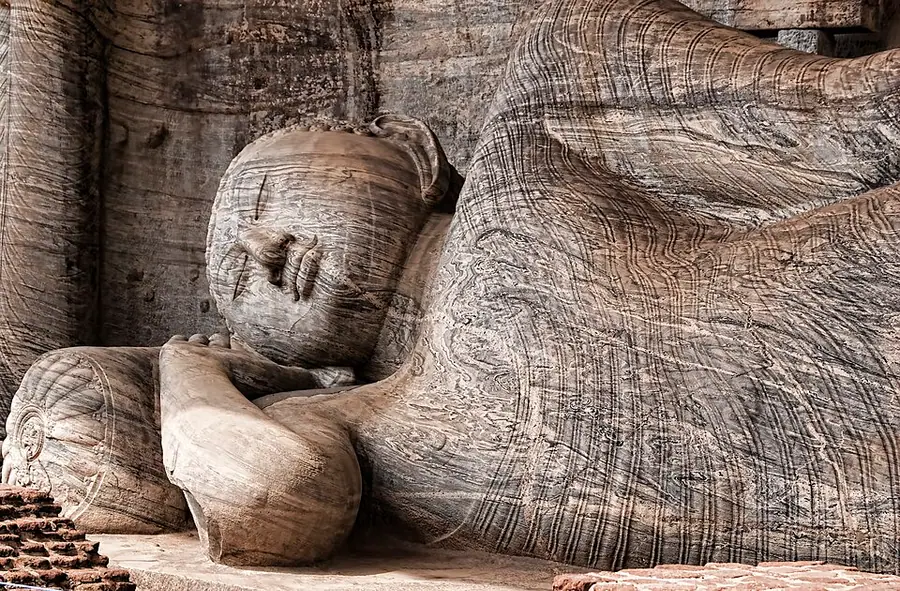
The short version: Theravāda and Mahāyāna share a founder, a monastic code descended from the same early rules, and a common stock of early discourses. They differ in which further scriptures they accept and in the goal they recommend. Theravāda holds to the Pali Canon and the ideal of the arhat, who is freed from rebirth. Mahāyāna adds a large body of later sūtras and urges everyone to take the longer path of the bodhisattva, who becomes a Buddha in order to free all beings.[1][2] Both names, and the habit of treating them as two churches, are more recent than the traditions they describe.
The evidence on Theravāda and Mahāyāna
“Hīnayāna”: a word for opponents
The Mahāyāna sūtras call the older paths the hīnayāna, the “inferior vehicle.” No school ever used that word of itself. It was a polemical term, and it is not a historical name for Theravāda, which is one surviving lineage of the older schools. Scholars now speak of “mainstream” or “Nikāya” Buddhism instead (§6).[1] Consensus
The Lotus Sūtra explains why the older paths were taught at all. A father whose children will not leave a burning house promises them carts drawn by goats, deer and oxen; when they run out, he gives each of them one great carriage. The three carts are the paths of the disciple, the solitary Buddha and the bodhisattva; the great carriage is Buddhahood for all.[3]
What it proves. Mahāyāna authors did not reject the older teaching. They kept it and ranked it as provisional, a skilful means for those not yet ready for the whole truth. That is the logical shape of the difference to this day. Consensus
Same rules, same monasteries
The sharpest historical point is that Mahāyāna never had monastic rules of its own. Monastic identity in India came from ordination lineage, and Mahāyāna monks were ordained in the mainstream lineages. Around 690 CE the Chinese pilgrim Yijing described what he saw in India and Southeast Asia. Both kinds of monk, he says, “adopt one and the same discipline (Vinaya),” and, in J. Takakusu’s translation:
“Those who worship the Bodhisattvas and read the Mahāyāna Sūtras are called the Mahāyānists (the Great), while those who do not perform these are called the Hīnayānists (the Small).”[4][5]
What it proves. In Yijing’s day the difference lay in what a monk worshipped and read, not in his rules or his membership. Both kinds followed the same Vinaya. Faxian, around 400, describes Indian monasteries that were Mahāyāna, non-Mahāyāna or mixed.[6] That arrangement survives in a changed form: Chinese, Korean and Vietnamese monks are still ordained under the Dharmaguptaka Vinaya, and Tibetan monks under the Mūlasarvāstivāda Vinaya. Both are codes of mainstream schools.[1] Majority
“Theravāda”: an old lineage with a new name
The word theravāda, “the teaching of the elders,” is rare in pre-modern sources. Where it occurs it usually refers to the Mahāvihāra monastery’s interpretation of the texts, not to a branch of Buddhism. Southeast Asian monks more often described themselves as belonging to the Sinhalese or Laṅkā lineage.[7] “Theravāda Buddhism,” as one of the three branches of a world religion, came into general use through European scholarship and after the World Fellowship of Buddhists met in Ceylon in 1950, where it replaced “Hīnayāna” as the polite name.[8] Majority
Mahāyāna in “Theravāda” lands
The countries now called Theravāda were not always so. In Sri Lanka the Abhayagiri monastery accepted Mahāyāna and later tantric texts for centuries, until King Parākramabāhu I unified the orders under the Mahāvihāra around 1165 (§5, §10).[9][10] A tenth-century inscription of King Mahinda IV (found, despite its conventional name, in the Abhayagiri complex) declares that, in Wickremasinghe’s translation as usually quoted, “none but the Bodhisattvas would become kings of Lanka.”[11] Borobudur in Java was a Mahāyāna monument, and Angkor under Jayavarman VII was a Mahāyāna kingdom before Cambodia turned to Theravāda in the thirteenth and fourteenth centuries (§10).[12][13]
What it proves. The bodhisattva ideal was not foreign to the Theravāda world. The Pali tradition itself has a bodhisatta path, with ten perfections (pāramī), for the rare person who will become a future Buddha: the Buddhavaṃsa tells how the ascetic Sumedha vowed to become a Buddha and took up the perfections one by one.[14] What it never did was recommend that path to everyone. Majority
What really differs
The goal. In the early texts the arhat reaches the same liberation as the Buddha; the Buddha is distinguished as the one who found the path and taught it.[15] Mahāyāna sūtras treat the arhat’s liberation as incomplete and urge the bodhisattva vow: to become a Buddha, however many lives it takes, for the sake of all beings.[16] Early Mahāyāna did not make this an easy popular option. The Inquiry of Ugra, one of the oldest datable Mahāyāna sūtras, presents it as a hard path for a few, ideally lived in the wilderness.[17][16]
The Buddha. The early discourses already call the Buddha the “embodiment of the dhamma”:
Tathāgatassa hetaṃ, vāseṭṭha, adhivacanaṃ ‘dhammakāyo’ itipi
“For this, Vāseṭṭha, is a term for the Realized One: ‘the embodiment of the dhamma.’” (Adapted from Bhikkhu Sujato’s translation.)[18]
In the Pali tradition that remains an epithet; the Buddha grew old and died at Kusinārā (§2).[19] Mahāyāna developed it into a theory of the Buddha’s bodies. The Lotus reveals that Śākyamuni’s lifespan is immeasurable and his death a display for those who needed it, and later Yogācāra thinkers distinguished a Buddha’s truth-body from the bodies in which he appears.[20][1] Mahāyāna also fills the universe with Buddhas and bodhisattvas who can be prayed to, such as Amitābha and Avalokiteśvara (§6).
The scriptures. Theravāda’s canon is the Pali Canon. Mahāyāna has no single closed canon: the new sūtras were added to the older texts rather than replacing them. The Chinese and Tibetan canons keep the early discourses and mainstream Vinayas alongside thousands of Mahāyāna works.[21][22] The great philosophies of emptiness and mind-only, Madhyamaka and Yogācāra, are Mahāyāna (§6).
What is shared. The four noble truths, dependent origination, not-self, karma and rebirth, the monastic precepts and much of the meditation practice belong to both. Both venerate relics and stupas, and both keep the Buddha’s life story.[2] Consensus
Where each is found today
Theravāda is the main form of Buddhism in Sri Lanka, Myanmar, Thailand, Laos and Cambodia. Mahāyāna in its East Asian forms prevails in China, Taiwan, Korea, Japan and Vietnam, and in its tantric form, often called Vajrayāna, in Tibet, Mongolia and Bhutan. The largest Buddhist populations are in Thailand (about 68 million) and China (about 53 million).[23] Vajrayāna is often counted as a third “branch,” but it understands itself as a form of Mahāyāna (§8, §9).
A short timeline
| Date | What happens | Confidence |
|---|---|---|
| c. 300–100 BCE | The early schools divide, mainly over monastic rules (§3)[24] | Majority |
| c. 1st c. BCE | First Mahāyāna sūtras composed[1] | Majority |
| 1st c. BCE | The Pali Canon written down in Sri Lanka[25] | Majority |
| c. 400 CE | Faxian finds Mahāyāna, non-Mahāyāna and mixed monasteries in India[6] | Consensus |
| c. 690 CE | Yijing: both follow the same Vinaya[4] | Consensus |
| c. 1165 | Sri Lanka’s orders unified under the Mahāvihāra[10] | Majority |
| 1950 | “Theravāda” adopted as the polite name in place of “Hīnayāna”[8] | Majority |
What scholars disagree about
Whether Mahāyāna was ever a sect. Most scholars, following Heinz Bechert, hold that it was not a schism in the technical sense, because Mahāyāna monks kept performing monastic acts with others under the same rules. Joseph Walser has questioned whether schism in India was always a matter of discipline rather than doctrine, and how separate Mahāyāna communities became in particular places is less clear.[1] Majority
How old the Theravāda lineage is. The Mahāvihāra traced itself to Mahinda, Ashoka’s son, and the council under Ashoka (§3, §4).[26] The chronicles that say so are the Mahāvihāra’s own partisan history, and the claim to be the original Buddhism is a claim, not a finding. Majority
Whether to speak of “three branches.” The Theravāda/Mahāyāna/Vajrayāna scheme is useful for maps and modern, and it hides the shared monastic law and the long history of mixing. Majority
Common misconceptions
- “Theravāda is Hīnayāna.” “Hīnayāna” was a Mahāyāna insult for the older paths, never a school’s own name.[8]
- “Theravāda is the original Buddhism.” It is one surviving lineage of the early schools, with its own later commentaries and history. Its canon is old but not the only early one (§0).[27]
- “Mahāyāna is the lay form, Theravāda the monastic form.” The earliest datable Mahāyāna texts were written by and for monks.[16]
- “Mahāyāna Buddhists reject the early teachings.” They kept them, and ranked them as provisional.[3]
Why it matters
The difference is real, but it is a difference inside one tradition: of scripture, goal and devotion, not of founder or monastic law. Seeing it historically explains why a Chinese monk and a Thai monk recite many of the same discourses, keep almost the same precepts, and still describe the purpose of the path differently.
For the origins of Mahāyāna, see Chapter 6: The Mahāyāna Turn. For the history of Theravāda in Sri Lanka and Southeast Asia, see Chapter 10: Theravāda and Southeast Asia.
References
- ^ a b c d e f Paul Williams Mahāyāna Buddhism: The Doctrinal Foundations. Routledge, 2nd ed., 2009. The standard introduction to Mahāyāna thought and to the origins debate.
- ^ a b Rupert Gethin The Foundations of Buddhism. Oxford University Press, 1998. The clearest introduction to early Buddhist thought and to what the canon is.
- ^ a b Saddharmapuṇḍarīka 2–3 — Lotus Sūtra. c. 1st–2nd c. CE (Chinese 286 CE). Buddhist Sanskrit. Skilful means (upāya) and the one vehicle (ekayāna): the earlier paths were provisional, and the parable of the burning house shows all three carts replaced by one great carriage of Buddhahood. read the text
- ^ a b Yijing, Account of Buddhism Sent from the Southern Seas — Nanhai jigui neifa zhuan. c. 691 CE. Classical Chinese. Mahāyāna and non-Mahāyāna monks keep the same Vinaya; those who worship bodhisattvas and read Mahāyāna sūtras are called Mahāyānists. The clearest contemporary statement that Mahāyāna was not a separate order. read the text
- ^ J. Takakusu, trans. A Record of the Buddhist Religion as Practised in India and the Malay Archipelago (A.D. 671–695), by I-tsing. Clarendon Press, 1896. full text Yijing's account of monastic life, including Nālandā's size, endowment and curriculum.
- ^ a b Faxian, Record of Buddhist Kingdoms — Foguo ji. c. 416 CE. Classical Chinese. The pilgrim's account of India c. 399–414, describing monasteries as Mahāyāna, non-Mahāyāna or mixed, and the two kinds of monks living side by side; he also stayed two years in Sri Lanka and counted the monks of its great monasteries. read the text
- ^ Peter Skilling "Theravāda in History". Pacific World, 3rd series, 11: 61–93, 2009. open access Shows how rarely and in what sense pre-modern sources use the word theravāda.
- ^ a b c Todd LeRoy Perreira "Whence Theravāda? The Modern Genealogy of an Ancient Term". In How Theravāda is Theravāda?, ed. P. Skilling et al., Silkworm Books, 2012. open library Traces 'Theravāda Buddhism' as a denominational label to the 20th century and the 1950 World Fellowship of Buddhists.
- ^ Mahāvaṃsa 37 — Mahāvaṃsa. c. 5th–6th c. CE. Pali. King Mahāsena, under the influence of a monk of the rival party, has the Mahāvihāra demolished and its materials taken to the Abhayagiri; it is later restored. read the text
- ^ a b R. A. L. H. Gunawardana Robe and Plough: Monasticism and Economic Interest in Early Medieval Sri Lanka. University of Arizona Press, 1979. The economics behind the Mahāvihāra–Abhayagiri rivalry.
- ^ Jetavanārāma slab inscription of Mahinda IV — Anurādhapura inscriptions. 10th c. CE (r. 956–972). Sinhala. A tenth-century royal inscription from Anurādhapura declaring that none but bodhisattvas become kings of Lanka: the bodhisattva ideal used for kingship in a Theravāda country.
- ^ Borobudur — Central Java. c. 780–830 CE. The Śailendra Mahāyāna monument: galleries carved with the Lalitavistara life of the Buddha, Jātakas and the Gaṇḍavyūha, rising to latticed stupas with seated Buddhas. about
- ^ Ian Harris Cambodian Buddhism: History and Practice. University of Hawai'i Press, 2005. The standard history, from Angkor's Hindu and Mahāyāna cults to Theravāda and beyond.
- ^ Buddhavaṃsa 2 — Buddhavaṃsa (Khuddaka Nikāya). c. 2nd–1st c. BCE. Pali. The ascetic Sumedha, meeting the past Buddha Dīpaṅkara, vows to become a Buddha and takes up the ten perfections (pāramī) one by one, beginning with giving: the Pali bodhisatta path. read the text
- ^ SN 22.58 — Sammāsambuddha Sutta (Saṃyutta Nikāya). c. 400–200 BCE. Pali. The Buddha and a monk freed by wisdom are freed in the same way; the difference is that the Buddha discovered, created and taught the unarisen path, which his disciples follow. read the text
- ^ a b c Jan Nattier A Few Good Men: The Bodhisattva Path according to The Inquiry of Ugra (Ugraparipṛcchā). University of Hawai'i Press, 2003. Translation and study of one of the earliest datable Mahāyāna sūtras; argues the early bodhisattva path was an elite monastic vocation.
- ^ T 322 (Fa jing jing) — Inquiry of Ugra (Ugraparipṛcchā). c. 181 CE. Classical Chinese. The earliest Chinese translation of the Inquiry of Ugra, a guide for householder and monastic bodhisattvas that praises renunciation and life in the wilderness. read the text
- ^ DN 27 — Aggañña Sutta (Dīgha Nikāya). c. 300 BCE. Pali. The four varṇas originate by contract and labour, not from a primal being's body — a direct counter-narrative to the Puruṣa Sūkta, read by Gombrich as satire. read the text
- ^ DN 16 — Mahāparinibbāna Sutta (Dīgha Nikāya). c. 400–200 BCE, with later layers. Pali. The last months of the Buddha's life: his age (80), the last meal of sūkaramaddava at Cunda's house, the death at Kusinārā and the division of the relics into eight shares. read the text
- ^ Saddharmapuṇḍarīka (whole) — Lotus Sūtra. c. 1st–3rd c. CE, in layers (Chinese 286 and 406 CE). Buddhist Sanskrit. The full Lotus Sūtra, including its later chapters: the Buddha's lifespan as immeasurable, his death a display for the sake of beings, and the chapter on Avalokiteśvara that circulated on its own in East Asia. read the text
- ^ Jan Nattier A Guide to the Earliest Chinese Buddhist Translations. International Research Institute for Advanced Buddhology, Soka University, 2008. Which Han-dynasty translations are really by whom, and therefore which texts existed when.
- ^ Oskar von Hinüber A Handbook of Pāli Literature. De Gruyter, 1996. The standard reference on what the Pali canon is, when its parts were fixed and how the language relates to what the Buddha spoke.
- ^ Pew Research Center How the Global Religious Landscape Changed From 2010 to 2020. Pew Research Center, 2025. open access The source of the 343 and 324 million estimates and the explanation of the decline.
- ^ Janice J. Nattier & Charles S. Prebish "Mahāsāṃghika Origins: The Beginnings of Buddhist Sectarianism". History of Religions 16: 237–272, 1977. doi Argues from the Mahāsāṃghika account that the first schism was over expanding the Vinaya, not over doctrine.
- ^ Dīpavaṃsa 20.20–21 — Dīpavaṃsa. c. 4th c. CE. Pali. Sri Lanka's oldest chronicle says that under King Vaṭṭagāmaṇi the monks, seeing beings decline, wrote down the Piṭakas and commentary, which had until then been passed on by mouth. read the text
- ^ Mahāvaṃsa 12–14 — Mahāvaṃsa. c. 5th–6th c. CE. Pali. After the third council Moggaliputta Tissa sends nine missions to the borderlands, and Ashoka's son Mahinda converts King Devānaṃpiya Tissa of Sri Lanka. about
- ^ Bhikkhu Anālayo A Comparative Study of the Majjhima-nikāya. Dharma Drum, 2 vols., 2011. Every Majjhima discourse set beside its Chinese, Sanskrit and Tibetan parallels. The method of §0 carried out at full scale.