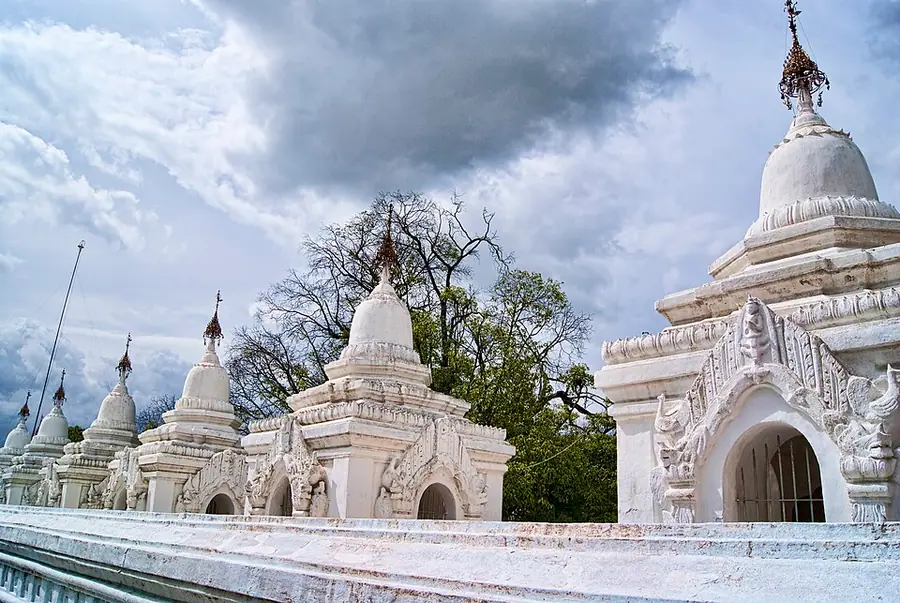
The short version: the Pali Canon was written down in Sri Lanka in the first century BCE, roughly three to three and a half centuries after the Buddha’s death, by monks who feared it would otherwise be lost.[1] Until then it existed only in memory. Writing it down did not freeze it: the commentaries were recast five centuries later, some books were added or disputed, and the printed editions of the twentieth century still disagree about where the canon ends. “When was it written?” has several answers, one for each of these stages.
The evidence for dating the Pali Canon
Three centuries of memory
The Buddha wrote nothing, and nothing suggests his early followers did either. Writing is not securely attested anywhere in India before Ashoka, around 250 BCE (§0).[2] The teaching was carried by groups of reciters (bhāṇaka), each responsible for one collection, who checked one another in communal recitation (§3). The texts still show it: the opening “thus have I heard,” the stock passages repeated word for word, the numbered lists that work as memory aids.[3][4]
The language shows something else. The Buddha taught in the eastern Ganga plain, probably in a local dialect. Pali is a literary language with a more western character, and the canon keeps scattered eastern forms, which most linguists read as traces of an older version that was translated into Pali.[4] So the canon was not only memorised but also carried from one dialect into another before anyone wrote it down. The Vinaya even records the Buddha refusing to have his words put into Vedic-style verse, and instead allowing them to be learned sakāya niruttiyā:
anujānāmi bhikkhave sakāya niruttiyā buddhavacanaṃ pariyāpuṇitun ti.
Most modern scholars read the phrase as permission to learn the word of the Buddha “in one’s own dialect.”[5][4] It is disputed: Buddhaghosa read it as the Buddha’s own dialect, and Bhikkhu Brahmali translates “using its own expressions.”
What it proves. On the usual modern reading, the Buddha’s word was treated from early on as something that could pass between languages. That is why a Pali text can be early in content and still not be the Buddha’s exact wording.
An emperor names seven texts
The only dated check on the oral period is an inscription. Around 250 BCE Ashoka’s Calcutta-Bairāṭ edict recommends seven texts to monks, nuns and lay followers. Several of its titles can be matched to discourses still in the canon, such as the advice to Rāhula about lying (MN 61) and the verses of the sage (Sn 1.12).[6] Named texts existed in Ashoka’s time, and some of them survive in the canon today.
Written down in a crisis
The oldest Sri Lankan chronicle, the Dīpavaṃsa, records the decision to write:
piṭakattayapāḷiñ ca tassa aṭṭhakatham pi ca mukhapāṭhena ānesuṃ pubbe bhikkhū mahāmatī || hāniṃ disvāna sattānaṃ tadā bhikkhū samāgatā ciraṭṭhitatthaṃ dhammassa potthakesu likhāpayuṃ ||
In Hermann Oldenberg’s 1879 translation: “Before this time, the wise Bhikkhus had orally handed down the text of the three Pitakas and also the Atthakatha. At this time, the Bhikkhus who perceived the decay of created beings, assembled and in order that the Religion might endure for a long time, they recorded (the above-mentioned texts) in written books.”[1][7]
What it proves. The monks who kept the canon remembered a long oral period followed by a deliberate decision to write, made out of fear of loss. The Mahāvaṃsa sets it in the reign of Vaṭṭagāmaṇi Abhaya, who lost his throne to a rebellion and Tamil invaders and spent about fourteen years in exile before regaining it.[8] Later commentaries remember the same years as a famine in which monks scattered and lines of reciters were broken.[9]
The commentaries also preserve the argument the survivors had. One party held that practice is the root of the teaching; the other, that learning is, because without the texts there is nothing to practise. The learners won.[10] Writing the canon down belongs to that victory, and it shaped Theravāda’s long preference for the scholar-monk.
Where: the Aluvihāra question
Neither the Dīpavaṃsa nor the Mahāvaṃsa says where this happened. The Aluvihāra cave monastery near Matale, now a national monument with a plaque recording the event, first appears in the story in Sinhala works of the thirteenth and fourteenth centuries, the Pūjāvaliya and the Nikāya-saṅgrahaya, which also describe a council of 500 monks.[11] That is more than twelve centuries after the event. The writing down is well attested; the place is a later tradition. Majority
The oldest physical Pali texts
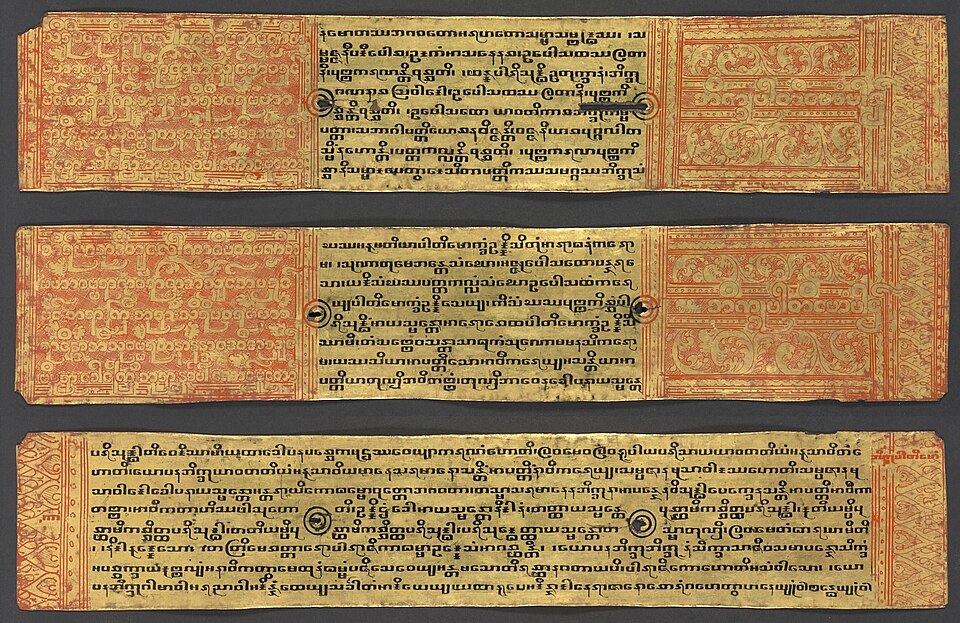
No manuscript from the first-century writing survives, and none could be expected to: palm leaf rots in the tropics. Almost every Pali manuscript is from the eighteenth or nineteenth century.[3] The oldest known is four folios of the Vinaya’s Cullavagga kept in the National Archives in Kathmandu, copied in the eighth or ninth century.[12][13] Older still are twenty gold leaves inscribed with Pali passages, buried in a reliquary at Śrī Kṣetra in Myanmar around the fifth or sixth century.[14]
The oldest physical Buddhist manuscripts of any kind are not in Pali. They are birch-bark scrolls from Gandhāra in Gāndhārī, from about the first century BCE to the second century CE. One is a version of the Rhinoceros Sūtra, the poem found in Pali as Sutta Nipāta 1.3. Its verses match the Pali closely but not exactly.[15][16] The Pali Canon was one recension among several, and the others were written down at about the same time.
Closed in stages, still not identical
Writing the canon down did not close it. The Kathāvatthu, an Abhidhamma book refuting other schools, is attributed by tradition to the council under Ashoka, so it is post-sectarian by its own account.[17] Several books of the Khuddaka Nikāya are late by language and content, and lineages counted that collection differently.[3]
The printed editions show the edges still moving. King Chulalongkorn’s Siamese edition of 1893, the first printing of an almost complete canon, left out eight Khuddaka texts, among them the Theragāthā, Therīgāthā and Jātaka.[18] The Burmese edition prepared for the Sixth Council (1954–56) includes the Milindapañha, Peṭakopadesa and Nettippakaraṇa; the Sri Lankan Buddha Jayanti edition (1957–1989) includes the last two but not the Milindapañha.[19][20][3]
A short timeline
| Date | What happens | Confidence |
|---|---|---|
| c. 400 BCE (±20 years) | The Buddha’s death, on the working chronology (§2)[21] | Contested |
| c. 400–100 BCE | The canon is carried by reciters, in more than one dialect[4] | Consensus |
| c. 250 BCE | Ashoka names seven texts[6] | Majority |
| 1st c. BCE | Written down in Sri Lanka under Vaṭṭagāmaṇi[1][8] | Majority |
| c. 1st c. BCE–2nd c. CE | Gāndhārī scrolls: the oldest Buddhist manuscripts[16] | Consensus |
| 5th c. CE | Buddhaghosa and the Pali commentaries[22] | Majority |
| c. 800–900 CE | The oldest Pali manuscript, in Nepal[12] | Consensus |
| 13th–14th c. | Sinhala works first name the Aluvihāra[11] | Majority |
| 1860–68 | The whole canon carved on 729 marble slabs at Mandalay; ratified at the Fifth Council, 1871[23] | Consensus |
| 1893 | First printed edition, in Siam[18] | Consensus |
What scholars disagree about
How much goes back to the Buddha. Comparison with the Chinese Āgamas shows a large shared core that existed before the schools divided, roughly the third century BCE.[24] Bhikkhu Sujato and Bhikkhu Brahmali argue that this core is substantially the Buddha’s own teaching.[25] Others, such as David Drewes, doubt that anything can be traced to him with confidence.[26] Most scholars sit between: early in content, edited in wording. Contested
The date of the writing. The often-quoted 29 BCE comes from older reckonings of the Sri Lankan king list. Vaṭṭagāmaṇi’s reign is now usually placed in the first century BCE without that precision. Majority
How reliable the oral period was. Recitation by groups is good at keeping wording stable, and the close agreement between independent recensions shows it worked. It is less good at stopping new material from being added, which is why the narrative and Abhidharma parts differ most between schools (§0). Majority
Common misconceptions
- “The Pali Canon is the Buddha’s own words, in his own language.” Pali was probably not his dialect, and the wording was shaped by three centuries of recitation (§0).[4]
- “The Pali Canon is the only early canon.” The Chinese Āgamas and the Gāndhārī and Sanskrit fragments preserve parallel collections of other early schools.[24][27]
- “The original Aluvihāra manuscripts survive.” None do, and no manuscript from anywhere near that date survives in Pali.[12]
- “The canon was fixed in the first century BCE.” It was written then and closed by stages; the printed editions still differ.[3]
Why the date matters
The Pali Canon is the most complete early Buddhist canon in an Indian language, and for most Western readers since the Pali Text Society was founded in 1881 it has stood for “original” Buddhism. Knowing when and how it was written down puts that in proportion. It is old and in large part early, but it is one school’s canon, preserved by one monastery in Sri Lanka, closed by stages, and edited by the institution that wrote the history of its own victory (§5, §10).
For the full story of how early Buddhist texts are dated, see Chapter 0: How We Know. For the writing down in its Sri Lankan setting, see Chapter 5: Writing It Down.
References
- ^ a b c Dīpavaṃsa 20.20–21 — Dīpavaṃsa. c. 4th c. CE. Pali. Sri Lanka's oldest chronicle says that under King Vaṭṭagāmaṇi the monks, seeing beings decline, wrote down the Piṭakas and commentary, which had until then been passed on by mouth. read the text
- ^ Richard Salomon Indian Epigraphy. Oxford University Press, 1998. open library The standard handbook for inscriptions and their dating.
- ^ a b c d e Oskar von Hinüber A Handbook of Pāli Literature. De Gruyter, 1996. The standard reference on what the Pali canon is, when its parts were fixed and how the language relates to what the Buddha spoke.
- ^ a b c d e K. R. Norman Pāli Literature. Harrassowitz, 1983. Short, dense and still reliable on the layers of the canon and the dialect problem.
- ^ Cullavagga 5.33.1 (Vin II 139) — Vinaya Piṭaka. c. 300–100 BCE. Pali. Two monks ask to put the Buddha's words into Vedic-style metre; the Buddha refuses and allows them to be learned "in one's own dialect". The phrase sakāya niruttiyā is read two ways. read the text
- ^ a b Calcutta-Bairāṭ edict — Bairāṭ, Rajasthan. c. 250 BCE. Prakrit in Brāhmī. Ashoka addresses the saṅgha directly and names seven texts he wants monks, nuns and laypeople to hear often. The only Ashokan list of Buddhist texts, and several can be matched to suttas that still survive. read the text
- ^ Hermann Oldenberg, ed. and trans. The Dîpavaṃsa: An Ancient Buddhist Historical Record. Williams and Norgate, 1879. full text Pali text and English translation of Sri Lanka's oldest chronicle; the translation quoted for Dīpavaṃsa 20.20–21.
- ^ a b Mahāvaṃsa 33 — Mahāvaṃsa. c. 5th–6th c. CE. Pali. Vaṭṭagāmaṇi's defeat by a brahmin rebel and Tamil invaders, fourteen years of exile, his return, the founding of the Abhayagiri and the writing down of the texts. read the text
- ^ Walpola Rahula History of Buddhism in Ceylon: The Anurādhapura Period. M. D. Gunasena, 1956. full text The standard account from the chronicles and commentaries, including the famine and the learning-versus-practice debate.
- ^ Manorathapūraṇī on AN 1 — Buddhaghosa's commentary on the Aṅguttara Nikāya. 5th c. CE. Pali. Recalls a famine-era debate between monks who held practice to be the root of the teaching and monks who held learning to be; learning (pariyatti) won.
- ^ a b Pūjāvaliya and Nikāya-saṅgrahaya on the writing of the canon — Sinhala Buddhist histories. 13th and 14th c. CE. Sinhala. Sinhala works of the thirteenth and fourteenth centuries that first place the writing down of the Pali Canon at the Aluvihāra monastery, at a council of 500 monks. The older chronicles name no place.
- ^ a b c Nepal Cullavagga folios — The Oldest Pāli Manuscript. c. 8th–9th c. CE. Pali. Four palm-leaf folios of the Cullavagga in the National Archives, Kathmandu. The oldest Pali manuscript known, more than a thousand years younger than the texts it carries. about
- ^ Oskar von Hinüber The Oldest Pāli Manuscript: Four Folios of the Vinaya-Piṭaka from the National Archives, Kathmandu. Akademie der Wissenschaften und der Literatur, Mainz, 1991. Edition of the eighth- or ninth-century Nepal folios.
- ^ Śrī Kṣetra gold leaves — Khin Ba stupa, Myanmar. c. 5th–6th c. CE. Pali. Twenty gold leaves inscribed with Pali passages, buried in a reliquary at the Pyu city of Śrī Kṣetra. The oldest physical Pali texts, centuries older than any Pali manuscript. about
- ^ Gāndhārī Rhinoceros Sūtra (BL fragment 5B) — British Library Kharoṣṭhī fragments. c. 1st c. CE. Gāndhārī in Kharoṣṭhī. A Gāndhārī version of the poem known in Pali as the Khaggavisāṇa Sutta (Sn 1.3). Its verses match the Pali closely but not exactly: the clearest physical proof that early texts circulated in more than one language. read the text
- ^ a b Richard Salomon Ancient Buddhist Scrolls from Gandhāra: The British Library Kharoṣṭhī Fragments. University of Washington Press, 1999. open library The discovery that put physical first-century Buddhist manuscripts on the table. Readable and careful about what the scrolls do and don't prove.
- ^ Kathāvatthu — Abhidhamma Piṭaka. c. 250 BCE onward, with later additions. Pali. 'Points of Controversy': over two hundred debates refuting other schools' views, attributed by Theravāda tradition to Moggaliputta Tissa at the Third Council. read the text
- ^ a b Chulalongkorn Tipiṭaka, 1893 — Siamese printed edition of the Pali Canon. 1893. Pali in Thai script. The first printed edition of an almost complete Pali Canon, 39 volumes in Thai script, issued for King Chulalongkorn's jubilee. It omits eight Khuddaka Nikāya texts, including the Theragāthā, Therīgāthā and Jātaka. about
- ^ Sixth Council edition (Chaṭṭha Saṅgāyana) — Burmese printed edition of the Pali Canon. 1950s–1962. Pali in Burmese script. The edition prepared for the Sixth Council held at Rangoon in 1954–56, with canon, commentaries and subcommentaries. Its Khuddaka Nikāya includes the Milindapañha, Peṭakopadesa and Nettippakaraṇa. about
- ^ Buddha Jayanti Tipiṭaka, 1957–1989 — Sri Lankan printed edition of the Pali Canon. 1957–1989. Pali in Sinhala script, with Sinhala translation. The Sri Lankan government edition begun for the 2,500th Buddha Jayanti, Pali text with Sinhala translation. It includes the Peṭakopadesa and Nettippakaraṇa but not the Milindapañha. about
- ^ Heinz Bechert, ed. The Dating of the Historical Buddha. Vandenhoeck & Ruprecht, 3 vols., 1991. The symposium that unsettled the traditional dates — and reached no consensus.
- ^ Visuddhimagga 1.1 — Buddhaghosa. 5th c. CE. Pali. Buddhaghosa opens his Path of Purification by quoting SN 1.23, "a wise person grounded in ethics, developing the mind and wisdom", and builds the whole book on its three terms: ethics, concentration, wisdom. read the text
- ^ Kuthodaw Pagoda Tipiṭaka slabs — Mandalay. 1860–68; ratified 1871. Pali in Burmese script. The whole Pali canon carved on 729 marble slabs for King Mindon, each in its own shrine, and recited and ratified by about 2,400 monks at the Fifth Council of 1871. about
- ^ a b Bhikkhu Anālayo A Comparative Study of the Majjhima-nikāya. Dharma Drum, 2 vols., 2011. Every Majjhima discourse set beside its Chinese, Sanskrit and Tibetan parallels. The method of §0 carried out at full scale.
- ^ Bhikkhu Sujato & Bhikkhu Brahmali The Authenticity of the Early Buddhist Texts. Journal of the Oxford Centre for Buddhist Studies, supplement to vol. 5, 2014. open access The case that the core of the Nikāyas and Āgamas goes back to the Buddha's time, argued from inside the tradition but with the scholarly apparatus.
- ^ David Drewes "The Idea of the Historical Buddha". Journal of the International Association of Buddhist Studies 40, 2017. Argues scholarship has established nothing about the man. Answered by Wynne, Levman and von Hinüber.
- ^ Richard Salomon The Buddhist Literature of Ancient Gandhāra: An Introduction with Selected Translations. Wisdom Publications, 2018. The best overview of every Gāndhārī collection found since 1994, with translations.