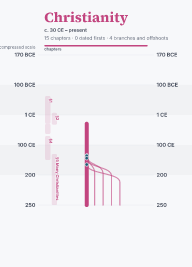
The short version: Christianity began in Jerusalem in the early 30s CE, among the Jewish followers of Jesus of Nazareth, who within a few years of his crucifixion, probably in 30 or 33 CE, were proclaiming that God had raised him from the dead and that he was Israel’s Messiah. There was no founding day and no single founder. Jesus preached a coming kingdom of God to fellow Jews; his followers made him the centre of their message; Paul and others carried it to non-Jews; and the movement became a separate religion from Judaism only over the following centuries. When it was “founded” depends on which of those steps you count. Majority
When was Christianity founded?
If one date has to be given, it is about 30–33 CE, the years of Jesus’ death and of his followers’ first claims that he had been raised. Every later step builds on that.
Jesus’ own dates are worked out from outside sources. John the Baptist began preaching “in the fifteenth year of the reign of Tiberius”, about 28–29 CE, and baptised Jesus; Jesus then preached for one to three years; and he was crucified at Passover under Pontius Pilate, prefect of Judea from 26 to 36 CE.[1][2][3] Astronomical tables make 7 April 30 or 3 April 33 the likeliest days.[4] Majority (Christianity §2)
The belief that defined the movement is almost as early. Paul, writing about 54 CE, quotes a creed he had “received”: that Christ died, was buried, was raised on the third day and appeared to Cephas (Peter), to the Twelve, to James and to others.[5] Most scholars date the formula to within about five years of the crucifixion, and think Paul learned it in Jerusalem or Damascus in the 30s.[6][7] Majority Historians can date the belief; whether it is true is a question of faith (§0).
What about Pentecost?
Many Christians date the church’s beginning to Pentecost, fifty days after Easter, when according to Acts the Holy Spirit came upon Jesus’ followers in Jerusalem. That is the church’s own account of its first day, written about fifty years later; historians cannot date the event itself, but it fits what they can date: a community in Jerusalem within months of the crucifixion. Majority
Pentecost was a Jewish festival first. The Torah’s Feast of Weeks, Shavuot, fell fifty days after the first sheaf of the barley harvest was offered, and Greek-speaking Jews called it pentēkostē, “the fiftieth”.[8] Paul still uses it as a date in the calendar: he will stay in Ephesus “until Pentecost”.[9] Consensus
Acts sets its story at that festival. The disciples are gathered in Jerusalem; a sound like a rushing wind fills the house, “tongues, as of fire” rest on each of them, and they begin “to speak in other languages”.[10] Peter preaches to the crowd of pilgrims, and “about three thousand persons” are baptised.[11] Consensus on what Acts says.
Three things limit what that account can show:
- Its date. Acts was written about 80–90 CE, or on Richard Pervo’s dating around 115, by an author who was not present and who arranges his story to carry the movement from Jerusalem to Rome (Christianity §4).[12][13] Majority
- Paul’s silence. Paul’s letters, the oldest Christian texts, never mention a founding Pentecost, though they show that ecstatic speech, “various kinds of tongues”, and other gifts of the Spirit were part of church life in the 50s.[14] Consensus
- The feast came later. The earliest Christians kept the whole fifty days after Easter as one festal season; a separate feast on the fiftieth day marking the Spirit’s coming is clear only by the late fourth century.[15] Majority
So Pentecost answers “when does the church remember its beginning” better than “when did it begin”. It is a fair symbol of the Jerusalem community’s start in the early 30s, not an independently dated event.
How old is Christianity?
Just under two thousand years, counting from about 30–33 CE. Counting from the first use of the word Christianismos, “Christianity”, it is a little over 1,900: the word first appears around 110 CE in the letters of Ignatius of Antioch.[16] Consensus
Who founded Christianity?
No one person did. Jesus is the figure the religion is about, but he did not found a church or a new religion; his first followers made the movement; and Paul shaped who could belong to it.
Jesus was a Galilean Jew who worshipped in synagogues, went up to the Temple and argued about the Torah as other Jewish teachers did.[17] The word ekklēsia, “church”, appears in the Gospels in only two passages, both in Matthew, and most scholars think Jesus founded a movement within Israel, not an institution. Majority His message, in the oldest Gospel, was that “the kingdom of God has come near”.[18] The question of whether he existed at all is answered on Was Jesus a real person?: almost all historians think he did. Consensus
After his death his followers formed a community in Jerusalem. Paul, describing a visit there about three years after his own conversion, stayed with Peter and met “James the Lord’s brother”; on a later visit, around 48–49, he dealt with “James and Cephas and John, who were acknowledged pillars”.[19][20] Consensus James led that church until he was stoned in 62.[21]
Paul joined a movement that already existed: he had persecuted it first, and churches in Jerusalem, Damascus, Antioch and Rome were there before him.[19] Consensus What he won was the argument that non-Jews could join without becoming Jews. Some writers, from William Wrede in 1904 to Hyam Maccoby in 1986, have called him the real founder; most scholars see him as a decisive interpreter of a movement whose worship, creed and rituals predated him.[22][23][24] Majority The full case is on Did Paul invent Christianity?
Where was Christianity founded?
In Jerusalem, in Roman Judea, with roots in Galilee. Jesus preached in the fishing towns and villages around the Sea of Galilee, such as Capernaum, Bethsaida and Magdala, then went to Jerusalem at Passover, where he was arrested and executed.[25][26] Consensus His followers’ first church was in Jerusalem, and before 70 that city was the movement’s centre: Acts describes James telling Paul of “many thousands of believers among the Jews… all zealous for the law”.[27] Majority
The world they lived in was Jewish and Roman at once. Judea had been under a Roman prefect since 6 CE, Galilee was ruled by Herod’s son Antipas, and many Jews hoped that God would soon act to restore Israel. The Jesus movement was one of several Jewish movements of the time, and its story makes sense only inside them.[28] Majority (Christianity §1)
How did Christianity start and spread?
It spread fast, along the roads and sea lanes of the eastern Roman Empire. Within twenty years of the crucifixion there were communities in Syria, Asia Minor, Greece and Rome, and most new members were not Jews. Majority (Christianity §3)
Antioch in Syria was the turning point. According to Acts, believers whose names it does not give preached there to Greeks, and Barnabas brought Paul from Tarsus to join them.[29] In the decade from about 37 to 47 Antioch became the base for preaching to gentiles. In the same passage Acts says that “in Antioch the disciples were first called Christians”.[30] The name is not used by Paul, and its earliest written uses are in Acts, 1 Peter and Ignatius, roughly 80–110 CE.[31] Consensus
The question of whether gentile men had to be circumcised was settled, for the moment, at a meeting in Jerusalem around 48–49, where the “pillars” agreed that they did not.[20] Majority Paul then founded churches in Macedonia, Achaia and Asia, in cities such as Philippi, Thessalonica, Corinth and Ephesus, and wrote the letters of about 50–60 CE that are the oldest Christian texts.[32] The church in Rome he did not found: it already existed when Claudius expelled Jews from the city, around 49, after disturbances “at the instigation of Chrestus”.[33][34] Majority Whether “Chrestus” is a garbled “Christus” is debated. Contested
By 64 the Roman crowd knew the group by name: Tacitus says Nero blamed the fire of Rome on those “whom the crowd called Christians”.[3] Consensus
When did Christianity split from Judaism?
Slowly, and at different times in different places. Paul never called himself a Christian and expected that “all Israel will be saved”.[35] The separation came in the generations after him. (Christianity §4)
Several events widened the gap. Rome destroyed the Jerusalem Temple in 70, and with it the centre of the Jerusalem church; tradition says that church had fled to Pella across the Jordan.[36] Around 112, Trajan told Pliny how to deal with people accused of being Christians, a group Roman officials now treated as distinct from Jews.[37] During the Bar Kokhba revolt of 132–135, according to Justin, the rebel leader punished Christians who would not deny Jesus; after it, Jews were barred from Jerusalem and its church was led for the first time by gentile bishops.[38][39] By about 155–160, Justin was calling Christians “the true spiritual Israel”.[40] Majority
Even then the line was not clean. Irenaeus, around 180, describes the Ebionites, Jewish followers of Jesus who kept the law and used only Matthew’s Gospel.[41] The story from the Jewish side is told in Judaism §7.
A short timeline
| Date | Event | Confidence |
|---|---|---|
| c. 28–29 CE | John the Baptist preaches; Jesus is baptised and begins preaching in Galilee[1][2] | Majority |
| 30 or 33 CE | Jesus is crucified in Jerusalem under Pontius Pilate[3] | Majority (year) |
| 30 or 33 CE (by Acts) | Pentecost: Acts says the Spirit came on the disciples in Jerusalem and about 3,000 were baptised[10][11] | Majority (as Acts’ account) |
| 30s CE | The resurrection creed; a Jerusalem church led by Peter and James[5][19] | Majority |
| c. 37–47 CE | Antioch a base for preaching to gentiles; there, says Acts, believers are first called Christians[29][30] | Majority |
| c. 48–49 CE | The Jerusalem meeting: gentile converts need not be circumcised[20] | Majority |
| c. 50–60 CE | Paul’s letters, the oldest Christian writings | Consensus |
| 64 CE | Nero blames the fire of Rome on the Christians[3] | Consensus |
| 70 CE | The Temple destroyed; the Jerusalem church loses its central place[36] | Consensus (destruction) |
| c. 110 CE | Ignatius first uses the word “Christianity”[16] | Consensus |
| c. 155–160 CE | Justin calls Christians “the true spiritual Israel”[40] | Consensus |
| 312–313 CE | Constantine backs Christianity; Christians given freedom of worship[42] | Consensus |
| 380 CE | Theodosius I makes Nicene Christianity the faith required by law[43] | Majority (scope) |
What scholars disagree about
What counts as the beginning. Some historians put it at Jesus’ preaching, since the movement grew from the group he gathered; others at the Easter belief, since that is what turned a dead prophet’s following into a community centred on him; others at the admission of gentiles, without which a separate religion would not have formed. All agree on the dates; they differ on which step makes something “Christianity”. Contested
What Jesus intended. Most scholars read him as a prophet who expected God to act soon to restore Israel, which would leave little room for planning a church.[17][44] N. T. Wright reads him instead as a prophet of Israel’s renewal around himself, and the Twelve he chose stood for Israel’s twelve tribes; on either reading he was gathering Israel, not founding a church.[45] Contested
When the parting happened. An older view, held with nuance by James Dunn, puts the separation by about 100–135; Adam Becker, Annette Yoshiko Reed and Seth Schwartz argue that it was regional and not complete until the Christian empire of the fourth century; Daniel Boyarin argues that authorities on both sides drew a border through what had been a continuum.[46][47][48][49] All three agree that by the mid-second century leading Christian writers treated church and synagogue as rival bodies. Contested
Paul’s share. Whether Paul changed the movement in kind or argued over one issue within it remains open: Wrede and Maccoby on one side, Hurtado and Dunn on the other, and Paula Fredriksen and Pamela Eisenbaum arguing that a separate religion did not yet exist for him to found.[22][24][50][51][52] Contested
Common misconceptions
- “Constantine founded Christianity.” Christians were known by name in Rome by 64, were the subject of imperial rulings around 112, and suffered the Great Persecution of 303–311, all before Constantine’s victory in 312. He legalised and favoured the church; Theodosius I made Nicene Christianity the state religion in 380.[53][42][43] See Did Constantine make Christianity the state religion? (Christianity §6) Consensus
- “Paul founded Christianity.” The resurrection creed, the Lord’s Supper and prayer to Jesus as Lord were all in place before him, and he persecuted the movement before he joined it.[5][54][55] He was its most influential early advocate for gentile members. Majority
- “Jesus founded a new religion.” He lived and died a Jew, and his message was about God’s kingdom for Israel. The break with Judaism took generations. Consensus
- “The first Christians called themselves Christians.” Paul speaks of “the saints”, “the brothers and sisters” and “the church of God”; the name appears, according to Acts, first at Antioch, and in writing only from about 80 CE.[30][31] Consensus
- “Christianity began in Rome.” It began in Judea and reached Rome within about twenty years. By about 96 the Roman church remembered Peter and Paul as its martyrs, which is part of why Rome later loomed so large.[56] Majority
- “The Gospels record the founding as it happened.” They were written about 70–110 CE, a generation or more after the events, each for its own audience; Paul’s letters are older (see Who wrote the Gospels?). Majority
Why it matters
The answer decides how the relationship between Christianity and Judaism is told. If Christianity was founded at a stroke, by Jesus, by Paul or by an emperor, the break with Judaism was a single event someone chose. The evidence points the other way: a Jewish movement, centred on a crucified Galilean its members believed God had raised, that opened its doors to gentiles and only over centuries became a separate religion. That also explains why the earliest Christian texts, Paul’s letters, read as arguments among Jews about who belongs to Israel’s Messiah. Majority
References
- ^ a b Luke 3:1–2 — Gospel of Luke (New Testament). c. 80–90 CE. Greek. John begins preaching 'in the fifteenth year of the reign of Emperor Tiberius', when Pilate was governor and Annas and Caiaphas high priests. read the text
- ^ a b Mark 1:9–11 — Gospel of Mark (New Testament). c. 70 CE. Greek. Jesus comes from Nazareth and is baptised by John in the Jordan. read the text
- ^ a b c d Tacitus, Annals 15.44 — Annals. c. 116 CE. Latin. Explaining the name of the Christians blamed for the fire of Rome, Tacitus says Christus was executed in the reign of Tiberius by the procurator Pontius Pilate.
- ^ Colin J. Humphreys and W. G. Waddington Dating the Crucifixion. Nature 306: 743–746, 1983. Astronomical calculation of the possible Passover Fridays, favouring 3 April 33 CE.
- ^ a b c 1 Corinthians 15:3–8 — Paul, First Letter to the Corinthians. c. 54 CE. Greek. A creed Paul 'received': Christ died, was buried, was raised on the third day, and appeared to Cephas, the Twelve, five hundred, James, all the apostles and Paul. read the text
- ^ James D. G. Dunn Jesus Remembered. Eerdmans, 2003. Jesus as remembered by his first followers, with a full treatment of the resurrection traditions.
- ^ Bart D. Ehrman How Jesus Became God: The Exaltation of a Jewish Preacher from Galilee. HarperOne, 2014. A developmental account of early Christology and the resurrection visions.
- ^ Leviticus 23:15–21 — Leviticus (Hebrew Bible). Priestly material, c. 6th–5th c. BCE. Hebrew. The Feast of Weeks (Shavuot): count fifty days from the offering of the first sheaf, then bring an offering of new grain; the festival Greek-speaking Jews called Pentecost. read the text
- ^ 1 Corinthians 16:8–9 — Paul, First Letter to the Corinthians. c. 54 CE. Greek. Paul will stay in Ephesus until Pentecost. read the text
- ^ a b Acts 2:1–4 — Acts of the Apostles (New Testament). c. 80–90 CE. Greek. At Pentecost the disciples are filled with the Holy Spirit and 'began to speak in other languages, as the Spirit gave them ability'. read the text
- ^ a b Acts 2:41 — Acts of the Apostles (New Testament). c. 80–90 CE. Greek. After Peter's sermon at Pentecost, 'about three thousand persons' are baptised and added to the community. read the text
- ^ Raymond E. Brown An Introduction to the New Testament. Doubleday, 1997. The Catholic standard introduction, fair to every position.
- ^ Richard I. Pervo Dating Acts: Between the Evangelists and the Apologists. Polebridge Press, 2006. Argues for a date of Acts around 115.
- ^ 1 Corinthians 12:4–11 — Paul, First Letter to the Corinthians. c. 54 CE. Greek. The Spirit's varieties of gifts: wisdom, knowledge, faith, gifts of healing, miracles, prophecy, discernment, tongues and their interpretation. read the text
- ^ Thomas J. Talley The Origins of the Liturgical Year. Pueblo, 1986. The main modern statement of the calculation theory of Christmas.
- ^ a b Ignatius, To the Magnesians 10 — Letters of Ignatius of Antioch. c. 110 CE. Greek. The earliest known use of the word Christianismos, 'Christianity', set against Ioudaismos. read the text
- ^ a b E. P. Sanders Jesus and Judaism. Fortress Press, 1985. Starts from the Temple incident and places Jesus within Jewish restoration eschatology.
- ^ Mark 1:15 — Gospel of Mark (New Testament). c. 70 CE. Greek. Jesus' first proclamation: 'The time is fulfilled, and the kingdom of God has come near.' read the text
- ^ a b c Galatians 1:13–2:14 — Paul, Letter to the Galatians. c. 50–55 CE. Greek. Paul's own account: he persecuted the church, received a revelation, stayed with Cephas and met 'James the Lord's brother', and later confronted Peter at Antioch. read the text
- ^ a b c Galatians 2:1–10 — Paul, Letter to the Galatians. c. 50–55 CE. Greek. After fourteen years Paul, Barnabas and Titus meet James, Cephas and John, who give 'the right hand of fellowship'. read the text
- ^ Josephus, Antiquities 20.200 — Jewish Antiquities. c. 93 CE. Greek. The high priest Ananus has 'the brother of Jesus who was called Christ, whose name was James' stoned in 62 CE; the passage is generally accepted as authentic. read the text
- ^ a b William Wrede Paulus. Gebauer-Schwetschke, Halle (Religionsgeschichtliche Volksbücher), 1904. Paul as the 'second founder of Christianity'.
- ^ Hyam Maccoby The Mythmaker: Paul and the Invention of Christianity. Harper & Row, 1986. Argues that Paul, not Jesus, founded Christianity; a minority view.
- ^ a b Larry W. Hurtado Lord Jesus Christ: Devotion to Jesus in Earliest Christianity. Eerdmans, 2003. The case that worship of Jesus began very early, within Jewish monotheism.
- ^ Mark 1:21 — Gospel of Mark (New Testament). c. 70 CE. Greek. Jesus teaches in the synagogue at Capernaum. read the text
- ^ Mark 11:15–18 — Gospel of Mark (New Testament). c. 70 CE. Greek. Jesus overturns the tables of the money-changers in the Temple, quoting Isaiah 56 and Jeremiah 7. read the text
- ^ Acts 21:20–26 — Acts of the Apostles (New Testament). c. 80–90 CE. Greek. James tells Paul of 'many thousands of believers among the Jews… all zealous for the law', and Paul purifies himself in the Temple. read the text
- ^ Josephus, Antiquities 18.1–10 — Jewish Antiquities. c. 93 CE. Greek. Quirinius comes to Syria to assess property after Judea's annexation in 6 CE; Judas the Galilean leads resistance to the census. read the text
- ^ a b Acts 11:19–26 — Acts of the Apostles (New Testament). c. 80–90 CE. Greek. Believers at Antioch preach to Greeks; Barnabas brings Saul from Tarsus. read the text
- ^ a b c Acts 11:26 — Acts of the Apostles (New Testament). c. 80–90 CE. Greek. At Antioch 'the disciples were first called Christians'. read the text
- ^ a b 1 Peter 4:16 — First Letter of Peter (New Testament). c. 80–100 CE. Greek. 'If any of you suffers as a Christian, do not consider it a disgrace', one of the earliest uses of the name. read the text
- ^ Wayne A. Meeks The First Urban Christians: The Social World of the Apostle Paul. Yale University Press, 1983. The Pauline churches as a cross-section of urban society.
- ^ Suetonius, Claudius 25.4 — Lives of the Caesars. c. 121 CE. Latin. Claudius 'expelled the Jews from Rome, since they were constantly making disturbances at the instigation of Chrestus'. about
- ^ Romans 15:22–29 — Paul, Letter to the Romans. c. 56–57 CE. Greek. Paul plans to visit Rome on his way to Spain after delivering the collection. read the text
- ^ Romans 11:25–29 — Paul, Letter to the Romans. c. 56–57 CE. Greek. 'And so all Israel will be saved'; 'the gifts and the calling of God are irrevocable'. read the text
- ^ a b Eusebius, Ecclesiastical History 3.5.3 — Ecclesiastical History. early 4th c. CE. Greek. Before the war the Jerusalem church, warned by an oracle, moved to Pella in Peraea. read the text
- ^ Trajan to Pliny, Letters 10.97 — Pliny the Younger, Letters. c. 112 CE. Latin. Trajan's reply: Christians are not to be sought out; if accused and convicted they are to be punished, but pardoned if they sacrifice; anonymous accusations are not to be admitted. about
- ^ Justin Martyr, First Apology 31 — First Apology. c. 155 CE. Greek. In the recent Jewish war Bar Kokhba ordered Christians alone to be punished unless they denied Jesus Christ and blasphemed. read the text
- ^ Eusebius, Ecclesiastical History 4.5–6 — Ecclesiastical History. early 4th c. CE. Greek. Fifteen bishops of Jerusalem 'of the circumcision' until the Bar Kokhba revolt; Jews barred from Aelia; Mark the first gentile bishop. read the text
- ^ a b Justin Martyr, Dialogue with Trypho 11 — Dialogue with Trypho. c. 155–160 CE. Greek. Christians are 'the true spiritual Israel', heirs of the new covenant. read the text
- ^ Irenaeus, Against Heresies 1.26.2 — Against Heresies. c. 180 CE. Greek (Latin translation). The Ebionites use only Matthew's Gospel, reject Paul as an apostate from the law, practise circumcision and keep the law. read the text
- ^ a b Lactantius, On the Deaths of the Persecutors 48 — On the Deaths of the Persecutors. 313 CE (letter); c. 315 (book). Latin. The text of the 'Edict of Milan', Licinius' letter granting Christians and all others freedom of religion and restoring church property. read the text
- ^ a b Codex Theodosianus 16.1.2 (Cunctos populos) — Codex Theodosianus. 27 February 380 CE. Latin. Theodosius orders all peoples to follow the faith of Damasus of Rome and Peter of Alexandria; only they are 'catholic Christians'. about
- ^ Dale C. Allison Jr. Jesus of Nazareth: Millenarian Prophet. Fortress Press, 1998. The case that Jesus expected the end of the age, built from many sayings rather than a few.
- ^ N. T. Wright Jesus and the Victory of God. Fortress Press, 1996. Jesus as a prophet announcing the end of Israel's exile.
- ^ James D. G. Dunn The Partings of the Ways between Christianity and Judaism. SCM Press, 1991. Traces the separation through Temple, Torah, election and Christology.
- ^ Adam H. Becker and Annette Yoshiko Reed, eds. The Ways that Never Parted: Jews and Christians in Late Antiquity and the Early Middle Ages. Mohr Siebeck, 2003. Essays arguing that Judaism and Christianity separated late and unevenly.
- ^ Seth Schwartz Imperialism and Jewish Society, 200 B.C.E. to 640 C.E.. Princeton University Press, 2001. Argues Jewish society largely dissolved after 135 and was rebuilt around synagogues in the Christian empire.
- ^ Daniel Boyarin Border Lines: The Partition of Judaeo-Christianity. University of Pennsylvania Press, 2004. The boundary between Judaism and Christianity as drawn late, by heresiologists on both sides.
- ^ James D. G. Dunn The New Perspective on Paul. Bulletin of the John Rylands Library 65: 95–122, 1983. The 1982 Manson lecture that named the New Perspective.
- ^ Paula Fredriksen Paul: The Pagans' Apostle. Yale University Press, 2017. Paul as an apocalyptic Jew whose mission was to bring gentiles, as gentiles, to Israel's God.
- ^ Pamela Eisenbaum Paul Was Not a Christian: The Original Message of a Misunderstood Apostle. HarperOne, 2009. Paul as a Jew who remained within Judaism, writing to gentiles.
- ^ Lactantius, On the Deaths of the Persecutors 34 — On the Deaths of the Persecutors. c. 314–315 CE. Latin. Galerius' edict of toleration of 311, allowing Christians to exist and assemble again. read the text
- ^ 1 Corinthians 11:23–26 — Paul, First Letter to the Corinthians. c. 54 CE. Greek. Paul hands on the words over the bread and cup 'on the night when he was betrayed', the oldest account of the Last Supper. read the text
- ^ 1 Corinthians 16:22 — Paul, First Letter to the Corinthians. c. 54 CE. Greek. Paul closes with the Aramaic prayer maranatha, 'Our Lord, come!', preserved untranslated in a Greek letter. read the text
- ^ 1 Clement 5 — First Letter of Clement (church of Rome to Corinth). c. 96 CE. Greek. Peter and Paul as examples of endurance 'through jealousy'; Paul reached 'the farthest bounds of the West' and bore witness before the rulers. read the text