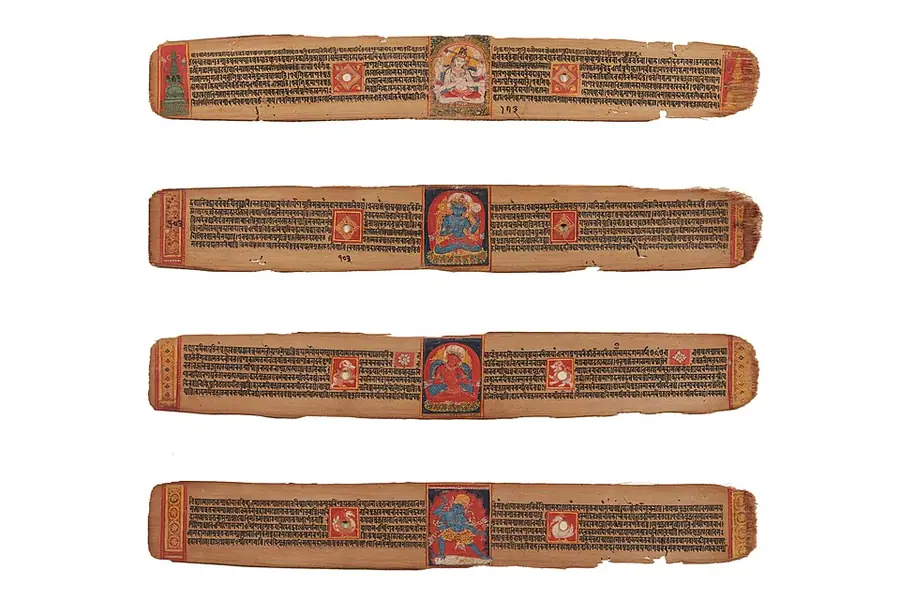
The short version: Mahāyāna came from inside Indian Buddhism, not from outside it. Around the first century BCE, monks began composing new sūtras, presented as the Buddha’s own word, which urged everyone to aim at full Buddhahood for the sake of all beings.[1] The movement had no founder and no separate monastic order. Its earliest traces are manuscripts from Gandhāra and dated Chinese translations. Who first composed and carried these texts, and why, is one of the longest-running arguments in Buddhist studies.
The evidence for Mahāyāna’s origins
The oldest manuscript
The oldest physical Mahāyāna text is a birch-bark scroll in Gāndhārī, part of the privately held Split collection, containing the first chapter of the Perfection of Wisdom in 8,000 Lines (Aṣṭasāhasrikā Prajñāpāramitā). Harry Falk and Seishi Karashima published it in 2012, with a radiocarbon date of roughly 47–147 CE.[2][3] A second Gāndhārī scroll, from the Bajaur collection, preserves part of a sūtra about the Buddha Akṣobhya and his eastern paradise, dated on palaeographic grounds to the late first or second century.[4][5]
What it proves. Mahāyāna sūtras were being copied in the northwest in the first century CE, in the same language and script as mainstream texts. The Split text already differs from later versions, so it had a textual history before this copy was made. Mahāyāna is older than the first century CE, by an amount nobody can measure. Consensus
The Chinese clock
The earliest dated evidence comes from China. In Luoyang, Lokakṣema, a monk from the Kushan lands, translated the Perfection of Wisdom in 179 CE, along with the Pratyutpanna Samādhi Sūtra, which names the Buddha Amitābha.[6][7] The Inquiry of Ugra, a manual for bodhisattvas, was translated by about 181.[8] Jan Nattier’s sorting of the Han-dynasty translations makes these among the firmest dates in the field.[9] Lokakṣema’s originals seem to have been in Gāndhārī, which points the same way as the manuscripts.[3]
Silence in stone
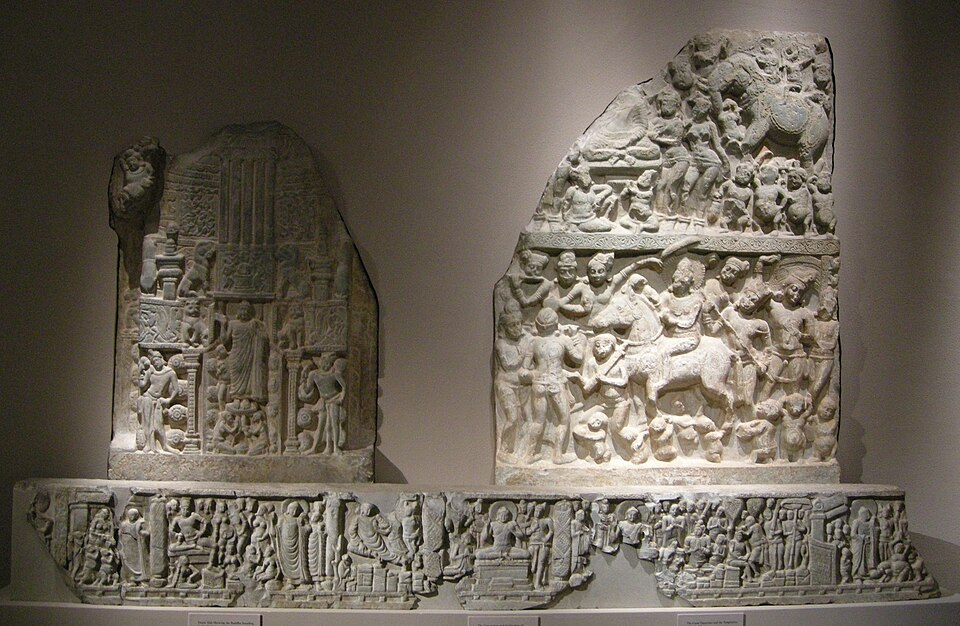
The inscriptions tell a different story. Hundreds of Buddhist donors recorded their gifts on stupas, images and monastery walls in the first centuries CE, and almost none mention Mahāyāna. They name Śākyamuni, relics, stupas and the mainstream schools.[10] The striking exception is a broken pedestal found at Govindnagar in Mathurā in 1977, dated in the twenty-sixth year of the Kushan king Huviṣka, about 153 CE on the era most scholars now accept. It names the image as the Buddha Amitābha.[11][12]
What it proves. Gregory Schopen pointed out in 1987 that this is the earliest Indian inscription naming Amitābha, and that his name does not appear again in Indian inscriptions for centuries. Mahāyāna becomes visible in Indian inscriptions only in the fourth and fifth centuries, when donors begin to dedicate their gifts “for the attainment of supreme knowledge by all beings.”[12][10] For its first several centuries, Mahāyāna was a minority movement that left texts but almost no public footprint. Majority
The texts’ own claims
The early Mahāyāna sūtras give clues about their authors by what they praise. The Perfection of Wisdom literature sets the written sūtra above the relic stupa. The Diamond Sūtra says of any place where even four lines of it are taught:
sa pṛthivīpradeśaś caityabhūto bhavet
“That spot of earth will become a shrine.”[13]
The Aṣṭasāhasrikā asks whether more merit comes from filling the world with relic stupas or from copying and worshipping the sūtra itself, and the book wins.[14] The Inquiry of Ugra, by contrast, says little about books: it tells householder bodhisattvas to aspire to leave home and monastic bodhisattvas to live in the wilderness.[15]
What it proves. Different early sūtras point to different communities. Some were promoting a cult of the written text against the cult of relics. Others held up a heroic, ascetic ideal for a small elite of monks. Neither describes a popular lay religion. Majority
The competing explanations
Lay devotees at stupas. In 1963 Akira Hirakawa argued that Mahāyāna arose among laypeople who gathered around stupas, which he took to be outside monastic control.[16] The theory dominated for decades and is now largely abandoned: inscriptions show monks and nuns controlling and funding stupas, and the earliest datable sūtras were written by monks and set the book above the stupa.[17][15][18] Majority
A cult of the book. Schopen’s 1975 reading of the “shrine” passages made early Mahāyāna a set of groups centred on a portable sacred text. It explains why so many sūtras praise themselves. Schopen later qualified it, and it fits the Perfection of Wisdom better than the devotional sūtras.[17] Contested
Forest ascetics. Reginald Ray and Paul Harrison argued that some of the earliest sūtras came from monks living as wilderness ascetics, practising meditation and visualisation, and critical of the settled town monasteries. Nattier’s study of the Ugra supports this for at least one community.[19][18][15] Critics note that other early sūtras are thoroughly urban, and that town monks could praise the forest without living in it.[20] Contested
Preachers of new texts. David Drewes proposed in 2010 that early Mahāyāna is best understood as a textual movement around preachers of the dharma (dharmabhāṇaka), who memorised and expounded the new sūtras and were accepted by some monks in otherwise ordinary monasteries. On this view there was no Mahāyāna community to find, which explains why the inscriptions are silent.[20] Contested
An outgrowth of one school. Older scholarship derived Mahāyāna from the Mahāsāṃghikas, whose Lokottaravāda branch taught a “supramundane” Buddha in the Mahāvastu.[21] Ideas did pass that way, but Mahāyāna sūtras were carried by monks of many lineages. Most scholars now think of several origins in several schools and regions.[18][1] Majority
Where: north or south?
The oldest manuscripts and the first translators point to the northwest: Gandhāra and the Kushan lands. But birch bark survives in a dry climate, and palm leaf in the humid south does not, so the northwest may simply be where Mahāyāna can be seen first. Some scholars have argued for a southern origin in Āndhra, the region later tradition associates with Nāgārjuna. The inscriptions of Nāgārjunakoṇḍa in the third century name only mainstream schools, and the southern case rests mainly on statements in later texts.[22][23] Contested
A short timeline
| Date | What happens | Confidence |
|---|---|---|
| c. 1st c. BCE | First Mahāyāna sūtras composed[1] | Majority |
| c. 47–147 CE | Split manuscript of the Perfection of Wisdom[3] | Consensus |
| late 1st–2nd c. CE | Bajaur sūtra on Akṣobhya[5] | Majority |
| c. 153 CE | Govindnagar pedestal names Amitābha[11] | Majority |
| 179 CE | Lokakṣema’s translations in Luoyang[6] | Consensus |
| c. 150–250 CE | Nāgārjuna’s philosophy of emptiness[24] | Majority |
| c. 4th–5th c. CE | Mahāyāna formulae appear in Indian inscriptions[10] | Majority |
| c. 690 CE | Yijing: Mahāyāna and non-Mahāyāna monks follow the same rules[25] | Consensus |
What scholars disagree about
Who the first Mahāyānists were. Forest monks, book devotees, preachers or all three in different places. The evidence fits a plural origin better than any single theory.[20] Contested
How early “early” is. The manuscripts give a floor in the first century CE. The first century BCE is an inference from the texts’ development, not a measurement. Majority
Whether Mahāyāna was ever a separate sect in India. It was not a schism in the technical sense, since its monks kept their mainstream ordination and rules (see the difference between Theravāda and Mahāyāna).[25] Majority
Common misconceptions
- “Mahāyāna was founded by Nāgārjuna.” The sūtras are older than Nāgārjuna, and the only sūtra his main work names is an early discourse, the Buddha’s advice to Kātyāyana.[26][2]
- “Mahāyāna began as a lay revolt against monks.” The earliest datable texts were written by and for monks.[15]
- “Mahāyāna began in China.” It began in India; China is where many of its texts found their largest audience, and some important scriptures were composed there later (§7).
- “The Mahāyāna sūtras were hidden and revealed later.” That is how the sūtras explain their own late appearance: preserved by bodhisattvas or nāgas until people were ready. In the life of Nāgārjuna translated by Kumārajīva, a nāga takes him under the sea and gives him the Mahāyāna sūtras.[27] It is a tradition, not evidence of age.
Why it matters
Mahāyāna became the Buddhism of most of East Asia and Tibet, and with it came emptiness philosophy, Pure Land devotion, celestial bodhisattvas and, eventually, Zen and tantra. Its origin shows a pattern that runs through this series: a religion changing through new texts written inside old institutions, long before the change was visible in public. The movement that would shape half of Asia began as manuscripts in a minority of monasteries, almost unnoticed by the donors whose inscriptions survive.
For the full story of the Mahāyāna turn, see Chapter 6: The Mahāyāna Turn. For how its texts reached China, see Chapter 7: Into China.
References
- ^ a b c Paul Williams Mahāyāna Buddhism: The Doctrinal Foundations. Routledge, 2nd ed., 2009. The standard introduction to Mahāyāna thought and to the origins debate.
- ^ a b Split collection Aṣṭasāhasrikā, parivarta 1 — Prajñāpāramitā (Gāndhārī). c. 47–147 CE (radiocarbon). Gāndhārī in Kharoṣṭhī. The oldest surviving Mahāyāna manuscript: a birch-bark copy of the Perfection of Wisdom in 8,000 Lines, close to the text Lokakṣema translated into Chinese in 179 CE. about
- ^ a b c Harry Falk & Seishi Karashima "A First-Century Prajñāpāramitā Manuscript from Gandhāra — parivarta 1". Annual Report of the International Research Institute for Advanced Buddhology 15: 19–61, 2012. Edition and radiocarbon date of the oldest Mahāyāna manuscript.
- ^ Bajaur Mahāyāna sūtra (BC 2) — Bajaur collection. c. late 1st–2nd c. CE. Gāndhārī in Kharoṣṭhī. Part of a Mahāyāna sūtra about the Buddha Akṣobhya and his eastern buddha-field Abhirati, on birch bark. Evidence that Pure Land ideas were circulating in Gandhāra almost as early as the Perfection of Wisdom. about
- ^ a b Ingo Strauch "More Missing Pieces of Early Pure Land Buddhism: New Evidence for Akṣobhya and Abhirati in an Early Mahāyāna Sūtra from Gandhāra". The Eastern Buddhist 41: 23–66, 2010. open access Edition and study of the Bajaur Akṣobhya sūtra.
- ^ a b T 224 (Daoxing banruo jing) — Lokakṣema's translations. 179 CE. Classical Chinese. Lokakṣema's Chinese translation of the Perfection of Wisdom in 8,000 Lines, dated by its colophon to 179 CE. A dated translation proves the source text existed by that year. read the text
- ^ T 418 (Banzhou sanmei jing) — Lokakṣema's translations. 179 CE. Classical Chinese. Lokakṣema's translation of the Pratyutpanna Samādhi Sūtra, a meditation in which the practitioner sees the Buddhas of the present, Amitābha among them. The earliest dated text to name Amitābha. read the text
- ^ T 322 (Fa jing jing) — Inquiry of Ugra (Ugraparipṛcchā). c. 181 CE. Classical Chinese. The earliest Chinese translation of the Inquiry of Ugra, a guide for householder and monastic bodhisattvas that praises renunciation and life in the wilderness. read the text
- ^ Jan Nattier A Guide to the Earliest Chinese Buddhist Translations. International Research Institute for Advanced Buddhology, Soka University, 2008. Which Han-dynasty translations are really by whom, and therefore which texts existed when.
- ^ a b c Gregory Schopen "Mahāyāna in Indian Inscriptions". Indo-Iranian Journal 21, 1979. Shows that Mahāyāna becomes visible in inscriptions only from the 4th–5th c., through the śākyabhikṣu donor formula.
- ^ a b Govindnagar Amitābha pedestal — Mathurā Museum. Year 26 of Huviṣka, c. 153 CE. Sanskritised Prakrit in Brāhmī. A broken image base found at Mathurā in 1977, dated in Huviṣka's reign and naming the image as the Buddha Amitābha. The only Indian inscription naming a Mahāyāna Buddha before the fifth century.
- ^ a b Gregory Schopen "The Inscription on the Kuṣān Image of Amitābha and the Character of the Early Mahāyāna in India". Journal of the International Association of Buddhist Studies 10: 99–137, 1987. Publishes the Govindnagar pedestal and draws out how isolated it is.
- ^ Vajracchedikā 12 — Diamond Sūtra. c. 2nd–4th c. CE. Sanskrit. Any place where even four lines of this sūtra are recited "will become a shrine" (caityabhūta). The phrase Schopen used to argue for a Mahāyāna cult of the book. read the text
- ^ Aṣṭasāhasrikā 3 — Perfection of Wisdom in 8,000 Lines. c. 1st c. BCE–1st c. CE, expanded later. Sanskrit. Copying and worshipping the written Perfection of Wisdom earns more merit than filling the continent with relic stupas, since the Buddha's body itself was produced by the perfection of wisdom.
- ^ a b c d Jan Nattier A Few Good Men: The Bodhisattva Path according to The Inquiry of Ugra (Ugraparipṛcchā). University of Hawai'i Press, 2003. Translation and study of one of the earliest datable Mahāyāna sūtras; argues the early bodhisattva path was an elite monastic vocation.
- ^ Akira Hirakawa "The Rise of Mahāyāna Buddhism and Its Relationship to the Worship of Stūpas". Memoirs of the Research Department of the Toyo Bunko 22, 1963. The classic statement of the lay-stupa theory of Mahāyāna origins, now largely abandoned.
- ^ a b Gregory Schopen "The Phrase 'sa pṛthivīpradeśaś caityabhūto bhavet' in the Vajracchedikā: Notes on the Cult of the Book in Mahāyāna". Indo-Iranian Journal 17: 147–181, 1975. The cult-of-the-book thesis: the written sūtra as a rival to the relic stupa.
- ^ a b c Paul Harrison "Searching for the Origins of the Mahāyāna: What Are We Looking For?". The Eastern Buddhist 28, 1995. A clear critique of the lay theory and a case for ascetic, monastic origins.
- ^ Reginald A. Ray Buddhist Saints in India: A Study in Buddhist Values and Orientations. Oxford University Press, 1994. Argues for a forest-renunciant strand in Indian Buddhism behind early Mahāyāna.
- ^ a b c David Drewes "Early Indian Mahāyāna Buddhism I: Recent Scholarship" and "II: New Perspectives". Religion Compass 4, 2010. The best short survey of the origins debate; proposes Mahāyāna as a textual movement of preachers.
- ^ Mahāvastu — Lokottaravāda Vinaya. c. 2nd c. BCE–4th c. CE. Buddhist Hybrid Sanskrit. A sprawling biography of the Buddha embedded in a monastic code, built up over centuries. One of the first texts to tell the life at length, with many Jātaka stories. about
- ^ Nāgārjunakoṇḍa Mahācaitya inscriptions — Nāgārjunakoṇḍa. c. 3rd c. CE. Prakrit in Brāhmī. Records of gifts by Ikṣvāku royal women, led by Cāṃtisirī, to the great stupa and to monasteries of named mainstream schools, among them the Aparamahāvinaseliyas, Bahuśrutīyas, Mahīśāsakas and Theriyas from Sri Lanka. about
- ^ J. Ph. Vogel "Prakrit Inscriptions from a Buddhist Site at Nagarjunikonda". Epigraphia Indica 20, 1929. The primary edition of the Ikṣvāku queens' donative records.
- ^ Mūlamadhyamakakārikā 24.18 — Nāgārjuna. c. 150–250 CE. Sanskrit. "Whatever is dependent origination, that we call emptiness": Nāgārjuna identifies emptiness with the oldest Buddhist doctrine of causation and calls it the middle way.
- ^ a b Yijing, Account of Buddhism Sent from the Southern Seas — Nanhai jigui neifa zhuan. c. 691 CE. Classical Chinese. Mahāyāna and non-Mahāyāna monks keep the same Vinaya; those who worship bodhisattvas and read Mahāyāna sūtras are called Mahāyānists. The clearest contemporary statement that Mahāyāna was not a separate order. read the text
- ^ Mūlamadhyamakakārikā 15.7 — Nāgārjuna. c. 150–250 CE. Sanskrit. Nāgārjuna cites the Buddha's instruction to Kātyāyana (the Kaccānagotta discourse, SN 12.15), in which both 'it is' and 'it is not' are rejected: the only discourse named in the Root Verses, and an early, not a Mahāyāna, text.
- ^ T 2047 (Longshu pusa zhuan) — Life of the Bodhisattva Nāgārjuna, attributed to Kumārajīva. early 5th c. CE. Classical Chinese. A great nāga bodhisattva takes Nāgārjuna into his palace under the sea and gives him countless profound vaipulya (Mahāyāna) sūtras, which he then spreads in South India: the legend of the hidden sūtras. read the text