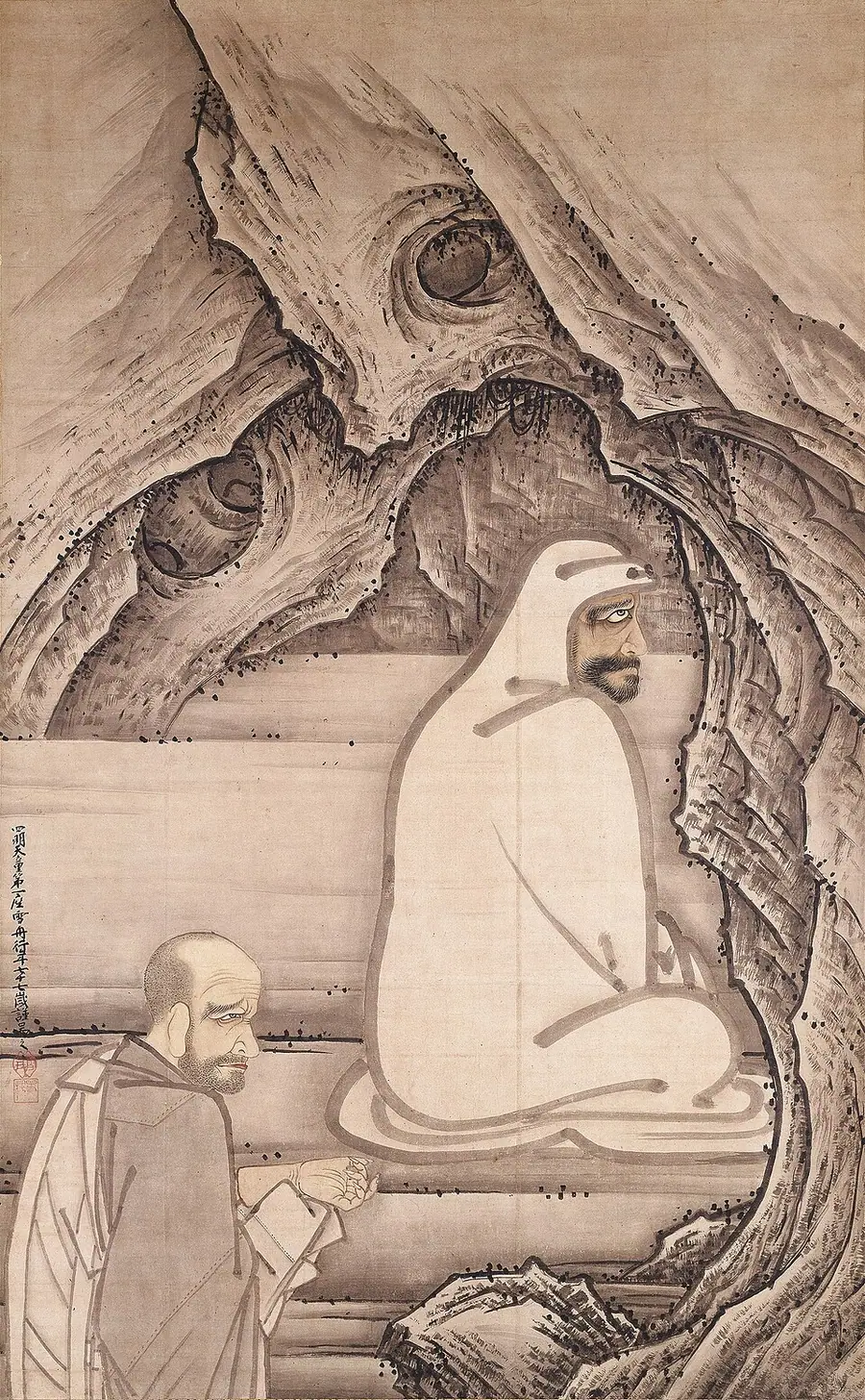
The short version: Zen comes from China. The word is the Japanese reading of chan 禪, itself short for channa 禪那, a Chinese transcription of the Sanskrit dhyāna, “meditative absorption” (Pali jhāna). Chan took shape as a distinct movement in Tang China in the seventh and eighth centuries, grew into the dominant form of monastic Buddhism under the Song, and travelled to Korea (as Seon), Vietnam (as Thiền) and Japan (as Zen).[1][2] Its founding story, a line of patriarchs running from the Buddha to Bodhidharma and on to Huineng, was assembled in China after the fact, and the manuscripts found at Dunhuang let historians watch it being written.
The evidence for where Zen came from
Bodhidharma: what the earliest sources say
Every Zen genealogy names Bodhidharma, an Indian monk, as the man who brought the teaching to China. The earliest mention of anyone of that name is in Yang Xuanzhi’s memoir of Luoyang’s monasteries, written in 547:
時有西域沙門菩提達磨者,波斯國胡人也。……自云年一百五十歲,歷涉諸國,靡不周遍。
“At that time there was a monk from the western regions called Bodhidharma, a man of Persia. … He said he was 150 years old, and had travelled through all countries without exception.”[3]
What it proves. That a foreign monk of that name was remembered in Luoyang in the early sixth century. It says nothing about meditation, disciples or a teaching. A century later, the historian-monk Daoxuan’s Continued Biographies of Eminent Monks (645) gives a different Bodhidharma: “of brahmin stock from South India,” who arrived first in the south, then went north to the Wei, and taught the disciples Daoyu and Huike a practice he called biguan, “wall contemplation,” with a short teaching on “two entrances” to the Way.[4] Whether the two Bodhidharmas are one man cannot be known. Contested
Everything else in the famous story is later: the interview with Emperor Wu of Liang, the nine years facing a cave wall at Shaolin, Huike cutting off his arm to show his sincerity, and Bodhidharma as the founder of Shaolin martial arts. These episodes appear in sources from the eighth century to the twentieth.[1][5] Daoxuan himself says Huike lost his arm to bandits.[6] Daoxuan’s “wall contemplation” may be the seed of the wall-gazing legend, though what biguan originally meant is itself debated.
Shenhui and the invention of the sixth patriarch
Chan emerged as a self-conscious movement in the seventh century around the “East Mountain” community of Daoxin (580–651) and Hongren (601–674) at Huangmei. By around 700 Hongren’s disciple Shenxiu was honoured at the Tang court as the leading meditation master of the empire.[1]
In 732, at an open assembly at Huatai, a monk named Shenhui attacked Shenxiu’s heirs. He claimed that the true sixth patriarch was not Shenxiu but an obscure southerner, Huineng (638–713), and that Shenxiu’s line taught a merely “gradual” awakening where Huineng taught a “sudden” one.[7] He coined the label “Northern school” for his rivals. His campaign worked: within a few generations every Chan lineage traced itself through Huineng.[1] Majority
The Platform Sūtra, rewritten
The Platform Sūtra tells Huineng’s story: an illiterate kitchen worker who wins the robe of the fifth patriarch by writing a better verse than Shenxiu. The copies found at Dunhuang, made around 830–860, give Huineng’s verse in an early form:
菩提本無樹,明鏡亦無臺,佛性常清淨,何處有塵埃?
“Bodhi originally has no tree, the bright mirror has no stand. Buddha-nature is always pure: where is there any dust?”[8]
Later editions, the ones that became standard, changed the third line to 本來無一物, “originally there is not a single thing,” and the last to 何處惹塵埃, “where could dust alight?”, and adjusted the second to 明鏡亦非臺.[9][10]
What it proves. That the founding text of Chan was edited for centuries, and that its most quoted line is a revision. The Dunhuang manuscripts, sealed in a cave around 1000 and rediscovered in 1900, are what allow the rewriting to be seen.[11] Majority
The Song genealogies and the slogan
Under the Song dynasty (960–1279) Chan became the main form of public monastic Buddhism in China. The Jingde Record of the Transmission of the Lamp (1004) fixed a genealogy from the seven Buddhas of the past through twenty-eight Indian patriarchs to Bodhidharma, and on through Huineng to the Song masters.[12] A century later the Zuting shiyuan (1108) presented the four-line slogan, “a separate transmission outside the teachings, not founded on words and letters, pointing directly at the human mind, seeing one’s nature and becoming a Buddha,” as a single verse of Bodhidharma’s.[13] Song Chan also produced the collections of “public cases” (gong’an, Japanese kōan), such as the Blue Cliff Record (completed c. 1125), that became its classic texts.[14]
John McRae, summing up the scholarship, offered a rule: “Lineage assertions are as wrong as they are strong.” The genealogies are not history, but they are excellent evidence of how Chan thought about authority.[1]
How Zen reached Japan and the West
Zen reached Japan as an import from Song China. Eisai (1141–1215) returned in 1191 with the Linji (Rinzai) lineage and argued in 1198 that Zen would protect the state.[15] Dōgen (1200–1253) returned in 1227 with the Caodong (Sōtō) lineage and wrote the Shōbōgenzō.[16] Under the Ashikaga shoguns the Rinzai “Five Mountains” became an academy of Chinese learning and an arm of government; Sōtō spread through the countryside mainly by offering funerals.[17][18]
The Zen most Westerners first met was later still. D. T. Suzuki, a Japanese lay scholar, presented Zen from the 1920s as a direct experience beyond doctrine and ritual, expressed in Japanese art and culture. Robert Sharf has argued that this picture owed much to Western philosophy and Japanese nationalism, and little to the ritual life of actual Zen monasteries (§12).[19]
A short timeline
| Date | What happens | Confidence |
|---|---|---|
| 547 | A monk named Bodhidharma recorded at Luoyang[3] | Consensus |
| 645 | Daoxuan’s biography of Bodhidharma and Huike[4] | Consensus |
| 7th century | The East Mountain community of Daoxin and Hongren[1] | Majority |
| 732 | Shenhui’s attack on the “Northern school”[7] | Consensus |
| c. 830–860 | Dunhuang copies of the Platform Sūtra[8] | Majority |
| 1004 | The Jingde genealogy[12] | Consensus |
| 1108 | The “separate transmission” slogan as one verse[13] | Majority |
| 1191 / 1227 | Eisai and Dōgen bring Rinzai and Sōtō to Japan[15][18] | Consensus |
| 1927 | Suzuki’s Essays in Zen Buddhism in English[19] | Consensus |
What scholars disagree about
Did Bodhidharma exist? A monk of that name was probably in Luoyang in the early sixth century, and a meditation teacher remembered as Bodhidharma probably taught Huike. Whether these are the same man, and whether he taught anything like later Chan, cannot be shown.[3][4][1] Contested
How Chinese is Chan? Chan drew on Indian Mahāyāna ideas, especially Buddha-nature (§6), on Indian meditation manuals and on the Laṅkāvatāra Sūtra, which its early teachers prized. It also drew on Chinese ideas of spontaneity and sudden insight. Daoxuan already records Bodhidharma handing Huike the four-fascicle Laṅkāvatāra.[6] Most historians describe Chan as a Chinese creation from Indian materials; older views of it as “Daoism in Buddhist dress” are now considered too simple.[1] Majority
Was Huineng real? Probably: the Lengqie shizi ji, a Northern-school record compiled before Shenhui’s campaign, already lists “Huineng of Shaozhou” among the disciples Hongren judged fit to teach.[20] But nearly everything in the Platform Sūtra’s account of him serves Shenhui’s campaign, and his illiteracy may be a literary device for the superiority of sudden insight over learning.[9][1] Contested
Common misconceptions
- “Zen is Japanese.” It is Chinese in origin; Japan received it in the twelfth and thirteenth centuries, and Korea earlier, from the ninth.[2][21] Vietnamese Thiền lineages claim sixth-century founders, but the text that records them is of the fourteenth century.[22]
- “Zen rejects scripture and ritual.” The slogan says so, but Chan and Zen monasteries recited sūtras, held elaborate rituals and, in Japan, performed most of the country’s funerals.[18]
- “Zen is a philosophy of spontaneity, not a religion.” That is Suzuki’s modern picture, aimed at Western readers; historical Zen was a monastic institution with precepts, liturgy and patrons.[19]
- “Bodhidharma founded kung fu.” The Shaolin connection is legend, attested centuries after his time.[5]
Why it matters
Zen tells its own history as an unbroken transmission from mind to mind outside the scriptures. The documents show something more interesting: a tradition that built that story deliberately, through polemic, editing and genealogy, because Chinese culture understood legitimacy through descent. Seeing how it was made does not make Zen less real. It shows Zen as one of the most creative things Chinese Buddhism produced.
For Chan in the context of Chinese Buddhism, see Chapter 7: Into China; for Zen in Japan, §11; for Suzuki and modern Zen, §12.
References
- ^ a b c d e f g h i John R. McRae Seeing Through Zen: Encounter, Transformation, and Genealogy in Chinese Chan Buddhism. University of California Press, 2003. The clearest statement of how Chan's lineage was constructed, with 'McRae's rules of Zen studies'.
- ^ a b Kenneth K. S. Ch'en Buddhism in China: A Historical Survey. Princeton University Press, 1964. Still the most useful one-volume narrative of Chinese Buddhist history.
- ^ a b c T 2092 (Luoyang qielan ji) — Yang Xuanzhi, Record of the Buddhist Monasteries of Luoyang. 547 CE. Classical Chinese. A memoir of Luoyang's monasteries; it mentions a western monk named Bodhidharma who admired the Yongning pagoda and said he was 150 years old. The earliest mention of the name. read the text
- ^ a b c T 2060 (Xu gaoseng zhuan) 16 — Daoxuan, Continued Biographies of Eminent Monks. 645. Classical Chinese. Daoxuan's Bodhidharma: a South Indian brahmin who reached the south, went north to the Wei, and taught Daoyu and Huike 'wall contemplation' (biguan) and the two entrances of principle and practice. read the text
- ^ a b Meir Shahar The Shaolin Monastery: History, Religion, and the Chinese Martial Arts. University of Hawai'i Press, 2008. doi Shows that Shaolin's fighting tradition is documented from the Tang and its developed martial arts from the late Ming, and that the attribution to Bodhidharma begins with a seventeenth-century manual.
- ^ a b T 2060 (Xu gaoseng zhuan) 16, 'Sengke' (Huike) — Daoxuan, Continued Biographies of Eminent Monks. 645 CE. Classical Chinese. Daoxuan's Huike: Bodhidharma gives him the four-fascicle Laṅkāvatāra as the only scripture fit for China; Huike loses an arm to bandits, not by cutting it off himself as later legend has it. read the text
- ^ a b Putidamo nanzong ding shifei lun — Shenhui, recorded by Dugu Pei. 732 CE (debate), recorded later. Classical Chinese. The record of Shenhui's attack at Huatai on the disciples of Shenxiu as a 'gradual' side branch, and his claim that Huineng was the true sixth patriarch. Survives in Dunhuang manuscripts.
- ^ a b Platform Sūtra (Dunhuang, S. 5475) — Liuzu tanjing. copied c. 830–860 CE. Classical Chinese. The earliest surviving version of the Platform Sūtra, in which Huineng's verse reads 'Buddha-nature is always pure' where later editions read 'originally there is not a single thing'. about
- ^ a b Philip B. Yampolsky The Platform Sutra of the Sixth Patriarch. Columbia University Press, 1967. Translation of the Dunhuang text with a study of how the Huineng story was built.
- ^ T 2008 (Liuzu dashi fabao tan jing) — Platform Sūtra, Zongbao edition. 1291 CE. Classical Chinese. The Yuan-dynasty edition that became standard. Huineng's verse reads 菩提本無樹,明鏡亦非臺,本來無一物,何處惹塵埃, where the Dunhuang copy has 'Buddha-nature is always pure'. read the text
- ^ Rong Xinjiang "The Nature of the Dunhuang Library Cave and the Reasons for Its Sealing". Cahiers d'Extrême-Asie 11: 247–275, 1999. doi Argues the library cave was a monastery's store of sacred texts, sealed in the early eleventh century, and reviews its discovery in 1900.
- ^ a b T 2076 (Jingde chuandeng lu) — Record of the Transmission of the Lamp. 1004 CE. Classical Chinese. The Song compilation that fixed Chan's genealogy of patriarchs from the past Buddhas through Bodhidharma and Huineng, with their recorded encounters. read the text
- ^ a b X 1261 (Zuting shiyuan) 5 — Muan Shanqing, Collection from the Garden of the Patriarchs. 1108. Classical Chinese. A Song Chan reference work which, under 'single transmission', says Bodhidharma 'singly transmitted the mind-seal ... what is called a separate transmission outside the teachings, not founded on words and letters, pointing directly at the human mind, seeing one's nature and becoming a Buddha' (教外別傳,不立文字,直指人心,見性成佛), the four phrases together as one formula. read the text
- ^ T 2003 (Biyan lu) — Yuanwu Keqin, Blue Cliff Record. c. 1125 CE (preface 1128). Classical Chinese. Yuanwu's commentary on Xuedou's verses on one hundred 'public cases' (gong'an), the classic kōan collection; its preface by Puzhao is dated 1128, and a later preface records that Yuanwu's disciple Dahui burned the blocks. read the text
- ^ a b Kōzen gokokuron — Eisai (Yōsai). 1198 CE. Classical Chinese. "Promoting Zen for the Protection of the Country": Eisai argues that Chan practice and strict precepts will strengthen the state and support Tendai, not threaten it.
- ^ Shōbōgenzō, Genjōkōan — Dōgen. 1233 CE. Medieval Japanese. "To study the Buddha Way is to study the self. To study the self is to forget the self" (trans. Robert Aitken and Kazuaki Tanahashi): practice and realisation are one.
- ^ Martin Collcutt Five Mountains: The Rinzai Zen Monastic Institution in Medieval Japan. Harvard University Press, 1981. The gozan system as institution and bureaucracy.
- ^ a b c William M. Bodiford Sōtō Zen in Medieval Japan. University of Hawai'i Press, 1993. How Sōtō Zen actually spread: funerals, precept rites and rural patrons, not Dōgen's philosophy.
- ^ a b c Robert H. Sharf "The Zen of Japanese Nationalism". History of Religions 33, 1993. Argues that Suzuki's Zen of pure experience was a modern construction shaped by Western philosophy and Japanese nationalism.
- ^ T 2837 (Lengqie shizi ji), 'Hongren' — Jingjue, Record of the Masters and Disciples of the Laṅkāvatāra. c. 713–720 CE. Classical Chinese. A Northern-school genealogy, quoting Xuanze, in which the dying Hongren names the disciples fit to teach, among them Shenxiu and 'Huineng of Shaozhou' (韶州惠能): evidence for Huineng independent of Shenhui. read the text
- ^ Robert E. Buswell Jr. & Donald S. Lopez Jr. The Princeton Dictionary of Buddhism. Princeton University Press, 2014. The standard one-volume reference, used here for the arrival of Seon in ninth-century Korea.
- ^ Cuong Tu Nguyen Zen in Medieval Vietnam: A Study and Translation of the Thiền Uyển Tập Anh. University of Hawai'i Press, 1997. doi The standard study of early Vietnamese Buddhism and of how its later chronicles constructed a Chan-style lineage.