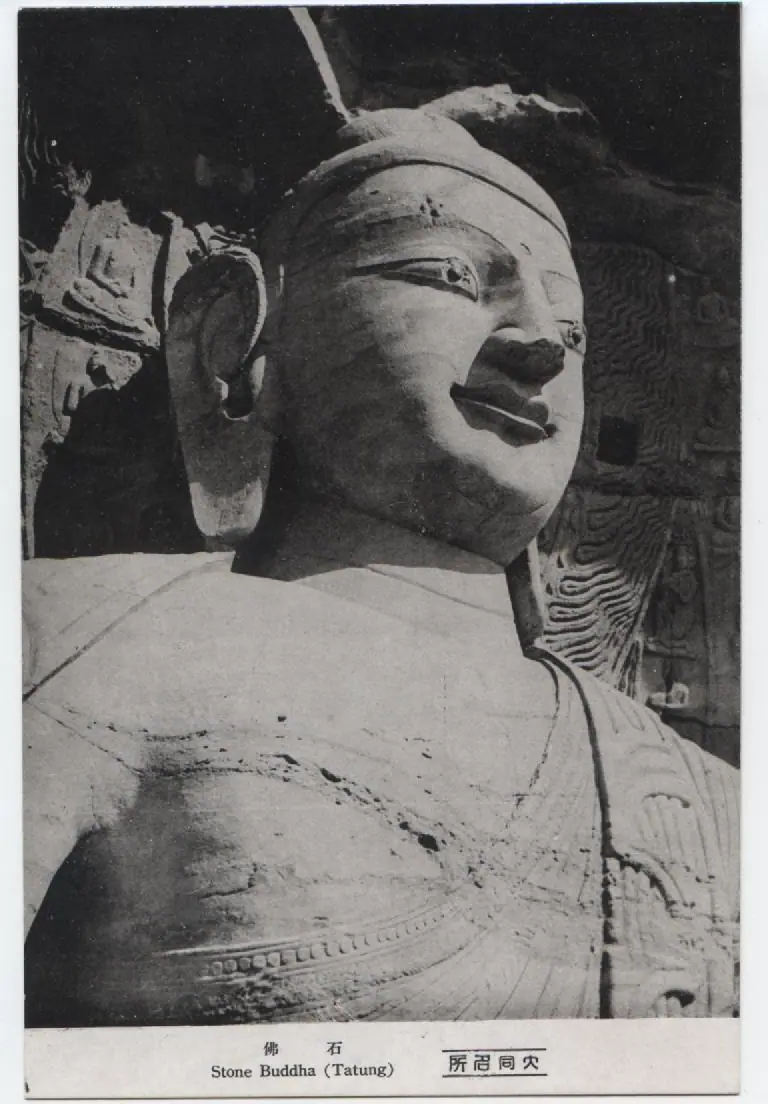
The short version: Buddhism reached China gradually, in the first century CE, with traders and envoys from Central Asia, and it took root through the work of foreign monks who translated its texts into Chinese.[1] Nobody brought it in a single mission. The first secure evidence is an edict of 65 CE, and the earliest translators, from about 148, were mostly Parthians, Kushans and Sogdians, with a few Indians.[2][3] The best-known account, Emperor Ming’s dream of a golden man, is a foundation legend written down later.
The evidence for how Buddhism reached China
The legend: Emperor Ming’s dream
Most Chinese Buddhist histories begin with a dream. The Han emperor Ming (r. 57–75) sees a golden man flying through the air, his ministers tell him it is the Buddha, and he sends envoys west who return with two Indian monks and a white horse carrying scriptures. The White Horse Monastery at Luoyang claims to stand where they lodged.
The fifth-century historian Fan Ye included the story in his History of the Later Han, but he introduced it with a careful phrase:
世傳明帝夢見金人,長大,頂有光明,以問羣臣。
“It is commonly said that Emperor Ming dreamed of a golden man, tall, with light shining from the top of his head, and asked his ministers about it.”[4]
What it proves. That by the fifth century the dream was the accepted story, and that the historian who preserved it reported it as hearsay. Shi chuan, “it is commonly said,” is how Chinese historians flag a tradition they cannot vouch for. The dream also opens the standard Biographies of Eminent Monks (c. 519), where it gives Buddhism an imperial invitation.[5] That is the purpose of the story: a foreign religion arrives not with merchants but at the emperor’s request. Most historians treat it as legend.[1] Majority
The first evidence: a prince’s offerings, 65 CE
In the same reign, a contemporary document shows Buddhism already present. When Emperor Ming’s half-brother Liu Ying, prince of Chu, offered silk to atone for his faults, the emperor returned it with an edict praising him because he “honours the gentle sacrifices of the Buddha” and told him to use the silk to feed the upāsakas and śramaṇas, lay followers and monks.[2]
What it proves. Buddhism was established at a Han court by 65 CE, with Indian terms already transcribed into Chinese. The court was at Pengcheng in the east, far from the Silk Road terminus, so the religion must have travelled with merchant communities for some time before. And it was understood as a cult of offerings and fasting, honoured beside Huang-Lao, the Daoist cult of immortality. Consensus
An earlier claim exists. A third-century history, the Weilüe, quoted in a fifth-century commentary, says that in 2 BCE a Chinese student received a Buddhist scripture orally from an envoy of the Kushan king:
昔漢哀帝元壽元年,博士弟子景盧受大月氏王使伊存口受浮屠經
“In the first year of Yuanshou of Emperor Ai of the Han, the student of the Academy Jing Lu received the Buddhist scripture orally from Yicun, envoy of the king of the Great Yuezhi.”[6]
It is plausible, since Kushan envoys did reach the Han court, but it survives only at second hand and no Han source confirms it. Contested
The carriers: Parthians, Kushans and Sogdians
The people who carried Buddhism to China were mostly Central Asians. The first securely identified translator, An Shigao, was a Parthian who arrived at Luoyang around 148 and translated texts on meditation and Abhidharma.[7][3] Lokakṣema, a Kushan, dated his translation of the Perfection of Wisdom in 8,000 Lines to 179.[8] Their Chinese surnames recorded their origins: An for Parthia, Zhi for the Yuezhi or Kushans, Kang for Sogdia, and Zhu for India.[1] Many texts came from Central Asian Buddhist communities in Gāndhārī and other Prakrits as well as Sanskrit, which is why the Kushan northwest of §5 matters for China.
A second route, by sea
A southern route ran by sea from India and Sri Lanka through Southeast Asia to Jiaozhi, in what is now northern Vietnam. The Biographies of Eminent Monks says Kang Senghui, the son of a Sogdian merchant family settled in Jiaozhi, arrived in the southern capital Jianye (Nanjing) in 247 and, with the support of the Wu ruler Sun Quan, built what the tradition remembers as the city’s first monastery.[5] Two centuries later the pilgrim Faxian went to India overland and came home by sea in 412.[9] Majority
Why it took hold
For two centuries Buddhism remained a minority religion of foreigners and a few enthusiasts. What changed its position was the fall of the Han in 220 and the long division that followed.[1][10]
- In the north, dynasties founded by steppe peoples ruled for most of the period to 589. They had reasons to favour a religion that, like them, came from outside, and they paid for monumental cave temples at Yungang and Longmen.[11]
- In the south, Chinese aristocrats who had fled the north discussed Buddhism in the terms of “dark learning” (xuanxue), a philosophy built on the Laozi and Zhuangzi. Buddhist ideas of emptiness looked to them like a deeper version of Daoist non-being.[1]
- Everywhere, monasteries offered something new: a career outside the family, a shelter from taxes and labour service, and rites for the dead that Chinese ancestor worship could absorb (§7).
Erik Zürcher called the result The Buddhist Conquest of China, while Kenneth Ch’en stressed the opposite direction, The Chinese Transformation of Buddhism. Most historians now see both.[1][12]
The translation problem
Buddhism arrived in Chinese words. The first translators borrowed Daoist terms: Lokakṣema rendered “suchness” as benwu, “original non-being,” and early texts used wuwei, “non-action,” for nirvāṇa.[3] Xiang Kai’s memorial of 166 records Chinese readers explaining the Buddha as Laozi, who had gone west and taught the barbarians.[13] The monk Dao’an (312–385) attacked this method, catalogued genuine translations in 374, and warned of the “five losses” every translation suffers.[14] Kumārajīva’s bureau at Chang’an from 401 produced versions precise and readable enough to become standard across East Asia.[15] Even so, East Asian Buddhism has always been read through Chinese texts, with their own vocabulary and associations (§0).
A short timeline
| Date | What happens | Confidence |
|---|---|---|
| 2 BCE (reported) | A Kushan envoy recites a scripture to Jing Lu[6] | Contested |
| 65 CE | Liu Ying’s offerings to the Buddha praised in an imperial edict[2] | Consensus |
| c. 148 | An Shigao begins translating at Luoyang[7] | Consensus |
| 166 | Shrines to the Buddha in the Han palace[13] | Consensus |
| 179 | Lokakṣema’s dated Mahāyāna translation[8] | Consensus |
| 220 | The Han dynasty falls; three and a half centuries of division begin | Consensus |
| 247 | Kang Senghui arrives at Jianye from Jiaozhi[5] | Majority |
| 401 | Kumārajīva reaches Chang’an[15] | Consensus |
| 412 | Faxian returns from India by sea[9] | Consensus |
What scholars disagree about
When it really arrived. Since Buddhism was established at a prince’s court by 65, it must have arrived earlier, probably among merchant communities in the first half of the first century. Whether the 2 BCE report is reliable is debated; it is the only earlier date with a source.[6][1] Contested
Who was the audience. Some historians stress elite patronage, from Liu Ying to the Northern Wei emperors. Others stress the foreign merchant communities and, later, ordinary people for whom monasteries offered services for the dead. The two pictures are compatible: the evidence that survives is mostly elite.[1] Majority
Early images. Small Buddha-like figures appear on late Han funerary “money trees” and tomb reliefs in Sichuan. Whether they show the Buddha as a Buddhist object of worship or as one more immortal in a Chinese afterlife is argued over.[16] Contested
Common misconceptions
- “Buddhism came to China from India.” Ultimately, yes; but the people who carried it and most of the first texts came from Central Asia, and the Kushan northwest (§5) was the hinge.[3]
- “Emperor Ming invited Buddhism.” The dream is a legend recorded centuries later. The contemporary edict shows Buddhism already present in his brother’s court.[4][2]
- “The Chinese took Buddhism as it was.” They read it through Daoist vocabulary, Confucian family ethics and Chinese politics, and in time composed scriptures of their own (§7).[12]
Why it matters
China was the turning point in Buddhism’s history. Its translations became the scriptures of Korea, Japan and Vietnam, its schools became Zen and Pure Land, and its Buddhism is the source of most of what East Asia, and much of the modern West, takes Buddhism to be. That all began not with an emperor’s dream but with merchants, envoys and foreign monks, and with a prince’s offerings recorded in 65 CE.
For the full story of Buddhism in China, from the first translations to the purge of 845, see Chapter 7: Into China.
References
- ^ a b c d e f g h Erik Zürcher The Buddhist Conquest of China: The Spread and Adaptation of Buddhism in Early Medieval China. Brill, 3rd ed., 2007. The classic account of how Buddhism entered Chinese elite culture up to the early fifth century. First published 1959.
- ^ a b c d Hou Hanshu 42 (Liu Ying) — History of the Later Han. 65 CE (edict); compiled 5th c. CE. Classical Chinese. Emperor Ming's edict of 65 CE praising the prince of Chu, who 'recites the subtle words of Huang-Lao and honours the gentle sacrifices of the Buddha', and returning his silk to feed upāsakas and śramaṇas. read the text
- ^ a b c d Jan Nattier A Guide to the Earliest Chinese Buddhist Translations. International Research Institute for Advanced Buddhology, Soka University, 2008. Which Han-dynasty translations are really by whom, and therefore which texts existed when.
- ^ a b Hou Hanshu 88 (Xiyu zhuan) — History of the Later Han. 5th c. CE. Classical Chinese. Fan Ye's account of the Western Regions gives Emperor Ming's dream of a golden man as something 'commonly said' (世傳), then notes Liu Ying and Emperor Huan as early followers. read the text
- ^ a b c T 2059 (Gaoseng zhuan) 1 — Huijiao, Biographies of Eminent Monks. c. 519–530. Classical Chinese. Opens with Emperor Ming's dream and the legendary first monks; its life of Kang Senghui, a Sogdian raised in Jiaozhi, has him reach Jianye in 247 and build a monastery with Sun Quan's support. read the text
- ^ a b c Weilüe, in Sanguozhi 30 (Pei Songzhi's commentary) — Weilüe. 3rd c. CE (quoted 429). Classical Chinese. Reports that in 2 BCE the student Jing Lu received a Buddhist scripture orally from Yicun, envoy of the Kushan (Great Yuezhi) king. The earliest claimed date for Buddhism in China, known only at second hand. read the text
- ^ a b T 602 (Anban shouyi jing) — An Shigao's translations. c. 148–170 CE. Classical Chinese. An Shigao's text on mindfulness of breathing, one of the first Buddhist meditation manuals in Chinese, from the Parthian translator who began work in Luoyang about 148. read the text
- ^ a b T 224 (Daoxing banruo jing) — Lokakṣema's translations. 179 CE. Classical Chinese. Lokakṣema's Chinese translation of the Perfection of Wisdom in 8,000 Lines, dated by its colophon to 179 CE. A dated translation proves the source text existed by that year. read the text
- ^ a b Faxian, Record of Buddhist Kingdoms — Foguo ji. c. 416 CE. Classical Chinese. The pilgrim's account of India c. 399–414, describing monasteries as Mahāyāna, non-Mahāyāna or mixed, and the two kinds of monks living side by side; he also stayed two years in Sri Lanka and counted the monks of its great monasteries. read the text
- ^ Kenneth K. S. Ch'en Buddhism in China: A Historical Survey. Princeton University Press, 1964. Still the most useful one-volume narrative of Chinese Buddhist history.
- ^ Wei shu 114 (Shi-Lao zhi) — History of the Wei. 554 CE. Classical Chinese. The Treatise on Buddhism and Daoism: Faguo calls the Northern Wei founder 'the Tathāgata of today'; the suppression of 446; Tanyao's five cave temples west of the capital. read the text
- ^ a b Kenneth K. S. Ch'en The Chinese Transformation of Buddhism. Princeton University Press, 1973. How Chinese ethics, politics and economics reshaped Buddhism, including filial piety and monastic economics.
- ^ a b Hou Hanshu 30B (Xiang Kai) — History of the Later Han. 166 CE (memorial). Classical Chinese. Xiang Kai's memorial to Emperor Huan: shrines to Huang-Lao and the Buddha stand in the palace, and 'some say Laozi went among the barbarians and became the Buddha'. read the text
- ^ T 2145 (Chu sanzang jiji) — Sengyou's catalogue. c. 515 CE. Classical Chinese. Sengyou's catalogue of translations, which preserves Dao'an's lost catalogue of 374 and his preface on the 'five losses and three difficulties' of translation. read the text
- ^ a b T 262 (Miaofa lianhua jing) — Kumārajīva's Lotus Sūtra. 406 CE. Classical Chinese. Kumārajīva's translation of the Lotus Sūtra, made at Chang'an in 406 and still the standard text across East Asia. read the text
- ^ Wu Hung "Buddhist Elements in Early Chinese Art (2nd and 3rd Centuries A.D.)". Artibus Asiae 47, 1986. The Han and Three Kingdoms images, from money trees to tomb reliefs, and how Buddhist motifs were absorbed into Chinese funerary art.