The short version: the “Laughing Buddha” is Budai 布袋, “Cloth Bag,” a Chinese Buddhist monk whose personal name was Qici 契此. He lived in Zhejiang in the late ninth and early tenth centuries and was remembered as a pot-bellied eccentric who wandered the markets with a sack on a staff.[1] Within a century of his death he was being identified with Maitreya (Chinese Mile 彌勒), the Buddha who is to come, and that identification is why he is called a Buddha at all.[2] He is not Śākyamuni, the historical Buddha of the fifth century BCE (§2). Consensus
The evidence for who Budai was
The earliest biography, 988
The earliest full account is in the Song Biographies of Eminent Monks, compiled by Zanning and presented to the throne in 988. It describes a monk of unknown family, perhaps from Siming (Ningbo):
形裁腲脮,蹙頞皤腹,言語無恒,寢臥隨處。常以杖荷布囊入鄽肆,見物則乞。
“Fleshy in build, with a wrinkled brow and a bulging belly, his speech was erratic and he slept wherever he happened to be. He always carried a cloth bag on a staff into the markets, and begged for whatever he saw.”[1]
It adds that he begged even pickled fish, put a little in his bag, slept in the snow without snow settling on him, and foretold the weather by his shoes. It quotes a verse, “Maitreya, true Maitreya, the people of the time do not recognise him,” and says that “people said he was a manifestation of Maitreya.” He died, it says, during the Tianfu era (901–904) at Fengchuan and was buried by the local people, and “between Jiangsu and Zhejiang many paint his image.”[1]
What it proves. That by 988 Budai was already a regional cult figure, painted across the lower Yangzi, and already linked with Maitreya. The belly and the bag, the two things everyone now recognises, are in the earliest description. Consensus
The Chan account and the death verse, 1004
Sixteen years later the Jingde Record of the Transmission of the Lamp listed Budai among Chan adepts “who did not hold office but were famous in their time.” It gives a different date and a fuller death scene:
梁貞明二年丙子三月師將示滅。於嶽林寺東廊下端坐磐石。而說偈曰。彌勒真彌勒,分身千百億,時時示時人,時人自不識。
“In the third month of the second year of Zhenming of the Liang [916], as the master was about to die, he sat upright on a flat stone under the eastern corridor of Yuelin monastery and spoke a verse: ‘Maitreya, true Maitreya, divides his body into hundreds of billions; from time to time he shows himself to people, and the people do not recognise him.’”[2]
The text adds that after his death people in other provinces saw him still walking with his bag, that “the fourfold community vied to paint his image,” and that his whole body was preserved in the east hall of Yuelin monastery.[2]
What it proves. That the Chan tradition adopted Budai as one of its holy fools, and that the Maitreya identification rested on a verse placed in his mouth at death. The two sources disagree on when he died, by about fifteen years. Most modern accounts follow the Chan date of 916. Majority
From eccentric monk to temple deity
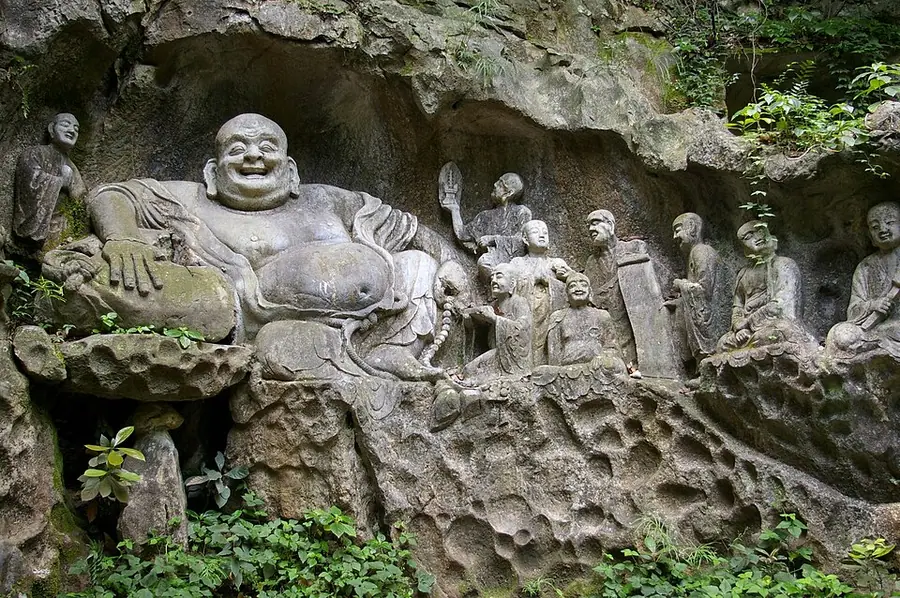
Budai’s image spread through painting and sculpture, much of it made in Chan circles.[3] At Feilaifeng near Hangzhou, a Song-dynasty rock-cut niche, usually dated to the Southern Song, shows him, huge and laughing, among eighteen arhats.[4] By the Ming period, Chinese monasteries commonly placed a Maitreya in Budai’s form in the entrance hall, the Hall of the Heavenly Kings, facing the gate, with the guardian Weituo behind him facing the main hall.[5] Visitors to a Chinese temple still meet Budai first and the historical Buddha last. Majority
In Japan: Hotei
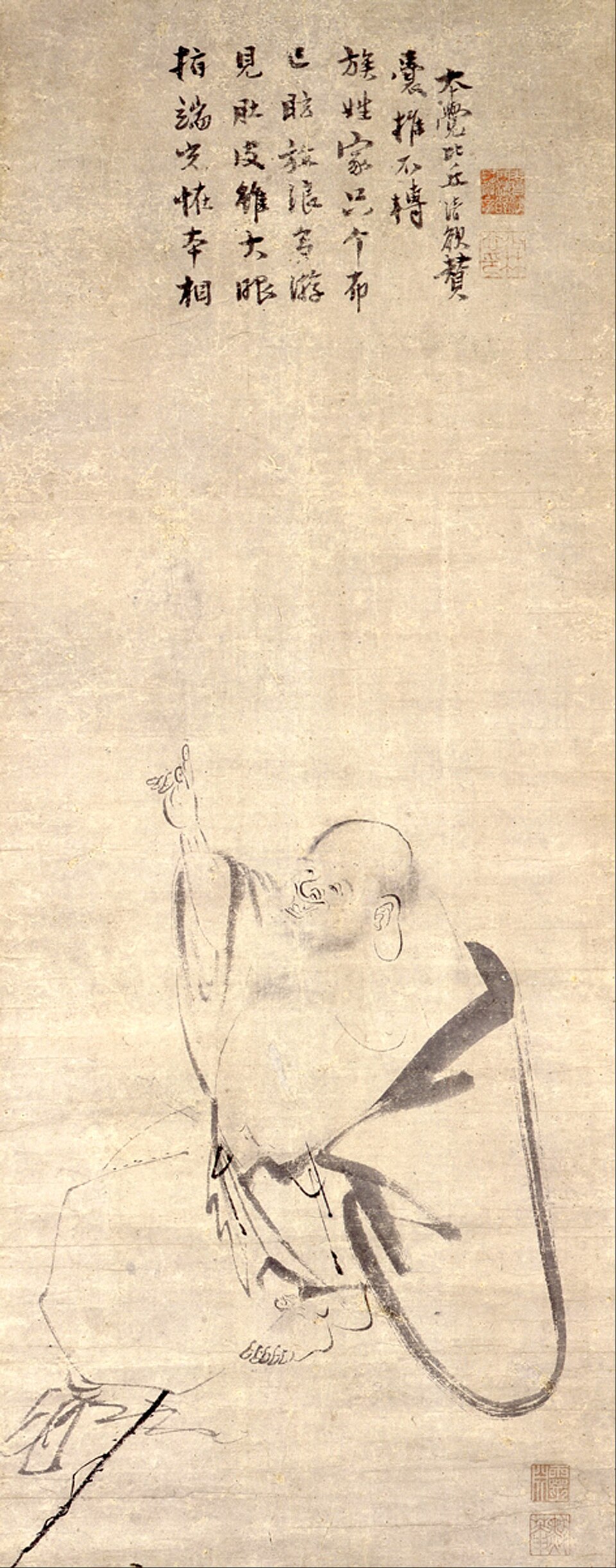
Japanese Zen monks brought Budai home as Hotei. He was a favourite subject of Chan and Zen ink painting, often shown laughing, sleeping on his sack, or pointing upward; the MOA Museum reads Mokuan’s pointing Hotei as foretelling the coming of Maitreya.[6] In the Muromachi period (1336–1573) he was grouped with Ebisu, Daikokuten, Bishamonten, Benzaiten, Fukurokuju and Jurōjin as one of the Seven Lucky Gods (Shichifukujin), a popular cult of good fortune whose members came from Buddhism, Daoism and Shintō.[7] Majority
Why he is not the historical Buddha
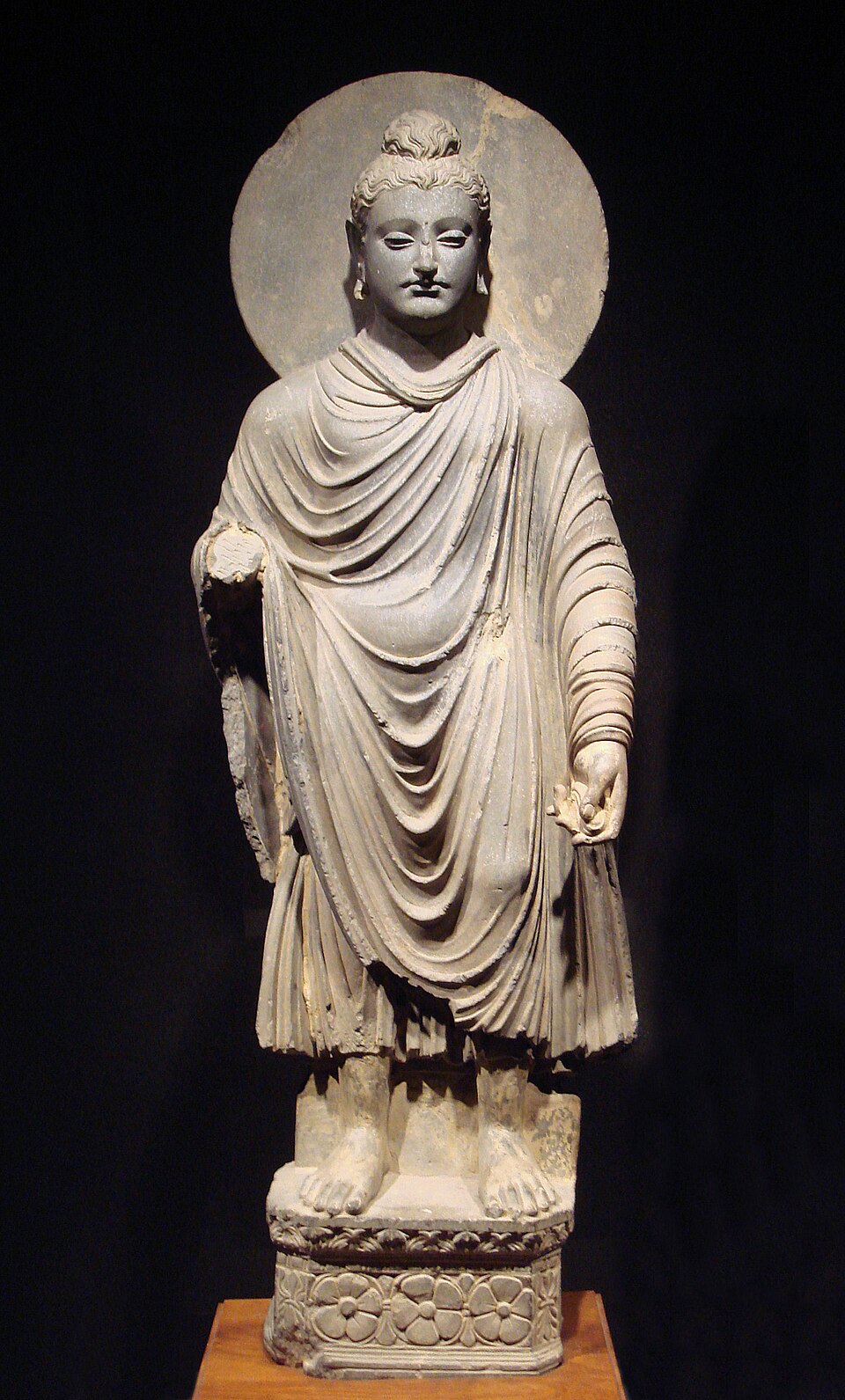
The historical Buddha, Siddhārtha Gautama or Śākyamuni, was a renunciant teacher of the fifth century BCE in north India (§2). When Buddhist art first showed him in human form, in Gandhāra and Mathurā in the first and second centuries CE, it gave him a monk’s robe, a cranial protuberance (uṣṇīṣa), elongated earlobes and a slender, composed body, conventions that every later Buddhist art kept (§5).[8] Budai lived some thirteen centuries later, in China, and his iconography comes from descriptions of a real, very un-ascetic monk.
The confusion is understandable. Budai is called Mile fo, “Maitreya Buddha,” in Chinese, and in the West the figurines are sold as “the Buddha.” But in Buddhist belief Maitreya is the next Buddha. A Pali discourse foretells his coming in a distant future age, and a sūtra translated into Chinese in the fifth century places him, meanwhile, as a bodhisattva in the Tuṣita heaven.[9][10] Budai is honoured as a manifestation of that future Buddha, not as the founder of Buddhism.
A short timeline
| Date | What happens | Confidence |
|---|---|---|
| c. 5th c. BCE | The historical Buddha, Śākyamuni (§2) | Majority |
| 1st–2nd c. CE | The first images of the Buddha, slender and robed (§5)[8] | Consensus |
| 901–904 or 916 | Death of Qici, called Budai, in Zhejiang[1][2] | Majority |
| 988 | First biography; Budai already painted and linked with Maitreya[1] | Consensus |
| 1004 | The death verse and Chan adoption[2] | Consensus |
| Song, prob. 1127–1279 | Song carving at Feilaifeng[4] | Majority |
| c. 1333–1343 | Mokuan Reien’s Hotei[6] | Majority |
| 1336–1573 | Hotei among Japan’s Seven Lucky Gods, grouped in the Muromachi period[7] | Majority |
What scholars disagree about
When he died. The 988 biography says during the Tianfu era (901–904); the 1004 Chan record says 916, with a dated death scene.[1][2] The later, more detailed account is the one usually repeated, but detail is not the same as reliability. Contested
Was the Maitreya identification his own? Both early sources give him a verse naming Maitreya, but the earlier one presents it as a saying and the identification as what “people said.” Whether Qici claimed to be Maitreya, joked about it, or had the claim made for him after death cannot be known. Maitreya cults had been politically dangerous in China, where rebels from the early seventh century onward proclaimed the coming of Maitreya,[11] and a harmless, laughing Maitreya may have suited monks and rulers alike. Speculative
Common misconceptions
- “The Laughing Buddha is the Buddha.” He is Budai, a tenth-century Chinese monk honoured as a form of the future Buddha Maitreya, not Śākyamuni.[2]
- “The Buddha was fat.” The early texts describe an ascetic who nearly starved himself before choosing a middle way, and early art shows him lean (§2, §5).[12]
- “Rubbing his belly brings luck” is a Buddhist teaching. It is popular custom. Budai’s role as a bringer of wealth and children belongs to folk religion and, in Japan, to the Seven Lucky Gods, not to Buddhist doctrine.[7] Majority
Why it matters
Budai shows Buddhism becoming Chinese. An Indian religion that began with a renouncer who left wealth behind produced, in China, a cheerful beggar-saint associated with plenty and children, and put him at the gate of its monasteries. The figure most of the world recognises as “the Buddha” is a local holy man from Zhejiang, which is a measure of how far, and how creatively, the religion travelled.
For Buddhism in China, see Chapter 7: Into China; for how the historical Buddha was first depicted, §5.
References
- ^ a b c d e f T 2061 (Song gaoseng zhuan) 21, 'Qici' — Zanning, Song Biographies of Eminent Monks. 988. Classical Chinese. The earliest life of Budai: pot-bellied, wrinkled brow, begging with a cloth bag on a staff; a verse naming Maitreya; died in the Tianfu era (901–904); 'many paint his image' in Jiangsu and Zhejiang. read the text
- ^ a b c d e f g T 2076 (Jingde chuandeng lu) 27, 'Budai' — Record of the Transmission of the Lamp. 1004. Classical Chinese. Lists Budai of Mingzhou among unaffiliated Chan adepts and gives his death in 916 at Yuelin monastery after the verse 'Maitreya, true Maitreya ... the people do not recognise him'. read the text
- ^ Helen B. Chapin "The Ch'an Master Pu-tai". Journal of the American Oriental Society 53, 1933. The classic study of Budai in Chan sources and painting.
- ^ a b Feilaifeng niche 68 — Feilaifeng, Hangzhou. Song dynasty, usually dated Southern Song (1127–1279). A rock-cut Budai, laughing and pot-bellied, at the centre of a group of eighteen arhats on the hill opposite Lingyin monastery. about
- ^ Hall of the Heavenly Kings (Tianwang dian) — Chinese monastery layout. Ming onward. The entrance hall of Chinese monasteries: Maitreya in Budai's form faces the gate, with the guardian Weituo behind him facing the main hall, a standard arrangement by the Ming period. about
- ^ a b Mokuan Reien, Hotei — MOA Museum of Art, Atami. c. 1333–1343. An ink painting of Budai by a Japanese Zen monk-painter working in China, inscribed by the Chan master Liaoan Qingyu; an Important Cultural Property. about
- ^ a b c Shichifukujin — JAANUS (Japanese Architecture and Art Net Users System). reference. English. The Seven Lucky Gods, Hotei among them, grouped in the Muromachi period; the membership was not fixed at first. about
- ^ a b John M. Rosenfield The Dynastic Arts of the Kushans. University of California Press, 1967. full text The classic statement of the Śiva reading of Oēśo, now contested.
- ^ DN 26 — Cakkavattisīhanāda Sutta (Dīgha Nikāya). c. 400–200 BCE, with later layers. Pali. A myth of moral decline and renewal ending with the prophecy that, when human lifespan has risen to 80,000 years, a Buddha named Metteyya (Maitreya) will arise: the only mention of Maitreya in the Pali discourses. read the text
- ^ T 452 (Guan Mile pusa shangsheng doushuaitian jing) — Sūtra on the Visualisation of Maitreya's Ascent to Tuṣita Heaven, trans. Juqu Jingsheng. 5th c. CE. Classical Chinese. Describes Maitreya's rebirth in the Tuṣita heaven, where he teaches as a bodhisattva until his descent as the next Buddha, and the merit of visualising him there; a basis of the Chinese Maitreya cult. read the text
- ^ Erik Zürcher "'Prince Moonlight': Messianism and Eschatology in Early Medieval Chinese Buddhism". T'oung Pao 68: 1–75, 1982. doi The classic study of Chinese Buddhist messianism, including the Maitreya expectations behind rebel movements.
- ^ MN 36 — Mahāsaccaka Sutta (Majjhima Nikāya). c. 400–200 BCE. Pali. The Buddha describes his extreme fasting and breath-holding, abandons them, and remembers sitting in the first jhāna as a boy under a rose-apple tree while his father worked. That memory becomes the way to awakening. read the text