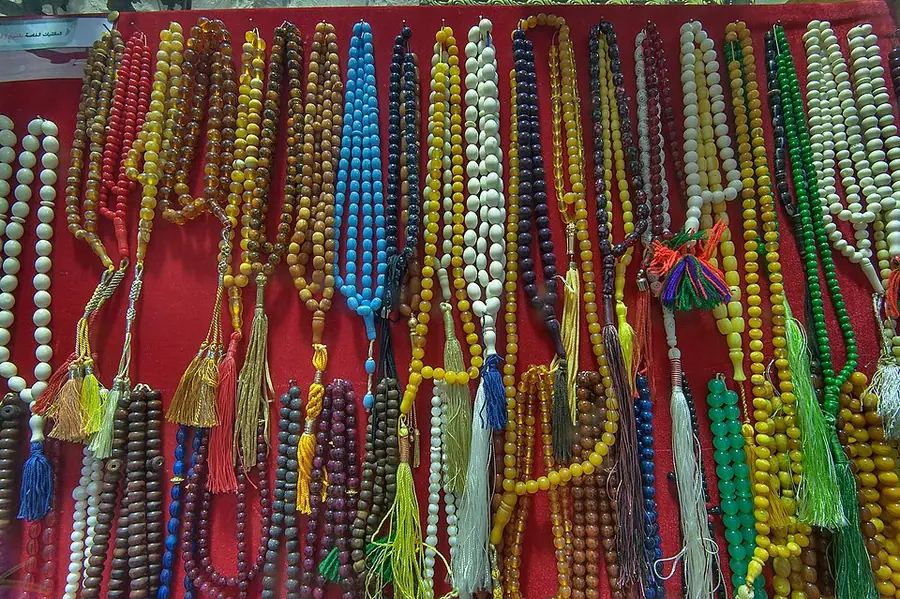
The short version: a string of beads is a counter. Every tradition that uses one asks its members to repeat a prayer, a name or a formula a fixed number of times, and moving a bead per repetition keeps count while the mind stays on the words. The Chinese Buddhist name for the object, shuzhu, means simply “counting beads”.[1] Consensus The harder question is history: did one invention spread across Asia and Europe, or did several religions arrive at the same tool? The evidence is thin in exactly the places where it would decide the matter. This page sets out what is dated, tradition by tradition.
India: the likeliest home, the hardest to date
Most scholars look to India for the first prayer beads. A 1918 survey of the subject concluded that “the Hindus were the first to evolve the rosary”, and the historian John Kieschnick calls the Indian origin of the Chinese rosary “undisputed”.[2][1] Majority The Sanskrit mālā means a garland, and the Hindu rosary is the japa-mālā, the garland for japa, the muttered repetition of a mantra or a divine name. Vaiṣṇava rosaries usually have 108 beads; Śaiva ones are also made with 32 or 64.[2] Majority
What India lacks is an early date. The great early Buddhist monuments at Sanchi and Bharhut, with hundreds of carved figures, show no rosaries; by the seventh century CE rosaries appear regularly in Hindu sculpture.[1] Majority The oldest literary mention found in the 1918 survey is in the Jain canon, which lists the rosary among the equipment of Brahmin ascetics and calls it the gaṇettiyā, “the counter”.[2] Majority The canon was written down in the fifth century CE from older material, so the passage cannot be dated precisely (Hinduism §6). Kieschnick concludes that the search for the ultimate origin of the rosary is “probably a lost cause”.[1] Majority
Buddhism: 108 seeds for a king
The early Buddhist monastic rules and discourses never mention beads, which suggests the rosary entered Buddhism several centuries after the order was founded.[1] Majority The earliest text that can be dated is a short Chinese sutra, the Mu-huanzi jing, “Sutra of the Soapberry Seeds”. In it a king asks the Buddha for a practice simple enough to follow amid the business of ruling. The Buddha tells him to thread 108 soapberry seeds on a string and, passing one seed at a time, to recite “Buddha, Dharma, Sangha”.[3] Consensus The sutra is said to have been translated in the fourth century, but its translator is unknown and it is first listed in a Chinese catalogue of 594, so the safe date is “known in China by the end of the sixth century”.[1] Majority
The practice spread with Pure Land devotion, in which believers call the name of Amitābha Buddha as many times as they can (Buddhism §7). The monk Daochuo (562–645) first had his followers count their recitations with beans or sesame seeds, then strung seeds into rosaries and gave them to monks, nuns and lay people alike. A relief of 629 already shows a monk holding one.[1] Consensus Later Chinese texts allowed rosaries of 54, 27 or 14 beads, and treated the count as part of what made the practice work.[1] Majority
Christianity: from pebbles to the rosary
The desert. The earliest Christian evidence is a story about the Egyptian monks (Christianity §6). Palladius, writing about 419–420, says that Abba Paul of Pherme said 300 prayers a day, “and he collected as many pebbles and kept them in his lap and threw out of his lap one pebble at each prayer”.[4] Consensus Knotted cords are still the Orthodox form of the counter.[2] Consensus
Paternosters. In the medieval West strings of beads were called paternosters, because they were first used to count repetitions of the Lord’s Prayer, and by the thirteenth century there were guilds of “paternosterers” who made them. The Our Father stood in for the psalms: the customs of Cluny, collected in 1096, have a brother who is not a priest say either fifty psalms or fifty Our Fathers for a dead monk.[5] Consensus In England the benefactor Lady Godiva, who died around 1075, left a circlet of gems threaded on a cord “in order that by fingering them one after another she might count her prayers exactly”.[5][2] Majority
The rosary. By the twelfth century the Hail Mary was being repeated 50 or 150 times, a set of 150 known as “Our Lady’s Psalter” because it mirrored the psalms.[5] Consensus The classic rosary took shape in the fifteenth century. Early in that century a Carthusian, Dominic of Prussia, attached a short meditation on the life of Christ to each Hail Mary, and in the 1470s the Dominican preacher Alan de la Roche and his colleagues founded rosary confraternities at Douai, Cologne and elsewhere (Christianity §8).[6][5] Consensus The name comes from Latin rosarium, a rose garden or garland of roses.[5][6] Majority
Islam: the subḥa and the argument over innovation
The counts. A hadith in the collection of Muslim tells believers to say “Glory be to God” 33 times, “Praise be to God” 33 times and “God is most great” 33 times after each prayer, and to make up the hundred with the profession of God’s oneness.[7] Consensus That is why the subḥa or misbaḥa has 33 beads, passed three times, or 99, a number also linked to the 99 names of God.[8] Consensus Shiʿi rosaries are often made of clay from Karbala.[8]
The opposition. In 1890 the Hungarian scholar Ignaz Goldziher showed that the subḥa is securely attested only in the third Islamic century, the ninth century CE, and that it was then used mainly by Sufis and the common people, without the approval of the learned (Islam §7).[9][8] Majority Rigorists called it a bidʿa, an innovation with no basis in the Prophet’s practice; the great Baghdad Sufi al-Junayd (d. 910) was reproached for owning one. As late as the fourteenth century the Maghribi jurist Ibn al-Ḥājj al-ʿAbdarī (d. 1336) denounced the subḥa among the innovations of his day.[9] Majority The defence came from al-Suyūṭī (d. 1505), whose short treatise argued that the beads were permitted.[8] Majority
Fingers. The objection had a textual basis. A hadith has the Prophet tell women to count their praises “on the fingertips, for they will be questioned and made to speak” on the Day of Judgment.[10] Consensus Some Muslims still count on their fingers for that reason, while others use beads, and both appeal to the Prophet’s example (see how hadith are graded).
Sikhism: remembering the Name
Guru Nānak (1469–1539) made nām simaran, “remembering the Name”, the centre of the discipline, but the Name in his hymns is not a word to be chanted for its own sake: it is God’s whole nature as revealed (Sikhism §2).[11][12][13] Consensus The Japjī, which opens the scripture and which Sikhs recite every morning, says that ritual washing, silence and fasting do not make a person true, and speaks of the uselessness of hearing and reciting without understanding.[14][11][12] Consensus on the text. The rosary does appear in Sikh art: the B40 janamsākhī, completed in 1733 and among the earliest dated images of Guru Nānak, shows him holding one (Sikhism §0).[15][16] Consensus on the painting. It was painted almost two centuries after his death, and says nothing about how, or whether, his first followers used beads.
The scripture itself is wary of the rosary. Guru Nānak counts “a rosary round the neck and a mark on the forehead” among a Brahmin’s observances that are empty without knowledge of God, and Kabīr, whose verses the Gurus included, asks why a man shows people his rosary of wood if he does not remember God in his heart. The same book makes the Name the true rosary: “These two syllables, Har Har, are my rosary,” writes Guru Arjan, and Kabīr calls his tongue his rosary (Sikhism §11).[17][18][19][20] Consensus on the texts. Bhāī Gurdās, early in the seventeenth century, says the true devotees of the gathering “broke the mālā and the tasbīh”, making a hundred beads the same as a hundred and eight, the counts of the Muslim and Hindu rosaries.[21][22] Majority on the reading.
No Sikh code requires beads. The Sikh Rahit Maryādā of 1950 mentions the rosary only to reject it: its Punjabi text lists tulsī, mālā, “basil, rosary”, among the delusive observances a Sikh should not put faith in, which the SGPC’s English version reads as one item, a necklace of tulsī (basil) wood. Kāhn Singh Nābhā’s dictionary of 1930 states that “in the Sikh religion there is no rule of repeating the Name by count”.[23][24][22] Majority Still, many Sikhs repeat Vāhigurū, the name of God given at initiation, “with or without a rosary”, in the words of The Encyclopaedia of Sikhism; a short hand-held one is a simaranī. The Nihaṅgs wear steel rosaries on their turbans, and the Nāmdhārīs have been known by a woollen one since the nineteenth century.[25][22] Majority Beyond the Mahān Kosh’s general definitions, no reliable source gives a usual count for a Sikh rosary.
A rough timeline
| Date | Evidence | Confidence |
|---|---|---|
| c. 420 CE | Paul of Pherme counts 300 prayers with pebbles[4] | Consensus |
| 5th c. CE | Jain canon written down; names the ascetic’s rosary[2] | Majority |
| By 594 CE | Mu-huanzi jing catalogued in China: 108 seeds[3][1] | Majority |
| 7th c. CE | Daochuo hands out rosaries; Hindu sculpture shows them regularly[1] | Consensus |
| 9th c. CE | The subḥa securely attested in Islam, and opposed[9] | Majority |
| 11th–13th c. | Paternoster beads in the West; Our Lady’s Psalter[5] | Consensus |
| 1336 | al-ʿAbdarī still denounces the subḥa as an innovation[9] | Majority |
| 15th c. | The Western rosary takes its classic form; al-Suyūṭī defends the subḥa[6][8] | Consensus |
| 1604 | The Ādi Granth compiled: Gurus and Kabīr on the rosary and the Name[19][18] | Consensus |
| 1733 | The B40 janamsākhī paints Guru Nānak holding a rosary[15] | Consensus |
| 1950 | The Sikh Rahit Maryādā lists tulsī, mālā among superstitions; requires no rosary[23] | Consensus |
What scholars disagree about
One invention or several. Goldziher thought it certain that the Muslim rosary came from India through Buddhist practice.[8] A once-popular theory had Crusaders bring the rosary to Europe from the Muslim world. Both rest on resemblance rather than a documented route. Christian counting with pebbles and strings is older than the Crusades, and counting by knots or stones is so simple that it may well have been invented again and again.[2][1] Contested Kieschnick calls the evidence linking Islamic and Christian beads to India “slight”, and notes that most writers allow for independent development.[1] Majority
Why 108. No single reason is agreed. The Chinese sutra tradition makes the 108 beads stand for 108 afflictions, and dozens of later texts repeat this; but the number has many unrelated meanings in Indian religion, and rosaries of other sizes were always in use.[1][2] Contested
Common misconceptions
- “St Dominic received the rosary from the Virgin Mary.” The story was spread by Alan de la Roche in the 1470s, more than 250 years after Dominic’s death; the Catholic Encyclopedia’s own article says that Alan based his claims on writers “that never existed”.[5] Consensus
- “The rosary was brought back by the Crusaders.” Paul’s pebbles and Godiva’s string of gems both predate the Crusades.[4][2] Majority
- “‘Rosary’ is a mistranslation of Sanskrit japa-mālā.” A popular theory says Europeans mistook japa, “muttering”, for japā, the China rose. The standard reference works trace the word to Latin rosarium and do not support it.[5][6] Speculative
- “Prayer beads have always been accepted in Islam.” For several centuries many scholars rejected them as an innovation.[9] Majority
Why it matters
Prayer beads look like an ancient shared symbol, but the evidence shows something more ordinary and more interesting: a counting tool that appears wherever a tradition asks for prayer by number. Its history in each religion begins with a dispute or an improvisation, from monks with pebbles and a teacher with sesame seeds to jurists arguing about innovation. For other practices whose origins turn out later than they look, see When did the big religious ideas first appear?
References
- ^ a b c d e f g h i j k l m John Kieschnick The Impact of Buddhism on Chinese Material Culture. Princeton University Press, 2003. open library Chapter 2, 'The Rosary' (pp. 116–138), is the best scholarly history of Buddhist beads and of how little is known about their origin.
- ^ a b c d e f g h i Winifred S. Blackman Rosaries. in James Hastings (ed.), Encyclopaedia of Religion and Ethics, vol. 10, T&T Clark, pp. 847–856, 1918. full text Old but still the fullest survey of prayer beads across religions, with the Jain, Hindu, Sikh and Christian evidence.
- ^ a b T 786 (Mu-huanzi jing) — Sūtra of the Soapberry Seeds. catalogued in China by 594 CE. Classical Chinese. The Buddha tells King Vaidūrya to string 108 soapberry seeds and pass one bead for each recitation of 'Buddha, Dharma, Sangha'. read the text
- ^ a b c Lausiac History 20.1 — Palladius, Lausiac History. c. 419–420 CE. Greek. Abba Paul of Pherme kept 300 pebbles in his lap and threw one out at each of his 300 daily prayers. read the text
- ^ a b c d e f g h Herbert Thurston & Andrew J. Shipman The Rosary. Catholic Encyclopedia, vol. 13, Robert Appleton, 1912. open library A Jesuit historian's demolition of the legend that St Dominic received the rosary from the Virgin.
- ^ a b c d Anne Winston-Allen Stories of the Rose: The Making of the Rosary in the Middle Ages. Pennsylvania State University Press, 1997. open library The standard history of how the Western rosary took shape in the fifteenth century.
- ^ Ṣaḥīḥ Muslim 597a — Ṣaḥīḥ Muslim, Kitāb al-Masājid. compiled before 875 CE. Arabic. Whoever says 'Glory be to God' 33 times, 'Praise be to God' 33 times and 'God is most great' 33 times after each prayer, and completes the hundred with the profession of God's oneness, is forgiven. read the text
- ^ a b c d e f A. J. Wensinck Subḥa. Encyclopaedia of Islam, 2nd ed., vol. 9, Brill, pp. 741–742, 1997. doi The reference-work summary: Sufi and popular use first, the counts of 33 and 99, al-Suyūṭī's defence.
- ^ a b c d e Ignaz Goldziher Le rosaire dans l'Islam. Revue de l'histoire des religions 21: 295–300, 1890. full text The founding study of the Muslim subḥa: securely attested only from the third Islamic century, and long opposed as an innovation.
- ^ Sunan Abī Dāwūd 1501; Jāmiʿ al-Tirmidhī 3583 — Hadith of Yusayra. compiled 9th c. CE. Arabic. The Prophet told the women to count their praises 'on the fingertips, for they will be questioned and made to speak'. read the text
- ^ a b W. H. McLeod Guru Nanak and the Sikh Religion. Clarendon Press, Oxford, 1968. The critical study of Nānak's life and theology, separating the janamsākhī tradition from the hymns.
- ^ a b Christopher Shackle and Arvind-pal Singh Mandair, trans. Teachings of the Sikh Gurus: Selections from the Sikh Scriptures. Routledge, 2005.
- ^ Eleanor Nesbitt Sikhism: A Very Short Introduction. Oxford University Press, 2nd ed., 2016.
- ^ Guru Granth Sāhib, ang 1 — Guru Nānak, Japu (Japjī). before 1539 CE (composed); 1604 CE (compiled). Punjabi in Gurmukhi. The first pauṛīs of the Japjī: cleansing, silence and cleverness do not make one true; the way is to walk in the hukam, outside which nothing stands. read the text
- ^ a b B40 Janamsākhī — British Library, MSS Panjabi B 40. 1733 CE. Punjabi in Gurmukhi. A dated and illustrated janamsākhī with 57 paintings, among the earliest surviving images of Guru Nānak.
- ^ Anne Murphy The Materiality of the Past: History and Representation in Sikh Tradition. Oxford University Press, New York, 2012.
- ^ Guru Granth Sāhib, ang 470 — Guru Nānak, Āsā dī Vār. before 1539 CE (composed); 1604 CE (compiled). Punjabi in Gurmukhi. "A rosary round the neck and a mark on the forehead": a salok listing a Brahmin's observances, all empty without knowledge of God. read the text
- ^ a b Guru Granth Sāhib, ang 1368 — Salok Kabīr 75. 1604 CE (compiled). Old Hindi (sant bhāṣā) in Gurmukhi. "Why show people your rosary of wood?": if Rām is not remembered in the heart, the rosary is of no use. read the text
- ^ a b Guru Granth Sāhib, ang 388 — Guru Arjan, Rāg Āsā. 1581–1606 CE. Punjabi in Gurmukhi. "These two syllables, Har Har, are my rosary": the Name as the rosary, enshrined in the heart and taken to the next world. read the text
- ^ Guru Granth Sāhib, ang 1364 — Salok Kabīr 1. 1604 CE (compiled). Old Hindi (sant bhāṣā) in Gurmukhi. "My rosary (simaranī) is my tongue, and Rām is on it": the first of Kabīr's saloks. read the text
- ^ Bhāī Gurdās, Vār 39.11 — Vārāṅ Bhāī Gurdās. before 1636 CE. Punjabi in Gurmukhi. The true devotees of the gathering (amalī khāse majalasī) "broke the mālā and the tasbīh", made a hundred the same as a hundred and eight, mixed the meru with the imām bead, and did not count Rām and Rahīm as separate names. read the text
- ^ a b c Kāhn Singh Nābhā Gurshabad Ratanākar Mahān Kosh. Patiala, 4 vols; text read in the BaniDB transcription, 1930. full text The Singh Sabhā encyclopaedic dictionary of Sikh literature. Cited here for ਜਪਮਾਲਾ ("in the Sikh religion there is no rule of repeating the Name by count"; the tasbīh of 100 with Bhāī Gurdās 39.11) and ਸਿਮਰਨਾ (a hand rosary of 27 beads and a head bead; Nihaṅg usage). The link is the scan of the first edition, vol. 2 (ਹ–ਜ), which has ਜਪਮਾਲਾ; ਸਿਮਰਨਾ is in vol. 1.
- ^ a b Sikh Rahit Maryādā — Code of conduct of the Shiromaṇī Gurdwārā Prabandhak Committee. approved 1945 CE; published 1950 CE. Punjabi. The code most Sikh institutions follow: who is a Sikh, the amrit ceremony, the Five Ks and the four cardinal prohibitions. about
- ^ W. H. McLeod Sikhs of the Khalsa: A History of the Khalsa Rahit. Oxford University Press, New Delhi, 2003. The code of conduct from the rahitnāmās to the Sikh Rahit Maryādā; the main source for dating the Five Ks.
- ^ Harbans Singh, ed. The Encyclopaedia of Sikhism. Punjabi University, Patiala, 4 vols, 1992. open access Published 1992–1998; the standard reference, with signed entries reporting both tradition and sources.