The short version: yes, on the balance of the evidence, though the evidence is indirect. Nothing written in the Buddha’s lifetime survives, because nothing religious was written down in his part of India then. What survives is a teaching kept in memory for two centuries, an emperor’s inscription at his birthplace about 150 years after his death, and a set of early texts whose oddities are hard to explain unless a real teacher stood behind them. Most specialists accept that combination as enough. A few do not, and their objection deserves to be stated properly.[1][2]
It helps to separate two questions that are often run together. One is whether there was a person, Gotama of the Śākyas, whose teaching founded the Buddhist order. The other is whether the familiar life story is true: the palace, the four sights, the escape at midnight. The answer to the first is probably yes. The answer to the second is mostly no, and that is not a fringe view (§2).[3]
The evidence for a historical Buddha
An emperor at the birthplace
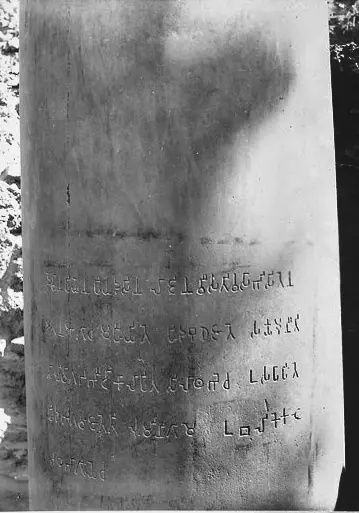
The hardest evidence is a stone pillar at Lumbini in southern Nepal, carved for the Mauryan emperor Ashoka around 249 BCE:
devāna piyena piyadasina lājina vīsativasābhisitena atana āgāca mahīyite hida budhe jāte sakyamunī ti
In E. Hultzsch’s translation: “When king Devānāṃpriya Priyadarśin had been anointed twenty years, he came himself and worshipped (this spot), because the Buddha Śākyamuni was born here.”[4][5]
What it proves. That within about a century and a half of the Buddha’s death, a specific village was identified as the birthplace of a specific person, and the most powerful ruler in India travelled there, exempted it from one tax and cut its share of the harvest to an eighth. The inscription calls him by a clan name, Sakyamuni, “the sage of the Śākyas,” not by a divine title. Ashoka was not inventing a founder. He was honouring one whose birthplace local people already knew.[4][6] It does not prove the identification was right, but a strong local tradition within five or six generations is hard to explain if there was no one to remember.
A second pillar nearby, at Nigali Sagar, records that Ashoka enlarged a stupa of an earlier Buddha, Konākamana.[7] That cuts both ways, and sceptics are right to raise it: by the third century BCE Buddhists already honoured mythical past Buddhas with real monuments. A pillar alone cannot separate a historical founder from a legendary one. The case needs the texts too.
Texts too awkward to be invented
The early discourses survive in Pali and, from other schools, in Chinese translation. Where these independent versions agree, the material is probably older than the schools themselves, which split in the third century BCE (§0).[8][9] Ashoka himself names seven Buddhist texts he wanted monks and lay people to hear, several of which can still be identified in the Pali canon.[10] That shared core contains things a later community building a hero would not have made up:
- Named teachers who failed him. He studied with Āḷāra Kālāma and Uddaka Rāmaputta and left both, unsatisfied. Neither man matters to any later Buddhist story.[11]
- A failure at the start of his mission. The first person he met after his awakening, an Ājīvika named Upaka, heard his claim, said “if you say so,” shook his head and went off down a side road.[11]
- An ordinary death. He dies of a stomach illness after a meal, at eighty, in a place Ānanda begs him not to die in: “this little hamlet, this jungle hamlet, this branch hamlet.”[12]
- The politics of his time. The discourses know the clan republics and the rivalry of Kosala and Magadha as they stood in the fifth century BCE, not as they stood after the Mauryas absorbed them.[13]
What it proves. That the early community preserved memories of a particular teacher in a particular place and time, including memories that did not flatter him. Alexander Wynne and Oskar von Hinüber make this argument in detail: names, places and legal practices in the texts fit the period of the Buddha and are hard to explain as later invention.[1][13]
The relics
In 1898 a stupa at Piprahwa, just south of the Nepal border, yielded a soapstone vase inscribed as a relic deposit “of the Blessed One, the Buddha, of the Śākyas.”[14] Its script is Ashokan or later, and its grammar can be read several ways, so it is not a deposit by the Buddha’s own relatives, as was first claimed.[15] It shows that by the third or second century BCE, Buddhists in the Śākya country were enshrining what they believed were his remains.
A short timeline
| Date | What happens | Confidence |
|---|---|---|
| c. 480–400 BCE | The Buddha’s life on the median chronology[16][17] | Contested (dates) |
| c. 400–250 BCE | Teaching transmitted orally; the first schools form (§3)[18][9] | Majority |
| c. 258 BCE | Ashoka visits the place of the awakening[19] | Consensus |
| c. 249 BCE | Ashoka’s Lumbini pillar[4] | Consensus |
| 1st c. BCE | Pali canon written down in Sri Lanka[20] | Majority |
| c. 1st–2nd c. CE | First complete life of the Buddha, the Buddhacarita[21] | Majority |
| 1896 | The Lumbini pillar rediscovered[6] | Consensus |
| 2017–2019 | Drewes questions the historical Buddha; Wynne and von Hinüber reply[2][1][13] | Contested |
What scholars disagree about
Whether anything can be known. David Drewes argued in 2017 that the “historical Buddha” was assumed by nineteenth-century scholars rather than demonstrated, and that the method of stripping legend from the texts to find a core assumes the core exists. On his reading we know nothing about the Buddha, including whether there was one.[2] This is a serious argument from a specialist, not a fringe claim, and it is a useful corrective to confident biographies. Most of the field has not followed it, for the reasons above. Majority against
How much of the teaching is his. Even scholars who accept the Buddha’s existence disagree about how much of the shared teaching goes back to him rather than to the first generations of his followers. Material older than the schools could still have been shaped in the century after his death (§0, §2).[22][9] Contested
Whether the life story preserves real memories. Some traditional authors hold that the later biographies record facts the early discourses simply had no reason to mention. The difficulty is that the most famous episodes appear first as stories about a past Buddha, Vipassī, and only later attach to Gotama.[23][3] Majority against
Common misconceptions
- “There is no evidence at all.” There is no contemporary evidence, which is normal for an Indian figure of the fifth century BCE. There is early, independent evidence, and an emperor’s inscription at the birthplace within about 150 years.[4]
- “If the miracles are legends, the man is too.” The legends grew over centuries and can be dated layer by layer. That growth is itself evidence of a figure they grew around (§2).[3]
- “Prince Siddhārtha is the historical Buddha.” The early discourses never use the name Siddhattha, and the Śākyas were a clan republic subject to Kosala, not a kingdom.[24][3]
- “Archaeology at Lumbini proved his date.” The 2013 excavation found a sixth-century BCE timber shrine under the temple. It shows Lumbini was sacred early; it does not date the Buddha.[25]
Why it matters
The question is not only antiquarian. If the Buddha is treated as a fully known person, every later layer of the tradition, from the palace story to the Mahāyāna sūtras that put new teachings in his mouth, can be read back onto him. If he is treated as unknowable, the history of Buddhism loses its starting point. The middle position, a real teacher whose biography was built up afterwards, is what makes it possible to date each later addition, and that is the method of this whole series.
For the full argument, including the dates, the birthplace and how the life story grew, see Chapter 2: The Buddha. For how the early texts are dated, see Chapter 0: How We Know.
References
- ^ a b c Alexander Wynne "Did the Buddha Exist?". Journal of the Oxford Centre for Buddhist Studies 16, 2019. The reply to Drewes.
- ^ a b c David Drewes "The Idea of the Historical Buddha". Journal of the International Association of Buddhist Studies 40, 2017. Argues scholarship has established nothing about the man. Answered by Wynne, Levman and von Hinüber.
- ^ a b c d John S. Strong The Buddha: A Short Biography. Oneworld, 2001. Traces how the life story was assembled across texts and centuries. The best single book for §2.
- ^ a b c d Rummindei pillar — Lumbinī. c. 249 BCE. Prakrit in Brāhmī. Lumbinī freed of the bali tax and liable to only an eighth share because "here the Buddha was born, the Sakyamuni" — the earliest datable evidence for veneration of the birthplace.
- ^ E. Hultzsch Inscriptions of Asoka. Corpus Inscriptionum Indicarum I, Clarendon Press, 1925. full text The primary edition of the edicts. Public domain.
- ^ a b Charles Allen The Buddha and Dr Führer: An Archaeological Scandal. Haus, 2008. How Lumbini was found in 1896, by whom, and why Alois Führer's later forgeries have made people wrongly doubt the Rummindei pillar and Piprahwa.
- ^ Nigali Sagar pillar — Nigali Sagar, Nepal. c. 249 BCE. Prakrit in Brāhmī. Ashoka records that he enlarged the stupa of the past Buddha Konākamana to double its size in his fourteenth year and came to worship in his twentieth. A cult of earlier Buddhas already existed by c. 250 BCE. read the text
- ^ Bhikkhu Anālayo A Comparative Study of the Majjhima-nikāya. Dharma Drum, 2 vols., 2011. Every Majjhima discourse set beside its Chinese, Sanskrit and Tibetan parallels. The method of §0 carried out at full scale.
- ^ a b c Bhikkhu Sujato & Bhikkhu Brahmali The Authenticity of the Early Buddhist Texts. Journal of the Oxford Centre for Buddhist Studies, supplement to vol. 5, 2014. open access The case that the core of the Nikāyas and Āgamas goes back to the Buddha's time, argued from inside the tradition but with the scholarly apparatus.
- ^ Calcutta-Bairāṭ edict — Bairāṭ, Rajasthan. c. 250 BCE. Prakrit in Brāhmī. Ashoka addresses the saṅgha directly and names seven texts he wants monks, nuns and laypeople to hear often. The only Ashokan list of Buddhist texts, and several can be matched to suttas that still survive. read the text
- ^ a b MN 26 — Ariyapariyesanā Sutta (Majjhima Nikāya). c. 400–200 BCE. Pali. The Buddha's own short account of leaving home: while young and black-haired, against the wishes of his weeping parents, he shaved his head and went forth. No palace, no secret flight at night. read the text
- ^ DN 16 — Mahāparinibbāna Sutta (Dīgha Nikāya). c. 400–200 BCE, with later layers. Pali. The last months of the Buddha's life: his age (80), the last meal of sūkaramaddava at Cunda's house, the death at Kusinārā and the division of the relics into eight shares. read the text
- ^ a b c Oskar von Hinüber "The Buddha as a Historical Person". Journal of the International Association of Buddhist Studies 42: 231–264, 2019. A specialist's reply to Drewes: personal names, place details and legal practice that make most sense as memories of a real person.
- ^ Piprahwa vase inscription — Piprahwa stupa, Uttar Pradesh. c. 3rd–2nd c. BCE. Prakrit in Brāhmī. Inscribed on a soapstone relic vase excavated in 1898: a relic deposit of the Lord Buddha, of the Sakyas, given by Sukiti's brothers with their sisters, sons and wives. Its date and grammar are still debated. about
- ^ Harry Falk Aśokan Sites and Artefacts: A Source-book with Bibliography. Philipp von Zabern, 2006. The archaeological handbook for the edicts.
- ^ Heinz Bechert, ed. The Dating of the Historical Buddha. Vandenhoeck & Ruprecht, 3 vols., 1991. The symposium that unsettled the traditional dates — and reached no consensus.
- ^ L. S. Cousins "The Dating of the Historical Buddha: A Review Article". Journal of the Royal Asiatic Society 6, 1996. doi Where the c. 400 BCE working default comes from.
- ^ Janice J. Nattier & Charles S. Prebish "Mahāsāṃghika Origins: The Beginnings of Buddhist Sectarianism". History of Religions 16: 237–272, 1977. doi Argues from the Mahāsāṃghika account that the first schism was over expanding the Vinaya, not over doctrine.
- ^ Rock Edict 8 — Ashokan rock edicts. c. 258 BCE. Prakrit in Brāhmī. Ashoka says that in his tenth regnal year he "went to Sambodhi", replacing pleasure tours with tours of dhamma. The earliest reference to the place of the awakening. read the text
- ^ Dīpavaṃsa 20.20–21 — Dīpavaṃsa. c. 4th c. CE. Pali. Sri Lanka's oldest chronicle says that under King Vaṭṭagāmaṇi the monks, seeing beings decline, wrote down the Piṭakas and commentary, which had until then been passed on by mouth. read the text
- ^ Buddhacarita — Aśvaghoṣa. c. 1st–2nd c. CE. Sanskrit. The first complete life of the Buddha from birth to death, a court epic in Sanskrit verse. The palace, the four sights and the flight at midnight appear here as one connected story. read the text
- ^ Lambert Schmithausen "On Some Aspects of Descriptions or Theories of 'Liberating Insight' and 'Enlightenment' in Early Buddhism". In Studien zum Jainismus und Buddhismus, ed. K. Bruhn & A. Wezler, Steiner, 1981. Shows that the canon preserves several different accounts of what liberates, and argues for their relative order.
- ^ DN 14 — Mahāpadāna Sutta (Dīgha Nikāya). c. 300–100 BCE. Pali. The four sights (an old man, a sick man, a corpse, a renunciant) told at length, but about the past Buddha Vipassī. Later biographies transfer the story to Gotama. read the text
- ^ DN 27 — Aggañña Sutta (Dīgha Nikāya). c. 300 BCE. Pali. The four varṇas originate by contract and labour, not from a primal being's body — a direct counter-narrative to the Puruṣa Sūkta, read by Gombrich as satire. read the text
- ^ R. A. E. Coningham, K. P. Acharya et al. "The Earliest Buddhist Shrine: Excavating the Birthplace of the Buddha, Lumbini (Nepal)". Antiquity 87: 1104–1123, 2013. doi The timber structure under the Maya Devi temple and its sixth-century BCE dates. Read the dating section closely before quoting the headline.