The short version: Islam emerged in the Ḥijāz, in western Arabia, in the 610s–630s CE. By Muslim tradition Muhammad received his first revelation in Mecca in about 610, emigrated to Medina in 622, the year from which the Islamic calendar counts, and died there in 632.[1][2] Majority Muslims understand Islam not as a religion Muhammad founded but as the religion of the one God taught by every prophet since Abraham, which he renewed as the last of them. Historians ask a different question, how a movement became a religion, and their answer stretches from the 610s to the 690s. What follows sets out each layer and how secure it is.
When was Islam founded?
Most historians would say between about 610 and 632, the years of Muhammad’s preaching in Mecca and leadership in Medina. The single most secure date is 622, the hijra. Majority
The tradition dates the first revelation to about 610, when Muhammad was about forty, and identifies it with the opening of sura 96, “Read! In the name of your Lord who created”.[1][3] That this was the first revelation is the tradition’s account, not something the Qur’an itself says, and Lawrence Conrad showed that ages such as forty at his call follow literary patterns for prophets as much as calendars (Muhammad).[4] Majority that the preaching began in Mecca; Contested on the exact year.
The hijra is firmer. The Islamic era counts from the first day of the lunar year in which Muhammad and his followers emigrated to Yathrib, later Medina: 16 July 622. An Egyptian papyrus, PERF 558, is dated “year twenty-two” of that era, 643 CE, so the reckoning was in official use within twenty-one years of the event.[2] Consensus
Muhammad died in Medina in 632, in the tradition’s account.[1] A few early Christian, Jewish and Samaritan texts seem to place the prophet alive at the start of the invasion of Palestine in 634; Stephen Shoemaker argues they preserve an early tradition, and most historians keep 632.[5][6] Contested
Who founded Islam?
Historians name Muhammad ibn ʿAbd Allāh, of the Meccan tribe of Quraysh, as the prophet whose preaching began it. Muslims say that God, not Muhammad, is its source, and that it is older than him. Consensus that both statements describe how each side sees it.
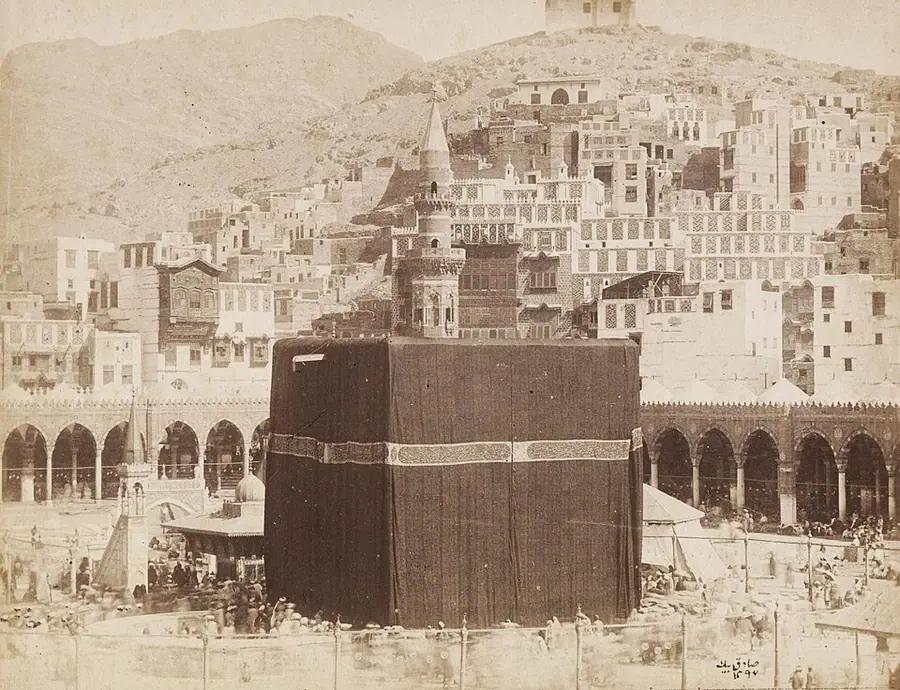
The Muslim view rests on the Qur’an. Islām means “submission” to God, and a muslim is one who submits.[7] The Qur’an names about two dozen earlier prophets, most of them biblical, and calls Muhammad “God’s Messenger and the seal of the prophets” (33:40).[8] It says that “Abraham was neither a Jew nor a Christian. He was upright and devoted to God, never an idolater” (3:67), and that “the religion with God is islām” (3:19).[9][10] It gives the Kaʿba an Abrahamic origin, and its message claimed that the shrine’s true religion had been Abraham’s monotheism, later corrupted by idols (How old is the Kaaba?).[11] On this view Muhammad restored a religion; he did not invent one. Consensus on what the Qur’an says.
Whether God spoke to Muhammad is outside what historical method can test, in either direction (How We Know). What historians can establish is that a man called Muhammad preached in western Arabia in the early seventh century and led the community that became Islam; a Syriac chronicle of about 640 already speaks of “the Arabs of Muhammad” (Was Muhammad a real person?).[12][13] Consensus
Where did Islam originate?
In the Ḥijāz, the western strip of Arabia along the Red Sea: first in Mecca, a sanctuary town, then in the oasis of Medina to its north. Majority
The Qur’an names Mecca once as Makka (48:24) and once as Bakka (3:96), and its sanctuary, “the House”, often; it addresses Quraysh by name and ties their prosperity to “the Lord of this House” (sura 106).[14][15] No inscription, coin or outside text from before Islam securely names Mecca, and a few writers have used that silence to place Islam’s origins further north. Most historians accept the Ḥijāz setting that the Qur’an and the tradition both imply; silence is weak evidence for a small town in a region that left few documents (Late Antique Arabia).[7][16] Majority
How did Islam start?
As a preaching movement in Mecca that became a community, then a state, in Medina. Majority
The early suras call their hearers to recognise one God in the signs of nature, prepare for a day of judgment, care for orphans and the poor, and learn from the punished peoples of the past.[17] Consensus on the themes. The tradition describes years of hostility from the leaders of Quraysh, the emigration of some followers to Christian Aksum around 615, and, after the deaths of Muhammad’s wife Khadīja and his protector Abū Ṭālib around 619, an agreement with pilgrims from Yathrib to protect him.[1] Majority
In Medina the movement acquired a constitution. A set of pacts preserved by Ibn Isḥāq and, independently, by Abū ʿUbayd, the “Constitution of Medina”, declares the believers of Quraysh and Yathrib “one community (umma) to the exclusion of other people”, with God and Muhammad as final arbiters, and includes Jewish allies of the Medinan clans; most scholars accept it as an early document.[18][19] Majority Eight years of war with Mecca followed, from Badr in 624, the one battle the Qur’an names, to the surrender of Mecca in January 630.[20][1] Majority on the sequence. Within twenty years of Muhammad’s death his successors had taken Syria, Iraq, Egypt and most of Iran (The conquests; Who were the first four caliphs?).[21] Consensus
The origins of Islam in late-antique Arabia
Islam began in a world of monotheists, not in isolation. Majority The kings of Ḥimyar in Yemen had worshipped one god, called Raḥmānān, “the Merciful”, from about 380, and the Qur’an’s al-Raḥmān is the same word.[22][17] Jewish tribes lived in the oases of the Ḥijāz, Yathrib among them; Christianity surrounded the region, in Najrān, Aksum and the Arab allies of Rome and Persia.[23][24] Majority The Qur’an’s opponents, it says itself, acknowledged God as creator but worshipped other beings beside him.[25][26] Majority
The years of Muhammad’s preaching were also the years of the last and most destructive war between Rome and Persia, 602 to 628, the only contemporary event the Qur’an clearly mentions (30:2–4). Apocalyptic expectation ran high among Christians and Jews alike, and the war left both empires exhausted just before the Arab conquests (Late Antique Arabia).[27][28] Majority
When did Islam become a separate religion?
Here the question “when was Islam founded” stops having one answer. The documents show a pattern: the Hijri era and the caliph’s title “commander of the believers” from the 640s, Muhammad’s name on a dated Muslim document only from 685–686, and the word islām in public only on the Dome of the Rock in 691–692.[2][29][30] Consensus on the pattern.
Two readings of that pattern are held by serious scholars (The Umayyads):
- A distinct religion from the start. Islam, with its scripture, prayer and pilgrimage, existed in Muhammad’s lifetime; the caliph ʿAbd al-Malik made public and imperial what was already there, and the early documents are quiet because few survive and most are receipts and building inscriptions.[6] Majority
- A community of “Believers”. Fred Donner argues that the first community called itself al-muʾminūn, “the believers”, far more often than muslimūn, and was open at first to pious Jews and Christians who accepted God’s oneness and the coming judgment; only under ʿAbd al-Malik and his sons did it define itself, by the Qur’an and the Prophet, as a separate religion called Islam.[7] Critics reply that the Qur’an already distinguishes believers from Jews and Christians, and that the documents may record a change of public language rather than of belief.[6] Contested
Both sides agree that by the 690s the empire’s religion was named and bounded, in Arabic, in public, and that its first great statement, on the Dome of the Rock, was an argument addressed to Christians (Why was the Dome of the Rock built?).[31] Majority
How do we know? The sources for the beginning of Islam
Unusually for a religion’s origins, a scripture survives from the founding generation, and almost everything else is later. Majority
- The Qur’an is a text of the early seventh century, fixed in writing within a generation of Muhammad’s death; leaves of it are radiocarbon-dated to the first decades of Islam. But it is not a narrative and gives almost no dates (When was the Qur’an written?; How old is the oldest Qur’an?).[17] Majority
- The biographies are late. Ibn Isḥāq’s life of Muhammad was written in the 750s or 760s, about 120 years after his death, and survives in later editions; it supplies nearly all the dates.[1][32] Consensus
- Outside witnesses are few but early: a Greek text set in 634 reports “a prophet… coming with the Saracens”, and an Armenian history of the 660s describes Muhammad as a merchant who taught the Arabs the God of Abraham.[33][34] Consensus that they confirm the outline.
That combination is why the outline, Mecca, Medina, 622, 632, is accepted while the year of the first revelation is not pinned down (How We Know).
A short timeline
| Date | Event | Confidence |
|---|---|---|
| c. 380 | Ḥimyar’s kings turn to one god, “the Merciful”[22] | Majority |
| c. 570 | Muhammad’s birth in the “Year of the Elephant”, by tradition[1][4] | Contested (date) |
| 602–628 | The last war between Rome and Persia[27] | Consensus |
| c. 610 | First revelation in Mecca, by tradition[1][3] | Majority (Meccan start); Contested (year) |
| 622 | The hijra to Medina; year 1 of the Islamic era[2] | Consensus |
| 622–627 | The pacts called the Constitution of Medina[18] | Majority |
| 630 | Mecca surrenders[1] | Majority |
| 632 | Muhammad dies in Medina[1][5] | Majority |
| 634 | A Greek text reports a prophet with the Saracens[33] | Majority |
| 643 | A papyrus dated by the Hijri era[2] | Consensus |
| 685–686 | First dated Muslim document to name Muhammad[29] | Consensus |
| 691–692 | “The religion with God is islām” on the Dome of the Rock[30] | Consensus |
What scholars disagree about
- The chronology before 622. The traditional dates for Muhammad’s birth and call are round numbers; most historians give “about 570” and “about 610” and treat both as approximate.[4] Majority
- The date of Muhammad’s death. 632 in the unanimous Muslim tradition; Shoemaker reads several outside texts as preserving a memory of him alive in 634.[5] Contested
- When Islam became a distinct religion. From Muhammad’s lifetime, or only when ʿAbd al-Malik drew the boundaries in the 690s.[7][31] Contested
- How far the tradition can be trusted at all. In the 1970s John Wansbrough, and Patricia Crone and Michael Cook in Hagarism, argued that the Muslim account of origins could not be relied on; Crone and Cook proposed a messianic movement centred on Jerusalem. That reconstruction found few followers, and the early Qur’an manuscripts have since ruled out Wansbrough’s late canon, but the case for testing the tradition rather than assuming it stuck.[35][36][37] Majority
Common misconceptions
- “Muhammad founded Islam in 610.” About 610 is the tradition’s date for the first revelation, not a documented founding; Muslims hold that Islam is older than Muhammad, and historians see a process running from Mecca to the 690s. Majority
- “The Islamic calendar starts at Muhammad’s birth, or his first revelation.” It counts from the year of the hijra, 622, and was in use by 643.[2] Consensus
- “Islam began in isolation, in a desert of idol-worshippers.” Arabia had Jewish, Christian and native monotheists, and the Qur’an’s own opponents acknowledged God as creator.[22][25] Majority
- “Islam was founded somewhere other than Mecca.” The idea rests mainly on the absence of Mecca from pre-Islamic documents, which is weak evidence; most historians accept the Ḥijāz.[7] Majority
Why it matters
“When was Islam founded?” sounds like a request for a year, and the honest answer is that it depends on whether one asks a believer or a historian, and what the historian counts. For Muslims the religion is as old as the first prophet. For historians, the preaching began in Mecca around 610, the community took shape in Medina from 622, and the name and boundaries of the religion were set in public under the Umayyads by the 690s. These answers do not contradict each other; they describe different things, and each layer has different evidence behind it (Muhammad). Majority
References
- ^ a b c d e f g h i j Ibn Isḥāq, Sīrat Rasūl Allāh — The Life of Muhammad (recension of Ibn Hishām). mid-8th c. CE (Ibn Hishām's recension, early 9th c.). Arabic. The earliest surviving Muslim biography of Muhammad; source for his alliance and conflicts with the Jewish tribes of Medina (Qaynuqāʿ, Naḍīr, Qurayẓa) and the conquest of Khaybar. about
- ^ a b c d e f PERF 558 (Austrian National Library, Papyrus Erzherzog Rainer) — Greek–Arabic receipt from Herakleopolis. Jumādā I 22 AH / 25 April 643 CE. Arabic and Greek. Receipt by the commander ʿAbd Allāh ibn Jābir for 65 sheep; the earliest dated Arabic papyrus, dated by the Hijri era, with dotted letters; the Greek calls the Arabs magaritai. about
- ^ a b Qur'an 96:1 — The Qur'an. 610–632 CE (recited); standard text c. 650. Arabic. 'Read! In the name of your Lord who created', traditionally the first revelation. read the text
- ^ a b c Lawrence I. Conrad Abraha and Muḥammad: Some Observations apropos of Chronology and Literary Topoi in the Early Arabic Historical Tradition. Bulletin of the School of Oriental and African Studies 50, 1987. The Year of the Elephant as a chronological topos rather than a remembered date.
- ^ a b c Stephen J. Shoemaker The Death of a Prophet: The End of Muhammad's Life and the Beginnings of Islam. University of Pennsylvania Press, 2012. The non-Muslim reports of the prophet alive at the conquest of Palestine.
- ^ a b c Robert G. Hoyland Seeing Islam as Others Saw It: A Survey and Evaluation of Christian, Jewish and Zoroastrian Writings on Early Islam. Darwin Press, 1997. The non-Muslim sources of the first Islamic century and a half, translated and discussed.
- ^ a b c d e Fred M. Donner Muhammad and the Believers: At the Origins of Islam. Belknap Press of Harvard University Press, 2010. Islam's origins in the early seventh-century preaching of Muhammad.
- ^ Qur'an 33:40 — The Qur'an. 610–632 CE (recited); standard text c. 650. Arabic. Muhammad is 'God's Messenger and the seal of the prophets'; one of the four places the Qur'an names him. read the text
- ^ Qur'an 3:67 — The Qur'an. early 7th c. CE. Arabic. Abraham 'was neither a Jew nor a Christian' but ḥanīf, 'upright', never an idolater. about
- ^ Qurʾan 3:18–19 — Qurʾan, Sūrat Āl ʿImrān. 7th c. CE. Arabic. 'The religion with God is islām': quoted on the Dome of the Rock in 691–692. read the text
- ^ Qur'an 2:127 — The Qur'an. early 7th c. CE. Arabic. Abraham and Ishmael raise the foundations of the House and pray for it to be accepted. about
- ^ Thomas the Presbyter, Chronicle (British Library Add. MS 14,643) — Syriac Chronicle of 640. c. 640 CE (manuscript copied 724). Syriac. Records a battle on 4 February 634 between the Romans and 'the Arabs of Muhammad' twelve miles east of Gaza: the earliest datable text to name Muhammad. about
- ^ Joshua J. Little Did Muhammad Exist? An Academic Response to a Popular Question. Islamic Origins (blog), 2025. Reviews the evidence and concludes there is no reasonable doubt that Muhammad existed.
- ^ Qur'an 3:96 — The Qur'an. early 7th c. CE. Arabic. 'The first House established for people' is the one at Bakka, identified with Mecca. about
- ^ Qur'an 106 — The Qur'an. early 7th c. CE. Arabic. Sūrat Quraysh: the tribe's 'winter and summer journeys' and the 'Lord of this House'. about
- ^ Patricia Crone Meccan Trade and the Rise of Islam. Princeton University Press, 1987. Questions Mecca's trade and the reliability of the sīra's detail.
- ^ a b c Nicolai Sinai The Qur'an: A Historical-Critical Introduction. Edinburgh University Press, 2017. The Qur'an as a historical text, from the current mainstream.
- ^ a b The 'Constitution of Medina' (Ibn Isḥāq via Ibn Hishām; Abū ʿUbayd, Kitāb al-Amwāl) — Pacts between Muhammad, the believers of Quraysh and Yathrib, and their Jewish allies. c. 622–627 CE (preserved in 8th–9th c. works). Arabic. Declares the believers 'one community to the exclusion of other people', regulates blood-money by clan, and makes the Jews of Banū ʿAwf 'a community along with the believers; to the Jews their religion and to the Muslims theirs'. about
- ^ Michael Lecker The "Constitution of Medina": Muḥammad's First Legal Document. Darwin Press, 2004. Edition, translation and commentary; the standard modern study.
- ^ Qur'an 3:123 — The Qur'an. 610–632 CE (recited); standard text c. 650. Arabic. 'God helped you at Badr': the only battle of Muhammad's lifetime the Qur'an names. read the text
- ^ Robert G. Hoyland In God's Path: The Arab Conquests and the Creation of an Islamic Empire. Oxford University Press, 2015. The conquests as empire-building, set in the frontier politics of Byzantium and Persia.
- ^ a b c Christian Julien Robin Arabia and Ethiopia. in S. F. Johnson (ed.), The Oxford Handbook of Late Antiquity, Oxford University Press, 2012. Ḥimyar's monotheism, Najrān, Aksum and Abraha, from the inscriptions.
- ^ Moshe Gil Jews in Islamic Countries in the Middle Ages. Brill, 2004. Detailed survey from pre-Islamic Arabia to the eleventh century, largely from Geniza sources.
- ^ Robert G. Hoyland Arabia and the Arabs: From the Bronze Age to the Coming of Islam. Routledge, 2001. The standard survey of pre-Islamic Arabia, its kingdoms, religions and languages.
- ^ a b Qur'an 29:61 — The Qur'an. early 7th c. CE. Arabic. The disbelievers, asked who created the heavens and earth, 'are sure to say, God'. about
- ^ Patricia Crone The Religion of the Qurʾānic Pagans: God and the Lesser Deities. Arabica 57, 2010. The Qur'an's opponents believed in God and worshipped lesser beings as intercessors.
- ^ a b James Howard-Johnston Witnesses to a World Crisis: Historians and Histories of the Middle East in the Seventh Century. Oxford University Press, 2010. The last Roman–Persian war and the sources for the seventh century.
- ^ Qurʾan 30:2–4 — Qurʾan, Sūrat al-Rūm. 7th c. CE. Arabic. 'The Romans have been defeated in the nearest land…': the Qur'an's one checkable reference to a contemporary event, the Persian conquest of 613–614. read the text
- ^ a b Arab-Sasanian drachm of ʿAbd al-Malik ibn ʿAbd Allāh, Bīshāpūr (British Museum) — Silver coin. 66 AH / 685–686 CE. Arabic and Middle Persian. Margin legend 'bism Allāh Muḥammad rasūl Allāh': the earliest dated Muslim text to name Muhammad, struck for a Zubayrid governor. about
- ^ a b Dome of the Rock, inner arcade inscription — Foundation inscription of ʿAbd al-Malik. 72 AH / 691–692 CE. Arabic. Monumental kufic band of Qur'anic passages on God's oneness and Jesus as messenger (4:171, 3:18–19, 19:33–36), dated 72; the founder's name was later replaced by al-Maʾmūn's. about
- ^ a b Jeremy Johns Archaeology and the History of Early Islam: The First Seventy Years. Journal of the Economic and Social History of the Orient 46, 2003. Islam as a public state religion becomes visible in the documents of the 690s.
- ^ Gregor Schoeler The Biography of Muhammad: Nature and Authenticity. Routledge, 2011. How the sīra was transmitted and what can be traced early.
- ^ a b Doctrina Jacobi nuper baptizati V.16 — Teaching of Jacob, Newly Baptised. set in 634 CE; written c. 634. Greek. A Jew reports that 'a prophet has appeared, coming with the Saracens', who claims the keys of paradise; the earliest reference to the prophet of the conquerors. about
- ^ History attributed to Sebeos (trans. R. W. Thomson and J. Howard-Johnston, 1999) — Armenian History. soon after 661 CE. Armenian. Describes Mahmet, a merchant of the sons of Ishmael, who taught the Arabs the God of Abraham, followed by an account of the conquests. about
- ^ John Wansbrough Quranic Studies: Sources and Methods of Scriptural Interpretation. Oxford University Press, 1977. The form-critical case for a late, composite canon.
- ^ Patricia Crone and Michael Cook Hagarism: The Making of the Islamic World. Cambridge University Press, 1977. Origins reconstructed from non-Muslim sources alone.
- ^ Fred M. Donner Narratives of Islamic Origins: The Beginnings of Islamic Historical Writing. Darwin Press, 1998. How the Muslim historical tradition formed, and a survey of the sceptical approaches.