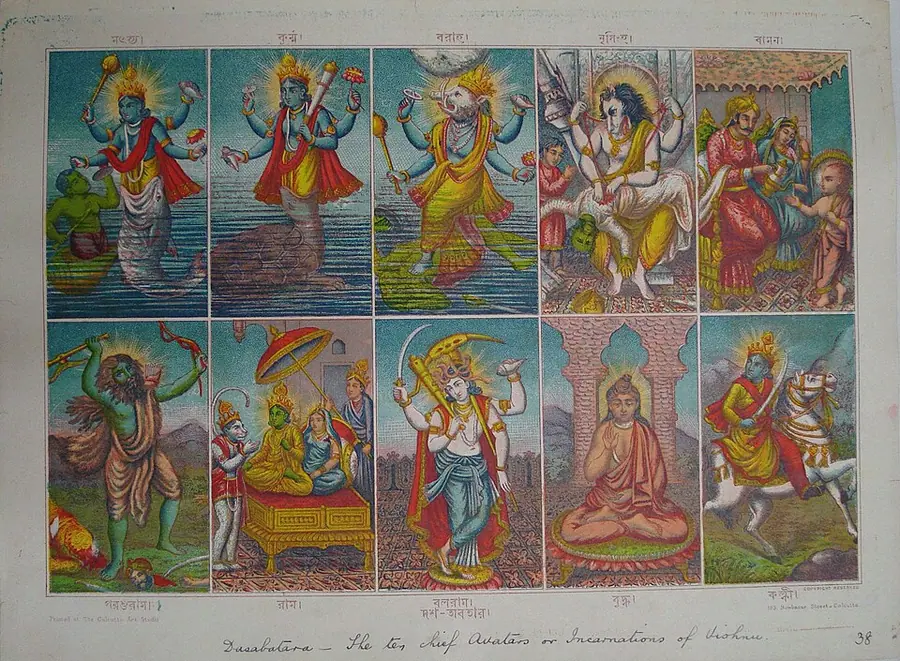
The short version: the Buddha became an avatar of Viṣṇu inside Hinduism, not inside Buddhism. From about the middle of the first millennium CE, Vaiṣṇava texts began to count him among the god’s descents, and by the seventh or eighth century a stone inscription lists him ninth of ten.[1] The idea had two faces. The older Purāṇas make him a trick: Viṣṇu takes the Buddha’s form to lead demons away from the Veda so that they can be defeated. Later devotional poetry makes him a teacher of compassion who rightly condemned animal sacrifice. No Buddhist school accepted either version, and since 1956 rejecting it has been a formal vow for millions of Indian Buddhists.[2]
The evidence for when the Buddha became an avatar
A “great delusion” sent to the demons
The Viṣṇu Purāṇa, one of the older Purāṇas and like all of them hard to date precisely, does not yet name the Buddha in a fixed list of avatars.[3] Instead it tells how the gods, losing to demons who were strong through Vedic austerities, asked Viṣṇu for help. He produced from his own body a figure called Māyāmoha, “great delusion.” Māyāmoha first appears naked and teaches one group of demons a Jain-sounding doctrine. Then, in H. H. Wilson’s translation:
“putting on garments of a red colour, assuming a benevolent aspect, and speaking in soft and agreeable tones, [he] addressed others of the same family, and said to them, ‘If, mighty demons, you cherish a desire either for heaven or for final repose, desist from the iniquitous massacre of animals (for sacrifice), and hear from me what you should do.’”[4]
The text then puns on the word budh-, “to know”: he tells them “Know!” (budhyadhvam), they answer “It is known,” and they abandon their religious duties. Once they have left the Veda, the gods defeat them.[4]
What it proves. That Brahmanical writers knew Buddhist and Jain teaching well enough to caricature it, red robes, the rejection of sacrifice and all, and that their first strategy was to explain these rival religions as a divine trick. The Buddha’s teaching is real and powerful in this story, which is why it works; but it is meant for demons, not for the righteous. The figure is an emanation of Viṣṇu, which is the step that later lists formalise. Wendy Doniger O’Flaherty reads the story as one of a family of Purāṇic myths in which the gods themselves send heresy into the world to ruin their enemies.[5] Majority
The first datable list: a Pallava cave
The earliest list of ten avatars that can be dated is carved in the Ādivarāha cave at Mahābalipuram in Tamil Nadu, from the Pallava period, usually placed in the seventh or eighth century:
matsyaḥ kūrmo varāhaś ca nārasiṃhaś ca vāmanaḥ | rāmo rāmaś ca rāmaś ca buddhaḥ kalkī ca te daśa ||
“The Fish, the Tortoise and the Boar, the Man-lion and the Dwarf, Rāma, Rāma and Rāma, the Buddha and Kalkin: these are your ten.”[1]
What it proves. That by about the seventh or eighth century the Buddha’s place in the list was settled enough to be cut in stone at a royal Vaiṣṇava shrine in the far south. The three Rāmas are Paraśurāma, Rāma of the Rāmāyaṇa and Balarāma; Kṛṣṇa is absent; one common explanation is that he was seen not as one avatar among others but as Viṣṇu himself, as the Bhāgavata Purāṇa later says outright.[6] The list’s order puts the Buddha just before Kalkin, at the start of the present age, which is how the Purāṇas place him. Consensus
“To delude the enemies of the gods”
The Bhāgavata Purāṇa, the most influential Vaiṣṇava scripture of the second millennium and usually dated to about the ninth or tenth century, gives the Buddha a birthplace and a purpose in one verse:
tataḥ kalau sampravṛtte sammohāya sura-dviṣām | buddho nāmnāñjana-sutaḥ kīkaṭeṣu bhaviṣyati ||
“Then, when the Kali age has begun, in order to delude the enemies of the gods, he will be born among the Kīkaṭas [in Magadha] as the son of Añjana, Buddha by name.”[7]
What it proves. That the deluder motif survived into the text that shaped Kṛṣṇa devotion across India for the next thousand years. The details are telling: he is the son of Añjana, not of Śuddhodana, and he is born in Magadha, where the Buddha taught, not at Lumbinī. The Purāṇa’s Buddha is a figure in Viṣṇu’s plan, not the teacher of the Buddhist texts (§2). Majority
The gentle reformer
Not every Hindu author took the hostile line. The Kashmiri poet Kṣemendra, in his Daśāvatāracarita completed in 1066, tells the Buddha avatar as a sympathetic version of the Buddha’s own life, without the deluder story, in a region where Buddhist and Hindu learning still lived side by side.[8] A century later Jayadeva’s Gītagovinda, written in eastern India in the late twelfth century, opens with a hymn to the ten avatars that is still widely sung. Its Buddha verse reads:
nindasi yajña-vidher ahaha śruti-jātaṃ sadaya-hṛdaya-darśita-paśu-ghātam | keśava dhṛta-buddha-śarīra jaya jagadīśa hare ||
“Ah, compassionate-hearted one, you condemn the whole body of Vedic sacrificial rules, which teach the slaughter of animals. Keśava, you who took the Buddha’s body, victory to you, Hari, lord of the world!”[9]
What it proves. That by the end of Buddhism’s life as a living institution in India, a major Vaiṣṇava poet could praise the Buddha for exactly what the Viṣṇu Purāṇa had treated as a trick: rejecting animal sacrifice. That reversal fits the long history in which non-violence passed from the renouncers into mainstream Hinduism (Hinduism §6). It also honours the Buddha by making him a moment in someone else’s god. Majority
A short timeline
| Date | What happens | Confidence |
|---|---|---|
| c. 400 BCE | The Buddha dies; his followers know him as a human teacher beyond the gods (§2)[10] | Contested (date) |
| c. 400–500 CE | Viṣṇu Purāṇa: Māyāmoha deludes the demons with renouncer doctrines[4][3] | Majority |
| c. 7th–8th c. | Mahābalipuram inscription lists the Buddha ninth of ten avatars[1] | Consensus |
| c. 9th–10th c. | Bhāgavata Purāṇa 1.3.24: the Buddha born “to delude the enemies of the gods”[7] | Majority |
| 1066 | Kṣemendra’s sympathetic Buddha avatar in Kashmir[8] | Consensus |
| Late 12th c. | Jayadeva’s Gītagovinda praises the Buddha for ending animal sacrifice[9] | Majority |
| c. 1590–1949 | The Mahabodhi temple at Bodh Gaya held by the Giri mahants, a Śaiva monastery, until the Bodh Gaya Temple Act; the Buddha worshipped there as an avatar (§12)[11][12] | Majority |
| 14 October 1956 | Ambedkar’s fifth vow rejects the Buddha’s avatarhood[2] | Consensus |
Why did Hindus make the Buddha an avatar?
Historians give three overlapping answers, and they differ more in emphasis than in substance.
Explaining a rival. The avatar doctrine is an elastic way of placing anything powerful inside Viṣṇu’s plan. The earliest versions use it to explain why a persuasive religion that rejected the Veda existed at all: it was a divine trick aimed at the wicked.[4]
Absorbing a rival. Once the Buddha was a form of Viṣṇu, a lay family that honoured him had no reason to choose between a monastery and a temple. The Hinduism series argues that this absorption was a symptom of Buddhism’s decline in India, not its cause: the decisive changes were in patronage, as kings and landholders funded temples and brahmins instead of monasteries (Hinduism §8).[13] For the last centuries of the monasteries themselves see Chapter 8: Tantra and the Last Age of Indian Buddhism, and How did Buddhism disappear from India? Majority
Honouring a teacher. By Jayadeva’s time the Buddha could be loved for his compassion, and for many Hindus today the avatar is simply a sign of respect.[9]
The list itself never fully settled. Some regional traditions put Balarāma or Kṛṣṇa in the ninth place and drop the Buddha; in Maharashtra Viṭhobā, and in parts of Odisha Jagannātha, can stand where the Buddha stands in other lists. G. A. Deleury records Maharashtrian images of the ten avatars in which the ninth, the Buddha, takes the form of Viṭhobā, and Prabhat Mukherjee cites a ritual text of the Dharma cult, the Dharma Pūjā Vidhāna, that calls Jagannātha the ninth incarnation, appearing as the Buddha on the sea-coast.[14][15] The avatar is a Vaiṣṇava teaching with local variants, not a single Hindu doctrine. Majority
Buddhist responses
Buddhist texts never counted the Buddha as anyone’s avatar. In the early discourses he is a human being who has gone beyond the gods, and gods such as Brahmā and Sakka (Indra) appear as his petitioners and followers (§2): it is Brahmā Sahampati who begs the newly awakened Buddha to teach.[16] Buddhists, too, absorbed Hindu figures in their own way. The Pali Dasaratha Jātaka tells a version of the Rāma story in which the wise prince Rāma is a past life of the Buddha himself.[17] In Sri Lanka, Viṣṇu became a guardian deity of the island’s Buddhism, subordinate to the Buddha and honoured in Buddhist temple shrines, a process John Holt traces over many centuries.[18] Each side, in other words, placed the other’s figures inside its own story. Majority
What scholars disagree about
The date of entry. Because the Purāṇas grew over centuries and were edited long after they began, nobody can say exactly when the Buddha first entered a Purāṇic avatar list. The Mahābalipuram inscription gives a firm latest date; anything earlier depends on dating passages in texts that resist dating.[3] Contested
Hostile or honouring? Some read the whole tradition as polemic dressed as praise, others as a genuine if one-sided form of respect that changed over time. The texts support both readings at different dates: the Viṣṇu Purāṇa is hostile and the Bhāgavata casts the Buddha as a deluder of demons, while Kṣemendra and Jayadeva plainly admire him.[4][8][9] Contested
What it means today. The question is now political. Some Hindu writers use the avatar to argue that Buddhism is a branch of Hinduism. Indian law in part reflects that older inclusive view: the Constitution’s Article 25 counts Buddhists, Jains and Sikhs as Hindus for laws on social reform and on opening Hindu religious institutions to all classes (Art. 25(2)(b), Explanation II), and the Hindu Marriage Act of 1955 applies to Buddhists.[19][20] Many Indian Buddhists, above all the Ambedkarite community, reject this as the same absorption that once erased Buddhism from India, and Ambedkar’s fifth vow states their position. The vows were given in Marathi and English versions differ: a widely circulated one reads “I do not and shall not believe that Lord Buddha was the incarnation of Vishnu. I believe this to be sheer madness and false propaganda,” while Gail Omvedt translates it “I agree that the propaganda that the Buddha was the avatar of Vishnu is false and mischievous.”[2][21][22] Political
Common misconceptions
- “The Buddha claimed to be Viṣṇu.” Nothing in any Buddhist text says so. The avatar idea is entirely a Vaiṣṇava teaching, and it appears centuries after his death.[1]
- “The Purāṇas always honour the Buddha.” The earliest stories make him a deceiver sent to demons; the admiring version comes later.[4][7]
- “The ten avatars are a fixed list.” The ninth place in particular varies by region and school.[14][15]
- “Buddhists and Hindus once agreed the Buddha was an avatar.” No Buddhist scripture or school teaches it. See Was the Buddha a Hindu?
Why it matters
The Buddha’s avatarhood is one of the clearest cases in religious history of a tradition absorbing its rival’s founder, and the record lets us watch the attitude change: from trickster, to tolerated reformer, to object of devotion, to a point of modern conflict. It shows how Hinduism grew by inclusion, and why that same inclusion felt, to many Buddhists, like erasure.
For the end of Indian Buddhism and the decline of its monasteries, see Chapter 8: Tantra and the Last Age of Indian Buddhism; for the Buddha the early texts actually describe, see Chapter 2: The Buddha; for Ambedkar’s conversion, see Chapter 12: Colonial Encounter and Buddhist Modernism.
References
- ^ a b c d Ādivarāha cave inscription, Mahābalipuram — Pallava inscriptions. Pallava, c. 7th–8th c. CE. Sanskrit. A single verse listing ten avatars of Viṣṇu: Fish, Tortoise, Boar, Man-lion, Dwarf, three Rāmas, Buddha and Kalkin. The earliest datable list of the ten, with the Buddha ninth and no Kṛṣṇa. read the text
- ^ a b c The twenty-two vows — B. R. Ambedkar, Nagpur. 14 October 1956. Marathi. The vows Ambedkar administered at his conversion: no faith in Brahmā, Viṣṇu and Maheśa, Rāma or Kṛṣṇa; denial that the Buddha was an avatar of Viṣṇu; and a commitment to equality. about
- ^ a b c Ludo Rocher The Purāṇas. Harrassowitz, 1986. open library The standard survey, and the clearest statement of why Purāṇas resist dating.
- ^ a b c d e f Viṣṇu Purāṇa 3.17–18 — Viṣṇu Purāṇa. c. 400–500 CE, hard to date. Sanskrit. Viṣṇu sends Māyāmoha, 'great delusion', who first naked and then in red robes teaches the demons to reject animal sacrifice and the Veda, punning on budh-, 'know'. The earliest Purāṇic treatment of Buddhist and Jain teaching as a divine trick.
- ^ Wendy Doniger O'Flaherty "The Origin of Heresy in Hindu Mythology". History of Religions 10(4): 271–333, 1971. doi The classic study of Purāṇic myths, Māyāmoha's among them, in which the gods send heresy to delude their enemies.
- ^ Bhāgavata Purāṇa 1.3.28 — Bhāgavata Purāṇa. c. 9th–10th c. CE. Sanskrit. After listing Viṣṇu's descents, including the Buddha, the text declares that these are portions of the Person, but Kṛṣṇa is the Lord himself (kṛṣṇas tu bhagavān svayam). read the text
- ^ a b c Bhāgavata Purāṇa 1.3.24 — Bhāgavata Purāṇa. c. 9th–10th c. CE. Sanskrit. At the start of the Kali age Viṣṇu will be born among the Kīkaṭas as the son of Añjana, 'Buddha by name', to delude the enemies of the gods. read the text
- ^ a b c Daśāvatāracarita (Buddha chapter) — Kṣemendra. 1066 CE. Sanskrit. The Kashmiri poet's account of Viṣṇu's ten avatars, completed in 1066, tells the Buddha avatar as a sympathetic version of the Buddha's own life, without the Purāṇic deluder motif. about
- ^ a b c d Gītagovinda 1, Daśāvatāra hymn — Jayadeva. Late 12th c. CE. Sanskrit. The opening hymn to the ten avatars praises Keśava 'who took the Buddha's body' for condemning Vedic sacrifice and the slaughter of animals out of compassion.
- ^ Heinz Bechert, ed. The Dating of the Historical Buddha. Vandenhoeck & Ruprecht, 3 vols., 1991. The symposium that unsettled the traditional dates — and reached no consensus.
- ^ Alan Trevithick The Revival of Buddhist Pilgrimage at Bodh Gaya (1811–1949): Anagarika Dharmapala and the Mahabodhi Temple. Motilal Banarsidass, 2006. The full history of the Bodh Gaya dispute to the 1949 Act.
- ^ Bodh Gaya Temple Act, 1949 — Bihar Act XVII of 1949. 1949; amended 2013. English. Places the Mahabodhi temple under a committee of four Hindus and four Buddhists chaired by the district magistrate of Gaya, who had to be Hindu until the 2013 amendment. about
- ^ Romila Thapar Early India: From the Origins to AD 1300. Penguin, 2002. full text The best single-volume political and social history for this whole span.
- ^ a b G. A. Deleury The Cult of Vithobā. Deccan College Postgraduate and Research Institute, Poona, 1960. full text The standard study of the Paṇḍharpūr god, including images of the ten avatars in which Viṭhobā stands in the Buddha's ninth place.
- ^ a b Prabhat Mukherjee The History of Medieval Vaishnavism in Orissa. R. Chatterjee, Calcutta, 1940. full text Traces the identification of Jagannātha with the Buddha and as Viṣṇu's ninth incarnation in Odisha's religious literature.
- ^ SN 6.1 — Brahmāyācana Sutta (Saṃyutta Nikāya). c. 400–200 BCE. Pali. After his awakening the Buddha inclines not to teach; the god Brahmā Sahampati appears, kneels and begs him to teach the Dhamma, and he agrees. read the text
- ^ Jātaka 461 (Dasaratha Jātaka) — Jātaka. Verses c. 3rd–1st c. BCE; prose commentary c. 5th c. CE. Pali. A Buddhist Rāma story in which the wise prince Rāma accepts exile calmly; the Buddha identifies Rāma as a past life of his own. read the text
- ^ John Clifford Holt The Buddhist Viṣṇu: Religious Transformation, Politics, and Culture. Columbia University Press, 2004. doi How Viṣṇu became a guardian deity of Sri Lankan Buddhism: the mirror image of the Buddha's place among Viṣṇu's avatars.
- ^ Constitution of India, Arts. 17 & 25 — Republic of India. 1950 CE. English. Untouchability abolished; religious freedom guaranteed; temples opened to all classes of Hindus by constitutional mandate. about
- ^ Hindu Marriage Act, 1955, s. 2(1)(b) — Act No. 25 of 1955, Parliament of India. 1955. English. Applies the Act to Hindus and also to any person who is a Buddhist, Jaina or Sikh by religion. about
- ^ Gail Omvedt Buddhism in India: Challenging Brahmanism and Caste. Sage, 2003. full text A history of Indian Buddhism written from an Ambedkarite standpoint; pp. 261–62 give the Nagpur conversion, U Chandramani, the crowd of about 400,000 and an English translation of the twenty-two vows.
- ^ Gail Omvedt Ambedkar: Towards an Enlightened India. Penguin, 2004. full text