The short version: for two centuries or more, the people who carved the first Buddhist monuments showed the Buddha’s life in detail without ever showing the Buddha. Then, around the turn of the first and second centuries CE, his human figure appeared in two regions of the Kushan empire at about the same time.[1][2] Which came first, and why the change happened then, are still argued over. The earliest images that can be dated closely are later than both styles’ first appearance, so the beginning itself can only be bracketed.
The evidence for the first Buddha images
Two centuries of an absent Buddha
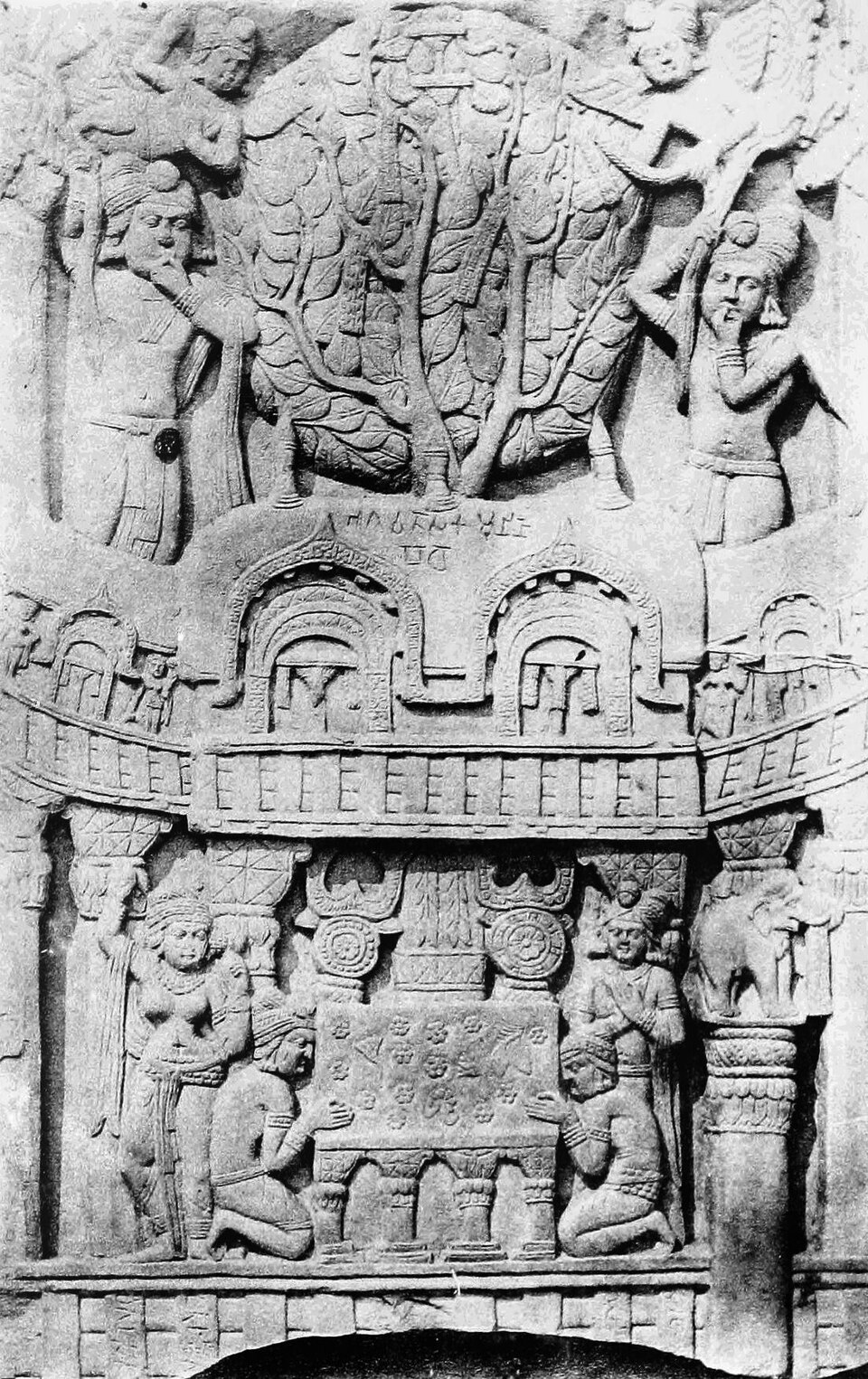
The narrative reliefs on the railings of Bharhut (c. 125–75 BCE) and the gateways of Sanchi (c. 50 BCE–25 CE) tell the Buddha’s last life scene by scene. In each scene he is an emblem: an empty seat under the Bodhi tree, a wheel for the first sermon, footprints on a ladder for the descent from heaven, a riderless horse under a parasol for the departure from the palace (§4). The same sculptors carved kings, crowds, gods and the Buddha’s past lives as animals in full figure. The absence applies only to the Buddha in his last life.[3][4][5]
Bharhut’s labels show that viewers knew whom the emblem meant:
Ajātasatu bhagavato vaṃdate
“Ajātasattu worships the Blessed One.”[3][6]
What it proves. The relief shows King Ajātasattu kneeling before an empty seat marked with footprints, and the label says he is worshipping the Buddha. Sculptors and their audience read the seat as the living Buddha at a moment in his life. Leaving out his body was a convention, and everyone understood it. Consensus
Was it a rule? The aniconism debate
The term “aniconism,” and the idea of an aniconic period governed by a ban on depicting the Buddha, go back to Alfred Foucher in the early twentieth century.[7] In 1990 Susan Huntington argued that many of these reliefs do not show events with the Buddha left out at all, but later worship at the holy sites: people venerating the Bodhi tree at Bodh Gaya, the wheel at Sarnath.[7] Vidya Dehejia replied in 1991 that the emblems are multivalent: the same seat can stand for the Buddha at an event, for the site of that event, or for the Buddha being worshipped now, and the Ajātasattu relief shows the first reading is real.[5] No early text forbids images of the Buddha, so “rule” is too strong. A long, consistent convention is certain. Contested
The oldest image named in writing: a coin
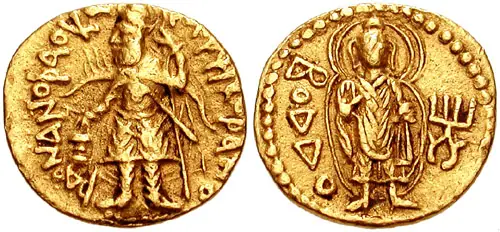
The Kushan king Kaniṣka, whose reign began around 127 CE on Harry Falk’s reading of the Kushan era, issued gold coins with a wide range of Greek, Iranian and Indian gods on their reverses.[8][2] Only a handful show a standing, haloed figure in a monastic robe with the label in Greek letters:
ΒΟΔΔΟ (Boddo)
Copper coins add ΣΑΚΑΜΑΝΟ ΒΟΥΔΟ, “Śākyamuni Buddha,” and ΜΕΤΡΑΓΟ ΒΟΥΔΟ, “Maitreya Buddha.”[9][10]
What it proves. By the 130s CE a standard image of the Buddha existed: halo, topknot, robe, a raised hand. It was established enough to be reduced to a coin die and recognised from a label. The coins are not the first Buddha images; they are the first that are both closely dated and named. They also show the Buddha as one deity among many on a king’s coinage. Kaniṣka’s own Rabatak inscription credits the goddess Nana with his kingship and does not mention the Buddha.[11] Consensus
Older, but harder to date
Two objects have a claim to be earlier.
The Bimaran reliquary, a small gold cylinder set with garnets, was found by Charles Masson in a stupa near Jalalabad in the 1830s. Around it a haloed Buddha with a raised hand stands between two figures usually identified as Brahmā and Indra.[12] It was found with coins in the name of the Indo-Scythian king Azes, which once suggested the first century BCE. Those coins are now thought to be posthumous issues, and estimates for the reliquary run from the early first century CE to the second. Contested
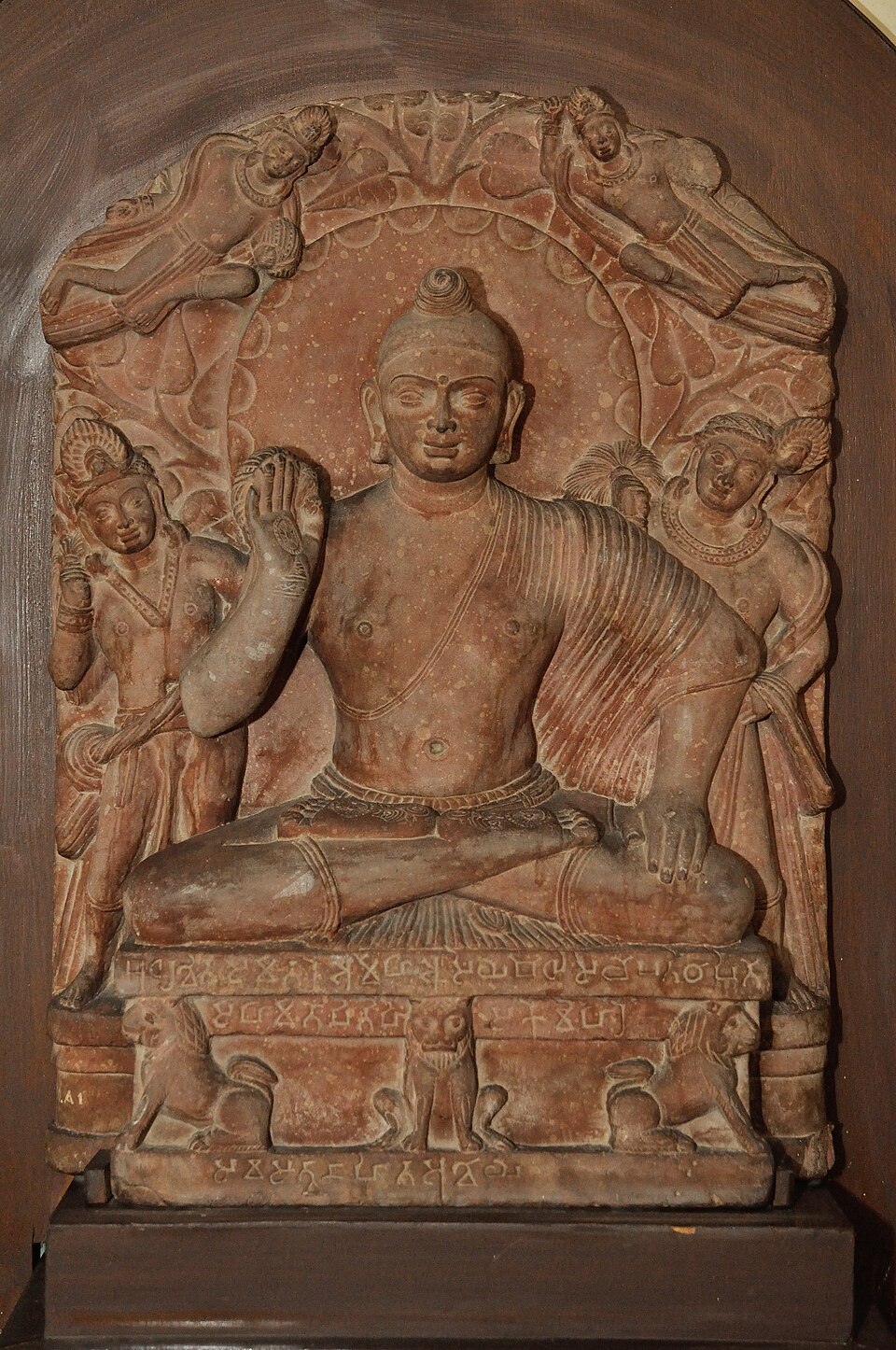
The Kaṭrā stele from Mathurā (Mathurā Museum A-1) shows a seated figure with a shaven head under a spiral topknot, right hand raised, flanked by attendants under a tree. Its inscription calls the figure a bodhisattva.[13] It is usually placed in the late first or early second century CE on the evidence of its script and style. Majority
The first securely dated large image
The colossal standing figure set up at Sarnath by the monk Bala, carved in Mathurā sandstone, is dated by its inscription to year 3 of Kaniṣka, about 130 CE.[14] Like the Kaṭrā stele it is called a bodhisattva. A large Buddha image had been made at Mathurā and carried hundreds of kilometres to the site of the first sermon, paid for by a monk. By then the type was established. Consensus
Gandhāra or Mathurā?
Foucher argued that artists trained in the Greco-Roman tradition invented the Buddha image in Gandhāra, giving him an Apollo-like face, wavy hair and a toga-like robe.[15] Ananda Coomaraswamy answered in 1927 that Mathurā developed its own image independently, from Indian sculpture of yakṣa nature spirits, and that the Greek theory reflected a European assumption that Indians could not have made it themselves.[16]
Most scholars now hold that the two styles appeared at about the same time under the Kushans and that neither simply copied the other.[1][2] One fact tilts the evidence. Mathurā images often carry dated inscriptions, while very few Gandhāran sculptures do, and Juhyung Rhi and Kurt Behrendt place most surviving Gandhāran Buddhas in the second and third centuries.[1][17] The question has also carried a political charge since Coomaraswamy’s day: whether a central image of Asian religion was a Greek or an Indian creation. Contested
A short timeline
| Date | What happens | Confidence |
|---|---|---|
| c. 125–75 BCE | Bharhut railing: the Buddha’s life shown through emblems, with labels[3] | Majority |
| c. 50 BCE–25 CE | Sanchi gateways: the same convention at its most elaborate[18] | Majority |
| early 1st–2nd c. CE | Bimaran reliquary, one of the earliest human Buddhas[12] | Contested |
| late 1st–early 2nd c. CE | Kaṭrā stele and early Mathurā images labelled bodhisattva[13] | Majority |
| c. 127–150 CE | Kaniṣka’s coins: ΒΟΔΔΟ[9] | Consensus |
| c. 130 CE | Bala’s bodhisattva at Sarnath, year 3 of Kaniṣka[14] | Consensus |
| c. 2nd–3rd c. CE | Peak of Gandhāran Buddha sculpture[1][17] | Majority |
What scholars disagree about
Whether there was a doctrinal ban. No text prohibits images, and the convention may have been artistic habit as much as principle. Huntington’s site-worship reading explains some reliefs well and others poorly.[7][5] Contested
Why images appeared when they did. Proposals include the Kushan court’s habit of putting deities on coins, the arrival of Greco-Roman portrait conventions, and a rising devotion to the Buddha as a present object of worship, which the Mahāyāna sūtras of the same period express in their own way (§6). None has been shown to be the cause. Speculative
What “bodhisattva” means on the early Mathurā images. It may mean the Buddha before his awakening, or it may reflect a lingering reluctance to show the fully awakened Buddha. Juhyung Rhi argues that the first figures really were made as bodhisattvas, a way of approaching a human image before the awakened Buddha himself was shown.[19] Contested
Common misconceptions
- “Greeks invented the Buddha image.” Gandhāran Buddhas are visibly Hellenistic in style, but Mathurā produced its own image at the same time, and Mathurā’s are the better dated.[16][1]
- “There are statues from the Buddha’s lifetime.” No image of the Buddha survives from within about five centuries of his death, and none of the early images is a portrait.
- “Early Buddhists banned images of the Buddha.” No early text says so; the convention is certain, the rule is not.[7][5]
- “The fat, laughing figure is the Buddha.” That is Budai, a Chinese monk who died in the early tenth century (§7), not Śākyamuni.[20]
Why it matters
The change from emblem to figure is one of the clearest dated turning points in Buddhist history. Before it, Buddhist worship centred on relics, stupas and the places of the Buddha’s life (§4). After it, the image became the centre of devotion across Asia, from the colossal Buddhas of Bamiyan and Longmen to the household shrine. It happened in the same centuries as the first Mahāyāna sūtras, the first written Buddhist texts and the spread of cult images of Viṣṇu and Śiva (Hinduism §7), when religions across India were learning to give their gods and saviours bodies.
For the full story of the first images and the Kushan world that produced them, see Chapter 5: Writing It Down. For the aniconic reliefs, see Chapter 4: Ashoka and the Making of a Pan-Indian Religion.
References
- ^ a b c d e Juhyung Rhi "Positioning Gandhāran Buddhas in Chronology: Significant Coordinates and Anomalies". In Problems of Chronology in Gandhāran Art, ed. W. Rienjang & P. Stewart, Archaeopress, 2018. open access Argues that most Gandhāran Buddha images are second- and third-century, later than often assumed. The volume is open access.
- ^ a b c John M. Rosenfield The Dynastic Arts of the Kushans. University of California Press, 1967. full text The classic statement of the Śiva reading of Oēśo, now contested.
- ^ a b c Bharhut label inscriptions — Bharhut stupa railing. c. 125–75 BCE. Prakrit in Brāhmī. Short labels naming the scenes, including 'Ajātasatu worships the Holy One' (Lüders) over an empty seat and 'the Bodhi of the Blessed Śākyamuni' over a tree shrine. read the text
- ^ John Marshall & Alfred Foucher The Monuments of Sāñchī. Manager of Publications, Delhi, 3 vols., 1940. The excavation and building history of Sanchi, with the inscriptions, from the 1912–19 restoration.
- ^ a b c d Vidya Dehejia "Aniconism and the Multivalence of Emblems". Ars Orientalis 21, 1991. The reply to Huntington: the same emblem can stand for the Buddha, a site or present-day worship, read from context.
- ^ Heinrich Lüders Bharhut Inscriptions. Corpus Inscriptionum Indicarum II.2, rev. E. Waldschmidt & M. A. Mehendale, 1963. full text The standard edition of the Bharhut donor and label inscriptions.
- ^ a b c d Susan L. Huntington "Early Buddhist Art and the Theory of Aniconism". Art Journal 49: 401–408, 1990. open access Argues that many 'aniconic' reliefs show later worship at holy sites rather than the Buddha's life with the Buddha left out.
- ^ Harry Falk "The yuga of Sphujiddhvaja and the Era of the Kuṣāṇas". Silk Road Art and Archaeology 7: 121–136, 2001. Fixes the start of Kaniṣka's era in 127 CE from an astrological text; now the standard Kushan chronology.
- ^ a b Kaniṣka's Buddha coins — Kushan coinage. c. 127–150 CE. Bactrian in Greek script. Gold coins with a standing Buddha labelled ΒΟΔΔΟ, and copper coins labelled ΣΑΚΑΜΑΝΟ ΒΟΥΔΟ (Śākyamuni) and ΜΕΤΡΑΓΟ ΒΟΥΔΟ (Maitreya). The earliest images that name the Buddha in writing. about
- ^ Joe Cribb "Kaniṣka's Buddha Coins: The Official Iconography of Śākyamuni and Maitreya". Journal of the International Association of Buddhist Studies 3: 79–88, 1980. The Buddha coins catalogued and read.
- ^ Rabatak inscription — Kaniṣka I, Afghanistan. c. 127 CE. Bactrian in Greek script. The Kuṣāṇa dynastic pantheon — Nana, Umma, Aurmuzd, Mihr and others. Oēśo is absent, which is one of the arguments against reading him as Śiva. about
- ^ a b Bimaran reliquary — Bimaran stupa 2, Afghanistan. c. 1st–2nd c. CE (disputed). Gold reliquary set with garnets, showing a haloed standing Buddha between Brahmā and Indra. Found with coins in the name of Azes, now thought posthumous issues; dated anywhere from the early first to the second century CE. about
- ^ a b Kaṭrā stele (Mathurā Museum A-1) — Kaṭrā Keśavdev, Mathurā. late 1st–early 2nd c. CE. Prakrit in Brāhmī. Seated Buddha with attendants in Mathurā red sandstone; the base inscription records that Amohāsī set up this 'bodhisattva'. An early standardised Mathurā image in the Indian yakṣa idiom. about
- ^ a b Bala's bodhisattva, Sarnath — Sarnath. year 3 of Kaniṣka (c. 130 CE). Prakrit in Brāhmī. Colossal standing figure in Mathurā sandstone with its umbrella shaft, set up by the monk Bala, 'master of the three baskets' (trepiṭaka). The earliest securely dated large Buddhist image.
- ^ Alfred Foucher L'art gréco-bouddhique du Gandhâra. Leroux, 2 vols. in 3, 1905. The classic argument that Greek-trained artists in Gandhāra invented the Buddha image. Published 1905–1951.
- ^ a b Ananda K. Coomaraswamy "The Origin of the Buddha Image". The Art Bulletin 9: 287–328, 1927. doi The case for an independent Indian origin at Mathurā, against Foucher.
- ^ a b Kurt A. Behrendt The Buddhist Architecture of Gandhāra. Brill, 2004. A phased chronology of Gandhāran monasteries and the place of images within them.
- ^ Sanchi south gateway inscription — Sanchi Stupa 1. c. 1st c. BCE. Prakrit in Brāhmī. The gateway is the gift of Ānanda, son of Vāsiṭhī, foreman of the artisans of King Siri Sātakaṇi: the Great Stupa's carved gateways belong to the Sātavāhana period. about
- ^ Juhyung Rhi "From Bodhisattva to Buddha: The Beginning of Iconic Representation in Buddhist Art". Artibus Asiae 54: 207–225, 1994. doi Argues that the first human images, labelled bodhisattva at Mathurā, were made as bodhisattvas before the Buddha himself was shown.
- ^ T 2061 (Song gaoseng zhuan) 21, 'Qici' — Zanning, Song Biographies of Eminent Monks. 988. Classical Chinese. The earliest life of Budai: pot-bellied, wrinkled brow, begging with a cloth bag on a staff; a verse naming Maitreya; died in the Tianfu era (901–904); 'many paint his image' in Jiangsu and Zhejiang. read the text