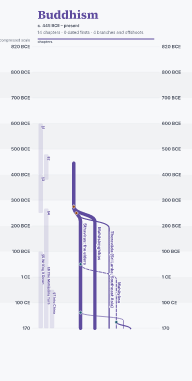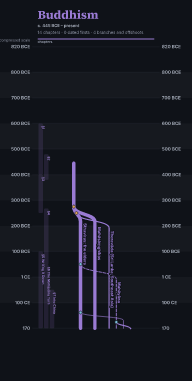
The short version: Buddhism was founded by the Buddha, a wandering teacher of the Gotama clan from the Śākya people at the foot of the Himalaya, who probably died around 400 BCE, at about eighty. He taught for some forty-five years in the middle Ganga plain, in what is now Bihar, eastern Uttar Pradesh and the Nepal Terai, and the order of monks and nuns he gathered there is the root of every later form of Buddhism.[1][2] That much most historians accept. The exact dates, the princely upbringing and most of the familiar life story are a different matter, and the religion as a whole took shape over the two centuries after him rather than on a single day (Buddhism §2). Majority
Who founded Buddhism?
The Buddha did: a man the early texts call Gotama, by his clan name, or Sakyamuni, “the sage of the Śākyas.” He renounced household life as a young man, trained under other teachers, and after an experience he called awakening began to teach a path of his own.[3][4] Majority
Three things about that answer are less simple than they look.
He was real, probably. No inscription from his lifetime names him, because nothing religious was written down in his part of India then. The case rests on Ashoka’s pillar at his birthplace, carved about 150 years after his death, and on early discourses full of names, places and awkward details that later inventors had no reason to create. Alexander Wynne and Oskar von Hinüber make that case in detail; David Drewes argues that none of it has ever been properly established. Most of the field sides with the first view.[5][6][7][8] The evidence is weighed in full on Was the Buddha a real person?
He was not called Siddhārtha, as far as the early texts know. The personal name Siddhattha (Sanskrit Siddhārtha) never occurs in the early discourses. It appears in biographies written centuries later, and the Theravāda life that uses it as standard, the Nidānakathā, dates from about the fifth century CE.[9][10] Consensus
He was not a prince in the legend’s sense. The Śākyas were a clan governed by an assembly of leading men, and the Aggañña Sutta says plainly that they were vassals of King Pasenadi of Kosala. His father Suddhodana is called rājā, but in a clan of this kind the word could mean a member of the ruling class or an elected head.[11][12] The early texts remember wealth, not kingship. The palace, the four sights and the escape at midnight belong to biographies written from the first or second century CE onwards, such as Aśvaghoṣa’s Buddhacarita.[13][9] Majority
Was he founding a new religion? Not in a sense he would have recognised. He was one of many samaṇas, renunciants who left home to seek release from rebirth, and he shared with Jains and with the Upaniṣads ideas such as karma and rebirth while rejecting the authority of the Veda. Whether that made him a Hindu reformer is a separate argument, taken up on Was the Buddha a Hindu? and in Hinduism §6.
Where did Buddhism originate?
Buddhism began in the middle Ganga plain of northern India and southern Nepal, in an area roughly 600 km across between the Himalayan foothills and the Ganga. Every place the tradition ties to the Buddha’s life lies within a few hundred kilometres (Buddhism §1). Majority
| Place | Today | What happened there | How secure |
|---|---|---|---|
| Lumbini | Rupandehi, southern Nepal | Birth[5] | Consensus |
| Kapilavastu | Piprahwa (India) or Tilaurakot (Nepal) | The Śākya home town[14] | Political |
| Uruvelā (Bodh Gaya) | Bihar, India | Awakening; Ashoka “went to Sambodhi” here c. 258 BCE[15] | Majority |
| Isipatana (Sarnath) | Near Varanasi, Uttar Pradesh | The first teaching, in the Deer Park[16] | Majority |
| Sāvatthī and Rājagaha | Uttar Pradesh and Bihar | Capitals of Kosala and Magadha, where most discourses are set[17][18] | Majority |
| Kusinārā | Kushinagar, Uttar Pradesh | Death at about eighty[1] | Majority |
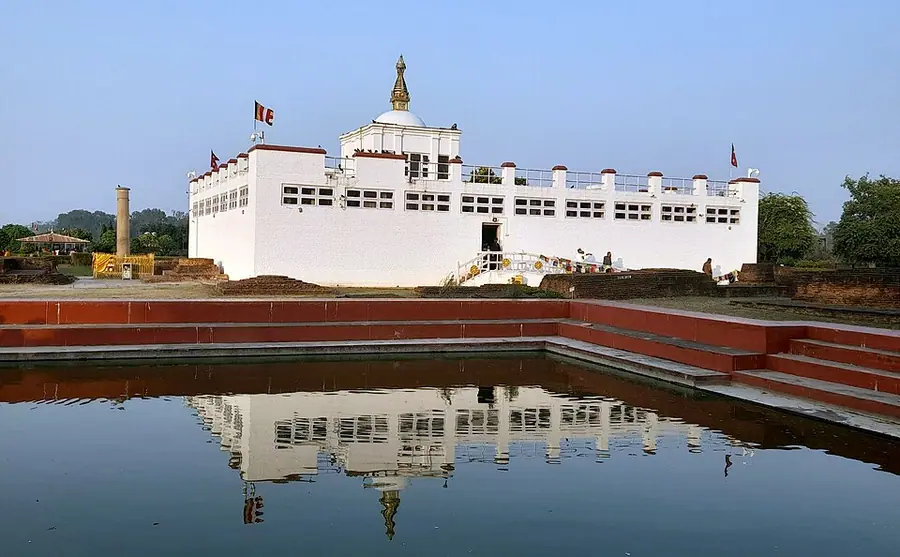
Lumbini is the one place fixed by hard evidence. Around 249 BCE Ashoka set up a pillar there saying he had come and worshipped “because here the Buddha, the sage of the Śākyas, was born,” and he freed the village of a tax.[5][19] The pillar was found again in 1896.[20] Where Kapilavastu stood is disputed between India and Nepal, and both governments have official positions.[14]
The setting matters as much as the sites. The Buddha’s world was the eastern Ganga plain of the second urbanisation: new walled cities, the first coined money, a class of rich merchants, and two kingdoms, Kosala and Magadha, swallowing the clan republics around them.[21][22] It lay east of the Vedic heartland, where brahmins were present but not dominant, and it was crowded with rival ascetic groups, Jains and Ājīvikas among them, competing for the same alms and patronage.[23][24] The Buddha’s main lay patrons were the kings of Kosala and Magadha and merchants of their cities.[17][18] Buddhism grew up in that market of teachers, not in isolation from it. Consensus
When was Buddhism founded?
Probably in the second half of the fifth century BCE. On the dating most scholars now use, the Buddha was born around 480 BCE, awakened in his mid-thirties around 445 BCE, and died around 400 BCE, each date uncertain by about twenty years either way (When did the Buddha live?). Contested
Four schemes circulate, and they are often confused:
- 544/543 BCE for his death is the traditional Theravāda date, from the Sri Lankan chronicles. It is still the basis of the Buddhist Era used in Sri Lanka and Southeast Asia.[25][2]
- 486/483 BCE is a correction of that date made by nineteenth- and early-twentieth-century scholars. It keeps the chronicles’ 218 years from the Buddha’s death to Ashoka’s consecration but fixes the consecration at about 268 BCE. Counting back eighty years gives the 563–483 BCE that most textbooks and encyclopedias still print.[2]
- About 368 BCE is implied by North Indian sources, which put Ashoka only about a century after the Buddha.[26][27]
- About 400 BCE, give or take twenty years, is where most scholars have converged since a symposium Heinz Bechert led at Göttingen in 1988. Richard Gombrich, working from the lineages of teachers recorded in the chronicles, arrived at about 404 BCE, and L. S. Cousins at a similar range.[26][28][2]
Every scheme counts back from Ashoka, the one firm anchor, and the question is how many years lay between them. The 2013 excavation at Lumbini found a timber shrine of the sixth century BCE beneath the brick temples, and its excavators read it as support for an earlier Buddha. It shows that Lumbini was sacred early, possibly before the Buddha was born there; it does not date him.[29][30]
How did Buddhism start and grow into a religion?
It started as an order of renunciants around one teacher and became a religion spread across India about a century and a half after his death, under the emperor Ashoka. Between those two points there were no scriptures in writing, no single leader and, after the Buddha’s death, no head of the order (Buddhism §3). Majority
The first teaching. All the early schools remembered the first sermon, at the Deer Park near Varanasi, as a middle way between sensual indulgence and the self-mortification the Buddha had himself tried and abandoned. Whether the four noble truths were part of it in their present form is argued over.[16][4]
An order modelled on a republic. The Buddha’s community was called the saṅgha, the word for a clan republic’s assembly, and it took decisions in formal meetings. According to the Mahāparinibbāna Sutta he appointed no successor and told the monks that the teaching and the discipline would be their teacher after he was gone.[1] The order kept the teaching in memory, by group recitation, for centuries before it was written down.
The councils. Buddhist tradition remembers three. The First, at Rājagaha just after the Buddha’s death, where Ānanda is said to have recited the discourses and Upāli the rules, is best read as a founding story that gives the canon its authority.[31] The Second, at Vesālī about a hundred years later, is more plausibly historical, and it was about monastic rules, chiefly whether monks could accept money.[32] Around the same period the order split for the first time, into the Sthaviras and the Mahāsāṃghikas.[33] The Third Council, under Ashoka, appears only in Theravāda sources.[34]
Ashoka. Around 260 BCE the Mauryan emperor, who ruled most of the subcontinent, declared himself a lay follower of the Buddha. His inscriptions are the first dated evidence for Buddhism anywhere. He visited the place of the awakening and the birthplace, recommended Buddhist texts by name and ordered schismatic monks and nuns expelled.[35][15][36][37] The Sri Lankan chronicles credit him with sending missionaries across Asia, his son Mahinda to Sri Lanka among them, though Ashoka’s own edicts never mention sending monks (Buddhism §4).[38][39] Contested (the missions)
A short timeline
| Date | Event | Confidence |
|---|---|---|
| c. 600–400 BCE | Second urbanisation of the Ganga plain; Kosala and Magadha expand[14][21] | Consensus |
| c. 480 BCE | Birth at Lumbini (median chronology)[5][26] | Contested (date) |
| c. 445 BCE | Awakening at Bodh Gaya; first teaching at Sarnath[16] | Majority |
| c. 400 BCE | Death at Kusinārā, aged about eighty[1][2] | Contested (date) |
| c. 300 BCE | Second Council at Vesālī[32] | Majority |
| c. 300–250 BCE | First split: Sthaviras and Mahāsāṃghikas[33] | Majority |
| c. 260 BCE | Ashoka becomes a lay follower[35] | Consensus |
| c. 249 BCE | Ashoka’s pillar at Lumbini[5] | Consensus |
| 1st–2nd c. CE | First complete life of the Buddha, the Buddhacarita[13] | Majority |
What scholars disagree about
Whether a founder can be known at all. Drewes’s argument is that the “historical Buddha” was assumed by nineteenth-century scholars rather than demonstrated, and that stripping the legends from the texts to reach a core presupposes the core exists.[8] It is a serious objection from a specialist. Most of the field answers that the incidental, unflattering material in the early texts is hard to explain without a real teacher behind it.[6][7] Majority
How much of Buddhism is his. Even those who accept the founder disagree about how much of the teaching goes back to him rather than to his first generations of followers. Material shared by all the early schools is older than the schools, but it could still have been shaped in the century after his death.[40][41] Contested
The dates. The c. 400 BCE consensus is a convergence, not a proof. Charles Prebish accepts the later date but points out how much of the reconstruction of early Buddhism was built on the older one, and the Lumbini excavators still argue for an earlier Buddha.[42][29] Contested
Common misconceptions
- “Buddhism began in 500 BC.” A round number that sits between schemes. The textbook dates put the Buddha’s death in 483 BCE, the current working date around 400 BCE, and in either case the founding was a process of decades, not a year.[2][26]
- “The Buddha was Prince Siddhārtha, heir to a kingdom.” The early discourses never use the name, and the Śākyas were a clan republic subject to Kosala.[11][9]
- “Buddhism began at Bodh Gaya.” The awakening is placed there, but the order was formed and taught across Kosala and Magadha over some forty-five years, and Lumbini, Sarnath and Kusinārā are equally part of the story.[1][16]
- “Buddhism originated in Nepal.” The Buddha was born in what is now Nepal, but he awakened, taught and died in what is now India, and that is where the order grew.[5][1]
- “The First Council fixed the scriptures.” The council story justifies the canon’s authority; the texts went on growing for centuries and were not written down until the first century BCE in Sri Lanka (see When was the Pali canon written?).[31][25]
Why it matters
“Who founded it, and when” sounds like a question with a one-line answer, and for Buddhism there is one: the Buddha, in the fifth century BCE, on the Ganga plain. The trouble begins when the one line is taken to carry the whole life story with it. The palace, the name Siddhārtha and the precise dates were added or computed later, and the religion that most people mean by “Buddhism” was built over the following two centuries by an order of monks and nuns and an emperor. Seeing which part belongs to which layer is what lets each later stage, from Ashoka to the Mahāyāna, be dated in its turn. The full argument is in Buddhism §2; the world he taught in is Buddhism §1.
References
- ^ a b c d e f DN 16 — Mahāparinibbāna Sutta (Dīgha Nikāya). c. 400–200 BCE, with later layers. Pali. The last months of the Buddha's life: his age (80), the last meal of sūkaramaddava at Cunda's house, the death at Kusinārā and the division of the relics into eight shares. read the text
- ^ a b c d e f L. S. Cousins "The Dating of the Historical Buddha: A Review Article". Journal of the Royal Asiatic Society 6, 1996. doi Where the c. 400 BCE working default comes from.
- ^ MN 26 — Ariyapariyesanā Sutta (Majjhima Nikāya). c. 400–200 BCE. Pali. The Buddha's own short account of leaving home: while young and black-haired, against the wishes of his weeping parents, he shaved his head and went forth. No palace, no secret flight at night. read the text
- ^ a b MN 36 — Mahāsaccaka Sutta (Majjhima Nikāya). c. 400–200 BCE. Pali. The Buddha describes his extreme fasting and breath-holding, abandons them, and remembers sitting in the first jhāna as a boy under a rose-apple tree while his father worked. That memory becomes the way to awakening. read the text
- ^ a b c d e f Rummindei pillar — Lumbinī. c. 249 BCE. Prakrit in Brāhmī. Lumbinī freed of the bali tax and liable to only an eighth share because "here the Buddha was born, the Sakyamuni" — the earliest datable evidence for veneration of the birthplace.
- ^ a b Alexander Wynne "Did the Buddha Exist?". Journal of the Oxford Centre for Buddhist Studies 16, 2019. The reply to Drewes.
- ^ a b Oskar von Hinüber "The Buddha as a Historical Person". Journal of the International Association of Buddhist Studies 42: 231–264, 2019. A specialist's reply to Drewes: personal names, place details and legal practice that make most sense as memories of a real person.
- ^ a b David Drewes "The Idea of the Historical Buddha". Journal of the International Association of Buddhist Studies 40, 2017. Argues scholarship has established nothing about the man. Answered by Wynne, Levman and von Hinüber.
- ^ a b c John S. Strong The Buddha: A Short Biography. Oneworld, 2001. Traces how the life story was assembled across texts and centuries. The best single book for §2.
- ^ Nidānakathā — Jātaka commentary. c. 5th c. CE. Pali. The Theravāda biography, prefaced to the Jātaka commentary: the vow under the past Buddha Dīpaṅkara, the birth, the four sights, the great departure and the awakening. about
- ^ a b DN 27 — Aggañña Sutta (Dīgha Nikāya). c. 300 BCE. Pali. The four varṇas originate by contract and labour, not from a primal being's body — a direct counter-narrative to the Puruṣa Sūkta, read by Gombrich as satire. read the text
- ^ Richard Gombrich Theravāda Buddhism: A Social History. Routledge, 2nd ed., 2006. A social history of Theravāda from the Buddha to modern Sri Lanka: strong on the Brahmanical background, the monastic-royal compact and caste in the saṅgha.
- ^ a b Buddhacarita — Aśvaghoṣa. c. 1st–2nd c. CE. Sanskrit. The first complete life of the Buddha from birth to death, a court epic in Sanskrit verse. The palace, the four sights and the flight at midnight appear here as one connected story. read the text
- ^ a b c Robin Coningham & Ruth Young The Archaeology of South Asia: From the Indus to Asoka. Cambridge University Press, 2015. The standard synthesis for §§1–6.
- ^ a b Rock Edict 8 — Ashokan rock edicts. c. 258 BCE. Prakrit in Brāhmī. Ashoka says that in his tenth regnal year he "went to Sambodhi", replacing pleasure tours with tours of dhamma. The earliest reference to the place of the awakening. read the text
- ^ a b c d SN 56.11 — Dhammacakkappavattana Sutta (Saṃyutta Nikāya). c. 400–200 BCE. Pali. The first sermon in its canonical form: the middle way between indulgence and self-mortification, then the four noble truths and the eightfold path. read the text
- ^ a b SN 3.1 — Dahara Sutta (Saṃyutta Nikāya). c. 400–200 BCE. Pali. King Pasenadi of Kosala asks how so young a man can claim awakening; the Buddha answers with four things not to be despised for being young, and the king goes for refuge. The canon's account of how the Buddha won his Kosalan patron. read the text
- ^ a b Mahāvagga 1.22 — Vinaya Piṭaka. c. 300–100 BCE. Pali. King Bimbisāra of Magadha gives the Bamboo Grove (Veḷuvana) at Rājagaha to the saṅgha, the first park donated to the order. read the text
- ^ E. Hultzsch Inscriptions of Asoka. Corpus Inscriptionum Indicarum I, Clarendon Press, 1925. full text The primary edition of the edicts. Public domain.
- ^ Charles Allen The Buddha and Dr Führer: An Archaeological Scandal. Haus, 2008. How Lumbini was found in 1896, by whom, and why Alois Führer's later forgeries have made people wrongly doubt the Rummindei pillar and Piprahwa.
- ^ a b Upinder Singh A History of Ancient and Early Medieval India. Pearson, 2008. open library The best textbook on the archaeology-plus-text synthesis.
- ^ Romila Thapar Early India: From the Origins to AD 1300. Penguin, 2002. full text The best single-volume political and social history for this whole span.
- ^ DN 2 — Sāmaññaphala Sutta (Dīgha Nikāya). c. 400–300 BCE. Pali. The six heterodox teachers — determinism, materialism, scepticism, atomism — the best map we have of the intellectual landscape, written by a rival. read the text
- ^ Johannes Bronkhorst Greater Magadha: Studies in the Culture of Early India. Brill, 2007. full text The strongest case for an eastern, non-Vedic origin for karma and rebirth. Influential and contested.
- ^ a b Dīpavaṃsa 20.20–21 — Dīpavaṃsa. c. 4th c. CE. Pali. Sri Lanka's oldest chronicle says that under King Vaṭṭagāmaṇi the monks, seeing beings decline, wrote down the Piṭakas and commentary, which had until then been passed on by mouth. read the text
- ^ a b c d Heinz Bechert, ed. The Dating of the Historical Buddha. Vandenhoeck & Ruprecht, 3 vols., 1991. The symposium that unsettled the traditional dates — and reached no consensus.
- ^ Aśokāvadāna — Divyāvadāna. c. 2nd c. CE. Buddhist Sanskrit. The North Indian legend of Ashoka: the dirt offering of his past life, the hell-prison, conversion by a monk, 84,000 stupas, the pilgrimage with Upagupta, and the half myrobalan given at his death. about
- ^ Richard Gombrich "Dating the Buddha: A Red Herring Revealed". In The Dating of the Historical Buddha, part 2, ed. H. Bechert, Vandenhoeck & Ruprecht, 1992. Argues from the chronicles' teacher lineages for a death c. 404 BCE.
- ^ a b R. A. E. Coningham, K. P. Acharya et al. "The Earliest Buddhist Shrine: Excavating the Birthplace of the Buddha, Lumbini (Nepal)". Antiquity 87: 1104–1123, 2013. doi The timber structure under the Maya Devi temple and its sixth-century BCE dates. Read the dating section closely before quoting the headline.
- ^ Michaela K. Reay, Ian A. Simpson, Robin A. E. Coningham et al. "Triterpenoid Wax Esters Confirm Ficus religiosa in Archaeological Sequences within the Mayadevi Temple Shrine, Lumbini – the Birthplace of Buddha". Frontiers in Geochemistry 3: 1507366, 2025. doi Biomarker evidence that a pipal tree stood in the central open space of the Lumbini shrine from about the mid-sixth century BCE.
- ^ a b Cullavagga 11 (Pañcasatikakkhandhaka) — Vinaya Piṭaka. c. 300–100 BCE. Pali. The First Council at Rājagaha: Upāli recites the rules, Ānanda the discourses; Ānanda is charged with five faults; the saṅgha resolves to neither add nor remove rules; the monk Purāṇa keeps his own version. read the text
- ^ a b Cullavagga 12 (Sattasatikakkhandhaka) — Vinaya Piṭaka. c. 300–100 BCE. Pali. The Second Council at Vesālī, a hundred years after the Buddha: Yasa objects to monks collecting money in a bowl, and seven hundred monks judge ten disputed practices. read the text
- ^ a b Janice J. Nattier & Charles S. Prebish "Mahāsāṃghika Origins: The Beginnings of Buddhist Sectarianism". History of Religions 16: 237–272, 1977. doi Argues from the Mahāsāṃghika account that the first schism was over expanding the Vinaya, not over doctrine.
- ^ Kathāvatthu — Abhidhamma Piṭaka. c. 250 BCE onward, with later additions. Pali. 'Points of Controversy': over two hundred debates refuting other schools' views, attributed by Theravāda tradition to Moggaliputta Tissa at the Third Council. read the text
- ^ a b Minor Rock Edict 1 — Ashokan edicts. c. 258 BCE. Prakrit in Brāhmī. Names the king as Asoka personally and records that he has been a lay follower for over two and a half years — his Buddhist affiliation in his own voice. read the text
- ^ Calcutta-Bairāṭ edict — Bairāṭ, Rajasthan. c. 250 BCE. Prakrit in Brāhmī. Ashoka addresses the saṅgha directly and names seven texts he wants monks, nuns and laypeople to hear often. The only Ashokan list of Buddhist texts, and several can be matched to suttas that still survive. read the text
- ^ Sarnath schism edict — Sarnath pillar. c. 250 BCE. Prakrit in Brāhmī. Ashoka orders that any monk or nun who splits the saṅgha be dressed in white and made to live apart. Division within the order was already a royal concern. read the text
- ^ Mahāvaṃsa 12–14 — Mahāvaṃsa. c. 5th–6th c. CE. Pali. After the third council Moggaliputta Tissa sends nine missions to the borderlands, and Ashoka's son Mahinda converts King Devānaṃpiya Tissa of Sri Lanka. about
- ^ Rock Edict 13 — Ashokan edicts. c. 256 BCE. Prakrit in Brāhmī. Names five Hellenistic kings whose reigns are independently dated — the peg the entire Indian chronology hangs from. read the text
- ^ Lambert Schmithausen "On Some Aspects of Descriptions or Theories of 'Liberating Insight' and 'Enlightenment' in Early Buddhism". In Studien zum Jainismus und Buddhismus, ed. K. Bruhn & A. Wezler, Steiner, 1981. Shows that the canon preserves several different accounts of what liberates, and argues for their relative order.
- ^ Bhikkhu Sujato & Bhikkhu Brahmali The Authenticity of the Early Buddhist Texts. Journal of the Oxford Centre for Buddhist Studies, supplement to vol. 5, 2014. open access The case that the core of the Nikāyas and Āgamas goes back to the Buddha's time, argued from inside the tradition but with the scholarly apparatus.
- ^ Charles S. Prebish "Cooking the Buddhist Books: The Implications of the New Dating of the Buddha". Journal of Buddhist Ethics 15, 2008. Accepts the c. 400 BCE date while attacking the reasoning behind it.