The short version: the Buddha probably died around 400 BCE, within about twenty years either way, aged about eighty. That puts his life roughly between 480 and 400 BCE. You will often see 563–483 BCE instead. That pair is not wrong in the sense of being invented, but it rests on an older calculation that most specialists no longer prefer.[1][2] The reason there are several answers is simple: nothing from the Buddha’s lifetime carries a date. Every date for him is worked out backwards from one king whose date is known, Ashoka, using a number of years that different Buddhist traditions remembered differently.
The evidence for the Buddha’s dates
The anchor: Ashoka
Ashoka’s Rock Edict 13 names five Greek kings, Antiochus, Ptolemy, Antigonus, Magas and Alexander, whose reigns are known from Greek sources. That fixes Ashoka’s consecration to about 268 BCE, give or take a few years.[3][4] It is the anchor of early Indian Buddhist chronology. Everything about the Buddha’s date depends on one more number: how many years separated his death from Ashoka.
Two traditions, two intervals
The southern tradition. The Sri Lankan chronicles count 218 years from the Buddha’s death to Ashoka’s consecration.[5][6] Taken with the chronicles’ own king lists, that gives a death in 544/543 BCE, the date behind the Buddhist Era still used in Sri Lanka, Myanmar, Thailand, Laos and Cambodia. The year 2026 is 2569 or 2570 BE, depending on the country’s convention. When nineteenth- and early-twentieth-century scholars fixed Ashoka independently at about 268 BCE but kept the 218-year interval, they got 486/483 BCE: the “corrected long chronology” that most textbooks still print.[1]
The northern tradition. Sanskrit sources of the Sarvāstivāda school, including the legend of Ashoka, put him about a century after the Buddha; in the legend the Buddha himself foretells that a boy will become King Aśoka a hundred years after his final nirvāṇa.[7] That gives a death around 368 BCE, the “short chronology,” which Bechert himself preferred.[1]
What it proves. That the two traditions disagree by about 120 years on a single number, and that neither can be checked directly. A choice between them has to be made on other grounds.
The teacher lineages
Richard Gombrich found those other grounds in the Vinaya’s lists of teachers. The Sri Lankan tradition names the line of monks who passed on the discipline from the Buddha’s death to Ashoka’s time, Upāli, Dāsaka, Sonaka, Siggava and Moggaliputta Tissa, with figures for when each ordained his successor. Gombrich argued that, read realistically, those figures fit an interval of about 136 years rather than 218, and concluded that the Buddha died about 404 BCE (268 + 136).[8] L. S. Cousins reviewed all the evidence and arrived at a similar range.[2]
What it proves. That the southern interval looks stretched, probably to fit other chronological schemes in the chronicles, and that the internal evidence points to a date close to the northern tradition’s. This is why the field converged near 400 BCE.
The dotted record
One more tradition is often cited for 486 BCE. A Chinese source reports a “dotted record” kept in Canton and linked to the monk Saṃghabhadra: a dot was said to have been added to a Vinaya text every year after the Buddha’s death, reaching 975 dots by 489 CE. Counting back gives 486 BCE.[9][1] Few specialists rely on it, because the record’s history before it reached China cannot be checked. Contested
Where was the Buddha born? Archaeology at Lumbini
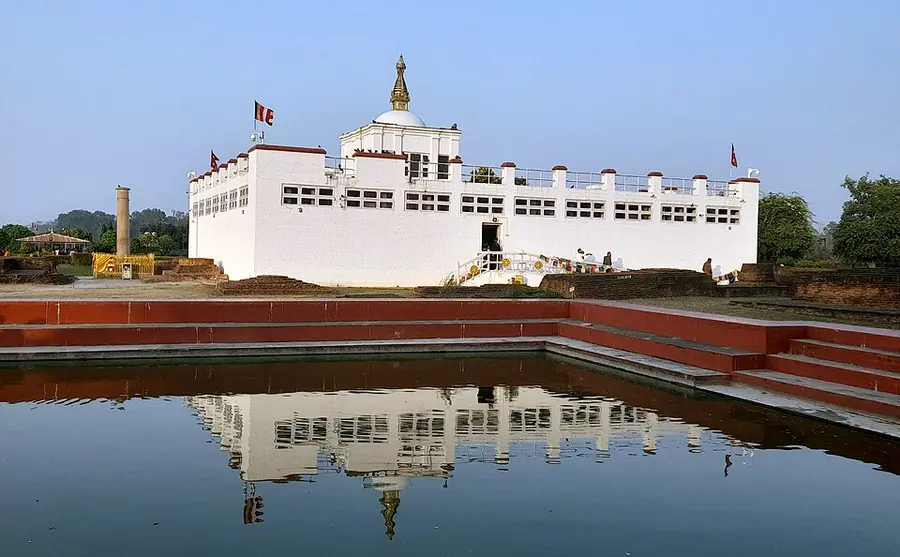
Tradition places the birth at Lumbinī, in the Terai of what is now southern Nepal, and the oldest datable evidence agrees. About 249 BCE Aśoka set up a pillar there whose inscription says “here the Buddha was born, the Sakyamuni.”[10] The pillar was found in 1896, and the forgeries of one of its finders, Alois Führer, do not touch it.[11] Consensus What it dates is the veneration of the place, not the birth itself.
In 2013 Robin Coningham’s team reported a timber shrine beneath the brick temples at Lumbini, dated by radiocarbon and luminescence to the sixth century BCE, and argued that it supported an earlier date for the Buddha.[12] A sacred tree shrine at Lumbini before the Buddha’s lifetime is equally consistent with the finding. It shows the place was holy early, not when he was born there. It has not displaced the c. 400 BCE working date. Contested
A short timeline of the debate
| Date | What happens | Confidence |
|---|---|---|
| c. 268 BCE | Ashoka consecrated; the anchor for all later calculations[3] | Consensus |
| 4th–5th c. CE | Sri Lankan chronicles fix the 218-year interval[5] | Consensus |
| 489 CE | The Canton “dotted record” reaches 975 dots[9] | Contested |
| 19th–early 20th c. | European scholars derive 486/483 BCE from the chronicles[1] | Consensus |
| 1956–57 | The 2,500th Buddha Jayanti, celebrated on the 544 BCE reckoning[13] | Consensus |
| 1988 | Bechert’s symposium, held under the Göttingen Academy, reopens the question[1] | Consensus |
| 1992 | Gombrich argues for c. 404 BCE from the teacher lineages[8] | Majority |
| 2013 | Lumbini timber shrine published[12] | Contested |
What scholars disagree about
Whether there is a consensus at all. There is not, strictly. Bechert’s symposium produced convergence, not agreement: most contributors placed the death within a few decades of 400 BCE, but some defended the corrected long chronology and Bechert himself leaned shorter.[1] “About 400 BCE” is a working date. Contested
What the later date changes. Charles Prebish accepted the later date but pointed out how much of the field’s picture of early Buddhism had been built on the earlier one. Moving the Buddha down by eighty years shortens the gap between his death and Ashoka, the first schisms and the first inscriptions, and so changes how much time the early community had to develop its texts and institutions.[14]
Whether the eighty-year lifespan is reliable. The age comes from the Buddha’s own words in the account of his last journey, and it is accepted in all traditions.[15] It is the only reason a birth date can be given at all. Majority
Common misconceptions
- “563 BCE is the traditional birth date.” It is a scholarly calculation from the nineteenth century. The Theravāda tradition’s own date for the death is 544/543 BCE, which makes the birth 624/623 BCE.[5][1]
- “The Buddha was a contemporary of Confucius and Pythagoras.” Only on the older dates. On the current working date he was an older contemporary of Socrates (c. 470–399 BCE).
- “The Lumbini dig proved the sixth-century date.” It proved that a shrine existed there in the sixth century, which is a different claim.[12]
- “The dates are unknowable, so any date will do.” The range is narrow by ancient standards: every serious scheme falls within the roughly 180 years between 544 and 368 BCE, and most specialists work within about forty years of 400 BCE.[2]
Why it matters
The date decides what the Buddha could have known and argued against. On the later date, the oldest Upaniṣads are clearly earlier than him, and the world of new cities, coins and kingdoms in §1 was already well established when he taught. It also decides how quickly Buddhism grew: from a teacher’s death to an emperor’s patronage in about 130 years, not 220. And it explains a calendar: when Sri Lanka and Thailand count the year as 2569 or 2570, they are counting from the oldest of the four dates, not the most likely one.
For the full argument about the Buddha’s life and what can be known of it, see Chapter 2: The Buddha. For how the early texts themselves are dated, see Chapter 0: How We Know.
References
- ^ a b c d e f g h Heinz Bechert, ed. The Dating of the Historical Buddha. Vandenhoeck & Ruprecht, 3 vols., 1991. The symposium that unsettled the traditional dates — and reached no consensus.
- ^ a b c L. S. Cousins "The Dating of the Historical Buddha: A Review Article". Journal of the Royal Asiatic Society 6, 1996. doi Where the c. 400 BCE working default comes from.
- ^ a b Rock Edict 13 — Ashokan edicts. c. 256 BCE. Prakrit in Brāhmī. Names five Hellenistic kings whose reigns are independently dated — the peg the entire Indian chronology hangs from. read the text
- ^ Richard Salomon Indian Epigraphy. Oxford University Press, 1998. open library The standard handbook for inscriptions and their dating.
- ^ a b c Dīpavaṃsa 20.20–21 — Dīpavaṃsa. c. 4th c. CE. Pali. Sri Lanka's oldest chronicle says that under King Vaṭṭagāmaṇi the monks, seeing beings decline, wrote down the Piṭakas and commentary, which had until then been passed on by mouth. read the text
- ^ Mahāvaṃsa 33 — Mahāvaṃsa. c. 5th–6th c. CE. Pali. Vaṭṭagāmaṇi's defeat by a brahmin rebel and Tamil invaders, fourteen years of exile, his return, the founding of the Abhayagiri and the writing down of the texts. read the text
- ^ Aśokāvadāna — Divyāvadāna. c. 2nd c. CE. Buddhist Sanskrit. The North Indian legend of Ashoka: the dirt offering of his past life, the hell-prison, conversion by a monk, 84,000 stupas, the pilgrimage with Upagupta, and the half myrobalan given at his death. about
- ^ a b Richard Gombrich "Dating the Buddha: A Red Herring Revealed". In The Dating of the Historical Buddha, part 2, ed. H. Bechert, Vandenhoeck & Ruprecht, 1992. Argues from the chronicles' teacher lineages for a death c. 404 BCE.
- ^ a b T 2034 (Lidai sanbao ji) 11 — Fei Changfang, Record of the Three Jewels through the Ages. 597 CE. Classical Chinese. The 'dotted record': a dot added to the Vinaya each year after the Buddha's death, passed from Upāli to Saṃghabhadra, who added the last at Guangzhou in 489 (Yongming 7), making 975 dots. Counting back gives 486 BCE. read the text
- ^ Rummindei pillar — Lumbinī. c. 249 BCE. Prakrit in Brāhmī. Lumbinī freed of the bali tax and liable to only an eighth share because "here the Buddha was born, the Sakyamuni" — the earliest datable evidence for veneration of the birthplace.
- ^ Charles Allen The Buddha and Dr Führer: An Archaeological Scandal. Haus, 2008. How Lumbini was found in 1896, by whom, and why Alois Führer's later forgeries have made people wrongly doubt the Rummindei pillar and Piprahwa.
- ^ a b c R. A. E. Coningham, K. P. Acharya et al. "The Earliest Buddhist Shrine: Excavating the Birthplace of the Buddha, Lumbini (Nepal)". Antiquity 87: 1104–1123, 2013. doi The timber structure under the Maya Devi temple and its sixth-century BCE dates. Read the dating section closely before quoting the headline.
- ^ Buddha Jayanti Tipiṭaka, 1957–1989 — Sri Lankan printed edition of the Pali Canon. 1957–1989. Pali in Sinhala script, with Sinhala translation. The Sri Lankan government edition begun for the 2,500th Buddha Jayanti, Pali text with Sinhala translation. It includes the Peṭakopadesa and Nettippakaraṇa but not the Milindapañha. about
- ^ Charles S. Prebish "Cooking the Buddhist Books: The Implications of the New Dating of the Buddha". Journal of Buddhist Ethics 15, 2008. Accepts the c. 400 BCE date while attacking the reasoning behind it.
- ^ DN 16 — Mahāparinibbāna Sutta (Dīgha Nikāya). c. 400–200 BCE, with later layers. Pali. The last months of the Buddha's life: his age (80), the last meal of sūkaramaddava at Cunda's house, the death at Kusinārā and the division of the relics into eight shares. read the text